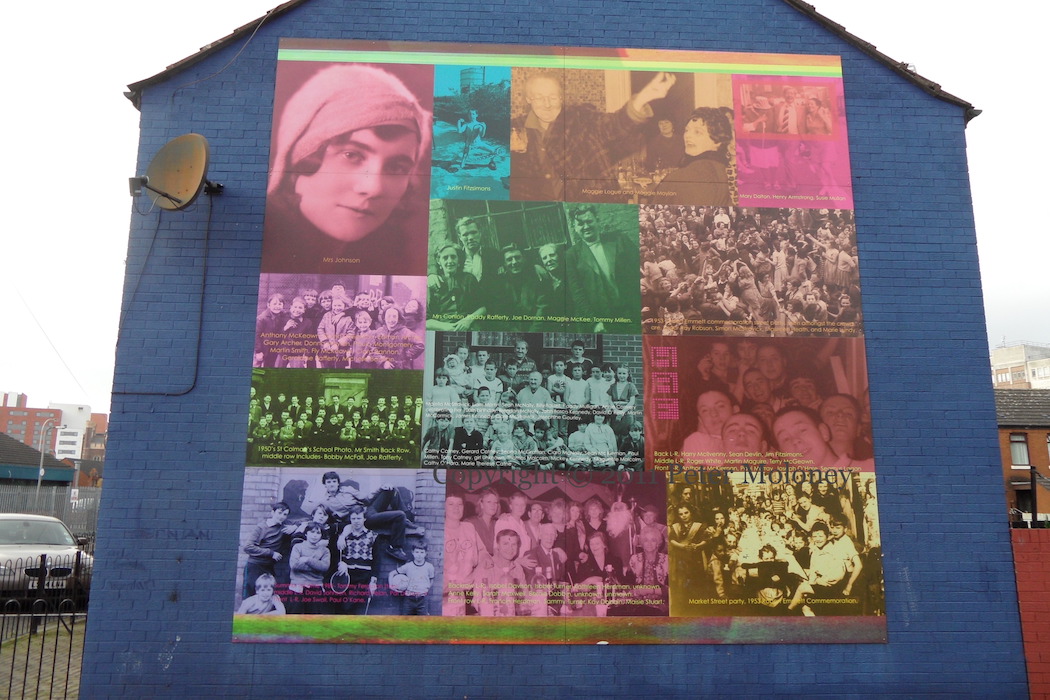
In 2008 and 2009 artist Raymond Henshaw completed a series of cultural murals about the Markets area of Belfast. This one showcases the people of the Markets. Two of the images – bottom right and two spots above it – show a street party to commemorate the 150th anniversary of the death of Robert Emmet in 1953. For a mural from that occasion (in Ardoyne) see Visual History 02.
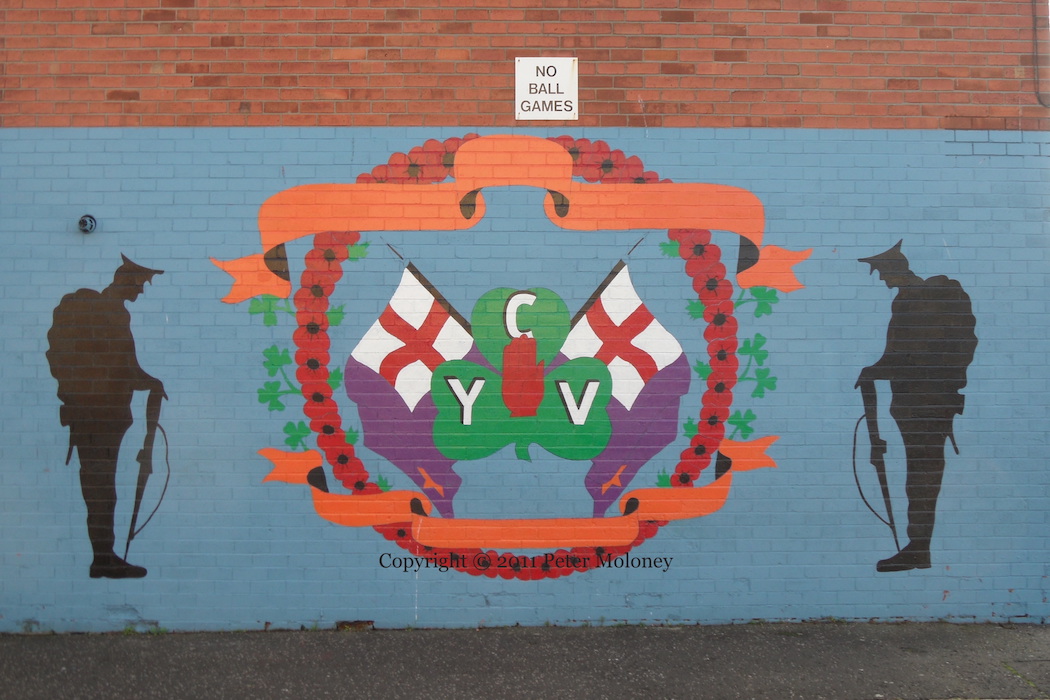
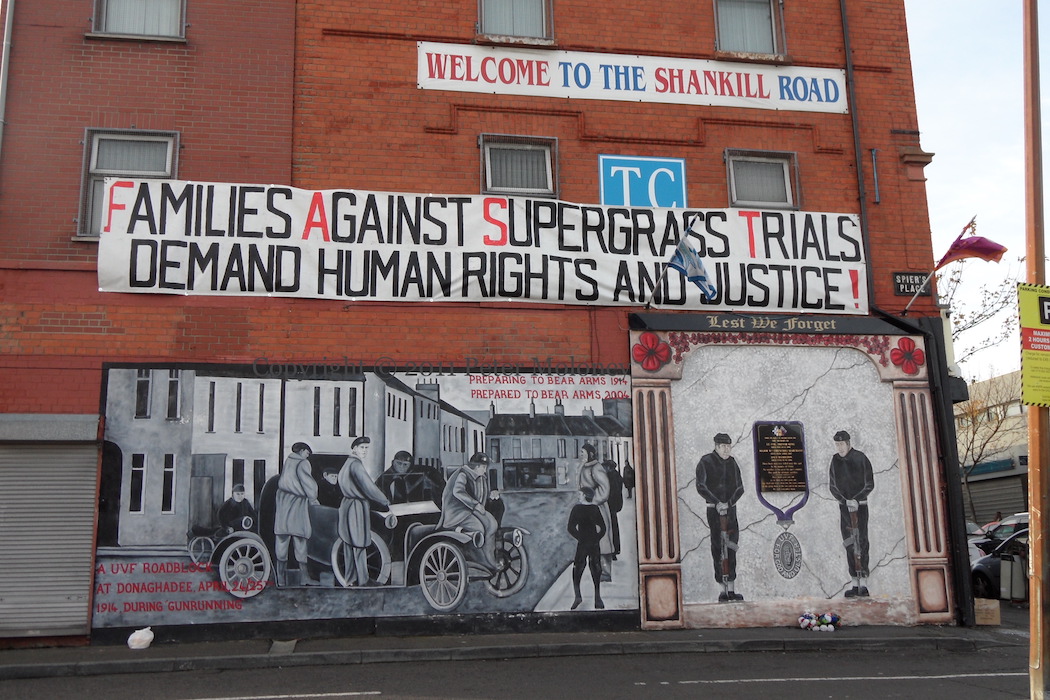
The shamrock and the poppy. The Young Citizen Volunteers formed a battalion of the Royal Irish Rifles and so part of the 36th (Ulster) Division during the first world war.
“Families Against Supergrass Trials demand human rights and justice!” The trials of fourteen (alleged) UVF members began in September, using supergrass witnesses (BBC | Guardian). A FAST banner is here seen in Spier’s Place. Extramural has images of the banners in Donegall Pass, Mount Vernon, and Newtownards Road. [The trial would largely collapse in February, 2012 (Guardian)]
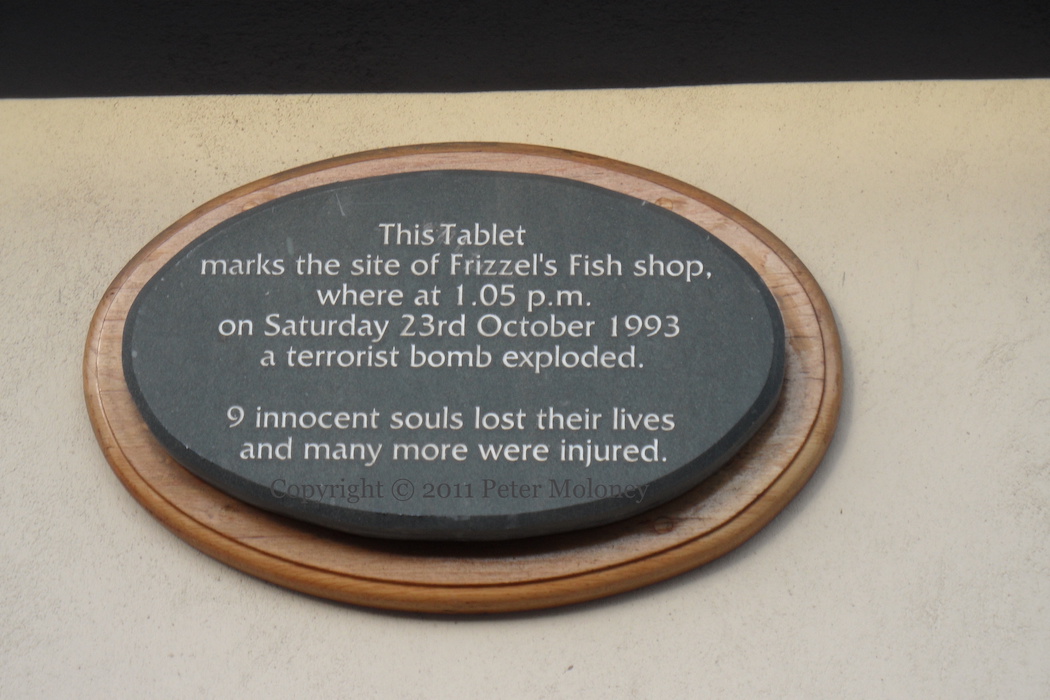
“This tablet marks the site of Frizzel[l]’s Fish shop, where at 1:05 p.m. on Saturday 23rd October 1993 a terrorist bomb exploded. 9 innocent souls lost their lives and many more were injured.”
The Shankill UDA and LPA had their headquarters October 23rd above Frizzell’s (here “Frizzel’s”) fishmongers on the Shankill Road. The meeting whose attendees were the intended target had ended early and the bomb exploded prematurely, killing nine people, including the owner and three members of his family, and one of the IRA bombers (elsewhere memorialized by a plaque in Ardoyne), and injuring 57 others.
See also: Shankill Atrocities which (in one of its panels) reproduces the scene after the bombing.
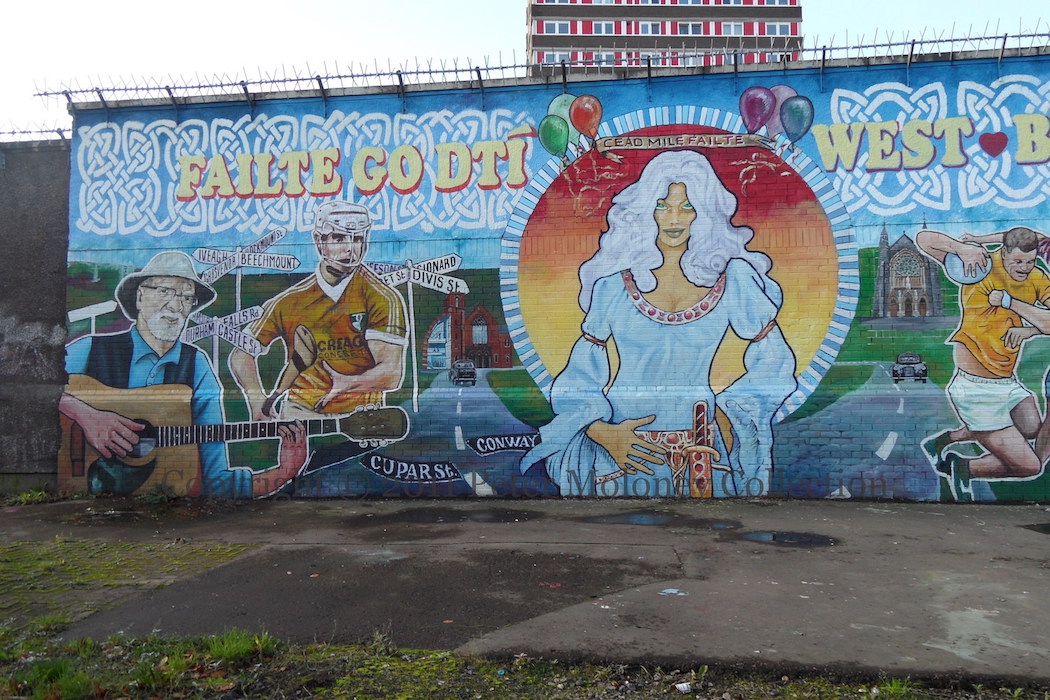
“Welcome to west Belfast”. West Belfast is portrayed as a place of music, sport, and dancing, whose landmark buildings and streets are under the watchful eye (and sword) of the goddess Érıu.
The image of the little boy with the “I [heart] Belfast” stickers and a bag of sweets, standing in the waste ground of Divis flats, is a photograph from the early days of Féıle An Phobaıl/West Belfast Festival.
On the Divis Street side, characters in the style of cartoonist Cormac (see e.g. Notes) are “Promoting west Belfast tourism” for “Fáılte Feırste Thıar”, “www.visitwestbelfast.com“. The attractions touted are: “Bop at the August “fleadh”. “Craıc agus ceol” (for Robert Ballagh’s dove coming out of the concrete block, see Féile An Phobail 2008), “The only thing you have here is “choice”. Tar ısteach agus (lıg do scíth)”. “Baın sult as. Tá mé ag éısteacht le Raıdıó Fáilte 107.1 FM”, “For more ideas on things to do, visit Oıfıg Fáılte at An Chultúrlann. There’s really nice food there too! at Caıfe Feırste”, “If it’s history you want go on a cemetery tour “City or Milltown””, “Enjoy a walk on ‘Slıabh Dubh’ (The black … … mountain)”, “Make sure you visit the “Irish republican history museum” at Conway Mill” (with ‘Long Kesh University Of Freedom’ sweater; “Sinn Féin touts” is not a sweater but graffiti.)
The ten deceased 1981 hunger strikers were preceded in the 1970s by two prisoners who died in English prisons: Michael Gaughan (d. 1974 WP) and Frank Stagg (1976 WP). Posters depicting these two, along with the Proclamation and the Tricolour, lie on the grass. The larger of the two quotations here is from Stagg: I want my memorial to be peace with justice.
The protesters on the left date back to a 1981 poster which was used on the very first mural – for both, see I’ll Wear No Convict’s Uniform.
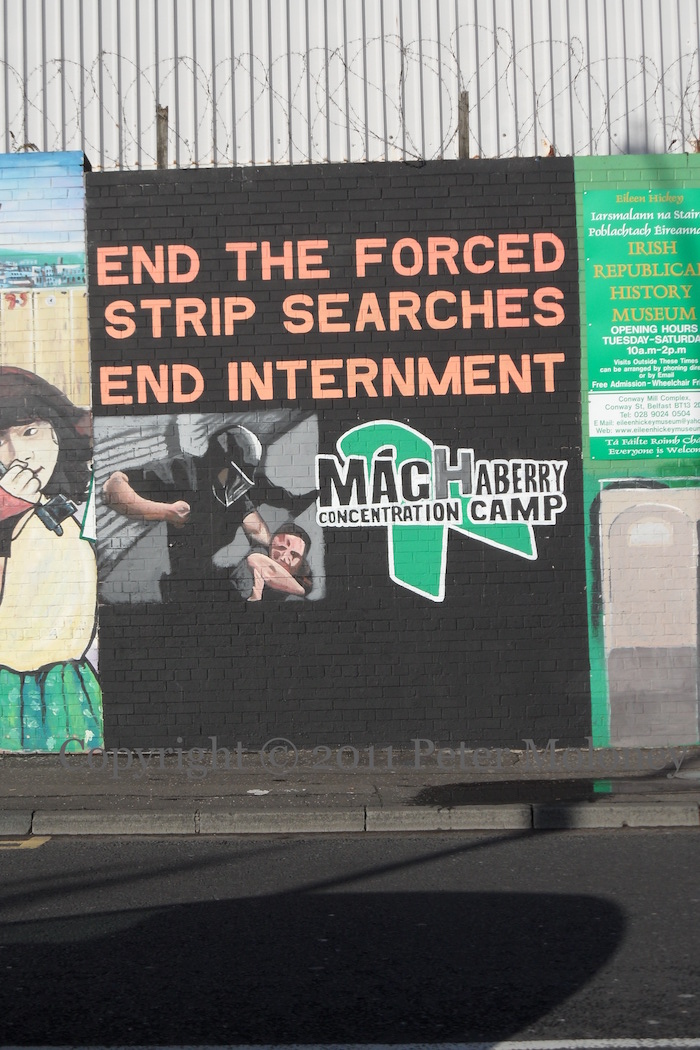
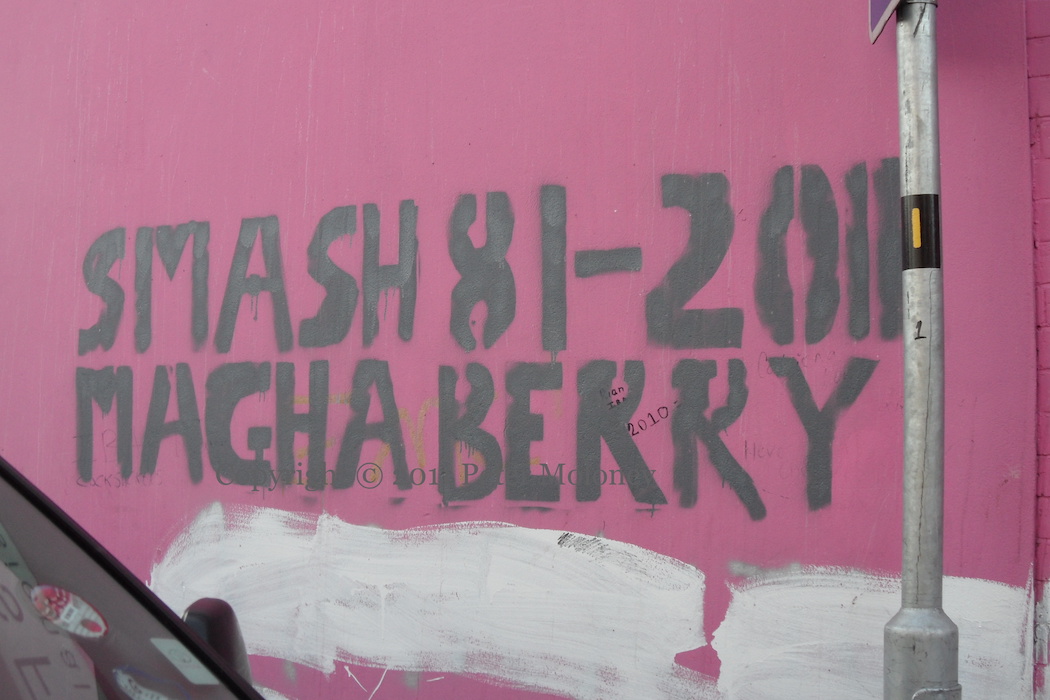
“End forced strip searches, end internment [at] Maghaberry concentration camp”. Republican prisoners are held in the Roe House at Maghaberry. Several republican prisoners (as many as five) are conducting a “dirty protest” in response to conditions and treatment, including integration with loyalist prisoners (Irish Echo | BBC). The green ribbon as an emblem goes back to the campaign after the ceasefire to release POWs – here is a mural from 1995.


 Peter Moloney Collection