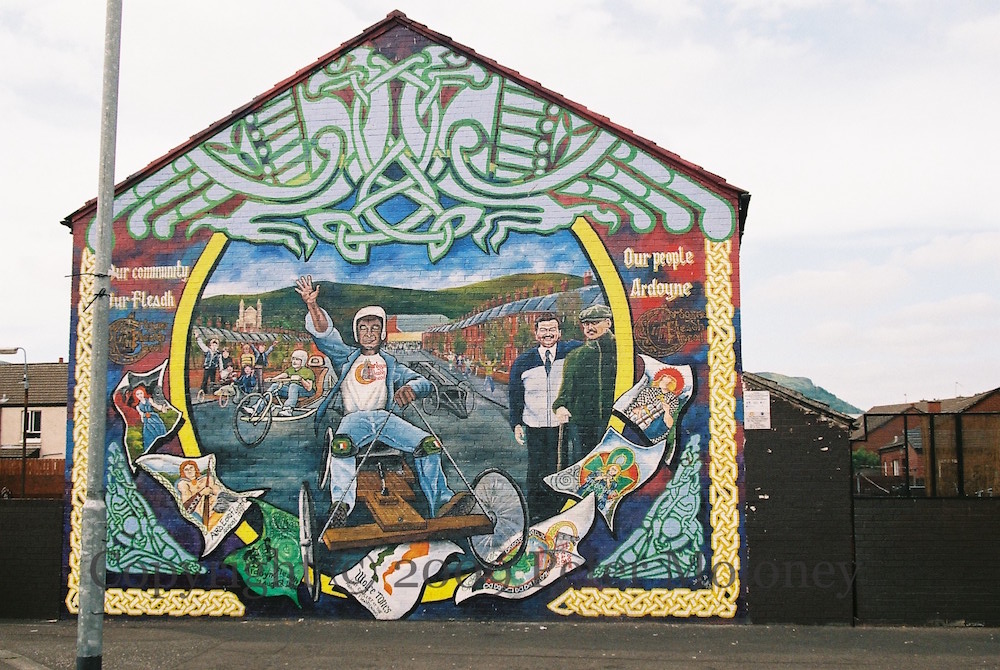
“Our community, our fleadh, our people – Ardoyne”. The Ardoyne fleadh cheoıl (tw | Fb) is held each August and includes fun days for the kids in addition to concerts. The plaque on the right indicates that the mural was part of the 2009 Re-Imaging Programme. The wall (on Brompton Park) has historically had a Fleadh mural (Maıreann An Spıorad | Fleadh Érıu – included on the 1995 poster, under the go-kart’s left wheel) though the immediately prior mural was a 25th anniversary hunger strike mural.
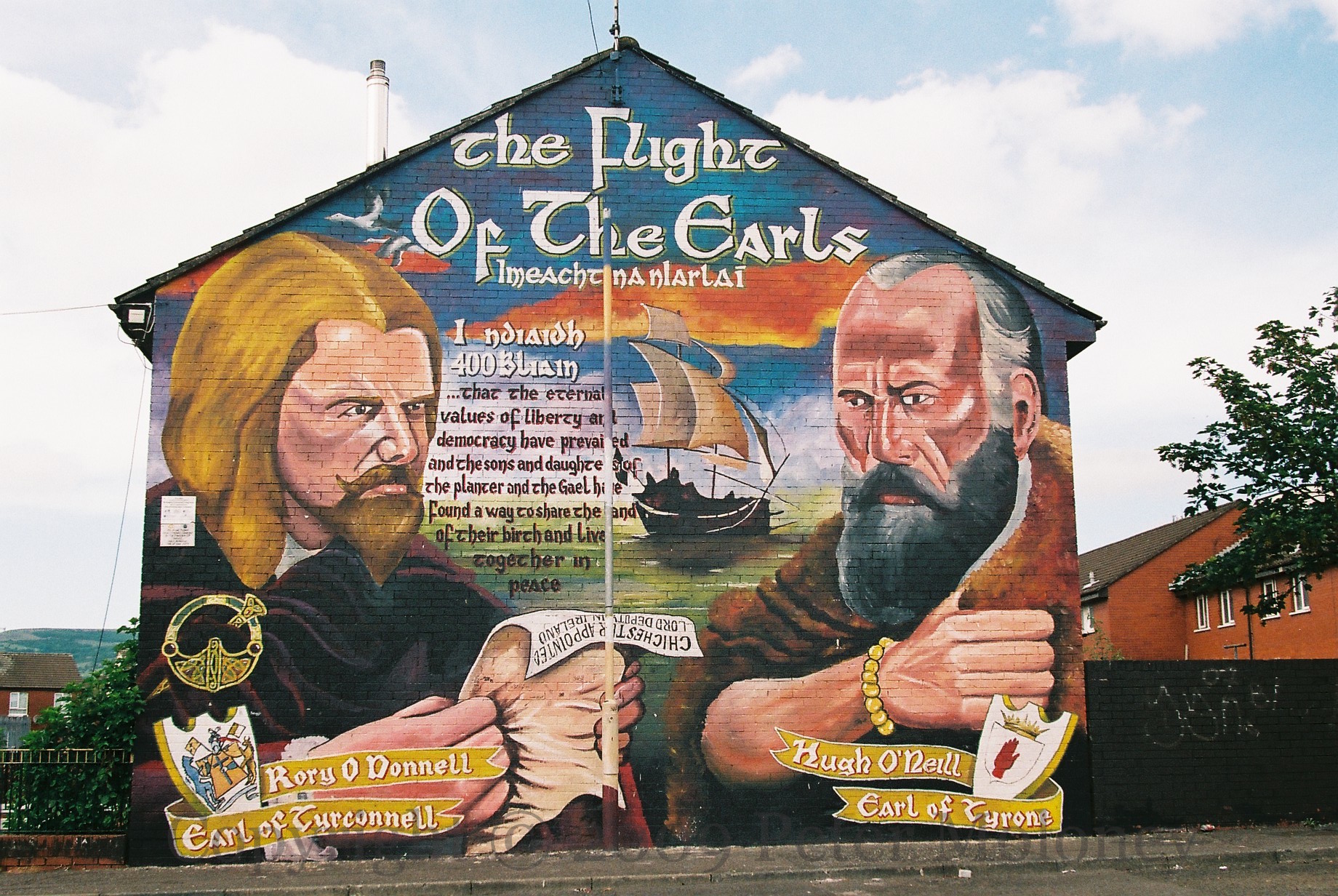
In 1607 – “400 blıaın” after the Anglo-Norman invasion of Ireland – 50 years of newly-asserted English control, most recently at the hands of Charles Blount – who defeated the pair in the Nine Years’ War – and Arthur Chichester – who, as O’Donnell is shown reading, was “appointed Lord Deputy in Ireland” in 1605 – compelled Earls Hugh O’Neill of Tyrone and Rory O’Donnell of Tyrconnell to depart Ireland on a ship bound for Spain in order to petition for Spanish support in reclaiming the lands and status they were losing under English rule. They ended up in Rome instead and never returned, ending the period of Gaelic chiefs rule in Ireland and making way for the plantation of Ulster.
The pair of plaques on the left indicate that the mural was painted as part of the Re-Imaging Communities Programme’ (top) and launched by President Mary McAleese on June 19th (bottom). Even though the subject was historical, the state funding for the project required the removal of a sword from O’Neill’s right hand; he is shown instead clutching the collar of his cloak. For more on the re-imaging programme, see Visual History 10.
“Imeacht na nIarlaí. I ndıadh 400 blıaın … that the eternal values of liberty and democracy have prevailed and the sons and daughters of the planter and the Gael have found a way to share the land of their birth and live together in peace.”
2009 image of the (second – see C05209) Great Hunger mural on Ardoyne Avenue (see previously the mural in 2002) with the correct spelling of “emigration” restored (see 2004).
“They buried us without shroud or coffin” is a line from an unrelated Seamus Heaney poem Requiem For The Croppies. Produced by “Ardoyne Art & Environment Project”.
“Seán Mac Dıarmada 1883-1916 a bhí ına chónaí ı Sráıd de Buıtléır sa bhlıaın 1905.” [who was living in Butler Street in the year 1905].
Seán Mac Dıarmada was born in Leitrim, left for Glasgow at age 15, but after two years returned to Belfast in 1905 (working on the trams) and – according to the new mural above – spoke from the back of a coal lorry in Clonard Street, outside the Clonard branch of the Ancient Order Of Hibernians. Mac Dıarmada was for a short time an AOH member, before moving on to the Irish Republican Brotherhood and Irish Volunteers, which led to his participation in the 1916 Easter Rising and execution on May 12th of that year.
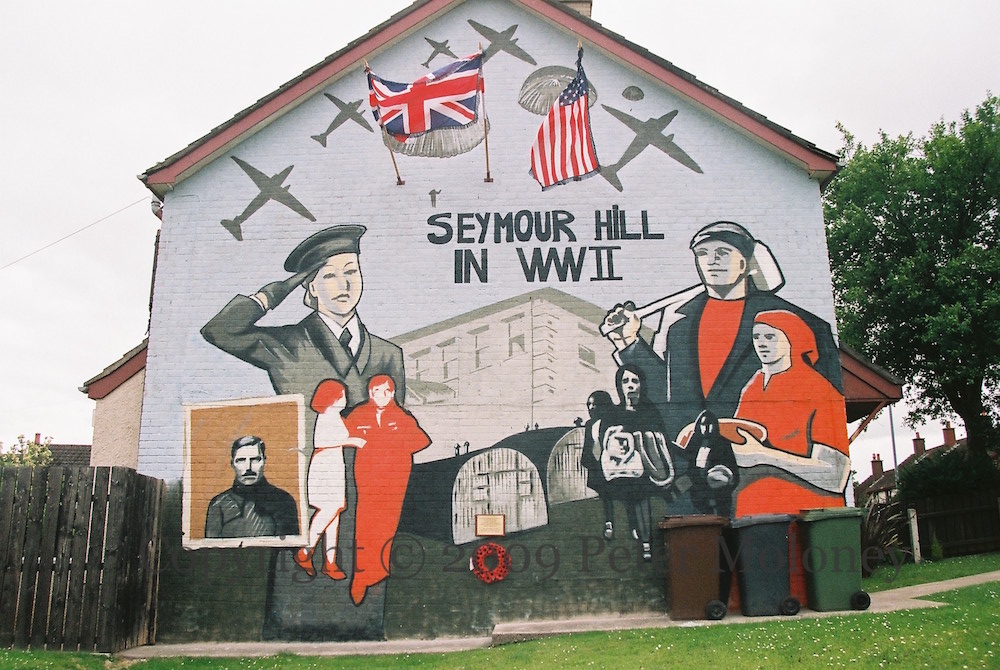
The plaque reads “This mural was dedicated by Col. Robin Charley on 1st July 2009 to the people from this area who contributed to the to the effort during World War II. Also our American allies who were based here and later contributed to the conflict.”
US forces were still segregated racially during WWII; “colored” soldiers (as they were then called) were housed in a camp at Ballybog Road (WW2NI) where Seymour Hill PS now is and just below Seymour Hill House which was used to house evacuees from Belfast after the blitz and which was formerly owned by the Charley family (Lisburn.com | Lord Belmont) – it is now administered by Radius (formerly the BIH Association).
The “framed” portrait on the left is of William “Billy” Harbinson, a member of the Royal Ulster Rifles who was a POW at Colditz (Lisburn.com | WW2NI); the photograph can be seen in the RUR museum.
Painted by Tim McCarthy (“Verz” ig) for the Re-Imaging Programme; it replaces a UDA mural.
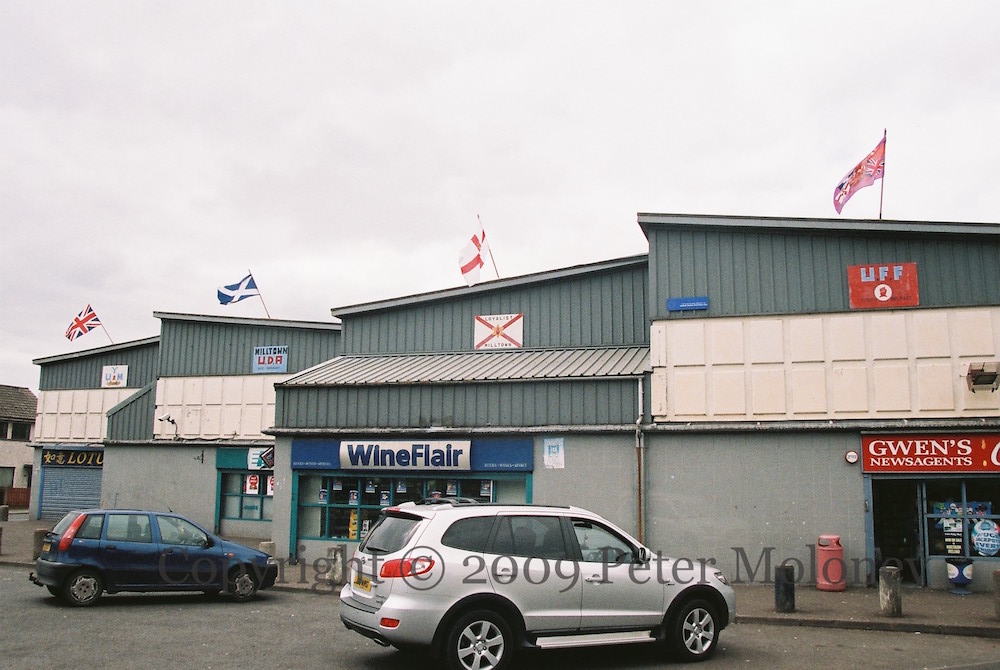
From left to right: “UYM Milltown”, “Milltown UDA – Quis Separabit”, “Loyalist Milltown” on a yellow-starred flag akin to the Ulster Nationalist flag, “UFF South Belfast”.





 Peter Moloney Collection