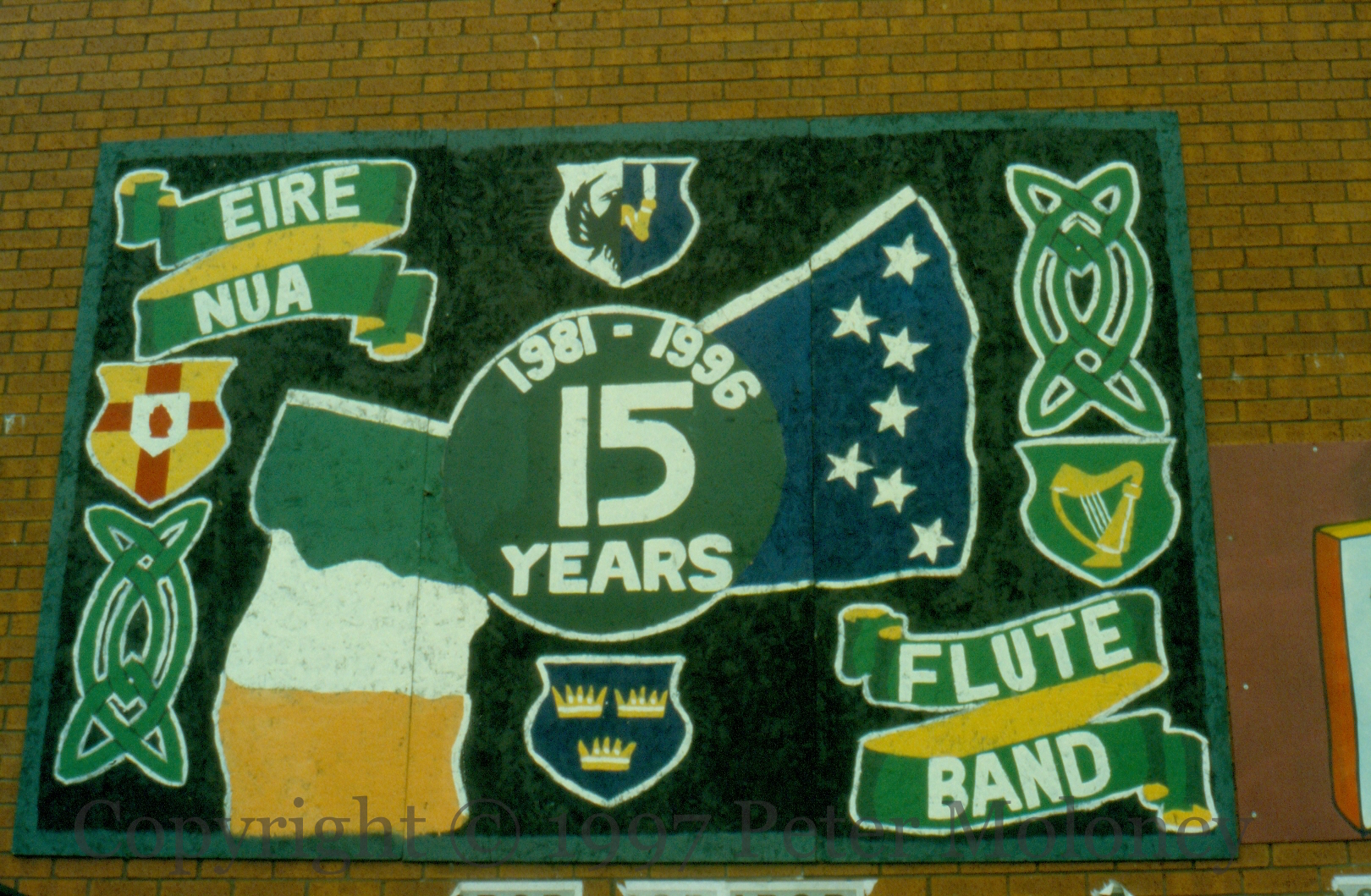
Éıre Nua Republican Flute Band (Fb) celebrates its fifteen anniversary with traditional republican symbols – the four provinces, celtic knotwork, and the flags of Ireland and socialism. Whiterock Road, Belfast.
Here are two parts (of what were at least three) of a long mural in Henry Street. Shown here are rioting outside McGurk’s Bar (see Campaign For Truth) and belongings being moved from a burning home.
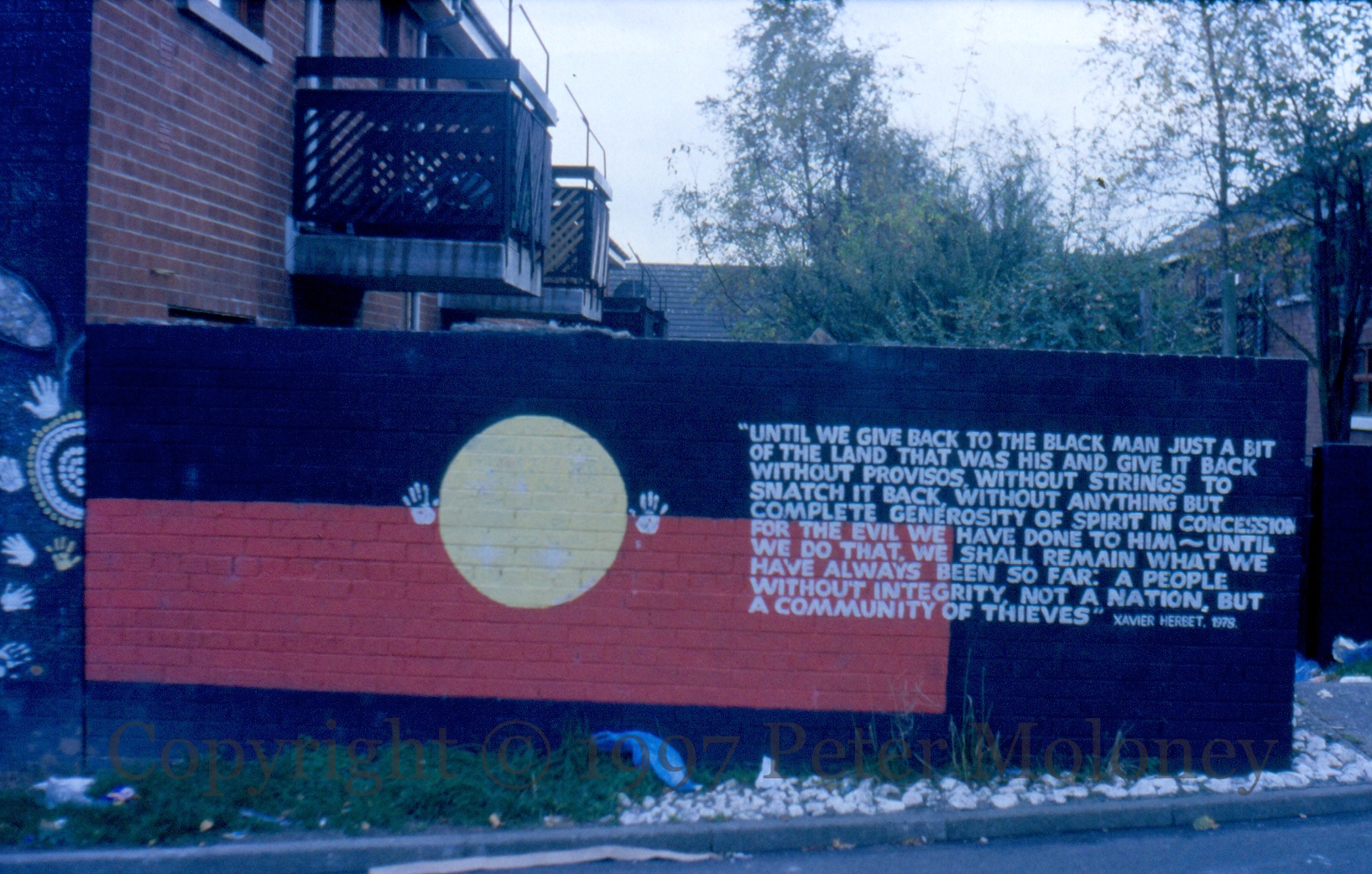
“Until we give back to the black man just a bit of the land that was his and give it back without provisos, without strings to snatch it back, without anything but complete generosity of spirit in concession for the evil we have done to him – until we do that, we shall remain what we have always been so far: a people without integrity, not a nation, but a community of thieves.” The words of [Australian writer] Xavier Herbert, 1978, over an aboriginal flag in which black represents the people, yellow the sun, and red the earth. Here is a timeline of the fight for indigenous rights in Australia.
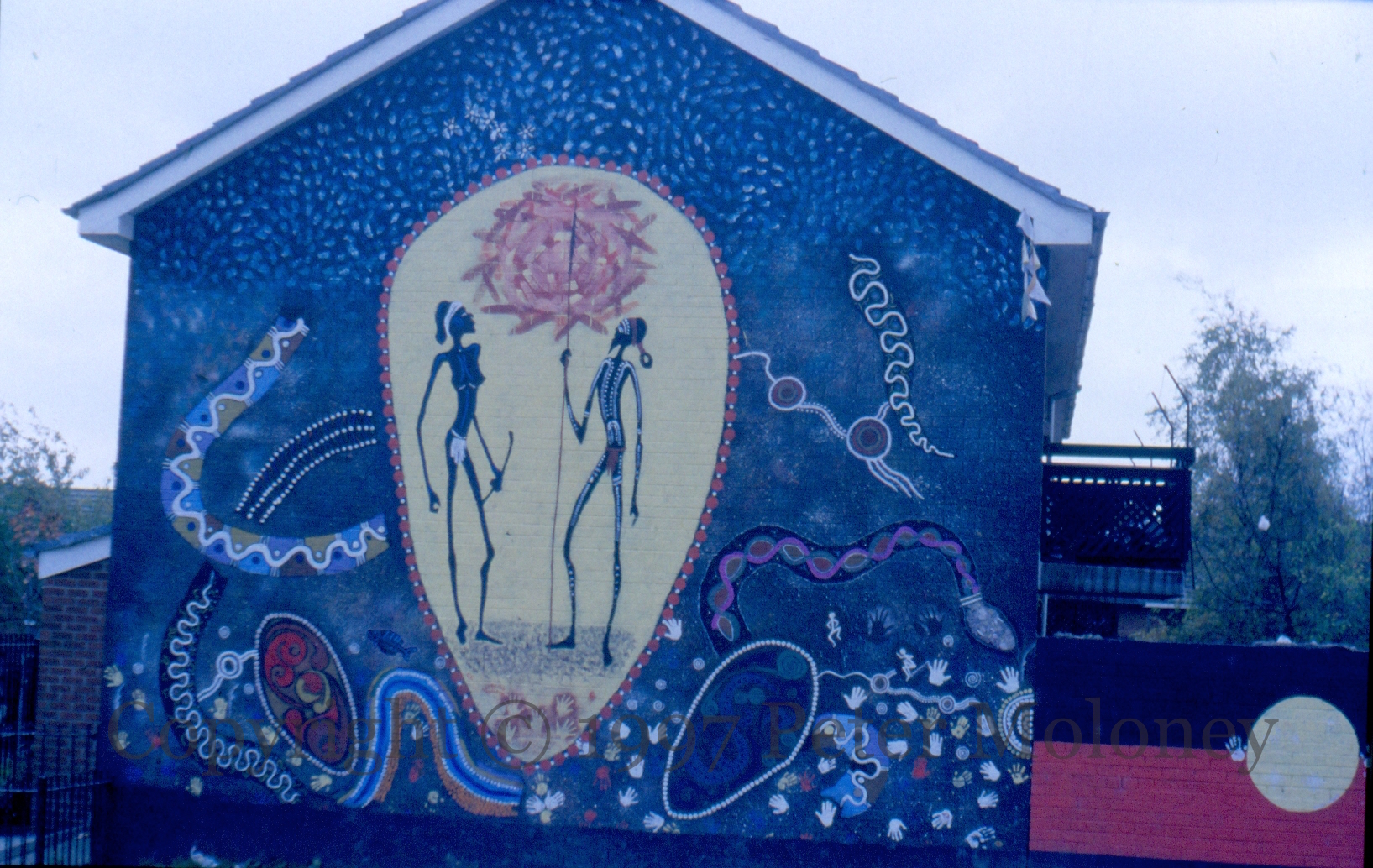
An unknown (please get in touch) piece of aboriginal art forms the main panel.
The third of three figures from the Society of United Irishmen to be featured in the New Lodge is William Steel Dickson. He was adjutant-general of the County Down Irishmen (see the blue plaque in Portaferry M08948) and was arrested a few days before the insurrection (WP). Like Henry Joy and Mary Ann McCracken and William Drennan, he is buried in Clifton Street Cemetery. New Lodge Road, Belfast.
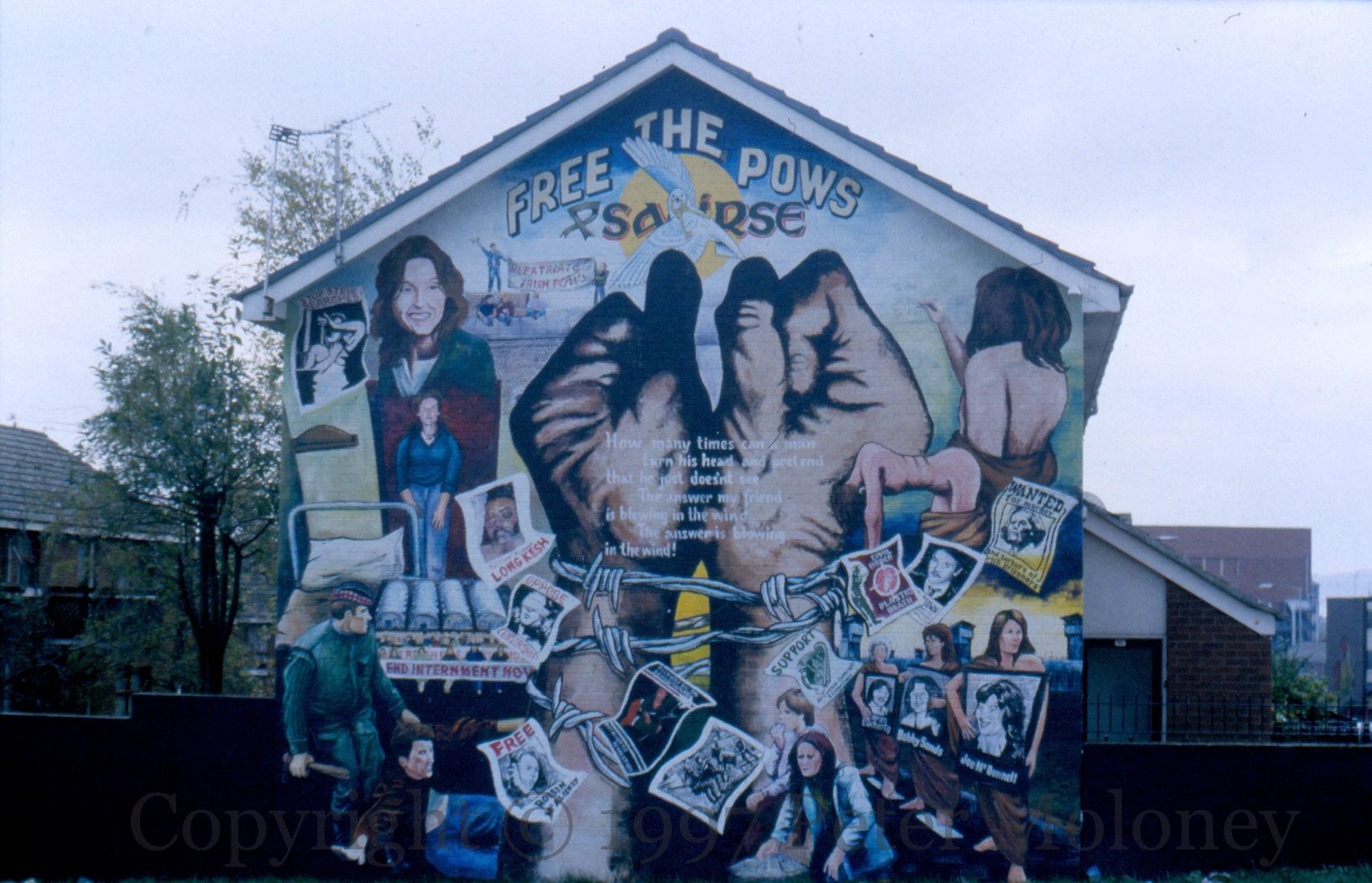
A collage of image from the previous 30 years, including banging bin-lids on the ground, Maıréad Farrell in Armagh prison, men on the blanket, the cages of Long Kesh, marches in support of the hunger strikers, and reproductions of various posters, against Margaret Thatcher, plastic bullets, internment, and censorship. There’s a quote from Bob Dylan in the middle, “How many times can a man turn his head and pretend that he just doesn’t see – the answer, my friend, is blowing in the wind, the answer is blowing in the wind.”
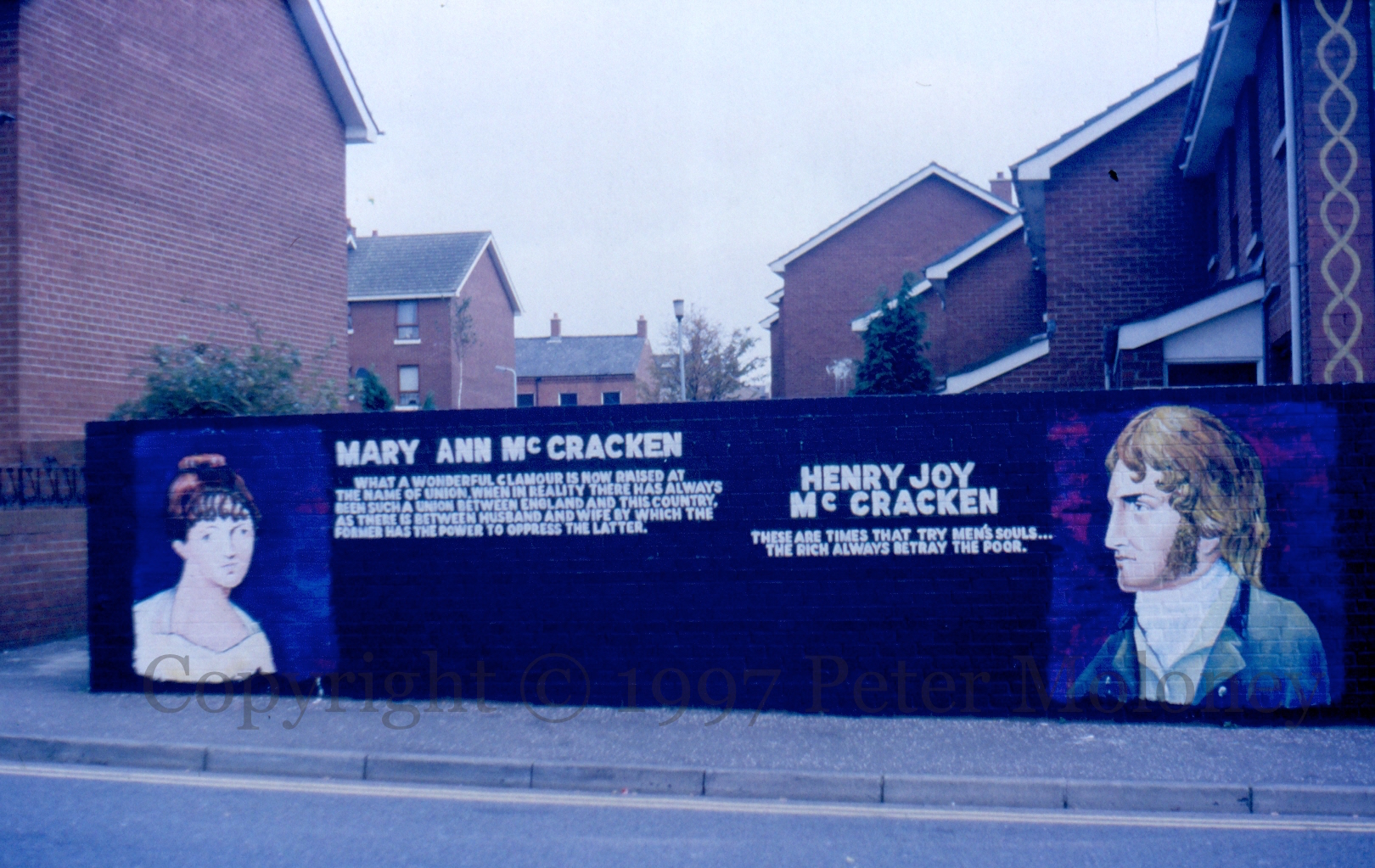
Portraits of, and quotes from, Mary Ann McCracken (“What a wonderful clamour is now raised at the name of union, when in reality there has always been such a union between England and this country, as there is between husband and wife by which the former has the power to oppress the latter.”) and her older brother Henry Joy McCracken (“These are the times that try men’s souls … the rich always betray the poor.”). The two – sister and brother – were Presbyterians and republicans. Henry led the Antrim uprising of the United Irishmen in 1798 and was executed for it; Mary Ann was an abolitionist and social reformer.
William Drennan, 1754-1820, was a doctor, poet, Presbyterian, one of the founders of the Society of United Irishmen, and the first person to refer to Ireland as “the Emerald Isle”, in his poem When Erin First Rose. The words in this mural are the epitaph on his stone in Clifton Street Cemetery: “Pure, just, benign. Thus filial love would trace the virtues, hollowing [sic] this narrow space. The Emerald Isle may grant a wider claim and link the patriot with his country’s name.”
Three guns are fired over a Tricolour-covered coffin. Mural in Friendly Way, Belfast, commemorating volunteers Joseph Downey, Brendan Davison, and Tony Nolan.
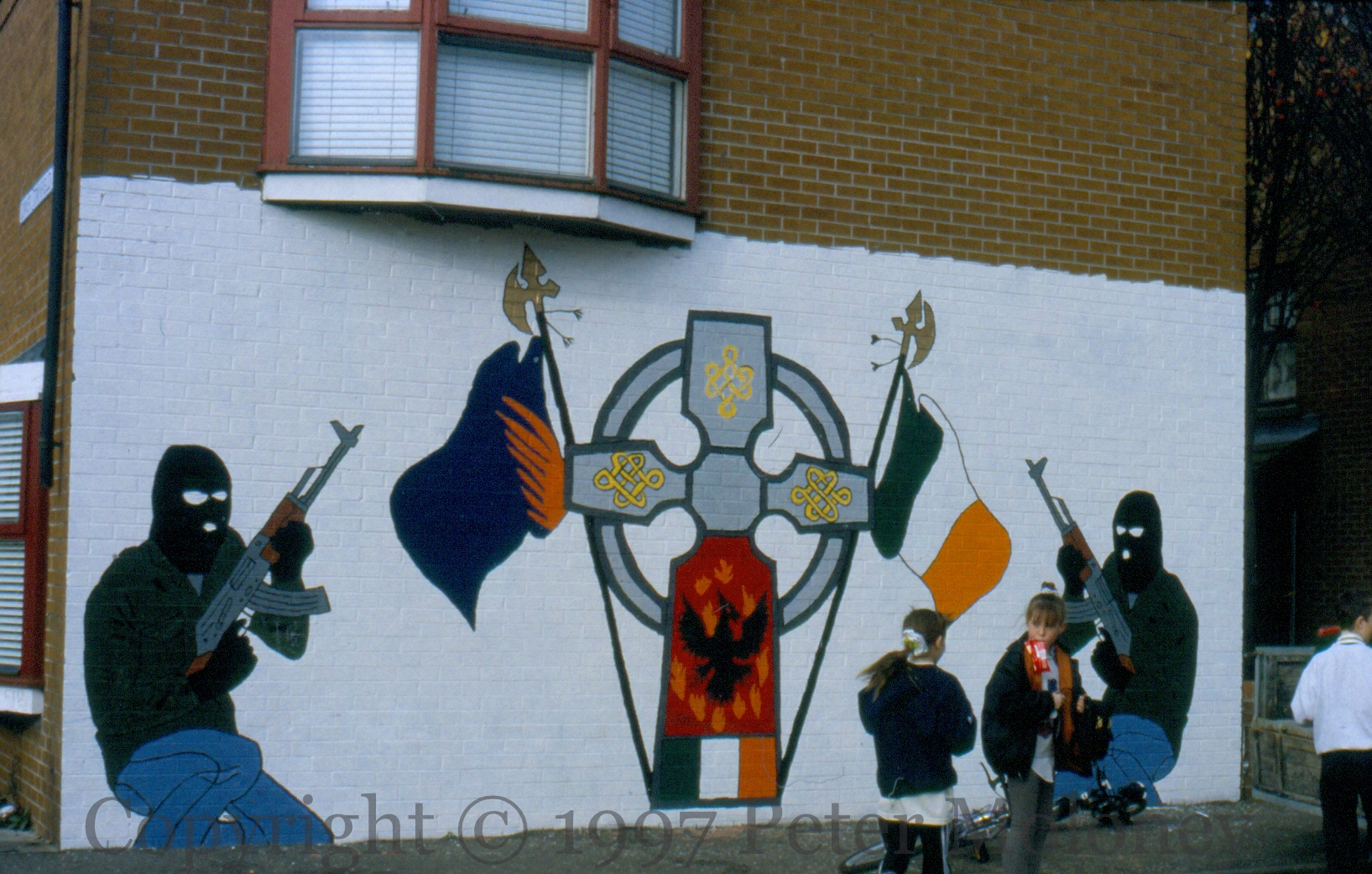
A mural of traditional republican symbols – armed and masked volunteers with celtic cross, phoenix, pikes, Tricolour and Sunburst flags – but unusual for 1997. Perhaps it dates to the period before the second/renewed ceasefire, on July 19th. Stanfield Place, Belfast. M01346





 Peter Moloney Collection