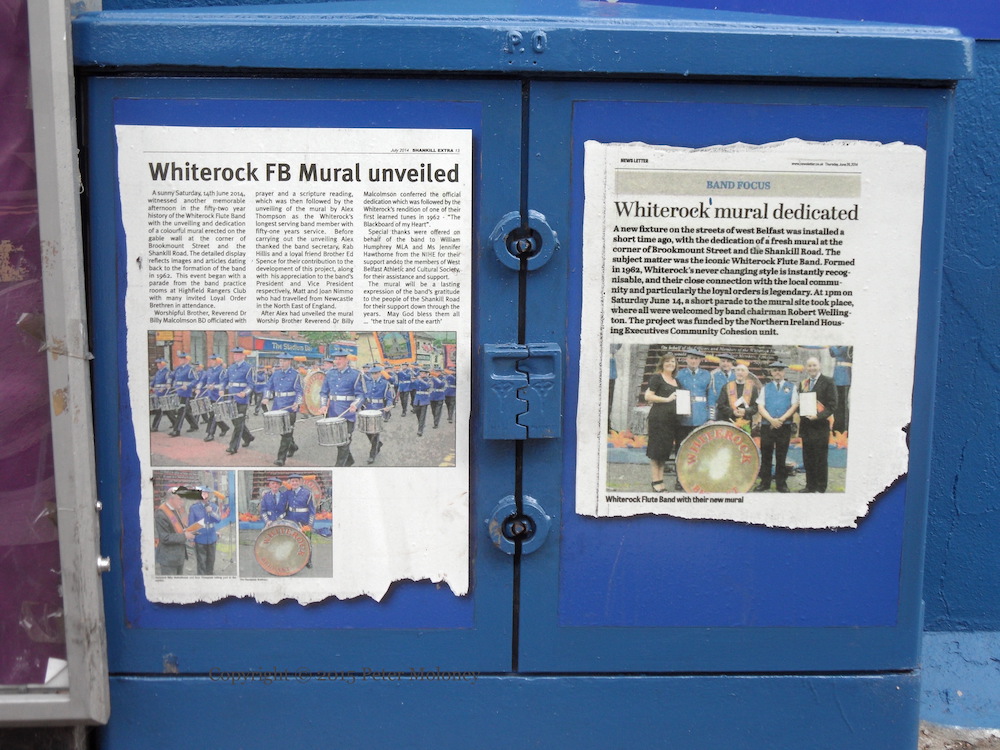
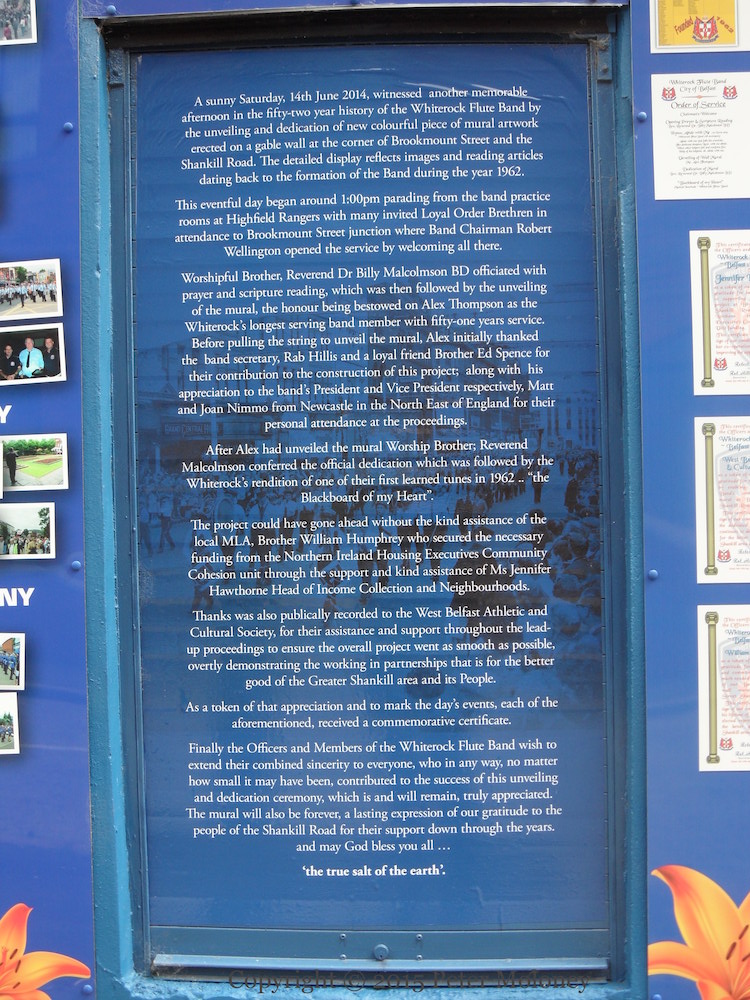
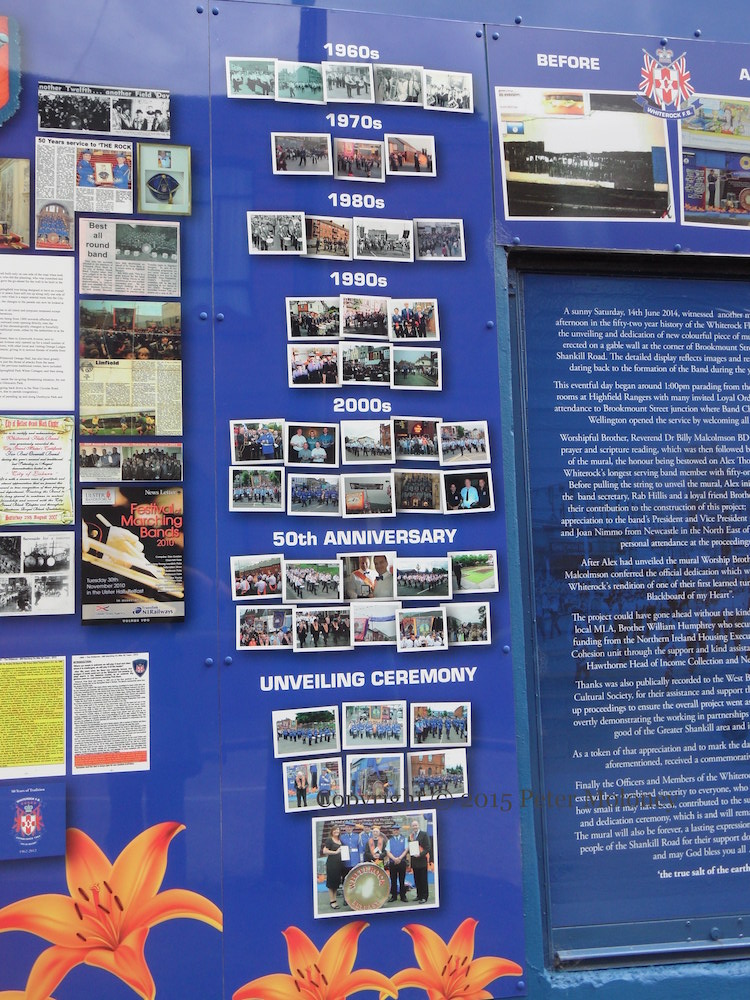
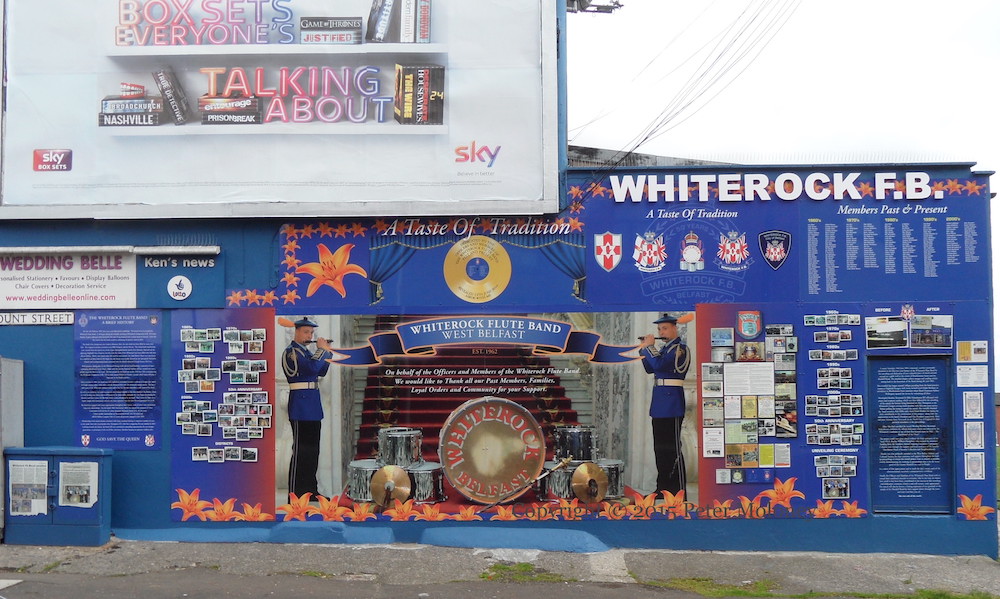
This is the post-launch version of the Whiterock flute band’s history wall (as compared to the partially completed wall from last year, before the launch). At the top, we now have a gold disc and orange lily, and, around the doorway on the far right, a list of members, photographs from years gone by, and an account of the launch, which took place on June 14th, 2014.
The final image is from July, by which time “Whiterock F.B.” in bold, white, lettering along the top right had been added.
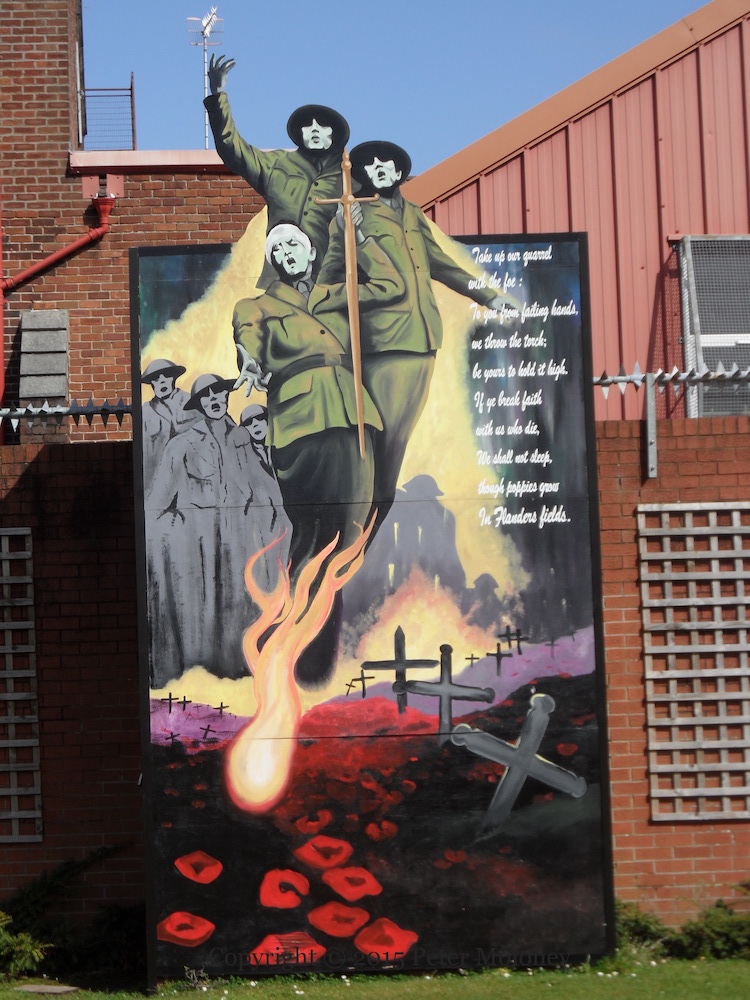
The Somme memorial Garden Of Reflection (between the Shankill graveyard and the Mountainview Tavern) has two new pieces. The first places two headstones (both reading “A soldier of the great war”) in a flower-bed in front of the mural, which shows a soldier, presumably from the Ulster division, on the fields of Flanders: “Greater love hath no man than this, that a man lay down his life for his friends. 1914-2014”
In the second, three wraiths of dead WWI soldiers – one with its head wrapped in a bandage – rise from the grave to issue a final edict: “Take up our quarrel with the foe; to you from failing hands we throw the torch; be yours to hold it high. If ye break faith with us who die, we shall not sleep though poppies grow in Flanders’ fields.”
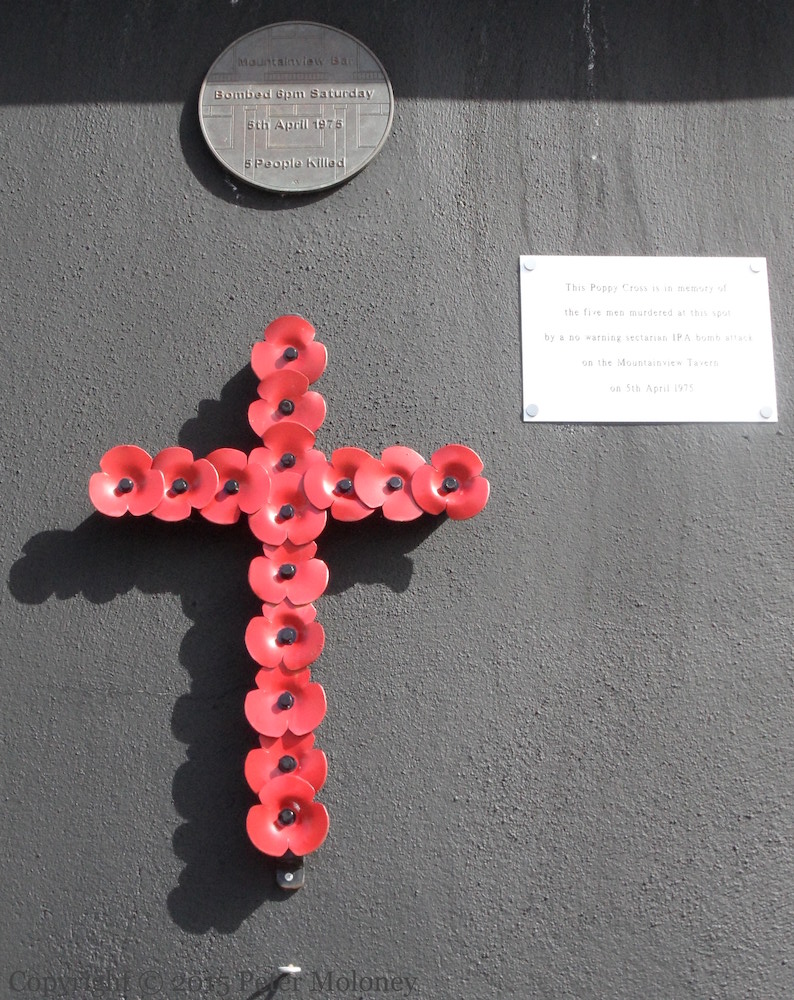
“This Poppy Cross is in memory of the five men murdered at this spot by a no warning sectarian IRA bomb attack on the Mountainview Tavern on 5th April 1975.” According to WP, the pub was full of punters who had been watching the 1975 Grand National (youtube) which Red Rum was attempting to win for a third consecutive time.
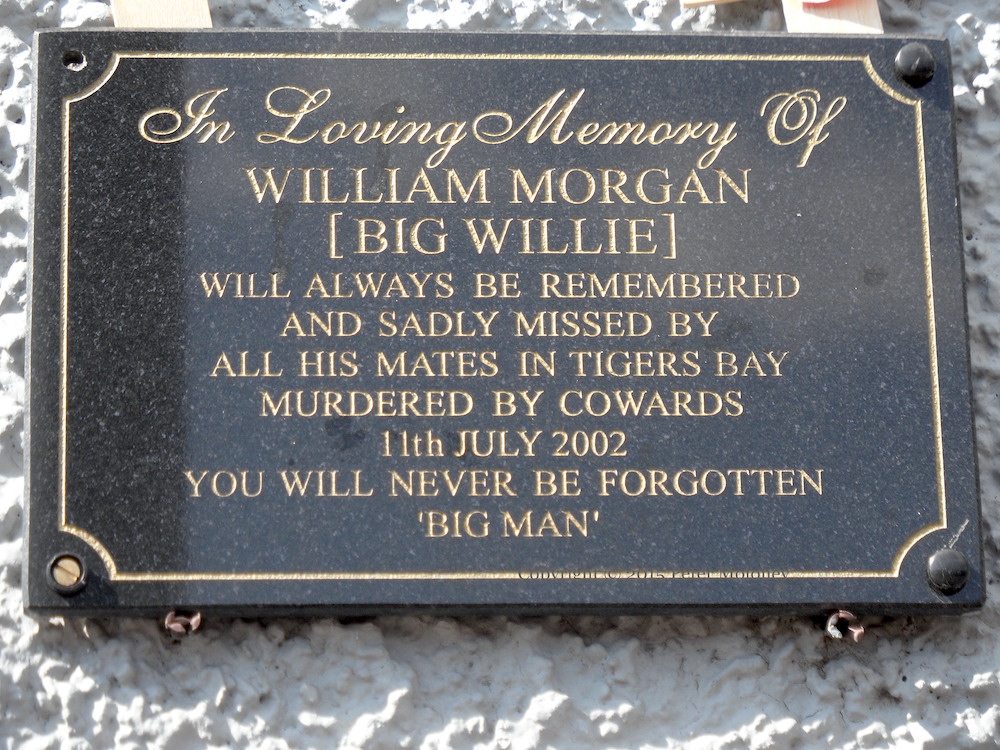
This is the new plaque to “William Morgan (Big Willie). Will always be remembered and sadly missed by all his mates in Tiger’s Bay. Murdered by cowards 11th July 2002. You will never be forgotten ‘big man’.”
Morgan was struck by a hit-and-run car on July 6th, 2002 and died in hospital five days later. The car is reported to have deliberately mounted the kerb where he was walking on North Queen Street and the attack was thought to have been sectarian, as the alleged driver and passenger were republicans and the car was found burned out in the New Lodge (NewsLetter | IndyMedia).
This graffiti on the hoardings around the building-site at the top of Woodvale Road, at the junction with Twaddell Avenue, where each night Orange bands march up to the police line, attempting to march past the Ardoyne shops and finish a parade from the Twelfth (of July) 2013.
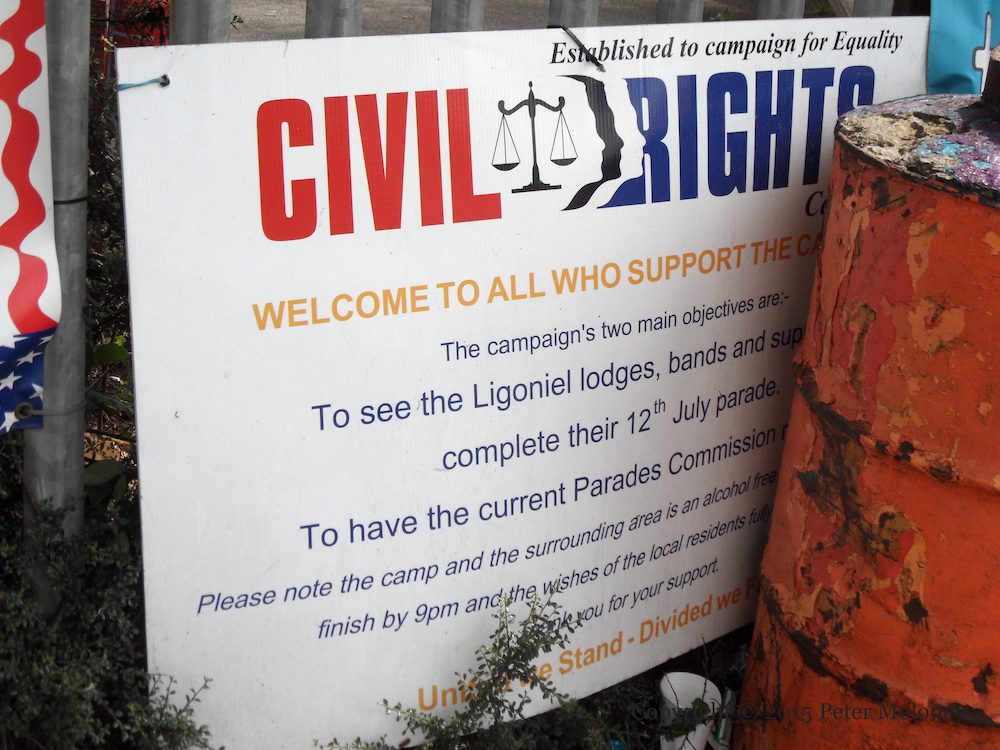
A camp was established on the site on Twaddell Avenue with signs using the language of “civil rights” and “equality”: “Established to campaign for Equality. Civil Rights. Welcome to all who support the campaign. The two main objectives are to see the Ligoniel lodges, bands and supporters complete their 12th july parade; to have the current parades commission removed. Please note the camp and the surrounding area is an alcohol free zone. All music must finish by 9 p.m. and the wishes of the local residents fully respected. Thank you for your support. United we stand – divided we fall.”
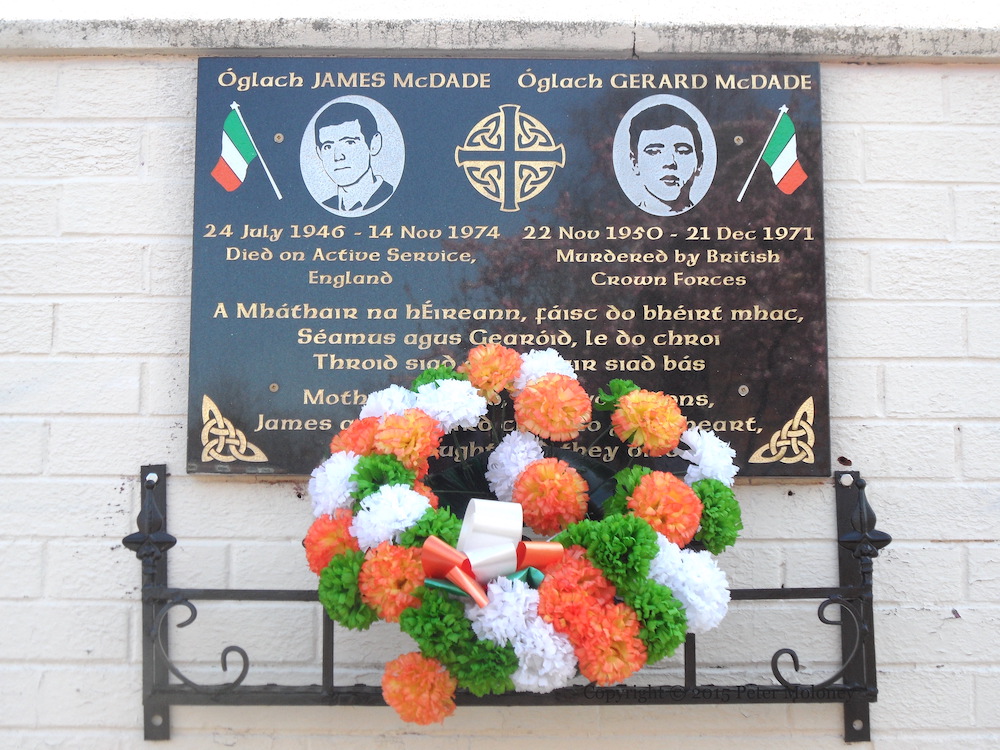
Two IRA memorial plaques have been mounted on a wall in Herbert Street, Ardoyne, close to the Sammy McLarnon plaque:
“Óglach James McDade 24 July 1946 – 14 Nov 1974 died on active service, England; Óglach Gerard McDade 22 Nov 1950 – 21 Dec 1971 murdered by British Crown Forces. A Mháthaır na hÉıreann, fáısc [strain, draw tight] do bhéırt mhac, Séamus agus Geraóıd, le do chroí. Throıd sıad agus fuaır sıad bás. Mother Ireland, hold your sons, James and Gerard, close to your heart. They fought and they died.”
The McDade family lived in Ardoyne. James died while planting a bomb in Birmingham, England; Gerard was shot by a British Army soldier – there is a plaque to his memory in Beechmount. (Sutton)
“Óglach Frankie Donnelly 26 Aug 1954 – 5 Jan 1979 died on active service; Óglach Laurence Montgomery 12 June 1954 – 5 Jan 1979 died on active service. Níl sa saol seo ach tréımhse gaırıd ar an bhóthaır fada chun na saoırse [in this life there is only a short period on the long road to freedom] – life is but a short part on the long journey to freedom”
Donnelly and Montgomery were killed in Northwick Drive, Ardoyne, by the premature detonation of a car-bomb. (Sutton)
Anti-Agreement stencilling in Meenan Square, Bogside, Derry: “Ireland unfree shall never be at peace – P. Pearse. PSNI-RUC not welcome. Tıocfaıdh Ár Lá” and “CIRA – RUC/PSNI scum beware”
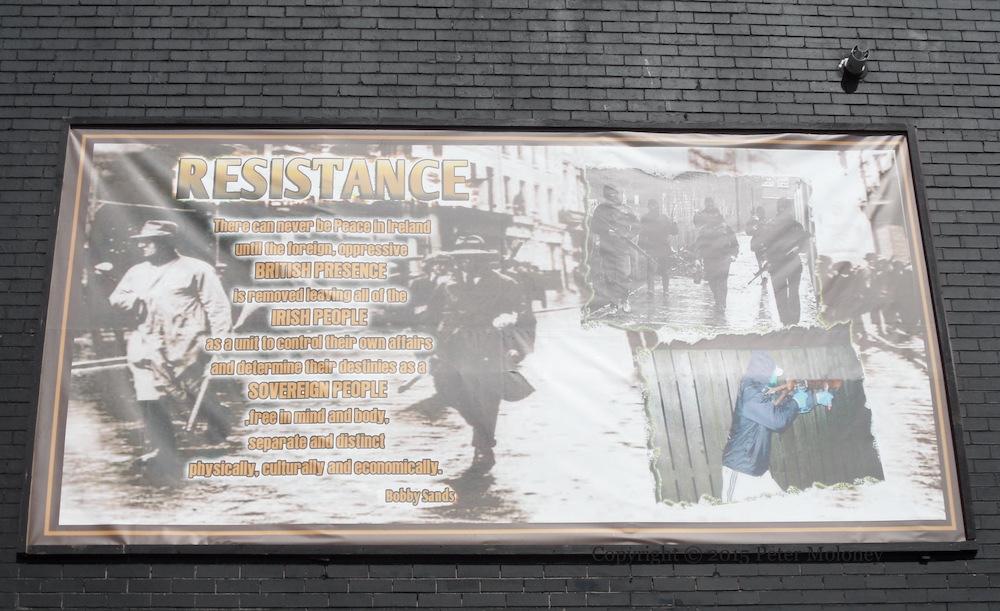
The three images employed here are: a scene from Grafton Street in the Battle Of Dublin in the civil war (1922) (irishhistory.blogspot.com), PIRA volunteers on patrol in 1987 (top right), and (bottom left) a home-made rocket-launcher used in a 2014 attack on police (see, e.g. irishmirror.ie).
“There can never be peace in Ireland until the foreign, oppressive British presence is removed leaving all of the Irish people as a unit to control their own affairs and determine their destinies as a sovereign people, free in mind and body, separate and distinct physically, culturally and economically.” Bobby Sands (Prison Diary May 1st)
“‘The Irish republic must be made a word of conjure with – a rallying point for the disaffected, a haven for the oppressed.’ – James Connolly 5th June 1868 – 12th May 1916.”
James Connolly was concerned not just with the political independence of Ireland but its economic independence: both political and economic liberty were required in order for the human being to live freely. The quote in the image above comes from Connolly’s 1897 essay “Socialism & Nationalism”. The economic context is clear when we read a little more broadly:
“To the tenant farmer, ground between landlordism on the one hand and American competition on the other, as between the upper and the nether millstone; to the wage-workers in the towns, suffering from the exactions of the slave-driving capitalist to the agricultural labourer, toiling away his life for a wage barely sufficient to keep body and soul together; in fact to every one of the toiling millions upon whose misery the outwardly-splendid fabric of our modern civilisation is reared, the Irish Republic might be made a word to conjure with – a rallying point for the disaffected, a haven for the oppressed, a point of departure for the Socialist, enthusiastic in the cause of human freedom.” (marxists.org)










 Peter Moloney Collection