“In loving memory of Damien Walsh ages 17 years murdered for his faith 25th March 1993. Also in remembrance of all the victims of this area. A Mhuıre banríon na nGaeıl guıgh orthu.” Sutton gives the first name as “Damian”. Shot by the UFF at Dairy Farm shopping centre, where he worked, and site of the plaque.
“Ballymurphy Massacre – Eddie Doherty – murdered by British Army 10 August 1971, aged 31, father of 4, corporation worker.”
Doherty was shot by a British Army soldier, one of 24 people to die as internment was introduced in August, 1971 (BelTel | Irish Story). The plaque is at the spot where Doherty was shot, on the Whiterock Road at Brittons Parade, Belfast. Profile at ballymurphymassacre.com.
“This plaque is dedicated to the memory of those murdered on 9th July 1972 by the British army. Fr Noel Fitzpatrick, Paddy Butler, Margaret Gargan, David McCafferty, Fıan John Dougal, and to all those murdered in Springhill, Whiterock, and Westrock area.” This is the new plaque to the five people killed in the Springhill-Westrock Massacre, and is on the house extension that the previous plaque. (See chapter 2 of An Pobal A Pheınteáıl.)
“In proud and loving memory of Vol, Jimmy Quigley, Belfast Brigade, Óglaıgh Na hÉıreann, killed in action 29th September 1972 by Crown forces. Ní dhéanfaıdh muıd dearmad [gur] fuaır sé bás ar son saoırse na hÉıreann.”
Quigley was shot by the British Army on Albert Street; the plaque is outside the family home in Brittons Parade, Belfast. Two profiles by Danny Morrison at Saoırse32.
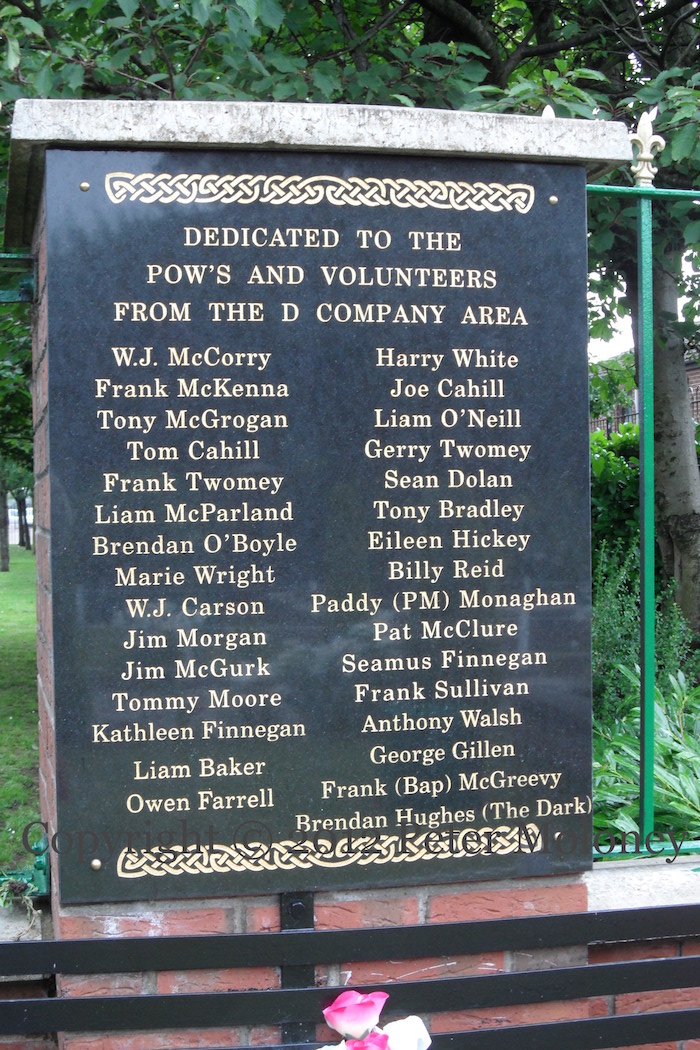
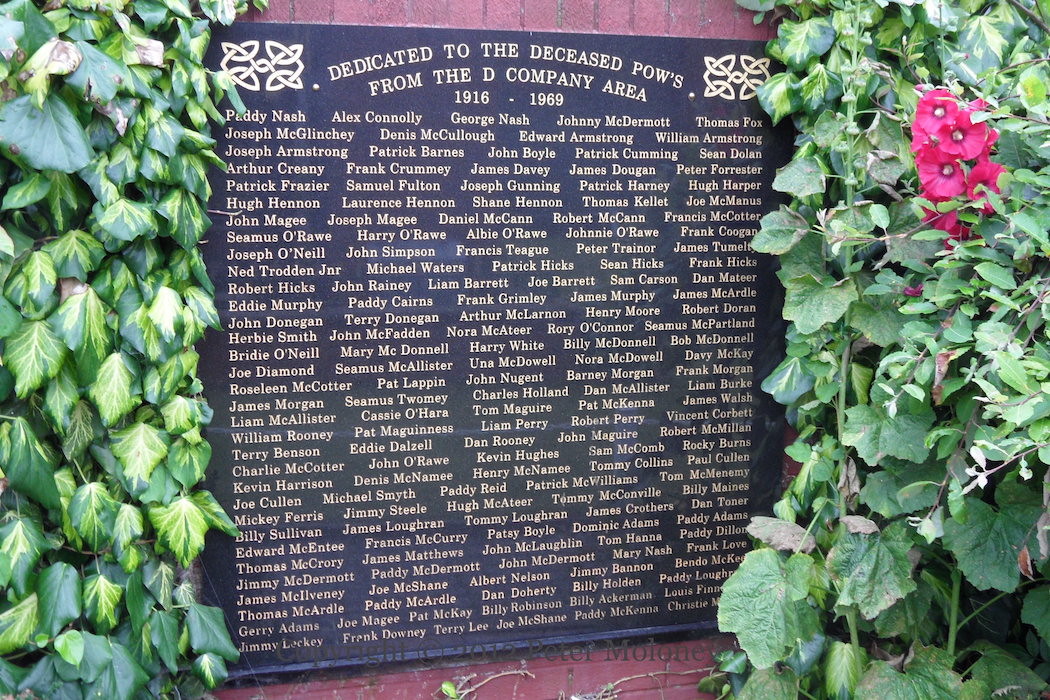
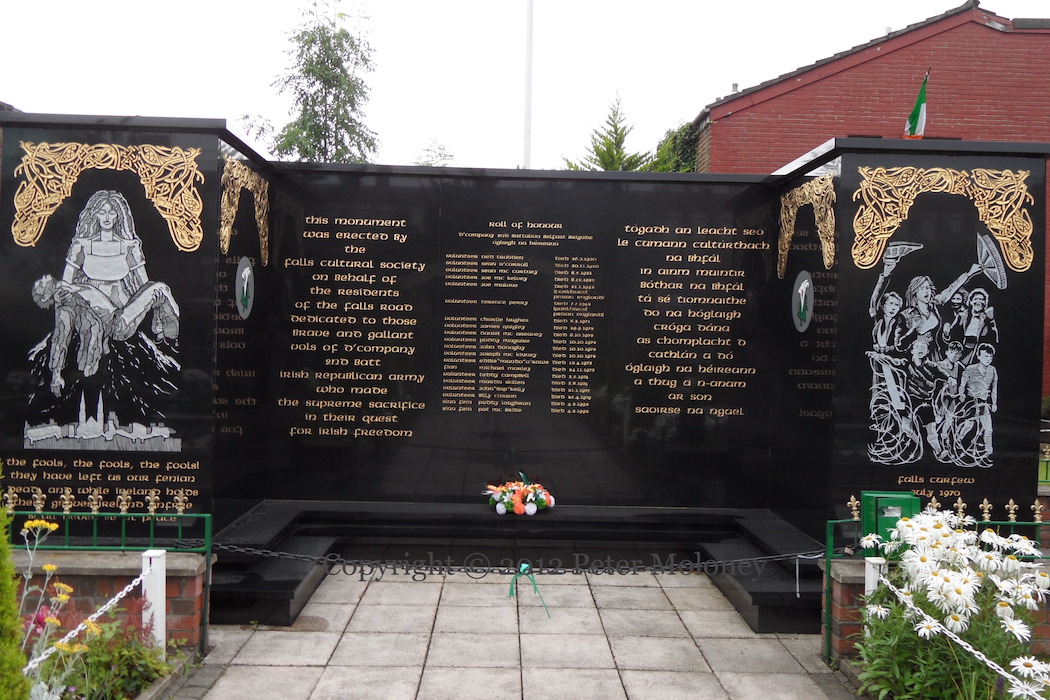
“Those brave and gallant vols of D Company IRA”, “POWs and volunteers”, “deceased POWs”, the D company volunteers who have “died of natural causes”, and the “civilians” who lost their lives. Some of these were seen before, in 2005’s Lower Falls Memorial Garden; the main addition is the large memorial with the illustrations, shown in the final image.
Top: “During the hunger-strike of 1981, in which ten men died, the Holy Rosary was recited here [on Freeduff Road], daily, by the community of Cullyhanna, to highlight the suffering of all the women and men in Armagh Gaol and Long Kesh, described by the late Cardinal Tomás Ó Fiach, a native of Cullyhanna, as being “worse than the sewers of Calcutta”. Go ndéana Dıa trócaıre ar a n-anam. Unveiled on the 8th July, 2001 by former hunger-striker, Paddy Quinn.”
Middle: The central panel is to Brendan Moley, Kevin Caherty, Michael McVerry, Brendan Burns, Fergal Caraher. Flanking this is a a longer list of volunteers, in English (left) and Irish (right). McVerry, Boyle, Jordan, McKiernan, Lochrie, Campbell, Cleary, Harvey, McElvanna, Caherty, McCreesh, Moley, Burns, Caraher, Duffy, Martin, Daly, Watters, Toner, Rogers. With smaller plaques to Tom Rooney & John Caraher, and to Brian Keenan.
Bottom: An individual memorial to “Vol Francis Caraher, Óglaıgh Na hÉıreann, murdered by British soldiers at this spot [on Tullyvallen Road] on 30th December 1990, aged 20 years.”
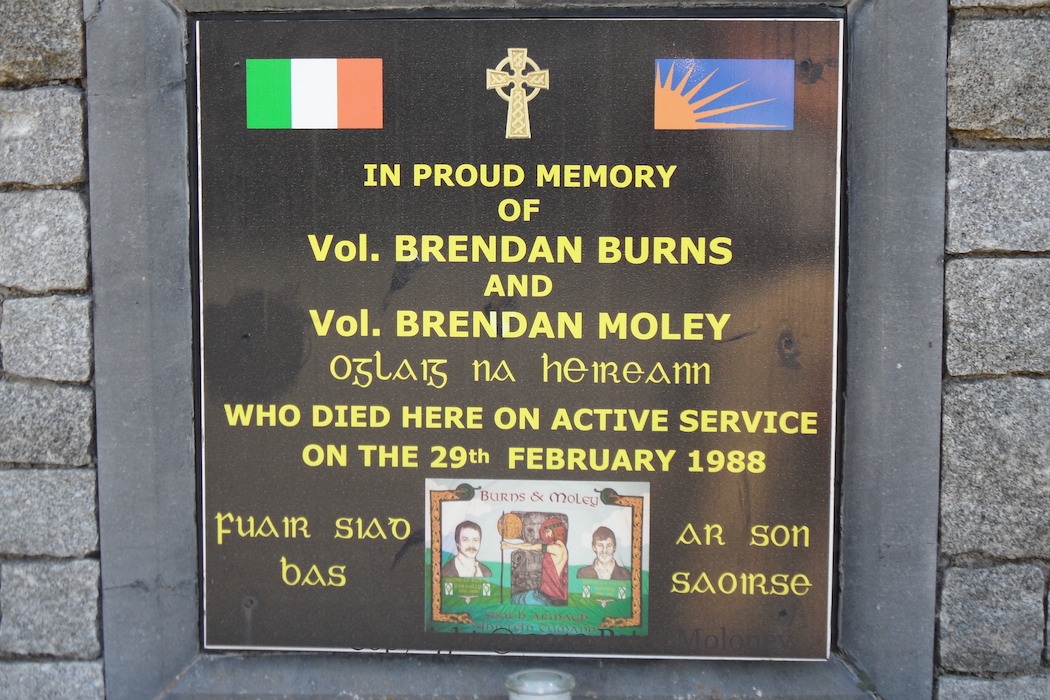
Two images from Creggan, Co. Armagh (near Crossmaglen). First, the memorial to “Brendan Burns, Carnally, 1958-1988” and “Brendan Moley, Dorsey, 1958-1998” “who died here on active service on the 29th February 1988 – fuaır sıad bás ar son na saoırse.” (Tribute from RN.) A Celtic warrior with a spear stands in front of a Janus statue. “South Armagh Sınn Féın Cumann.”
Below, “restore political status”. Both are on Donaldson’s Road.
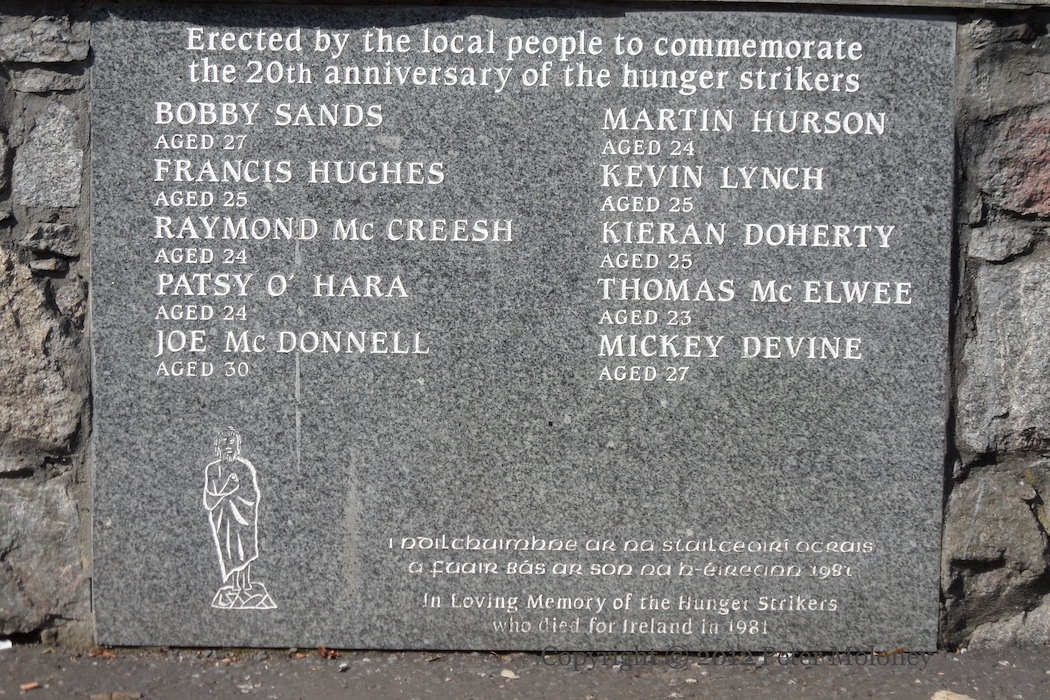
“Erected by the local people to commemorate the 20th anniversary of the hunger strikers. I ndıl chuımhne ar na staılceoırí ocraıs a fuaır bás ar son na h-Éıreann 1981. In loving memory of the hunger strikers who died for Ireland in 1981.” With a small blanketman illustration.
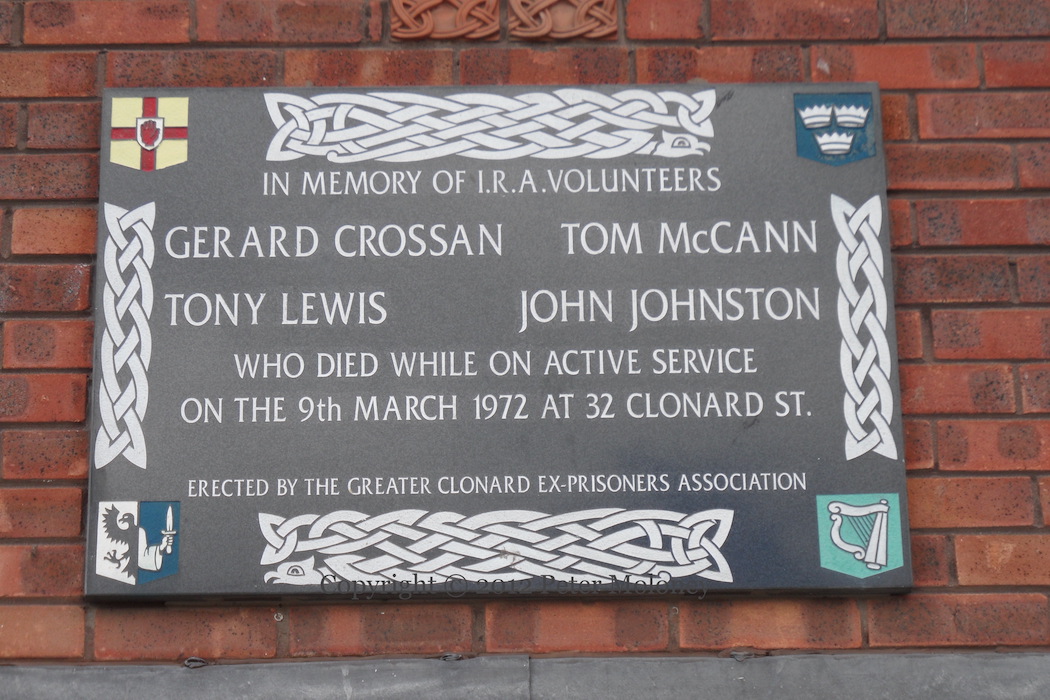
“In memory of IRA volunteers Gerard Crossan, Tom McCann, Tony Lewis, John [Sean] Johnston, who died while on active service on the 9th March 1972 at 32 Clonard St. Erected by the Greater Clonard Ex-Prisoners Association.” The four died in a premature explosion (“active service”) presumably at the home of Lewis, who lived in Clonard Street. Crossan and Johnston were 19, McCann and Lewis were 20 (The Troubles 11).
“Jim Stranney, republican and socialist, 1915-1938, fought and died in the Spanish Civil War 1936-1939. ‘You were of the people and for the people your life was laid.’ No pasarán. Erected by Teach Na Fáılte [INLA ex-prisoners] & The Belfast Cultural and Local History Group.” Stranney was killed in an assault on a fascist position near Gandesa on July 30th or 31st, 1938 (Belfast Media | tw). For a brief biography see CarltonBooks.
Above the door of 10 John Street, Belfast, which is perhaps where his parents lived.