“¡No pasarán! In memory of the International Brigades and the men from Derry, Donegal & Tyrone who served in the struggle against fascism in defence of the Spanish Republic 1936 – 38. I measc laochra lucht oıbre go raıbh a n-aınm – May their names [name] be among the heroes of labour. Erected by the North West Spanish Civil War Project, July 2013.”
The plaque is on the Unite building in Carlisle Road, Derry.
The IRSP board is in Fahan Street. It names Thomas Traynor, John Murphy, Benjamin Frederick Murray, Eamon McGrotty, George Gorman, Jack Flynn, James Donald, Peadar O’Donnell, James Campbell, Hugh O’Donnell, Paddy O’Daire, Joseph Kelly, Paddy Roe McLaughling, Francis William Vincent O’Donnell, Brian Goold-Verschoyle, Paddy Glacken, Phil Boyle, Hugh Bonner, Herbert Pollock, Charles McGuinness, William McChrystal, Joe Boyd.
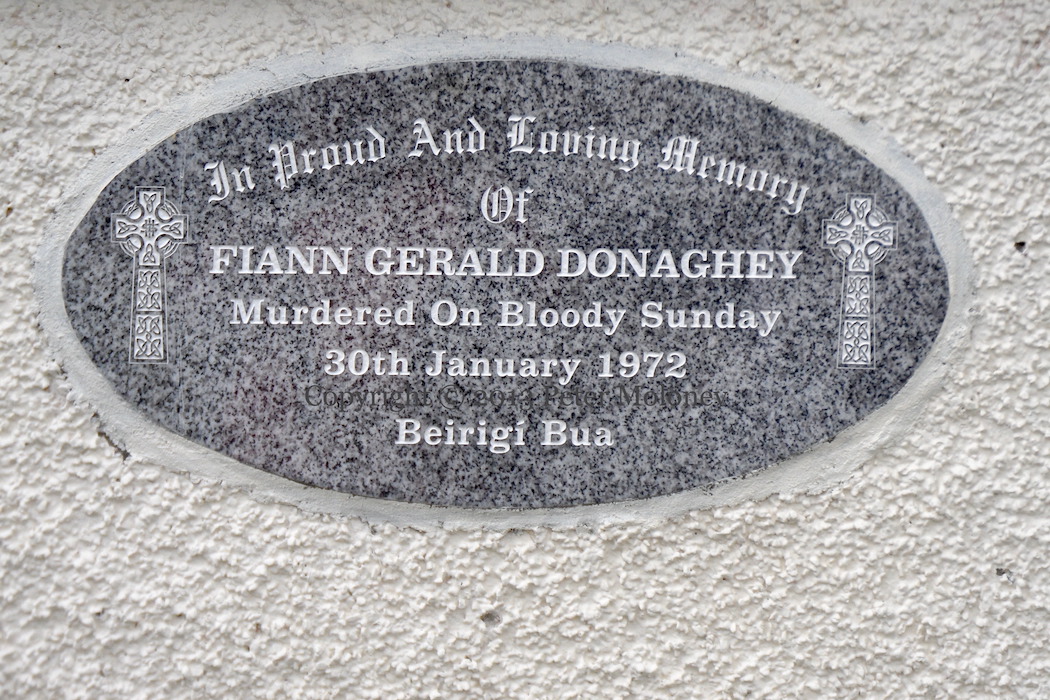
“In proud and loving memory of Fiann [sic] Gerald Donaghey, murdered on Bloody Sunday, 30th January 1972. Beirigí bua.” Donaghey was killed by the same bullet that also killed Gerard McKinney. The plaque is at the (modern-day) spot where he died, on the outside of Glenfada Park (south).
Robert Dougan was commander of the UDA South Belfast Brigade and lived the Oranmore Drive (BelTel). He was killed by the IRA on February 10th, 1998 while sitting in a car outside Balmoral Textiles in Dunmurry, which led to a month-long expulsion of Sinn Féin from the talks (L.A. Times); two months later the Good Friday Agreement was signed. There had been attempts on his life in 1993 and 1994 (Irish Times).
This is a new plaque to Stephen McConomy in Fahan Street, Derry, which includes the death of his mother, Maria “Mia” McConomy in July 2008 (Find A Grave). (For the previous plaque, see M03363)
“Stephen McConomy (a child of 11 years) Murdered by a plastic bullet aged 11 years on 16th April 1982. Always remembered by his loving brothers, family and late mother. May they both rest in peace.”
“Tógtha ar an 90ú comóradh de luíochán na hÁırse Éıgıptıgh/Erected on the 90th anniversary of the Epytian Arch Ambush. I gcuımhne [ar] Óglaıgh/In memory of Óglaıgh William Canning, John Francis O’Hare, Peter Shields, Óglaıgh Na hÉıreann. A maríodh iad, agus ıad sa tóır ar Phoblacht na hÉıreann, ag Forsaí Choróın na Breataıne/Who were killed by the British Crown Forces in the pursuit of an Irish Republic. “The republic stands for truth and honour. For that is the noblest in our race. By truth and honour, principle and sacrifice alone will Ireland be free.” – Liam Mellows.”
The ambush was on the night of December 12/13th, 1920; Canning died at that time, Shields on the 25th, and O’Hare the following July. Here is an account from Republican News; testimony can be found in the Military Archives.
“Strength in our hearts, strength of our limbs, consistency of our tongues.” “Na Fıanna Ard Eoın 1909-2009 – one hundred years of resistance. In proud memory Fıan Davy McAuley … Josh Campbell … Josie McComiskey … Bernard Fox. ‘You may kill the revolutionary, but never the revolution.’ Dedicated by the Republican Network for Unity.” The four deceased are portrayed on four small boards, along with standing figures of Fianna from both centuries.
“The Story Of The Murder Of Volunteer Seamus Bradley On The 31st Of July 1972, Operation Motorman.
On the 4th of July 1972, the British government met with army intelligence and army personnel, between them they created a blue print which was first called operation carcan to later be changed to operation motorman. In this secret meeting that place on the 4th of July, the army were to take 20,000 troops from the UN forces, and the government gave orders on a shoot to kill policy and confirmed that no soldier would be held accountable for their actions on that day. Over 1,500 of these soldiers and 300 centurion tanks were sent to free Derry to tear down the barricades and cause havoc, but the provisional IRA intercepted their blue print and decided to step down to protect the innocent people of Northern Ireland. It was 4:10am, there were 25 – 30 people at the Creggan shops when there was gunfire heard, Vol. Seamus Bradley unarmed drew attention to himself to save others.
He ran down Bishop field where a soldier was to get out of a saracen, take aim in a kneeling position and fire two shots hitting him in the back, Vol. Seamus Bradley fell. Then the saracen drove down the field to where he lay, they put him in the saracen and took him away to St. Peter’s school, no one knew what happened after that. All they know is that he was interrogated, the pictures tell their own story. He was shot again three more times at close range, he was tortured and beaten and left to bleed to death at the hands of the British army. Afterwards it was confirmed by a doctor that none of Seamus Bradley’s injuries had been life threatening and had he received medical aid he would have lived.
This memorial is to commemorate Vol. Seamus Bradley just yards from where he fell. Vol. Seamus Bradley on the 2nd Battalion of B company Oglaigh Na H-Eireann, even though he was shot five times and beaten they could not make him betray his comrades.
I lived and loved and laboured with a patriot’s heart and will that the dawning years might make you fearless and unfettered still. When a future age shall find thee free men stand by thy side Mother Ireland o” remember me.
They may kill our bodies and take our blood but they will never break our spirits. Vol. Seamus Bradley. The war is not over until Ireland is free.”
“In proud memory of Óglach Sean McKee killed in action by British Paratroopers 18th May 1973 aged 17 years – “Better to die on your feet than live on your knees””
McKee was shot in Fairfield Street while aiming at a 3 Para observation post in an abandoned building in Butler Street (Lost Lives 847).
“In memory of óglach James Quigley, died 29th Sept. 1972 [and] óglach Patricia McKay, died 30th Sept. 1972. Killed on the streets where they were born by the British Army.” Quigley was shot while waiting to ambush a British Army patrol in Albert Street; McKay (of the OIRA) (and Ian Burt of the Royal Anglicans) was killed in Ross Street in a subsequent gun battle. (Lost Lives 614-616.)
“The Workers Party National Commemoration Committee. Erected in memory of all those comrades who dedicated their lives for establishment of a democratic, secular, socialist, republic. ‘I have given whatever I had to give for the party, for the people of Ireland, and for a better world, but others have given more, much more. Comrades have given their lives.’ – Tomás Mac Gıolla TD. For the unity of Protestant, Catholic and Dissenter.”