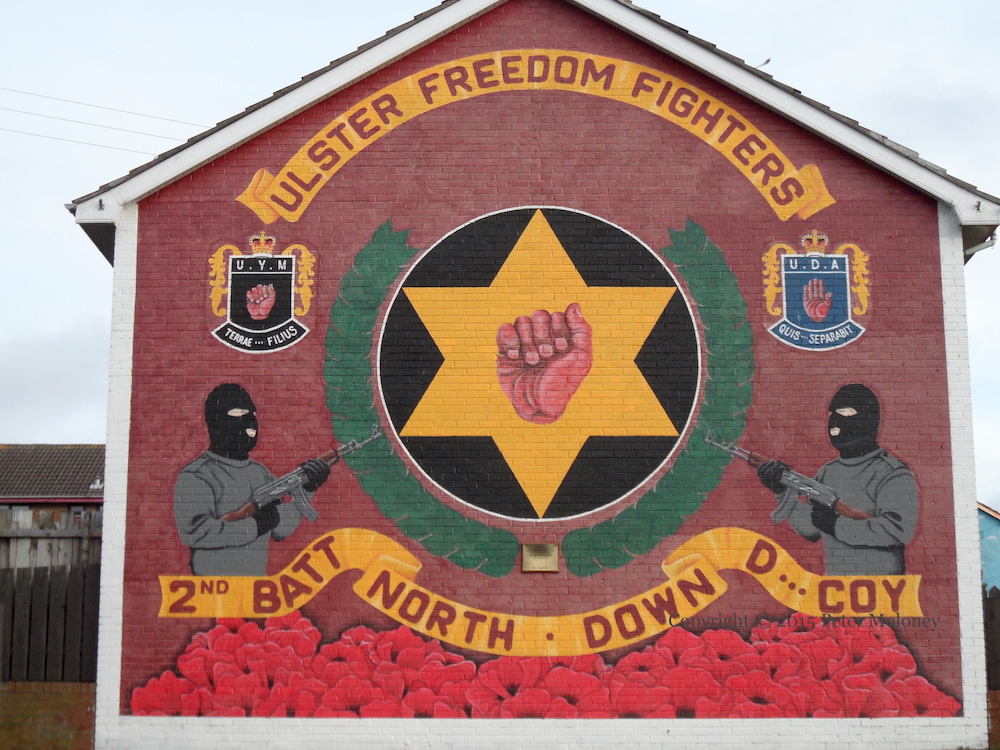
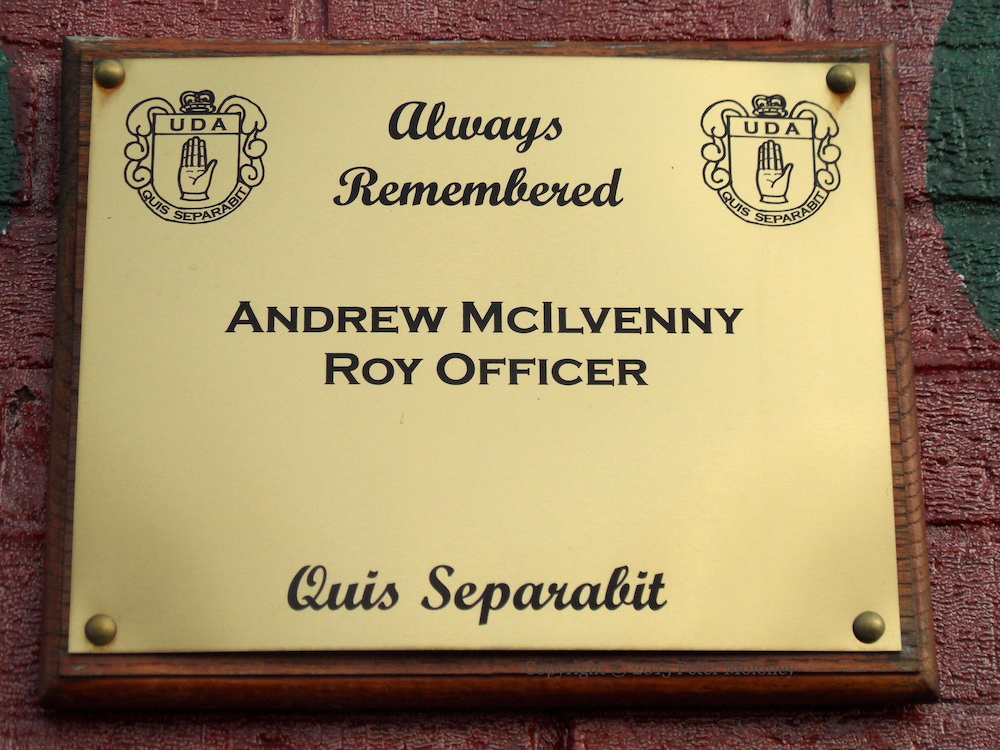
UFF/UDA/UYM (North Down, 2nd battalion, D company) memorial mural in Bloomfield estate, Bangor, to Andrew McIlvenny and Roy Officer, with hooded gunmen on a bed of poppies flanking the UFF clenched fist.
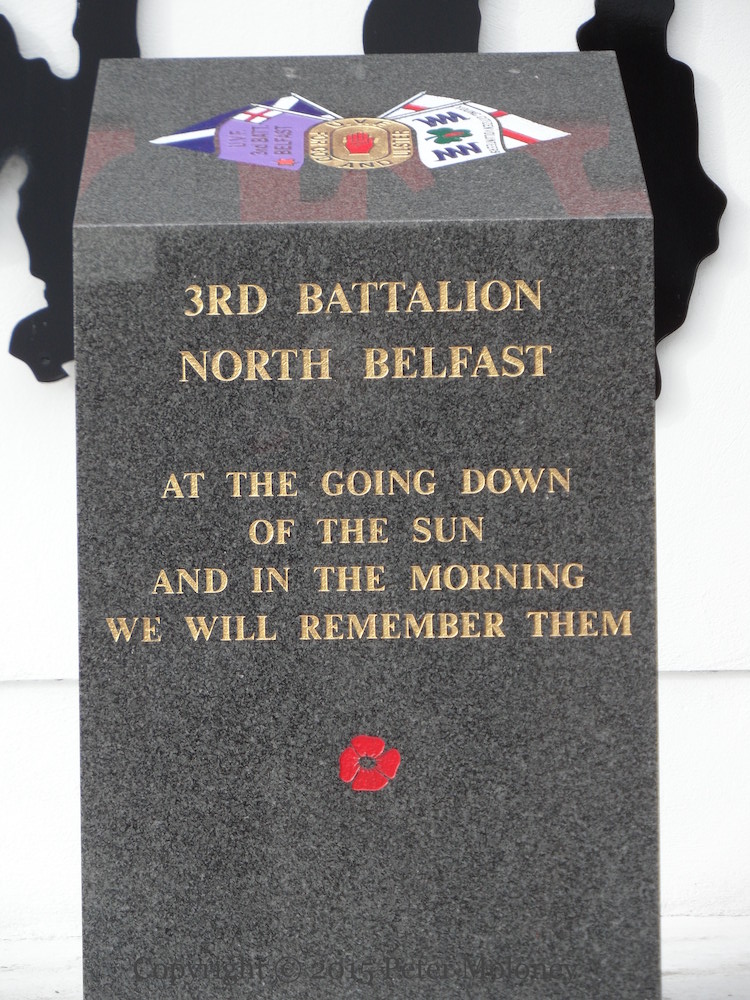
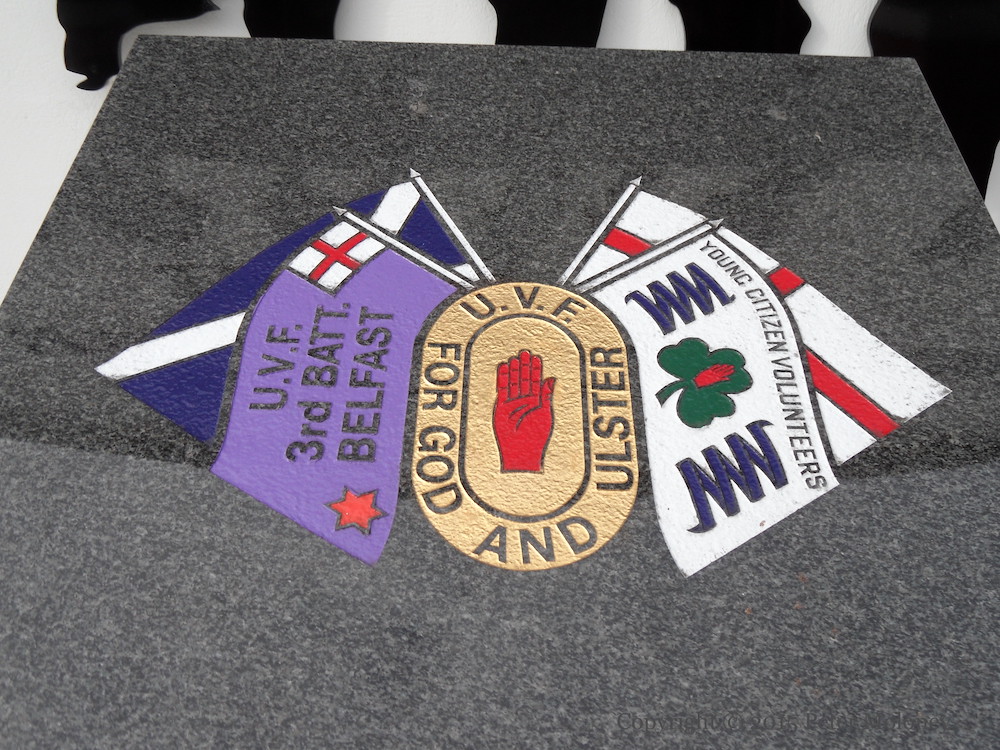
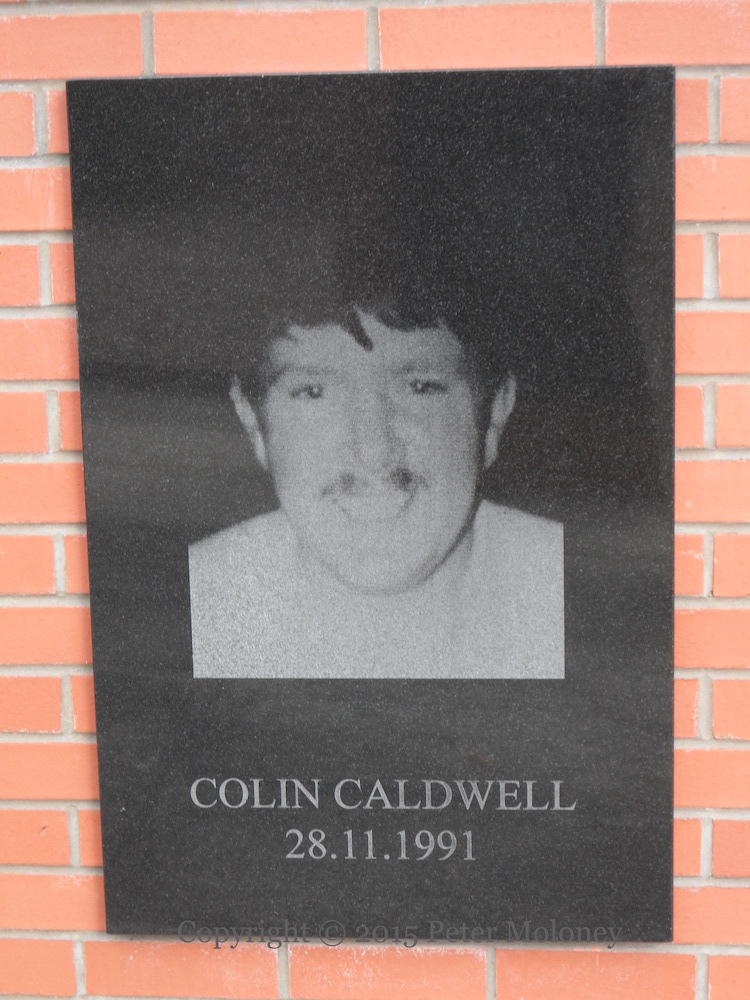
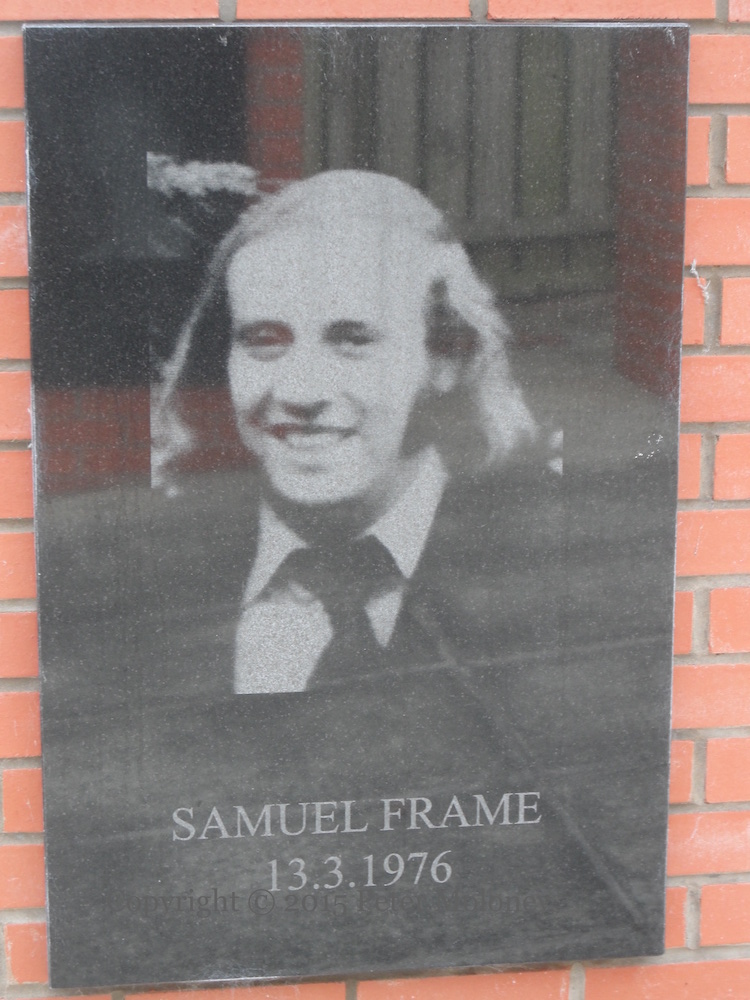
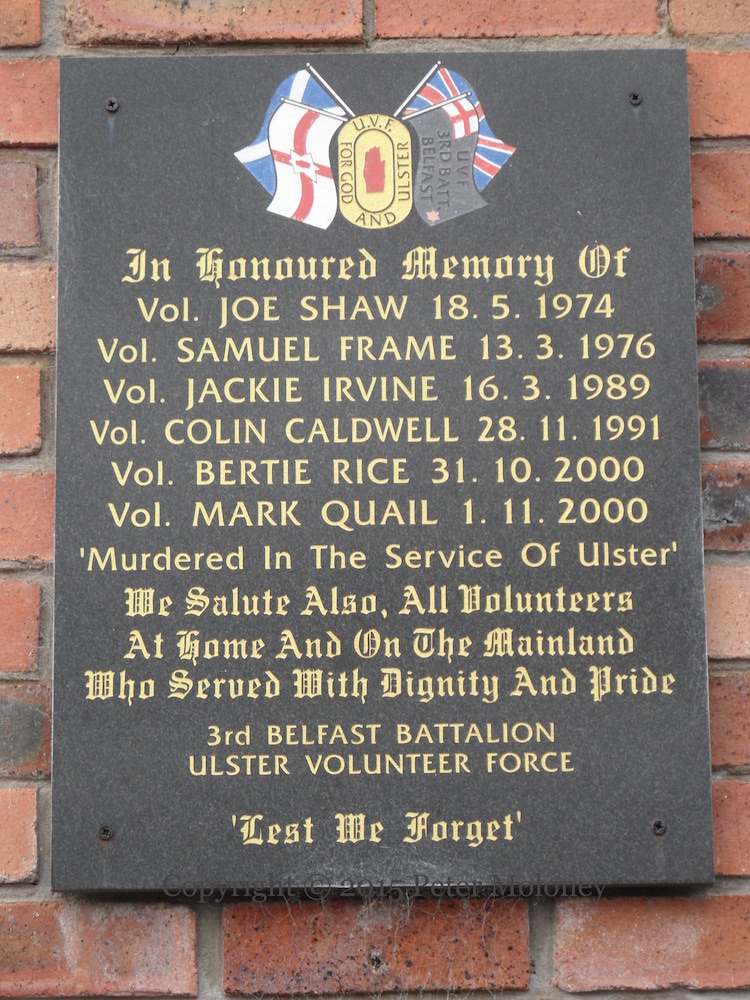
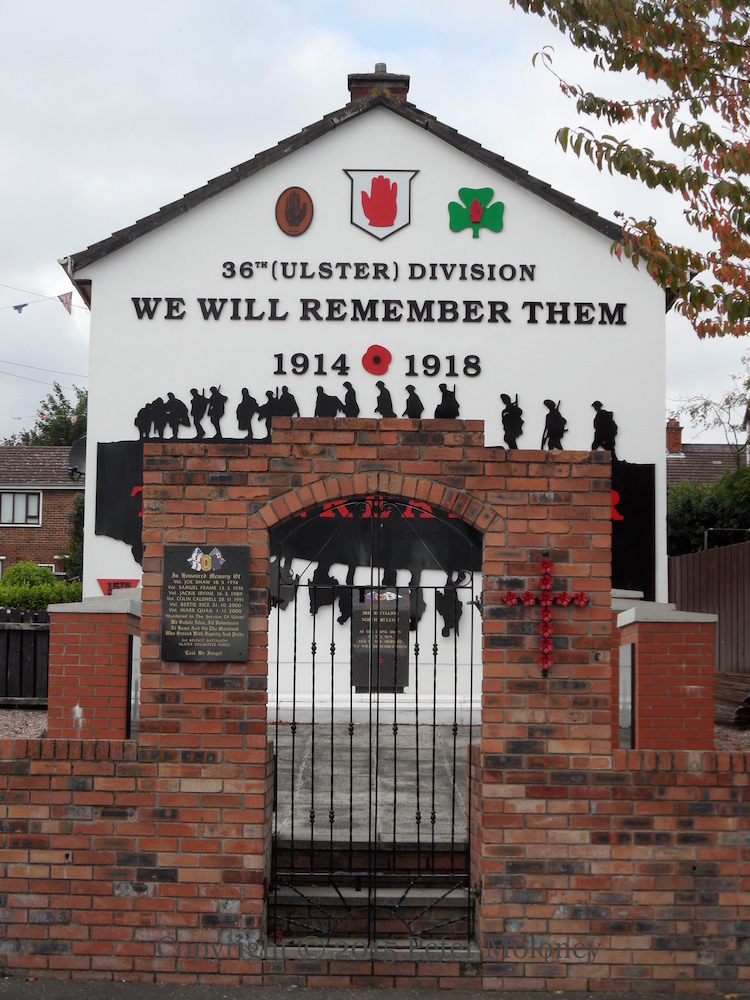
The memorial garden in Mount Vernon, which previously had and Ulster Volunteers mural and UVF stone, has undergone a major redevelopment this year (2015) with a new “cut-out” mural to the 36th (Ulster) Division and stand-alone memorial plaques to six UVF (3rd Belfast Battalion) members who were listed the plaque on the outside wall of the garden. “Murdered in the service of Ulster: Joe Shaw 18-5-1974, Samuel Frame 13-3-1976, Jackie Irvine 16-3-1989. Colin Caldwell 28-11-1991, Bertie Rice 31-10-2000, Mark Quail 1-11-2000.”
“We salute also all volunteers at home and on the mainland who served with dignity and pride.”
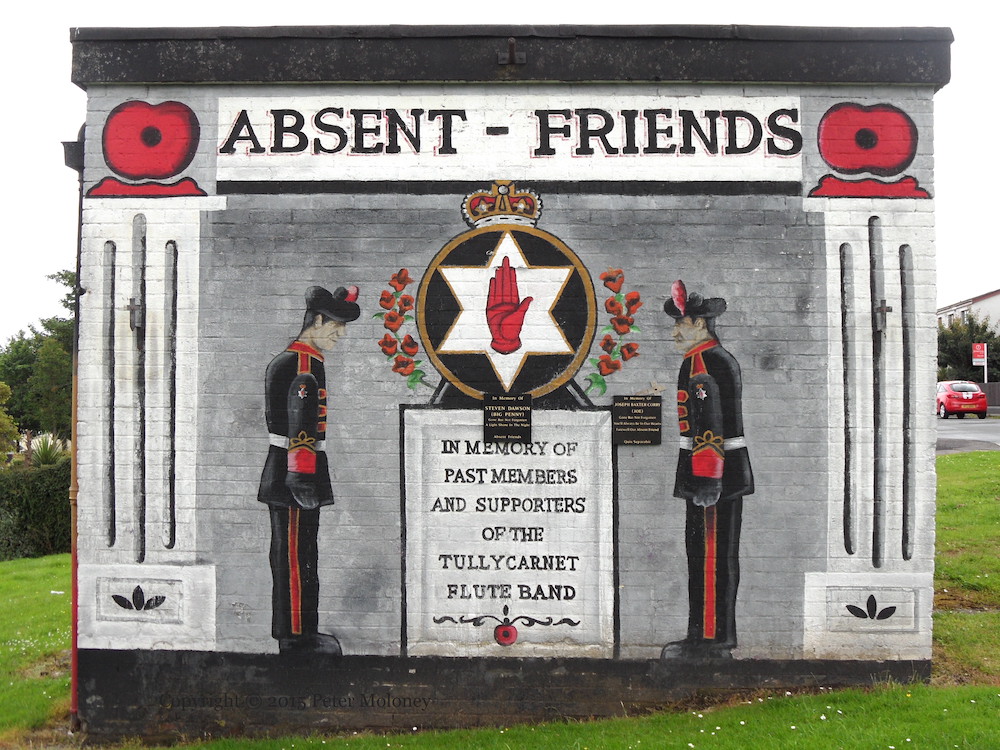
The Tullycarnet Flute Band mural on the electrical sub-station in Lochinver Drive, Tullycarnet, as been repainted/touched up (compare to 2013).
The plaques read: “In memory of Steven Dawson (Big Penny). Gone but not forgotten. A light shone in the night”, and “In memory of Joseph Baxter Corry (Joe). Gone but not forgotten. You’ll always be in our hearts. Farewell our absent friend.”
“In memory of volunteers Pat and Dan Duffin, murdered by the RIC in their home at 64 Clonard Gardens 23rd April 1921. Erected the by the Greater Clonard Ex-Prisoners Association.”
The IRA shot dead two members of the British Auxiliaries, Ernest Bolan and John Bales, in Donegall Street in Belfast city centre on April 23rd, 1921. Just before midnight, Pat and Dan Duffin were shot to death by men who entered their Clonard home.
Another brother, John, was upstairs and not harmed and when he approached the scene he found not only his dead brothers but the station dog of the Springfield Road RIC barracks (“GB Kenna“, real name Fr John Hassan).
DeValera led the funeral cortège along the Falls. Joe Devlin would include the Duffin murders in a Westminster speech in June, following the killings in a single night of Alexander McBride, Malachy Halfpenny, and William Kerr (Hansard). The RIC in west Belfast under CI Harrison, DI Nixon, and in this case DI Ferris (Aiken et al.), would continue their killings into 1922 – see The RIC Murder Gang.
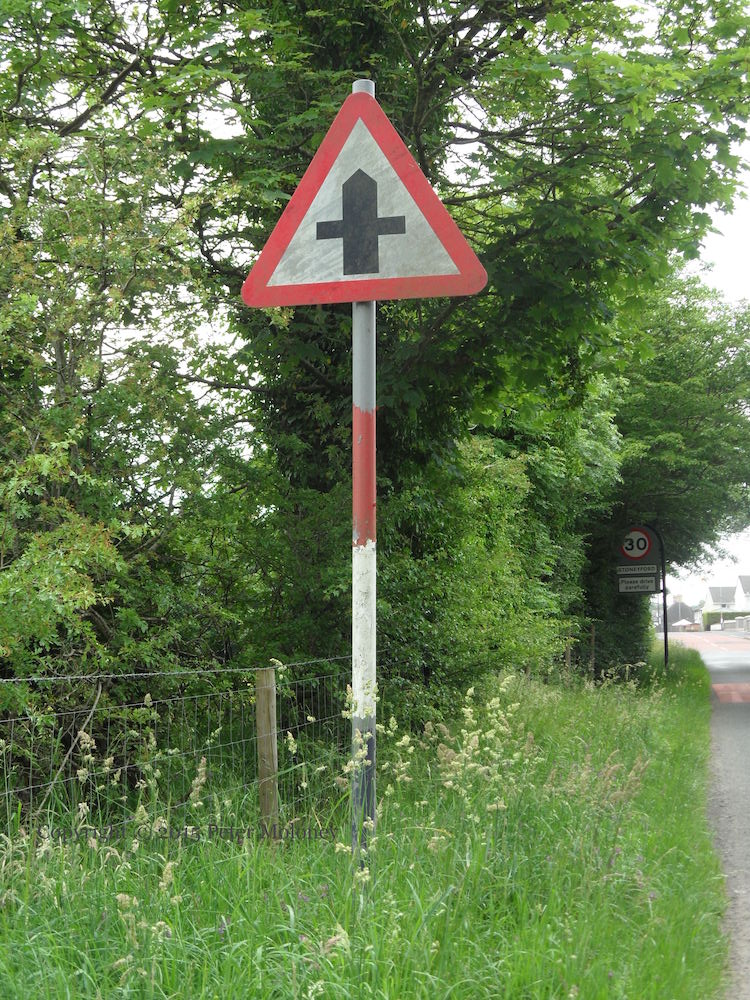
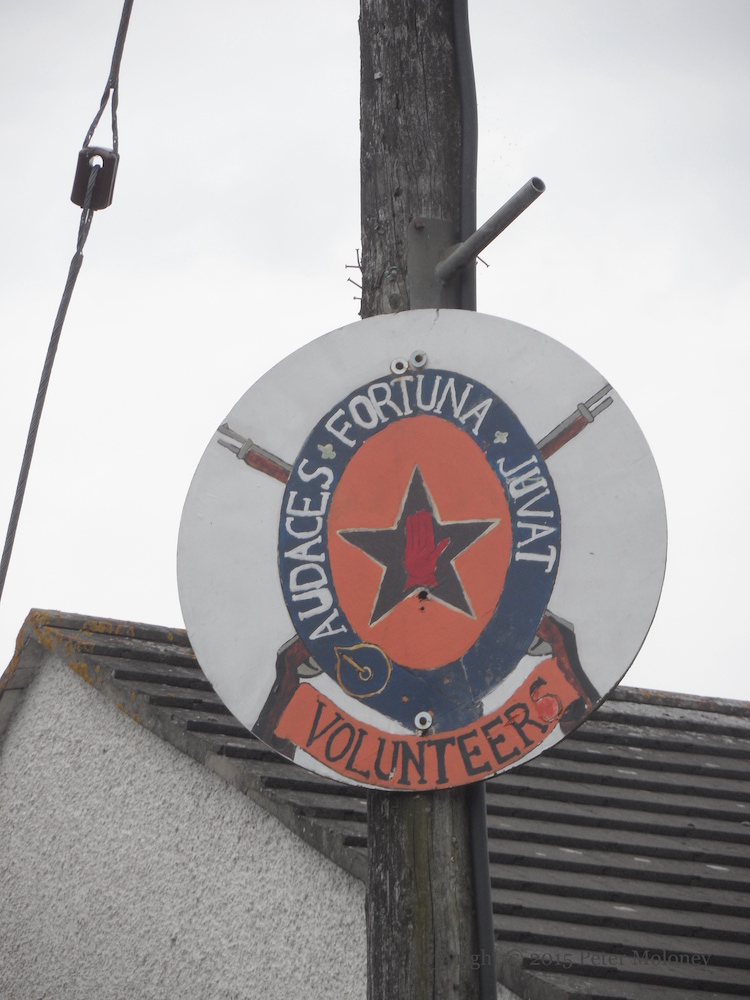
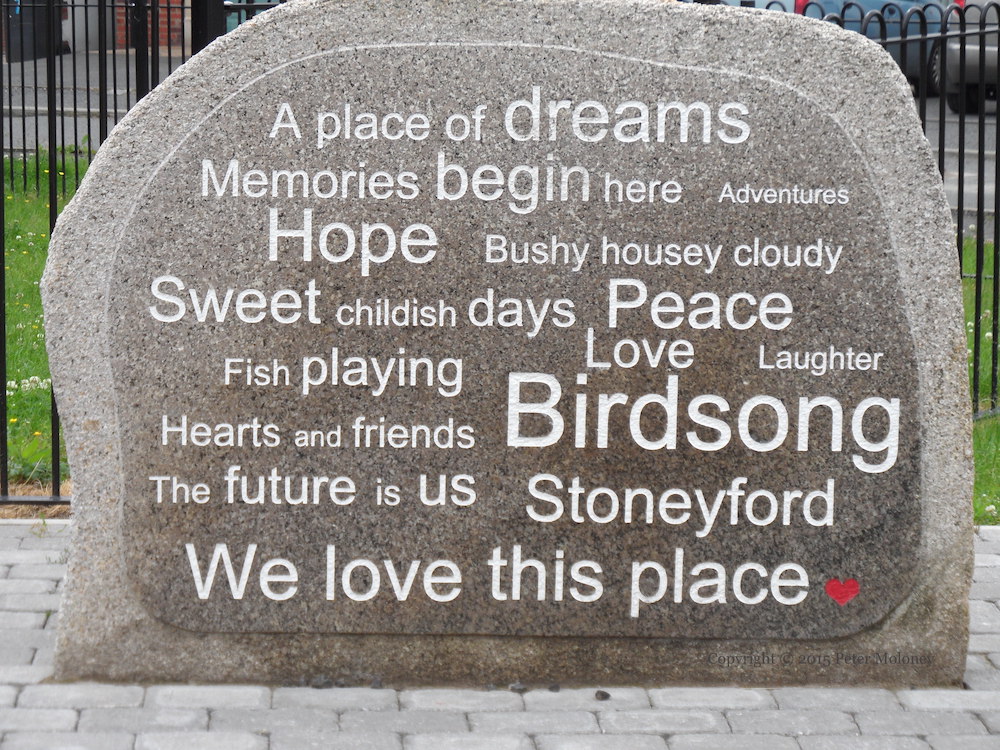
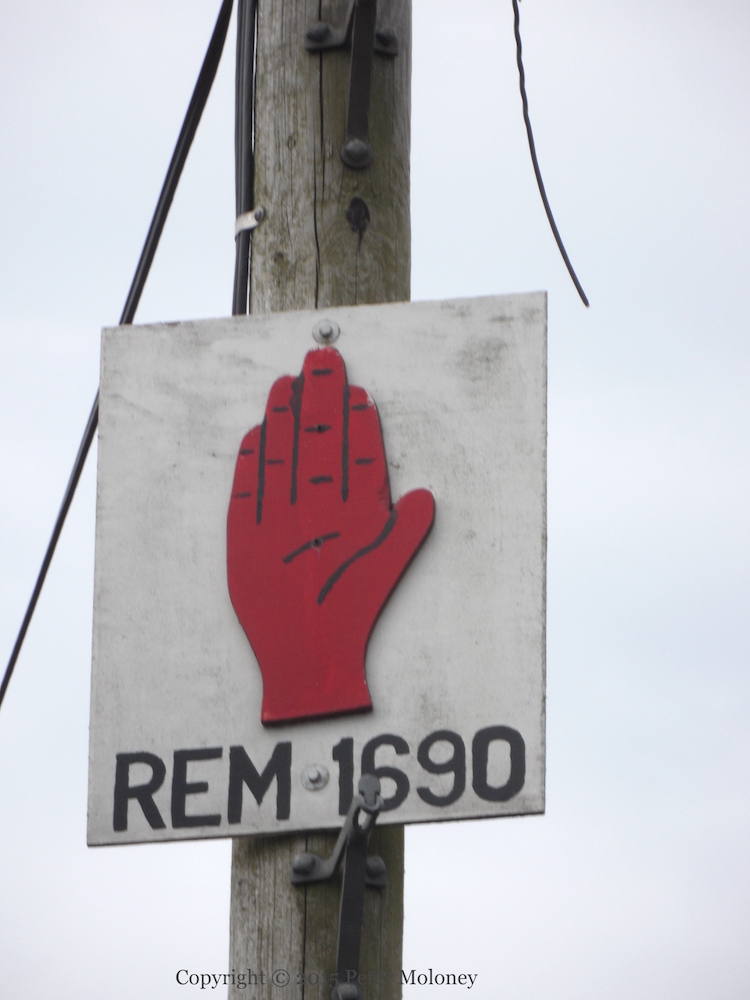
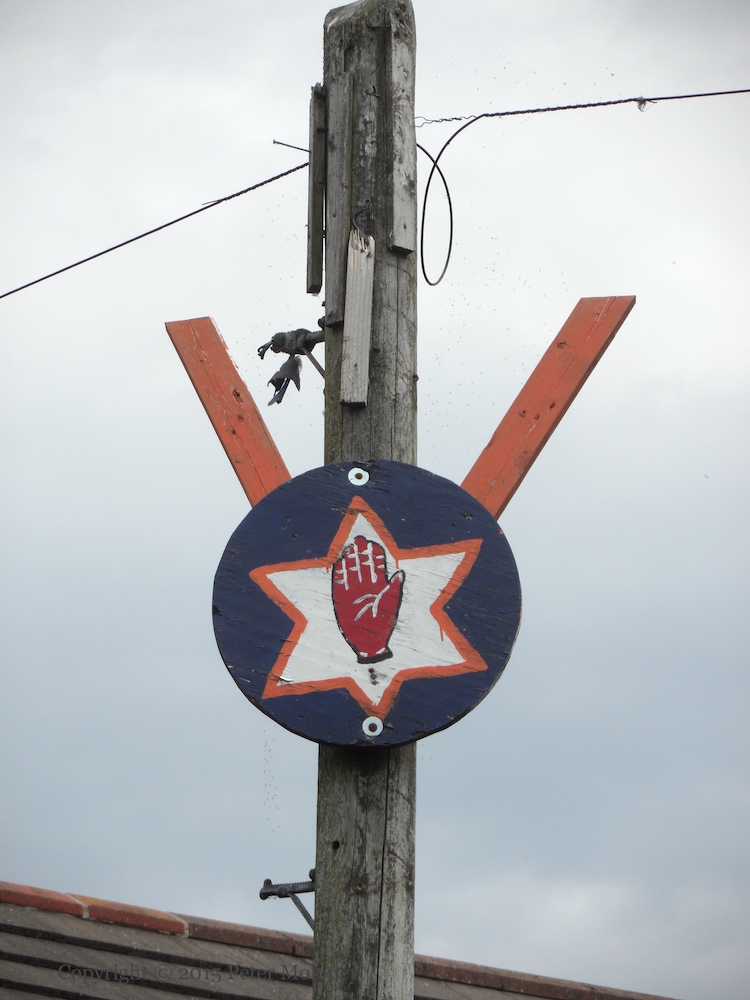
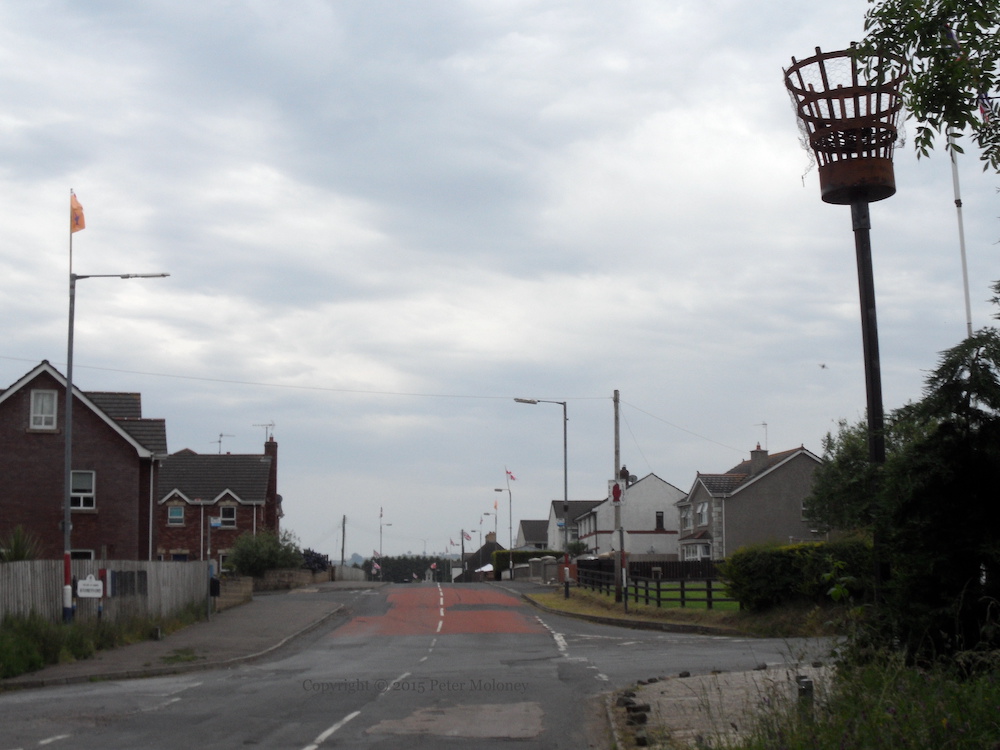
Here is a gallery of images from the village of Stoneyford, ten miles north of Lisburn. The view in the final image is from the cross-roads at north end of the village, with the brazier next to the WWI memorial visible on the right, and the nameplate on the fence on the left. The Orange Hall is in the middle of the village. The village was a centre for the small anti-Agreement organisation the “Orange Volunteers” (WP).
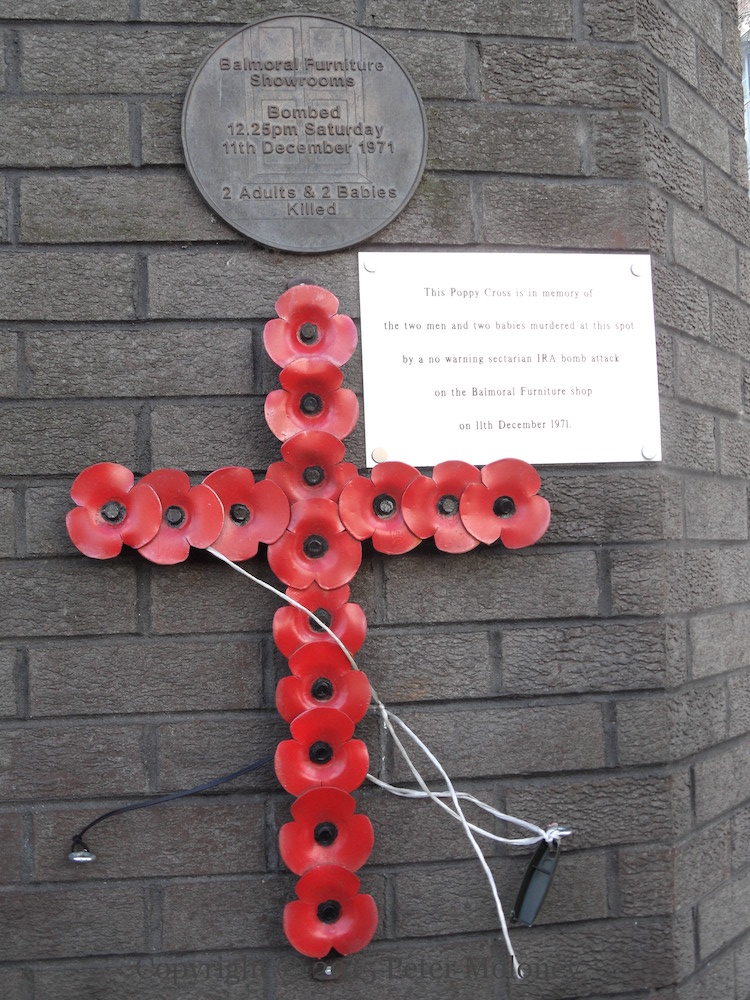
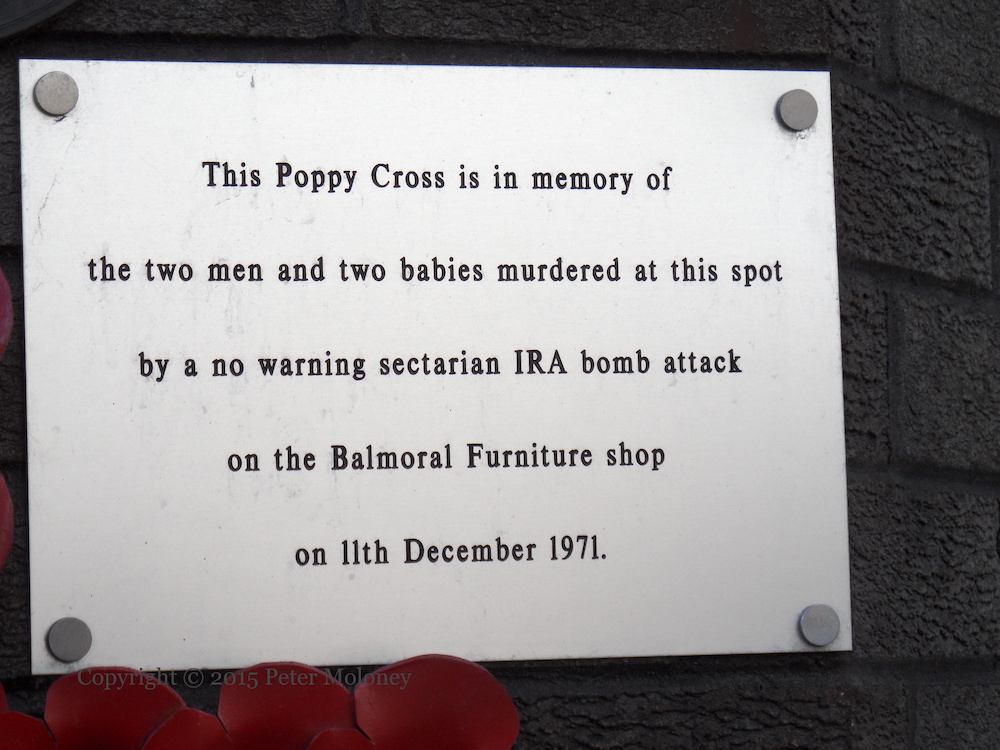
“This Poppy Cross is in memory of the two men and two babies murdered at this spot by a no-warning sectarian IRA bomb attack on the Balmoral Furniture shop on 11th December 1971”
“Fıann [sic] Robert Allsopp lived at this address. Died on active service March 3rd 1975. Fuaır sé bás ar son na hÉıreann. 1959-1975” Allsopp died at the family home (on the New Lodge Road) from the accidental discharge of a gun. The O’Neill-Allsopp flute band is named in his honour (and in honour of Jim O’Neill) and the band has a mural in Donore Court.
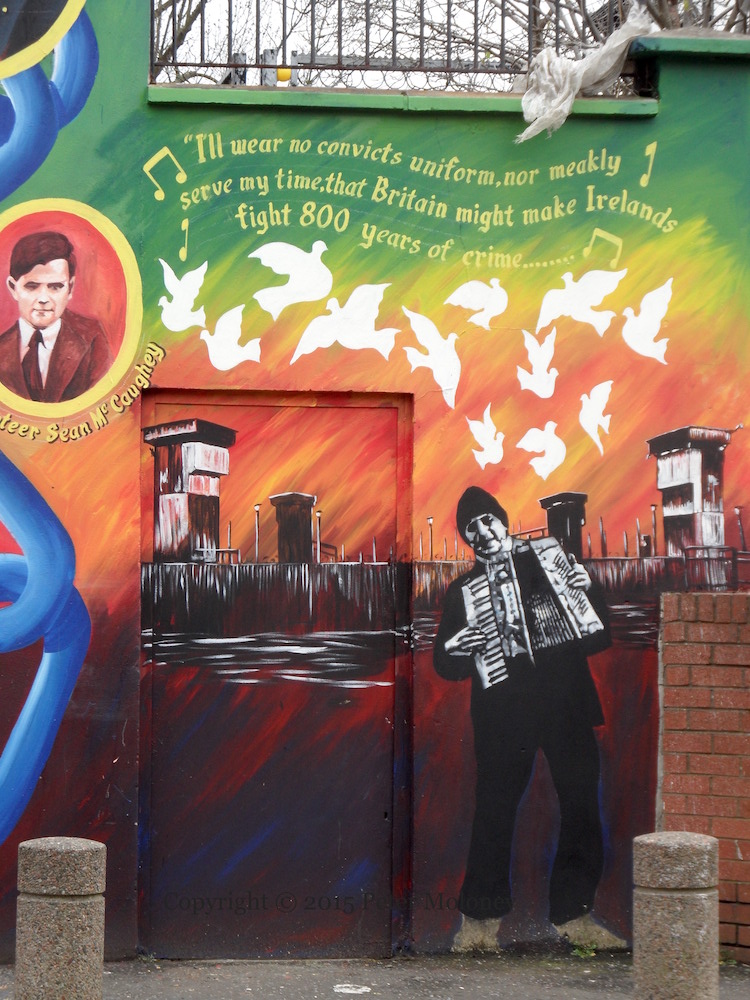
The Bobby Sands mural in Sevastopol Street has been given a facelift, including the blocking-up of a vent on Sands’s left cheek. Kieran Doherty and Joe McDonnell have been added in place of the 1798 medallions on each side. On the side-wall are Sean McCaughey, ten doves representing the 1981 hunger-strikers, and Long Kesh. Aerosol‘s accordion-player stencil has been also been retained, on the right.
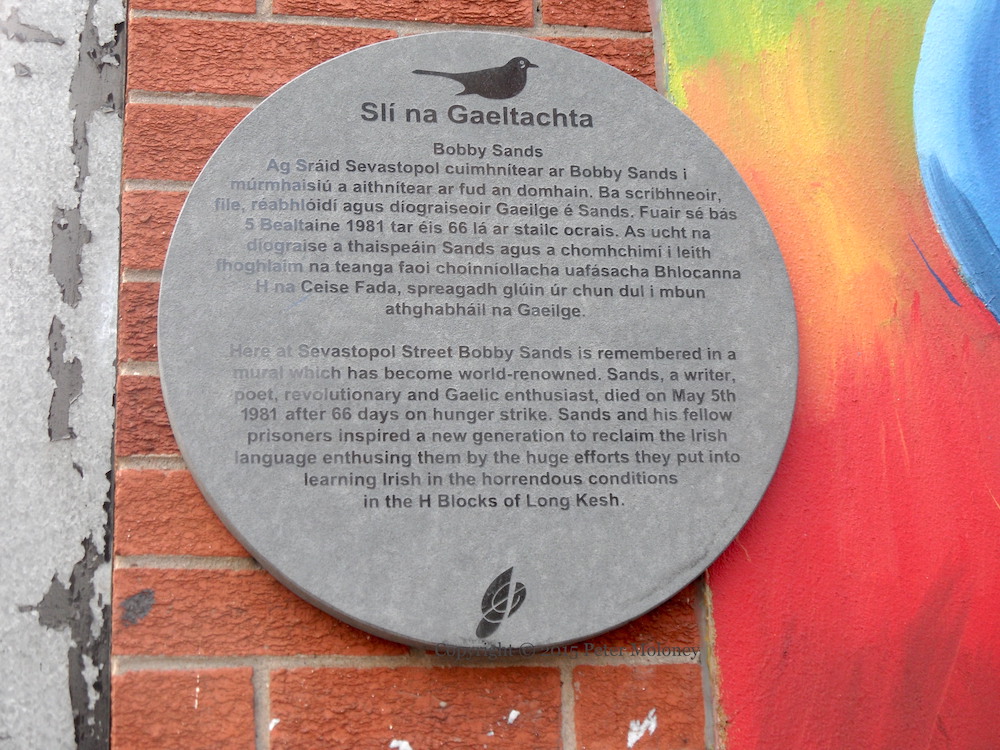
The ‘Slí Na Gaeltachta’ plaque off to the left reads:
Ag sráıd Sevastopol cuımhnıtear ar Bobby Sands ı múrmhaısıú a aithnıtear ar fud an domhaın. Ba scrıbhneoır, file, réabhlóıdí agus díograıseoır Gaeılge é Sands. Fuaır sé bas 5 Bealtaıne 1981 tar éıs 66 lá ar stailc ocraıs. As ucht na dıograıse a thaıspeáın Sands agus a chomhchımí ı leıth fhoglaım na teanga faoı choınníollacha uafásacha Bhlocanna H na Ceıse Fada, spreagadh glúın úr chun dul ı mbun athghabháıl na Gaeılge.
Here at Sevastopol Street Bobby Sands is remembered in a mural which has become world-renowned. Sands, a writer, poet, revolutionary and Gaelic enthusiast, died on May 5th 1981 after 66 days on hunger strike. Sands and his fellow prisoners inspired a new generation to reclaim the Irish language enthusing them by the huge efforts they put into learning Irish in the horrendous conditions on the H Blocks of Long Kesh.
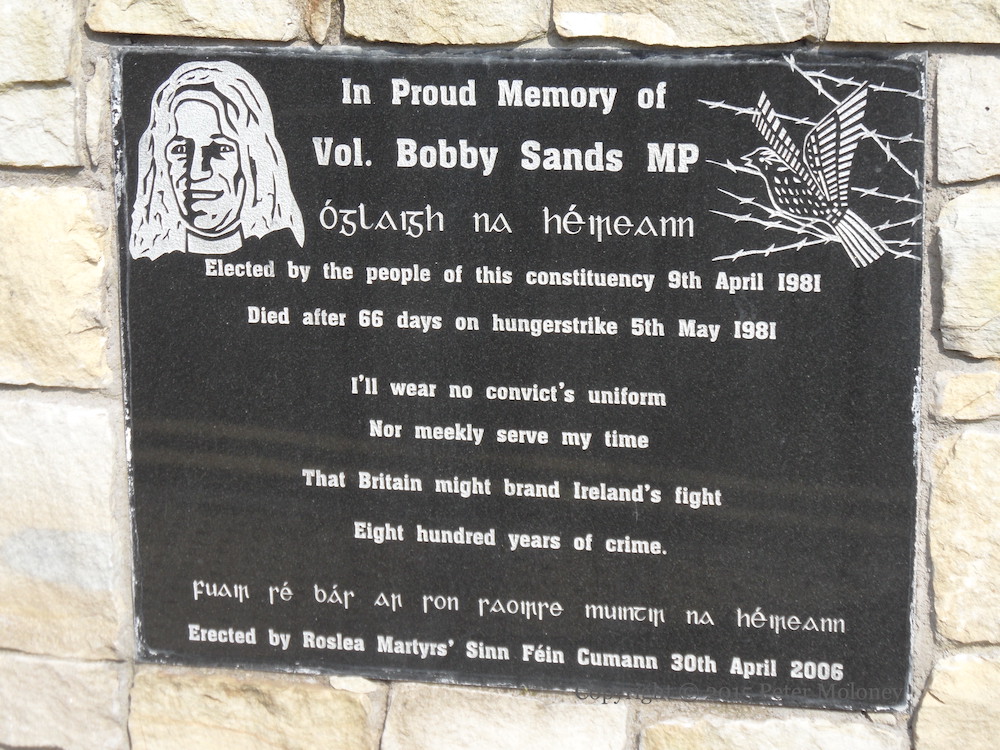
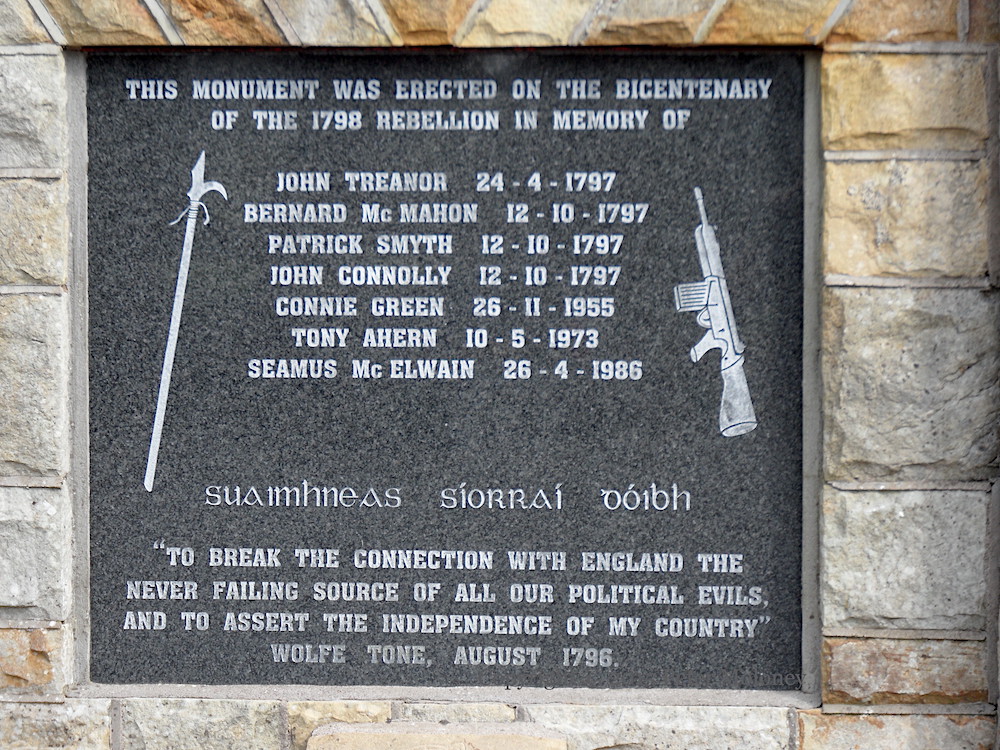
Here are a number of republican pieces from Roslea/Rosslea, Co Fermanagh:
“In proud memory of Vol. Bobby Sands MP Óglaıgh Na hÉıreann. Elected by the people of this constituency 9th April 1981. Died after 66 days on hungerstrike 5th May 1981. ‘I’ll wear no convict’s uniform/Nor meekly serve my time/That Britain might brand Ireland’s fight/Eight hundred years of crime’. Fuaır sé bás ar son saoırse muıntır na hÉıreann.”
Sands’s poem The Rhythm Of Time is at the centre of portraits of the twelve dead hunger strikers in the Troubles era; the board was mounted in 2011 for the thirtieth anniversary of the 1981 strike. The text at the bottom includes this line: “The use of the hunger-strike by Irish republicans began when James Connolly, while imprisoned during the 1913 ‘lock-out’, went on hunger strike.”
“This monument was erected on the bicentenary of the 1798 rebellion in memory of John Treanor 24-4-1797, Bernard McMahon 12-10-1797, Patrick Smyth 12-19-1797, John Connolly 12-10-1797, Connie Green 26-11-1955, Tony Ahern 10-5-1973, Seamus McElwain 26-4-1986. Suaımhneas síorraí dóıbh. [eternal rest [be] upon them] ‘To break the connection with England the never failing source of all our political evils, and to assert the independence of my country’ – Wolfe Tone, August 1796 [‘An Argument on Behalf of the Catholics of Ireland by a Northern Whig’, September, 1791]”
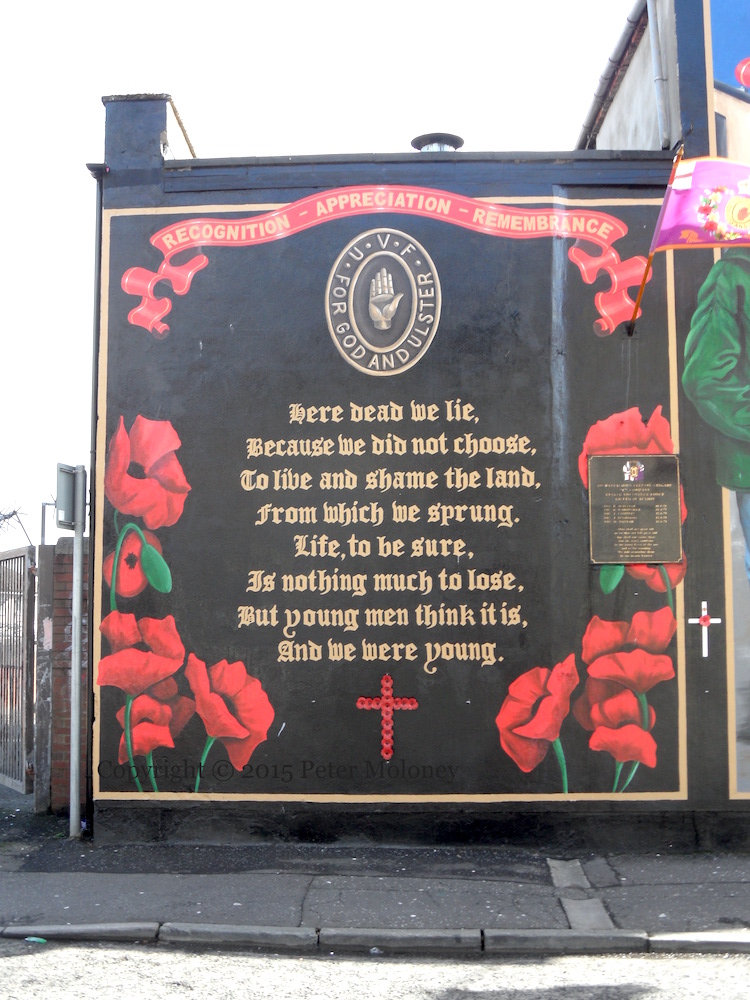
This pair of murals was launched in September last year (2014).
On the left A. E. Housman’s 1919 poem “Here dead we lie” is featured, together with the poppies that grew on the Western Front in WWI, in a UVF commemorative mural. The 36th (Ulster) Division is not mentioned specifically. “Here dead we lie, because we did not choose,/to live and shame the land, from which we sprung.//Life, to be sure, is nothing much to lose,/but young men think it is, and we were young.”
The plaque on the right-hand side (which pre-dates the murals) lists the names of five UVF members killed in the 70s who are depicted in the second mural.
They are (l-r) Thomas Chapman, James McGregor, Robert McIntyre, William Hannah, and Robert Wadsworth, who were killed between 1973 and 1978. The mural is unusual in that it shows bare-faced full figures; loyalist murals sometimes include head-shots (at the top of the mural, in the apex of a gable wall) but only masked men appear as full figures. There is a similarity in composition and style (and perhaps even palette) to existing republican murals such as this one of five B. Coy IRA volunteers in Ballymurphy.





















 Peter Moloney Collection