South East Antrim UDA

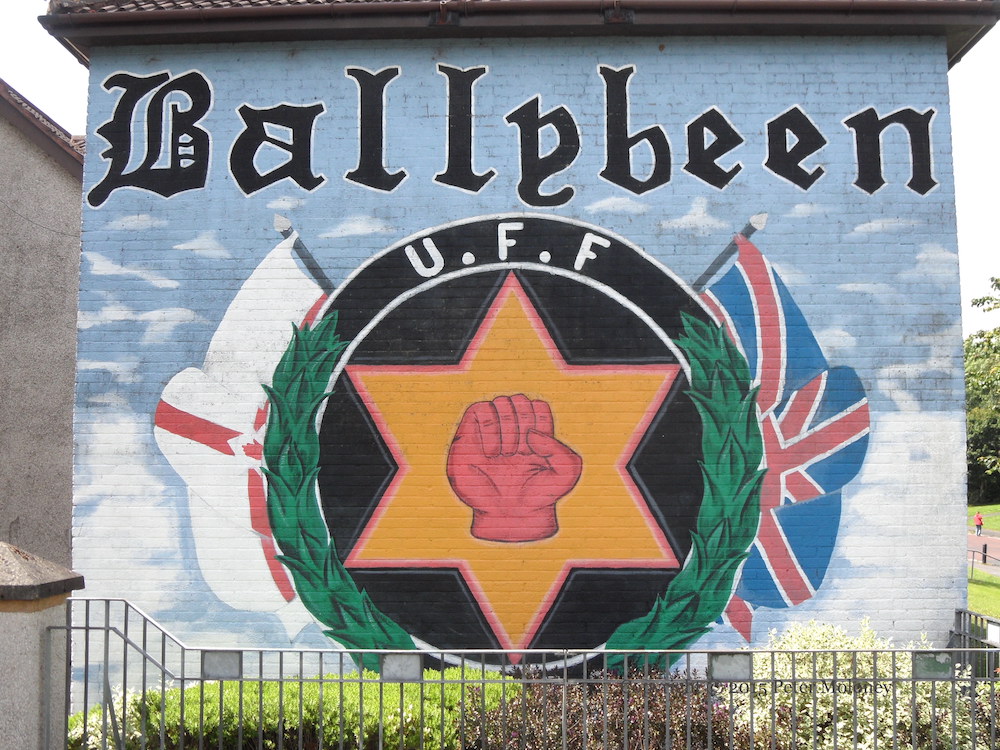
“South East Antrim Ulster Defence Association” with shamrock, thistle, and rose, but not the daffodil – though the Welsh “Red Dragon” is included alongside the Scottish Saltire, the flag of Northern Ireland, and Queen Elizabeth II’s royal standard. 

The mural originally read “Ulster Defence Union” rather than “Ulster Defense Association” – see X01208.

Oakfield Drive, Carrickfergus

Click image to enlarge
Copyright © 2015 Peter Moloney
M11831

Doıre Naofa

The Christian missionary Colm Cılle (in Latin, Columba), born in Donegal, founded a monastic settlement on the banks of the Foyle (then still part of Donegal) around 540 AD. The “Doıre” part of the name means “oak grove” and perhaps refers (as the information panel suggests) to “a sacred grove of trees, which may have pre-dated the monastery.” The mural above shows a reconstruction of the Derry monastery c. 700 AD. The name “Londonderry” dates to 1662.

Columba moved on to Scotland circa 563 and founded an abbey on the island of Iona. Among his reputed miracles is the banishment of a great water beast from the River Ness in 565.

“This is a reconstruction of the early Christian monastery at Derry around 700 AD which was founded by St Colum Cille around 546 AD. Colum Cille left his community in Derry in 563 AD with twelve companions to found the great monastery of Iona. He only subsequently returned to Ireland once and died in 593 AD. Although St Colum Cille founded a number of Irish monasteries, it would appear that Derry was his principal residence until he left Ireland. The name itself, Doıre, (sometimes Doıre Colum Cılle) means ‘the oakgrove of Colum Cille’ a sacred grove of trees, which may have pre-dated the monastery.”

“Is athchuthú é seo ar an mhainistir luath-Chríostaí i nDoıre thart ar 700 AD a bhunaigh Naomh Cholm Cıille thart ar 546 AD. D’fhág Colm Cille a phobal ı nDoıre thart ar 563 AD le dáréag eıle le mómhaınıstır oıleán Í a chur ar bun. Níor fhill sé go hÉıreann ach uaır amháın agus fuaır sé bás in AD 593. Cé gur bhunaigh Naomh Cholm Cille roınnt maınıstreacha eıle ı nÉırınn, shocrıgh sé ı nDoıre de réır cosúlachta go dtí gut ımıgh sé. Déanann an t-aınm ‘Doıre Cholmcılle’ tagaırt do dhoıre naofa, a bhí ann roımh an mhaınıstir.”

U Bennett Street, Derry, on the side wall of Tıgh Seoırse.

Click image to enlarge
Copyright © 2015 Peter Moloney
M12523 M12524 M12525
M12522

Poet, Gaeılgeoır, Revolutionary, IRA Volunteer

April 1st:

The Bobby Sands mural in Sevastopol Street has been given a facelift, including the blocking-up of a vent on Sands’s left cheek. Kieran Doherty and Joe McDonnell have been added in place of the 1798 medallions on each side. On the side-wall are Sean McCaughey, ten doves representing the 1981 hunger-strikers, and Long Kesh. Aerosol‘s accordion-player stencil has been also been retained, on the right.

For a full history of the wall, see the Bobby Sands (Sevastopol Street) Visual History page.

The ‘Slí Na Gaeltachta’ plaque off to the left reads:

Ag sráıd Sevastopol cuımhnıtear ar Bobby Sands ı múrmhaısıú a aithnıtear ar fud an domhaın. Ba scrıbhneoır, file, réabhlóıdí agus díograıseoır Gaeılge é Sands. Fuaır sé bas 5 Bealtaıne 1981 tar éıs 66 lá ar stailc ocraıs. As ucht na dıograıse a thaıspeáın Sands agus a chomhchımí ı leıth fhoglaım na teanga faoı choınníollacha uafásacha Bhlocanna H na Ceıse Fada, spreagadh glúın úr chun dul ı mbun athghabháıl na Gaeılge.

Here at Sevastopol Street Bobby Sands is remembered in a mural which has become world-renowned. Sands, a writer, poet, revolutionary and Gaelic enthusiast, died on May 5th 1981 after 66 days on hunger strike. Sands and his fellow prisoners inspired a new generation to reclaim the Irish language enthusing them by the huge efforts they put into learning Irish in the horrendous conditions on the H Blocks of Long Kesh.

Click image to enlarge
Copyright © 2015 Peter Moloney
M12515 M12502 M12503 [M12504] [M12505] [M12506] [M12507] [M12508] M12509
Slí: M11752 [M12516] [M12517]
in prog: M11749 [M11750] [M11751]

Those Who Hungered For Justice

This is a 2015 repainting of a 2001 mural in Glenwood. The ten deceased hunger-strikers of 1981 are listed in the bottom right: Bobby Sands, Francis Hughes, Raymond McCreesh, Patsy O’Hara, Joe McDonnell, Martin Hurson, Kevin Lynch, Kieran Doherty, Tom McElwee, Mickey Devine. In the main panel, a lark in barbed wire flies over the H-blocks of Long Kesh and a funeral volley being fired over a Tricolour-draped coffin.

Glenwood Gardens, Dunmurry

Click image to enlarge
Copyright © 2015 Peter Moloney
M12493 [M12494] [M12495] [M12496] [M12497]

The Belfast Blitz

In the “Belfast Blitz” of April and May 1941, during WWII, 900 people died and half the homes in Belfast were destroyed or damaged (WP). In the apex of this mural, a Nazi bomber sets buildings alight; in the main panel, people, including a milkman, walk among the bombed-out buildings, while others (bottom right) test out a piano that has been moved. 

On the side-wall to the right is a painted frame surrounding a manufactured plaque with the names of locals who died in the blitz.

By JMK (Jonny McKerr – Fb) in Hogarth Street, Tiger’s Bay, north Belfast. Both the lamp-post and the electrical box have been painted into the mural.

McKerr also did a piece in the area of images from WWI – see The Home Front.

Click image to enlarge
Copyright © 2015 Peter Moloney
M11778 M11777 M11779 M11776

The Home Front

The central image of soldiers at the battle of the Somme is surrounded by images of various occupations: shipyard workers and miners (perhaps), along with images of women welding, carrying coke, and nursing. It’s not clear what the “fair wartime wage” refers to: there was a general strike at the shipyards in 1919 (The Great Unrest | Workers’ Liberty). 

The nurse is apparently the Grand Duchess Olga Nikolaevna of Russia (WP). The image of a person carrying a sack of coke is from the Imperial War Museum’s collection.

The lower wall is intended to be full, but painting has ceased indefinitely.

Artist Jonny McKerr (Fb) also did a similarly-styled piece on The Belfast Blitz.

Edlingham Street, Tiger’s Bay, north Belfast

Click image to enlarge
Copyright © 2015 Peter Moloney
M11773 M11774 M11775 M11772

Yeomna Qadm

“Viva Palestine”. This pro-Palestine mural features sky-jacker Leila Khaled (also seen in in Hugo Street) and the emblem of the Popular Front For The Liberation Of Palestine (WP). The Arabic on the right is an equivalent of “Tıocfaıdh ár lá” on the left.

See also: The same elements used in another mural Oppression Breeds ResistanceThe Popular Front in Northumberland Street | “Viva Palestine” in Ardoyne and on Black Mountain/Slıabh Dubh

AMCOMRI Street, off Beechmount Avenue/Ascaıll Ard na bhFeá, west Belfast.

Click image to enlarge
Copyright © 2015 Peter Moloney
M11766 [M11767] [M11768] [M11769]

Cogús

“End internment by remand – End forced strip searches – End controlled movement”.

Fists are raised in defiance of the police state (both PSNI/NIPS and Gardaí/IPS). Cogús (meaning “conscience”) is the division of the Republican Network for Unity (Fb) concerned with political prisoners.

Beechmount Avenue, west Belfast

Click image to enlarge
Copyright © 2015 Peter Moloney
M11763 [M11764] [M11765]

Recognition, Appreciation, Remembrance

This pair of murals was launched in September last year (2014).

On the left A. E. Housman’s 1919 poem “Here dead we lie” is featured, together with the poppies that grew on the Western Front in WWI, in a UVF commemorative mural. The 36th (Ulster) Division is not mentioned specifically. “Here dead we lie, because we did not choose,/to live and shame the land, from which we sprung.//Life, to be sure, is nothing much to lose,/but young men think it is, and we were young.”

The plaque on the right-hand side (which pre-dates the murals) lists the names of five UVF members killed in the 70s who are depicted in the second mural.

They are (l-r) Thomas Chapman, James McGregor, Robert McIntyre, William Hannah, and Robert Wadsworth, who were killed between 1973 and 1978. The mural is unusual in that it shows bare-faced full figures; loyalist murals sometimes include head-shots (at the top of the mural, in the apex of a gable wall) but only masked men appear as full figures. There is a similarity in composition and style (and perhaps even palette) to existing republican murals such as this one of five B. Coy IRA volunteers in Ballymurphy.

Carnan (or “C. Coy”) Street, west Belfast.

Click image to enlarge
Copyright © 2015 Peter Moloney
[M11729a] M11730 [M11731] [M11732] [M11733] [M11734]
M11735 [M11736] [M11737] [M11738] [M11739] [M11740] [M11741]
M11729 [M11946]

We Shall Not Sleep

The Somme memorial Garden Of Reflection (between the Shankill graveyard and the Mountainview Tavern) has two new pieces. The first places two headstones (both reading “A soldier of the great war”) in a flower-bed in front of the mural, which shows a soldier, presumably from the Ulster division, on the fields of Flanders: “Greater love hath no man than this, that a man lay down his life for his friends. 1914-2014”

In the second, three wraiths of dead WWI soldiers – one with its head wrapped in a bandage – rise from the grave to issue a final edict: “Take up our quarrel with the foe; to you from failing hands we throw the torch; be yours to hold it high. If ye break faith with us who die, we shall not sleep though poppies grow in Flanders’ fields.”

Click image to enlarge
Copyright © 2015 Peter Moloney
M11723 M11724