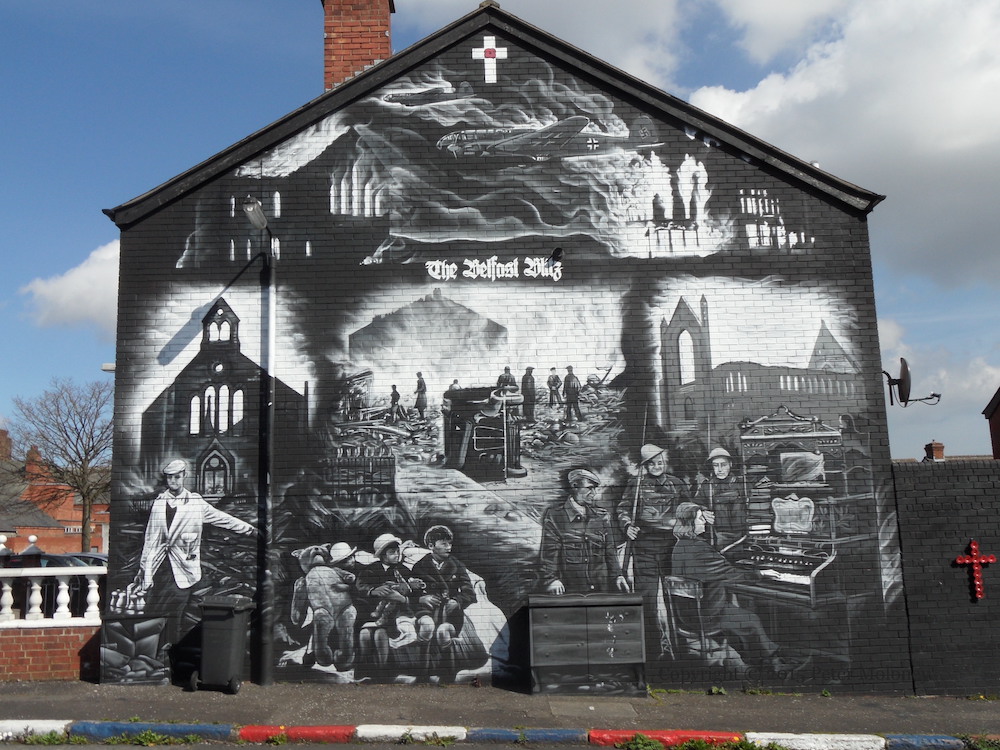
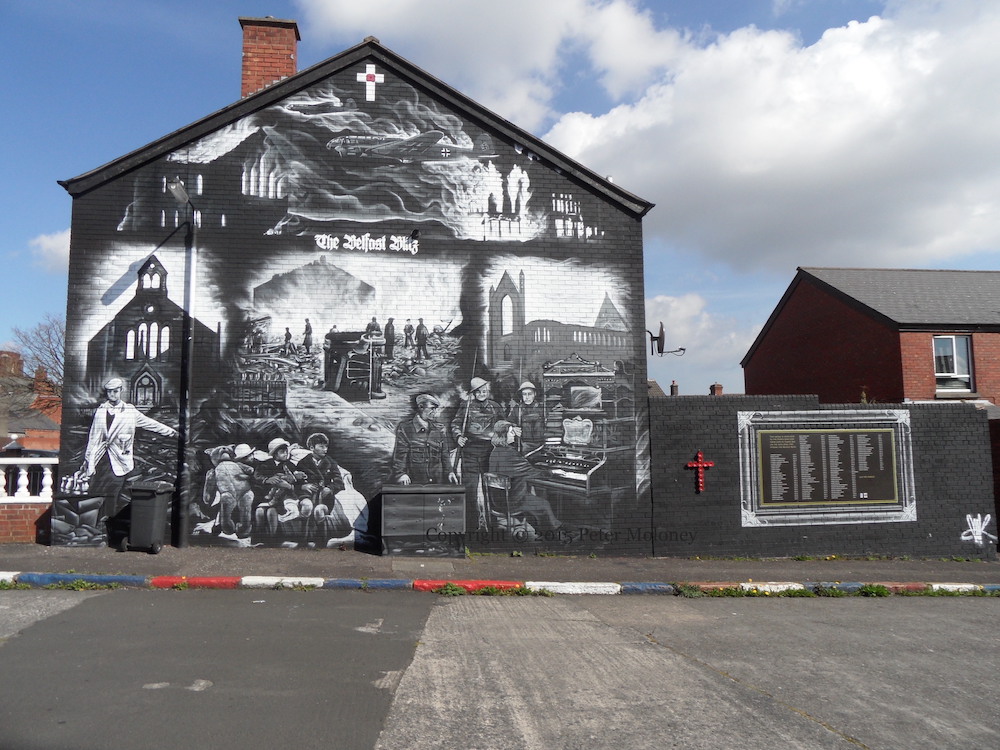
In the “Belfast Blitz” of April and May 1941, during WWII, 900 people died and half the homes in Belfast were destroyed or damaged (WP). In the apex of this mural, a Nazi bomber sets buildings alight; in the main panel, people, including a milkman, walk among the bombed-out buildings, while others (bottom right) test out a piano that has been moved.
On the side-wall to the right is a painted frame surrounding a manufactured plaque with the names of locals who died in the blitz.
By JMK (Jonny McKerr – Fb) in Hogarth Street, Tiger’s Bay, north Belfast. Both the lamp-post and the electrical box have been painted into the mural.
McKerr also did a piece in the area of images from WWI – see The Home Front.
The central image of soldiers at the battle of the Somme is surrounded by images of various occupations: shipyard workers and miners (perhaps), along with images of women welding, carrying coke, and nursing. It’s not clear what the “fair wartime wage” refers to: there was a general strike at the shipyards in 1919 (The Great Unrest | Workers’ Liberty).
“Viva Palestine”. This pro-Palestine mural features sky-jacker Leila Khaled (also seen in in Hugo Street) and the emblem of the Popular Front For The Liberation Of Palestine (WP). The Arabic on the right is an equivalent of “Tıocfaıdh ár lá” on the left.
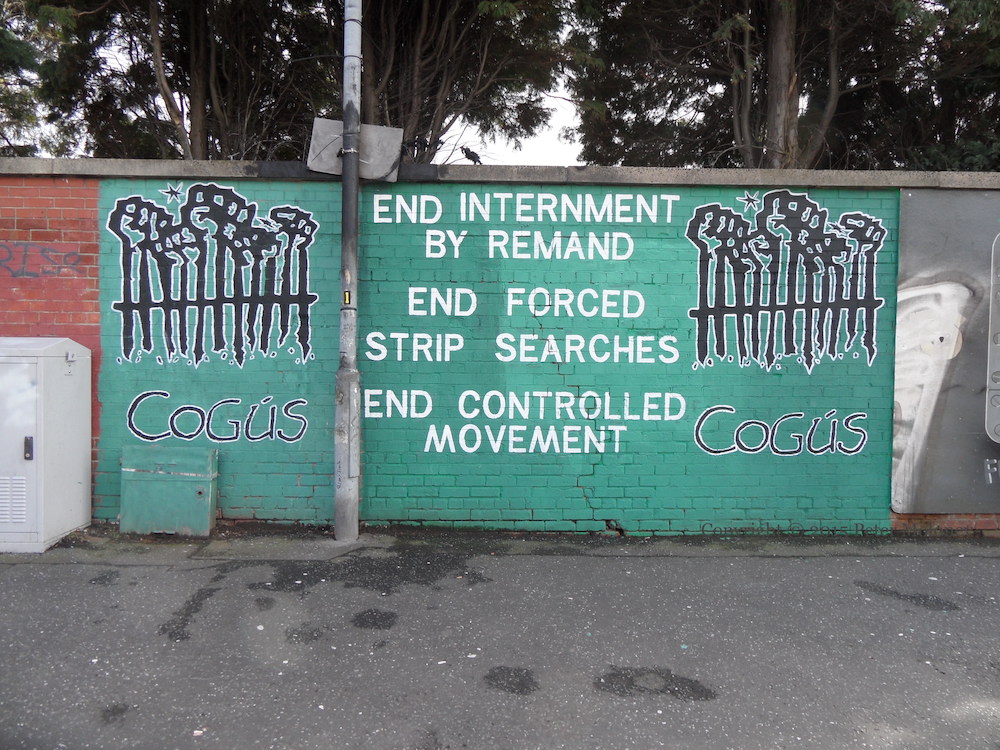
“End internment by remand – End forced strip searches – End controlled movement”.
Fists are raised in defiance of the police state (both PSNI/NIPS and Gardaí/IPS). Cogús (meaning “conscience”) is the division of the Republican Network for Unity (Fb) concerned with political prisoners.
This pair of murals was launched in September last year (2014).
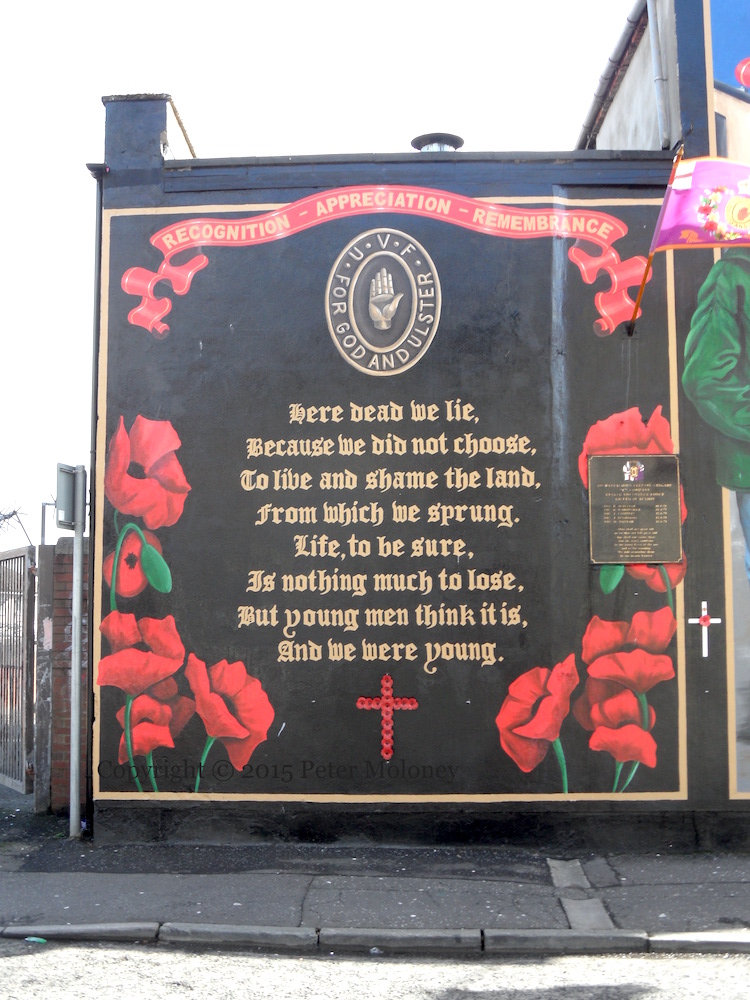
On the left A. E. Housman’s 1919 poem “Here dead we lie” is featured, together with the poppies that grew on the Western Front in WWI, in a UVF commemorative mural. The 36th (Ulster) Division is not mentioned specifically. “Here dead we lie, because we did not choose,/to live and shame the land, from which we sprung.//Life, to be sure, is nothing much to lose,/but young men think it is, and we were young.”
The plaque on the right-hand side (which pre-dates the murals) lists the names of five UVF members killed in the 70s who are depicted in the second mural.
They are (l-r) Thomas Chapman, James McGregor, Robert McIntyre, William Hannah, and Robert Wadsworth, who were killed between 1973 and 1978. The mural is unusual in that it shows bare-faced full figures; loyalist murals sometimes include head-shots (at the top of the mural, in the apex of a gable wall) but only masked men appear as full figures. There is a similarity in composition and style (and perhaps even palette) to existing republican murals such as this one of five B. Coy IRA volunteers in Ballymurphy.
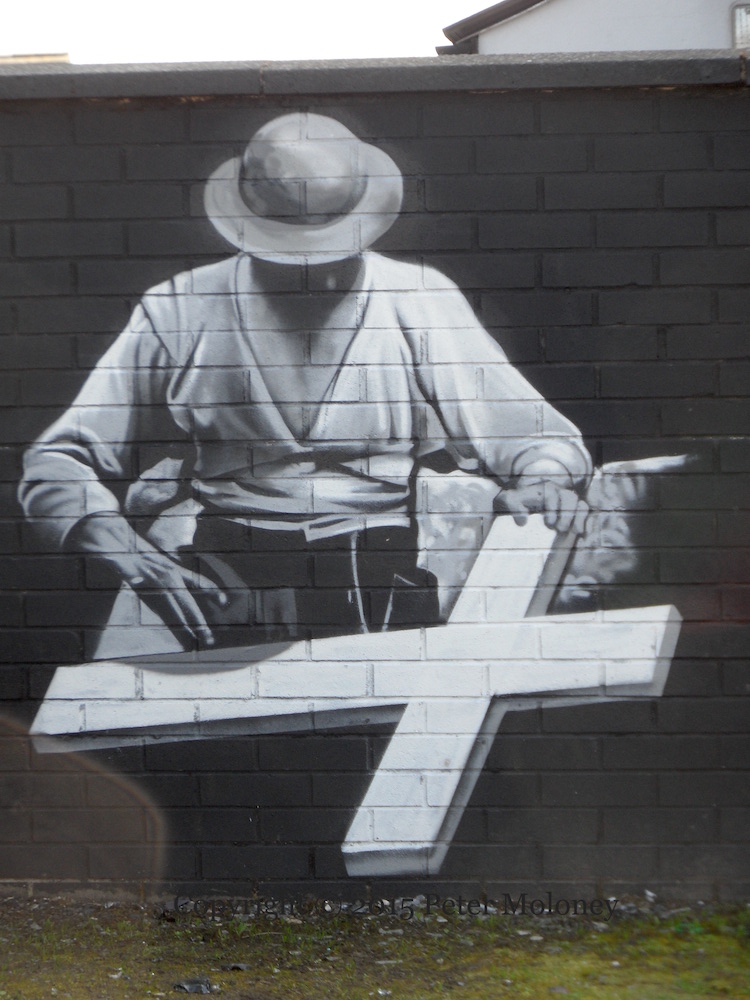
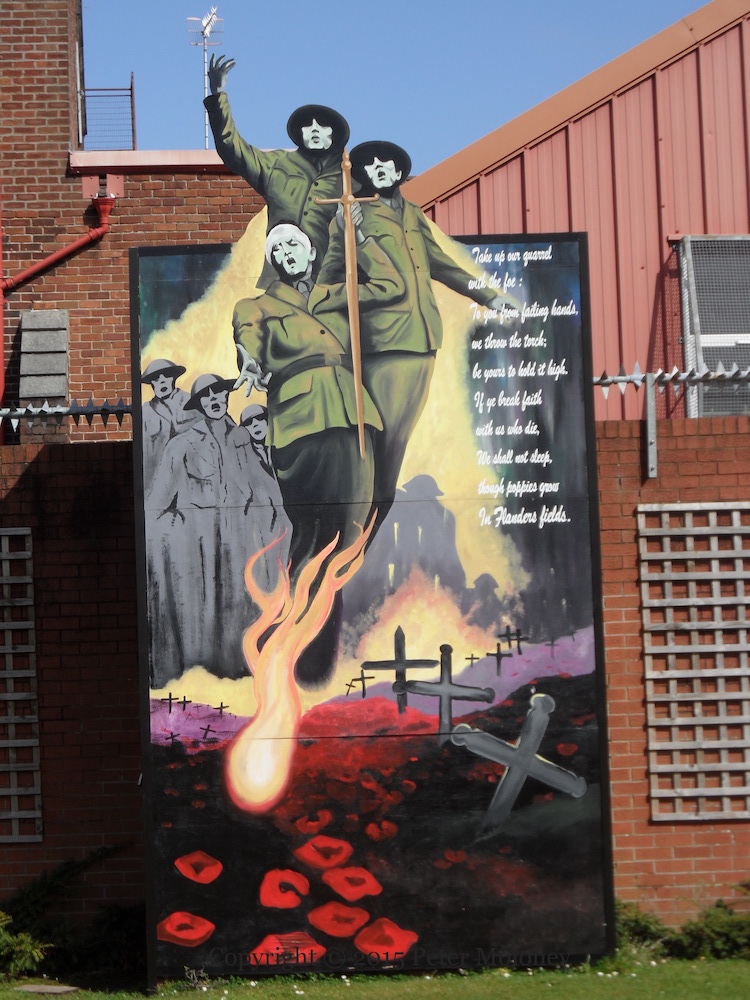
The Somme memorial Garden Of Reflection (between the Shankill graveyard and the Mountainview Tavern) has two new pieces. The first places two headstones (both reading “A soldier of the great war”) in a flower-bed in front of the mural, which shows a soldier, presumably from the Ulster division, on the fields of Flanders: “Greater love hath no man than this, that a man lay down his life for his friends. 1914-2014”
In the second, three wraiths of dead WWI soldiers – one with its head wrapped in a bandage – rise from the grave to issue a final edict: “Take up our quarrel with the foe; to you from failing hands we throw the torch; be yours to hold it high. If ye break faith with us who die, we shall not sleep though poppies grow in Flanders’ fields.”
“Fáılte go dtí Brandywell” – this is a long mural about the welfare of children, citing rights 3, 6, 9, 23, 24, and 31 from the UN’s Convention On The Rights Of The Child, as rendered by Caroline Castle.
Countess Markievicz, carrying a flag of Cumann Na mBan, and Ethel Lynch, carrying a flag of the Derry IRA, take centre stage in the Mná Na hÉıreann mural in London-/Derry/Doıre’s bogside. Markievicz is famous for her role in the Easter Rising of 1916 (WP); Lynch died in December 1974 of injuries sustained when a bomb exploded prematurely. Between them, “Liberty leads the people” waving an Irish Tricolour.
To their left are three Derry women protesting the conditions in Armagh Women’s Prison and in the H-Blocks. This article on Mary Nelis (the protester on the right, with Kathleen Deeny and Theresa Deery) describes the photograph on which this part of the mural is based. The women in Armagh prison were allowed to wear their own clothes and so were not ‘on the blanket’ as their male counterparts in the H-Blocks of Long Kesh were. However, they did engage in a “no wash” protest, which lasted from February 1980 until March 1981, and three of them – Maıréad Farrell, Mary Doyle, and Margaret Nugent – joined the 1980 hunger strike.
To their right (beyond the coffin scene) members of Cumann Na mBan are on parade; the photo of on which this is based can be seen in Mothering Sunday In Beechmount, though the faces have been changed here, presumably to those of more contemporary volunteers.
The figure wearing a cloth cap and holding a rifle is Eithne Coyle, a leader and later president of Cumann Na mBan, imprisoned both by the Black and Tans before the treaty and after it by the Provisional Irish government (WP). For the photograph on which her pose here is based, see An Phoblacht‘s History Of Cumann Na mBan.
In the four corners are circles of Betsy Gray, Anne Devlin, Mary Ann McCracken, and Máıre Drumm. Gray and McCracken were Presbyterians; Gray fought (or at least, was killed) in the 1798 rebellion, as did McCracken’s brother Henry Joy; Mary Ann went on to work for the poor of Belfast and lobby against slavery. Anne Devlin assisted in Robert Emmet’s 1803 rising. (National Graves Assoc) Máıre Drumm was vice-president of Sınn Féın and commander of Cumann Na mBan, who are shown marching on the right-hand side.
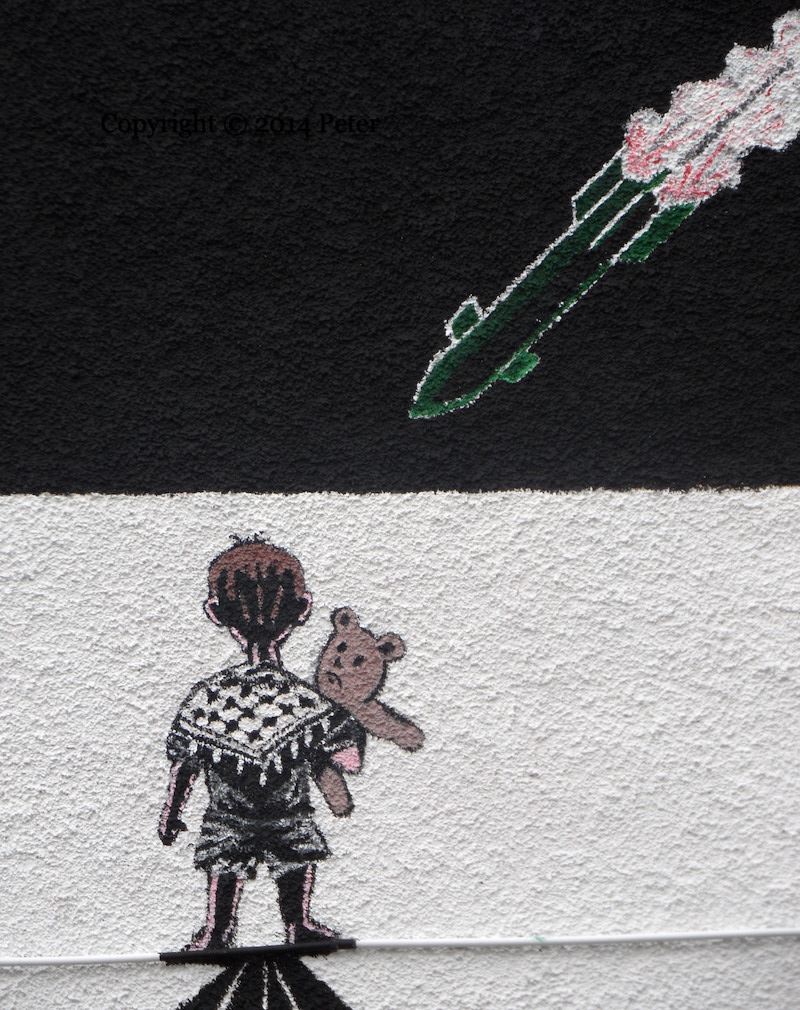
Carlos Latuff’s (ig) image of an Israeli Apache helicopter firing a “hellfire” missile at a Palestinian child has been reproduced in Springhill Park, Strabane, by John Carlin and others (Highland Radio).
This is an end-of-life image – or perhaps a preparation-for-repainting image – of the mural at the corner of Ardoyne Avenue. The mural is still is reasonable shape (compared to 2008) but the 34 medallions with portraits to local volunteers and activists have been removed.










 Peter Moloney Collection