This is the new UDA board in Harryville, Ballymena, replacing the simple board of M05965 with an ornate frame around white six-pointed star surrounded by “SEAB [South East Antrim Brigade], UDA, 4th Batt, A Coy”
Robert Dougan was commander of the UDA South Belfast Brigade and lived the Oranmore Drive (BelTel). He was killed by the IRA on February 10th, 1998 while sitting in a car outside Balmoral Textiles in Dunmurry, which led to a month-long expulsion of Sinn Féin from the talks (L.A. Times); two months later the Good Friday Agreement was signed. There had been attempts on his life in 1993 and 1994 (Irish Times).
Here are various walls supporting Stephen Murney, an éırígí (web) activist currently in prison since December 2012 on terrorism charges (BBC-NI).
The first is in Hugo Street, to which an éırígí star was later added; the second (from March) is on Divis Street; the third, next to the outstretched arms of Jim Larkin, is under the advertising hoarding in Northumberland Street – in November, Larkin and the banner were replaced with the stencils in the two following images. The final image is from the Andersonstown Road.
Operation Motorman, the British Army’s retaking of ‘Free Derry’, took place on July 31st, 1972. This is the repainted mural (the in-progress shot is from April); for the 2001 original, see M01426. (Part of The People’s Gallery by the Bogside Artists.)
For the installation to Seamus Bradley, who died during the operation, (and for the photo the mural is based upon) see X01130.
“Damn your concessions England, we want our country.” Board to Seán Mac Dıarmada in Ardoyne, detailing his exploits leading up to and including the 1916 uprising and his earlier connection with the local area. “Seán lived at 106 Butler Street, Ardoyne in 1906-08.”
The Clowney Street phoenix, originally painted in 1981, is repainted – for a history, see The Oldest Murals.
Above, the board at the centre of the mosaics has changed, from an image of blanketmen to a montage of photographs “commemorating the courage and sacrifice of the hunger strikers”.
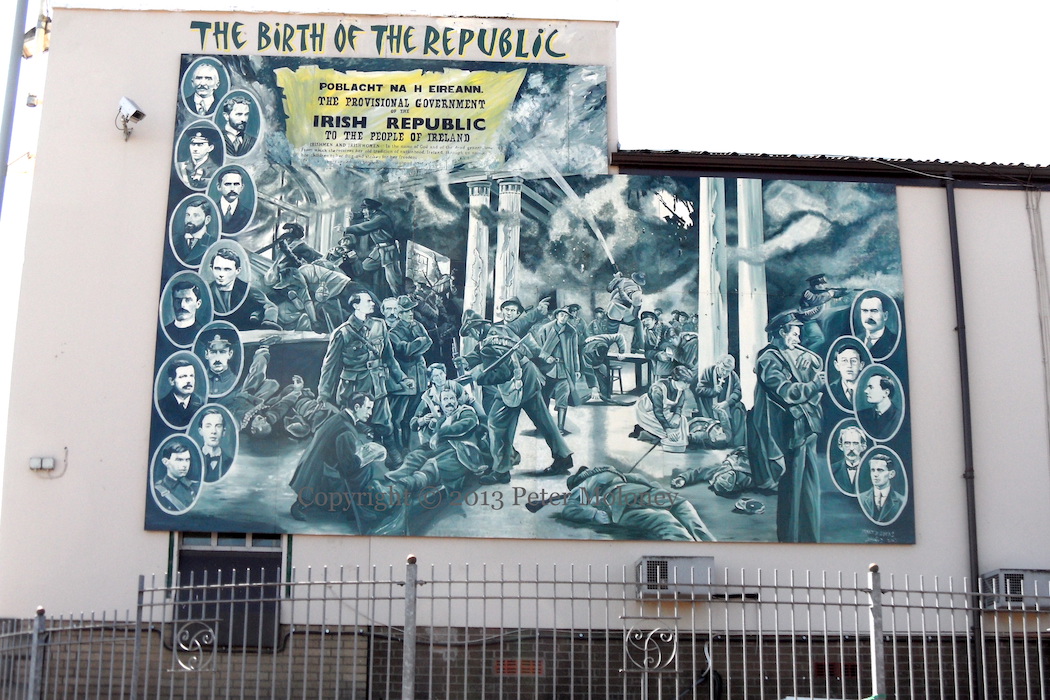
In addition to the seven signatories of the Proclamation of an Irish Republic, nine other leaders of the Easter Rising were executed in the wake of the rebellion. The portraits of all 16 are part of this new mural (on boards) of Walter Paget’s painting The Birth Of The Irish Republic. (For Paget’s painting, see the painting’s Visual History page.) In order of appearance, the 16 (with links to their WP pages) are …
Craigavon House was the home of James Craig, a political centre during the (3rd) Home Rule crisis – an estimated 100,000 people congregated at Craigavon House on the 23rd of September, 1911, to hear Edward Carson’s inaugural speech as Unionist leader (McNeill Ch. 4 | We Will Take Nothing Else) – and a hospital during the latter part of WWI (Bangor Historical). It has fallen into disrepair, covered over by the fourteen panels seen here, in order to serve as the rallying point of the 100th anniversary commemorative parade in April (RTÉ | BBC).
Various people and units are portrayed: USSF, post house staff, motor car corps, young citizen volunteers, the Larne gun-running, Fred Crawford, Edward Carson, James Craig, the nursing corp, Ethel Burnside, the 36th Division, the Ulster Covenant.
This is a new plaque to Stephen McConomy in Fahan Street, Derry, which includes the death of his mother, Maria “Mia” McConomy in July 2008 (Find A Grave). (For the previous plaque, see M03363)
“Stephen McConomy (a child of 11 years) Murdered by a plastic bullet aged 11 years on 16th April 1982. Always remembered by his loving brothers, family and late mother. May they both rest in peace.”