Fleadh Cheoıl Na hÉıreann is held in the north for the first time with the 62nd fleadh being held in Derry from August 11th to 18th (BBC). Free Derry Corner is decorated with the symbols of the festival and Comhaltas and the event’s web address. Programme.
Along the bottom can be faintly seen “Culture theft ££”.
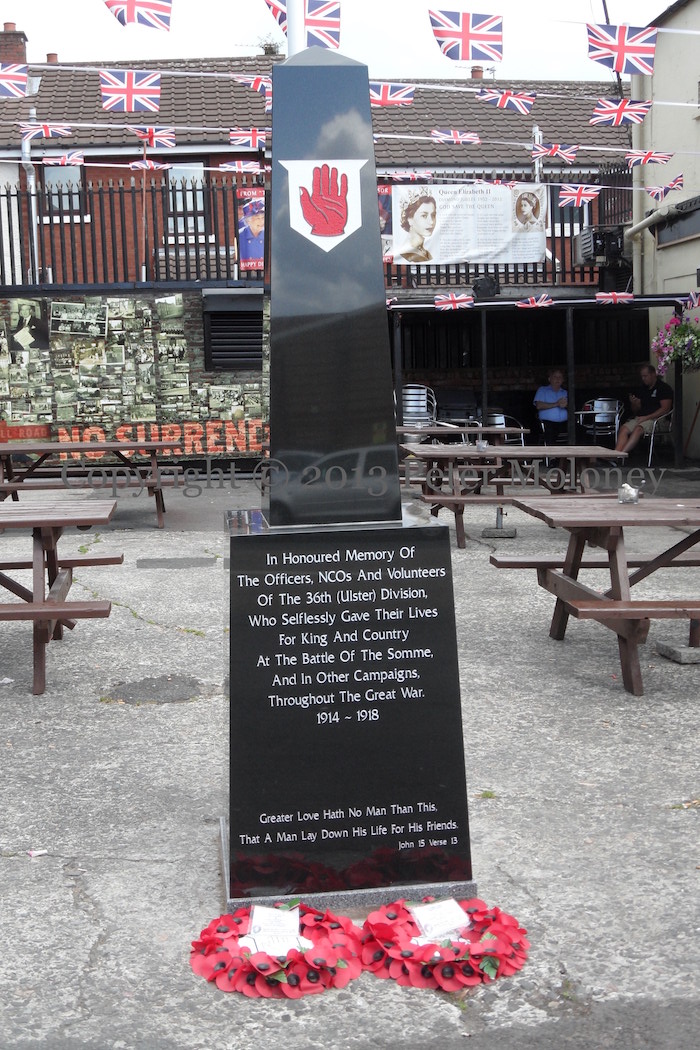
“In honoured memory of the offices, NCOs and volunteers of the 36th (Ulster) Division, who selflessly gave their lives for King and country at the battle of the Somme, and other campaigns, throughout the Great War 1914-1918. ‘Greater love hath no man than this, that a man lay down his life for his friends. John 15 Verse 13′”
The ‘No surrender’ photograph montage shows images of life on the Shankill, from the Home-Rule period onward. It includes various old murals (see Visual History 01) and a photo of Hugh Smyth (see Third-Class Citizens).
Here are three images – two ‘before’ and one ‘after’ — of the Eleventh Night bonfire in the Fountain area of Londonderry. The stolen board is from the Derry Volunteers Annual Commemoration on June 30th.
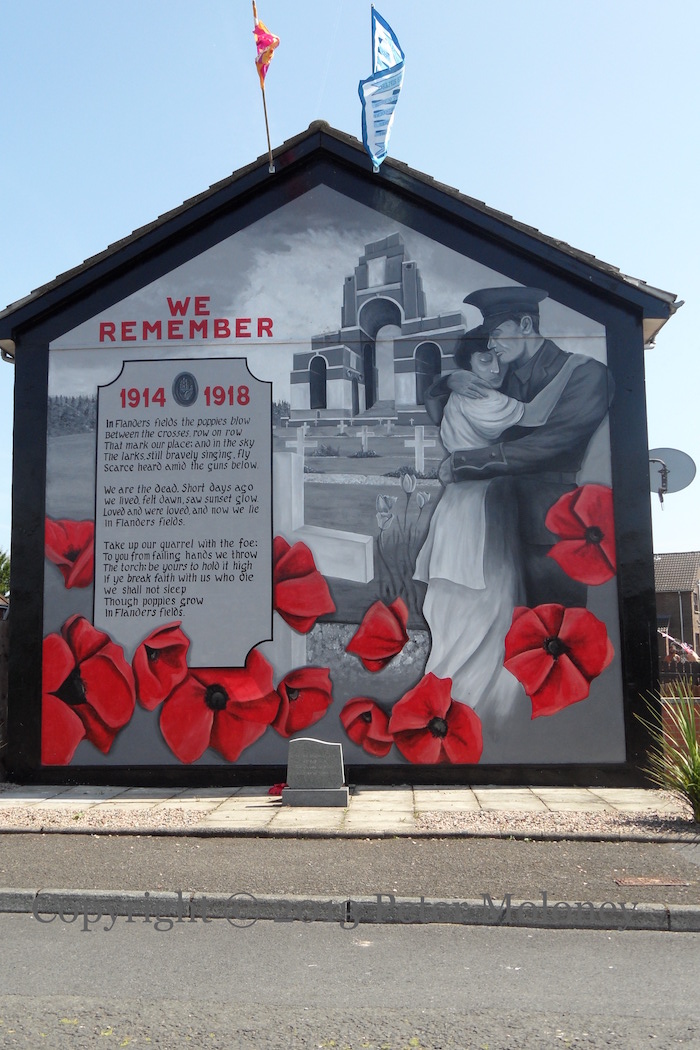
Canadian physician John McCrae’s poem In Flanders Fields and the triple arches of the Thiepval memorial to the missing are featured in this Monkstown mural. It is McCrae’s poem that is thought to have given rise to the use of the poppy as a symbol of military remembrance (WP). The names of over 72,000 dead are inscribed on the memorial (WP| travelfranceonline).
“In Flanders fields the poppies blow/Between the crosses, row on row/That mark our place; and in the sky/The larks, still bravely singing, fly/Scarce heard amid the guns below.//We are the Dead. Short days ago/We lived, felt dawn, saw sunset glow,/Loved and were loved, and now we lie/In Flanders fields//Take up our quarrel with the foe:/To you from failing hands we throw/The torch; be yours to hold it high./If ye break faith with us who die/We shall not sleep/Though poppies grow/In Flanders fields.”
The larger plaque on the board above reads, “We wish to pay tribute to the young men and women from this area, who are currently serving or have served with Her Majesty’s Forces in Afghanistan and to those from Northern Ireland who have paid the Surpreme Sacrifice. Lest we forget”.
The smaller one has part of the Ode of Remembrance from Laurence Binyon’s poem For The Fallen: “They shall grow not old, as we that are left grow old, Age shall not weary them, Nor the years condemn, At the going down of the sun, And in the morning, We will Remember them.”
The side-wall reads “End PSNIRA political policing – free Protestant hostages” with a pair of fists bound by rope (rather than barbed wire).
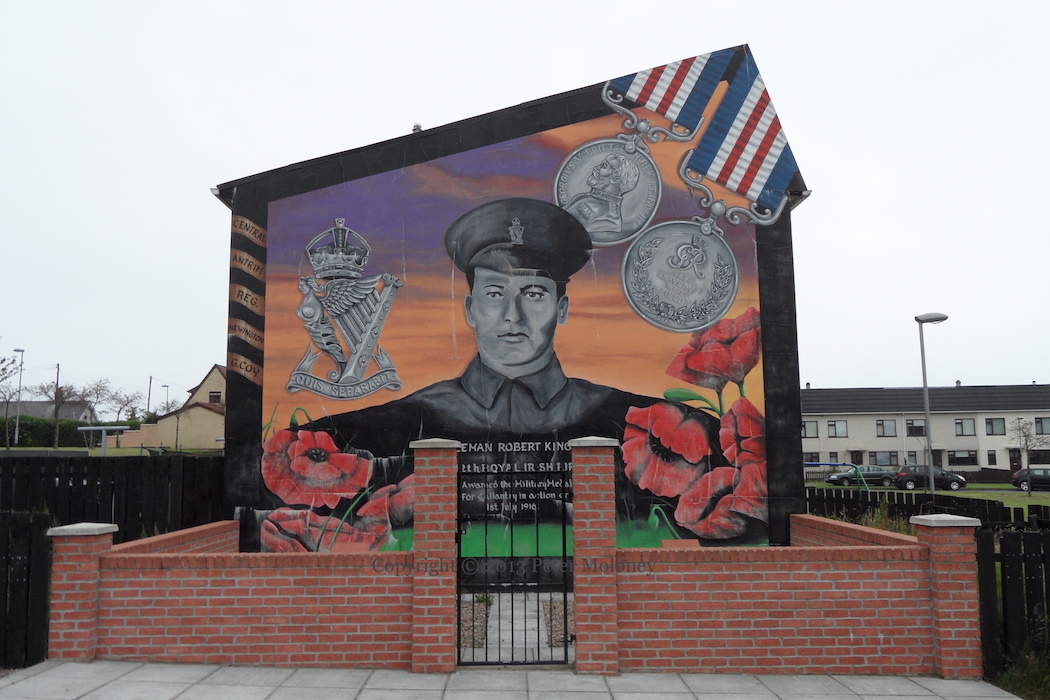
Robert King, of the 12th Royal Irish Rifles, who joined the army from the Ulster Volunteers, was “awarded the Military Medal for gallantry in action on 1st July 1916” at the Somme. The two sides of the medal are shown in the top right, with George V on one side and “for bravery in the field”. The 12th Rifles were drawn from the Central Antrim regiment of the Ulster Volunteers including the Newington area of Larne; King, however, was from Ship Street.
These placards are around the base of the Whitehead bonfire. From left to right: “Peter Robinson Marty’s puppet”, “Alliance SDLP Sinn Fein scum – you’ll never break our Ulster British culture”, “Parades Commission vermin once again dance to IRA scum. Time for every loyal Ulsterman to stand & fight!!”, “Alliance Party shove your shared future”.
The Ulster Tower at Thiepval, France, is a replica of Helen’s Tower in Clandeboye, around which the 36th (Ulster) Brigade, which formed in August 1914 from the Ulster Volunteers and Young Citizen Volunteers, began their training (see this gallery of images from North Down Museum at BBC-NI). After a year of training in Ireland and England, the Division was deployed to France in September 1915.
In the top corners are two views of the local Scrabo Tower. Produced by muraltec.









 Peter Moloney Collection