The Fountain bonfire on July 11th, ready for burning after nightfall, with a slew of CNR flags and banners, including Irish Tricolours, as well as flags and electoral boards for Sınn Féın. At the bottom are two small boards and a wreath for the 30th anniversary of the second hunger strike.
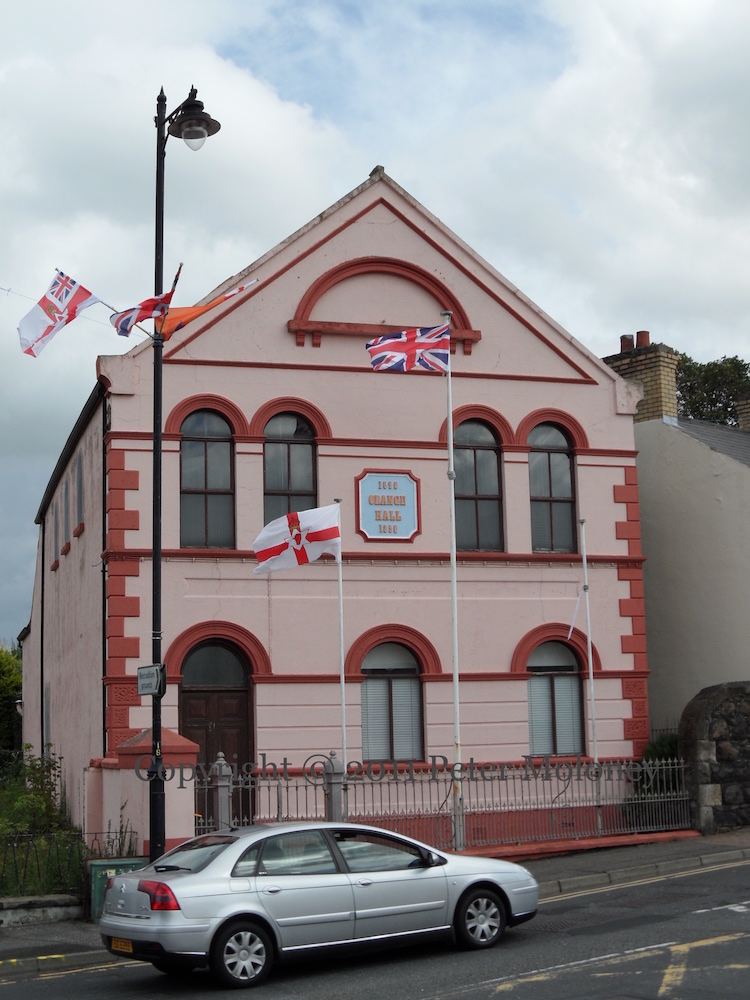
Limavady District Lodge 6 (Fb) in Catherine Street, Limavady. The central panel reads 1690-1890, the latter perhaps being the date the hall was constructed.
This is the completed version of the mural earlier shown in-progress. The four main panels show the men of the 36th (Ulster) Division going over the top on the first day of the Somme (1st July 1916), the “angel of Mons” (WP), Ulster Tower (“This tower was dedicated to the glory of God. In grateful memory of the officers, non commissioned officers and men of the 36th (Ulster) Division, and of the sons of Ulster in other forces who laid down their lives in the great war, and of all their comrades in arms who, by divine grace, were spared to testify to their glorious deeds. ‘Throughout the long years of struggle …. the men of Ulster have proved how nobly they fight and die’ – 16th November 1918 King George V”), and Thiepval Memorial (“Dear men and brothers, going out/to fight for Ulster’s need/we hail you with a mighty shout/brave friends, and true in deed.//Your country holds you in renown/your names will never be dead/and some sweet angel has a crown/for each dear, manly head.”)
The connections between the 36th (Ulster) Division and the Ulster Volunteers are commemorated in Seapatrick: on the left is the YCV shamrock – the 14th battalion of the Royal Irish Rifles was the YCV battalion; on the right, with the digits “1912” is the West Down regiment, 1st battalion (Banbridge) of the Ulster Volunteers, but we also have the years “1914 – 1918” – in September 1914 men from Banbridge (presumably including Seapatrick) joined D Company of 13th (Service) Battalion of the Royal Irish Rifles (1st County Down Volunteers) and part of the 108th Brigade of the 36th Ulster Division) (Bygone Days).
Seapatrick Road, Seapatrick (near Banbridge), Co Down
Work-in-progress images from the new mural in memory of the dead from the 36th (Ulster) Division in St Leonard’s Crescent (the old Newcastle Street) in east Belfast.
The four main panels show the men of the 36th going over the top on the first day of the Somme (1st July 1916), the “angel of Mons” (WP), Ulster Tower (“This tower was dedicated to the glory of God. In grateful memory of the officers, non commissioned officers and men of the 36th (Ulster) Division, and of the sons of Ulster in other forces who laid down their lives in the great war, and of all their comrades in arms who, by divine grace, were spared to testify to their glorious deeds. ‘Throughout the long years of struggle …. the men of Ulster have proved how nobly they fight and die’ – 16th November 1918 King George V”), and Thiepval Memorial (“Dear men and brothers, going out/to fight for Ulster’s need/we hail you with a mighty shout/brave friends, and true in deed.//Your country holds you in renown/your names will never be dead/and some sweet angel has a crown/for each dear, manly head.”)
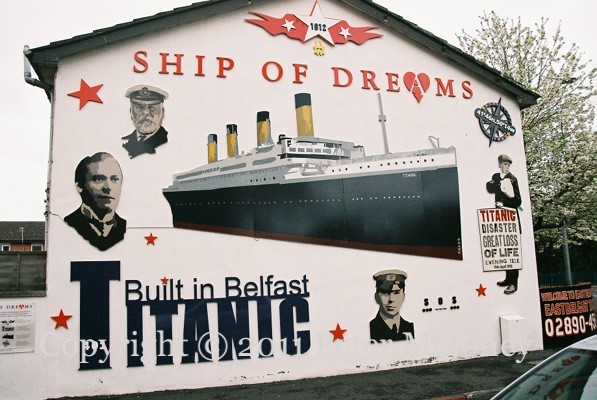
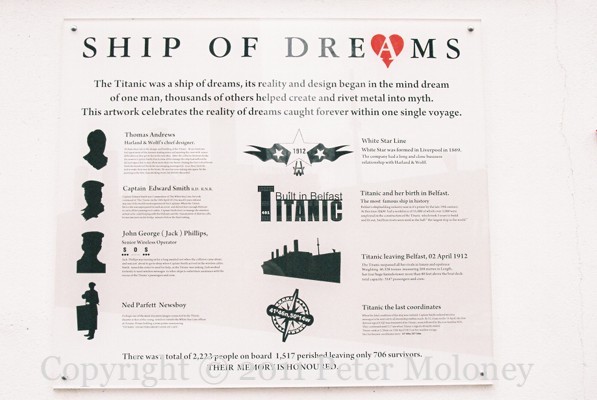
“Built in Belfast”. The White Star Line ship Titanic sank in the Atlantic in the early morning of April 15th, 1912, a thousand miles from New York (the co-ordinates are given in the top right), having been launched from Belfast’s Harland & Wolff shipyard, which is near this mural just off the Newtownards Road in east Belfast. The portraits are of Captain Edward Smith, architect Thomas Andrews, Jack Phillips (wireless officer), and paperboy Ned Parfett.
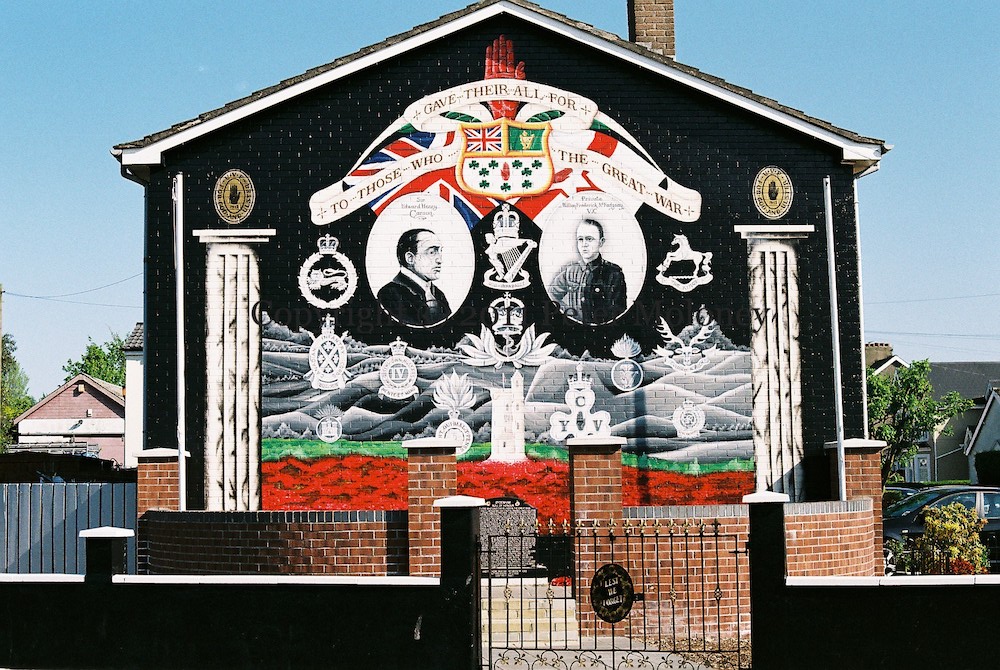
The portraits are of Edward Henry Carson and Private William McFadzean VC; the stone is a “Sydenham Roll Of Honour”. The insignia of various British Army units are shown over the hills around Thiepval and a sea of poppies. Seen previously from a distance in 2010.
“Is Gaeıl sınne” [we are Irish-speakers]. Pobal mural on Northumberland Street promoting the work in abhcóıdeachy/advocacy, cearta/rights, forbaırt phobaıl/community development, straıtéıs/strategy, taıghde/research, faıreachán/monitoring, ealaíon/arts, carried out in Teach Uí Chorráın in Ionad an Dá Spuaic [Twin Spires], and the “Tá” campaign for “acht na Gaeılge” an Irish-language act.