The Belfast Blitz

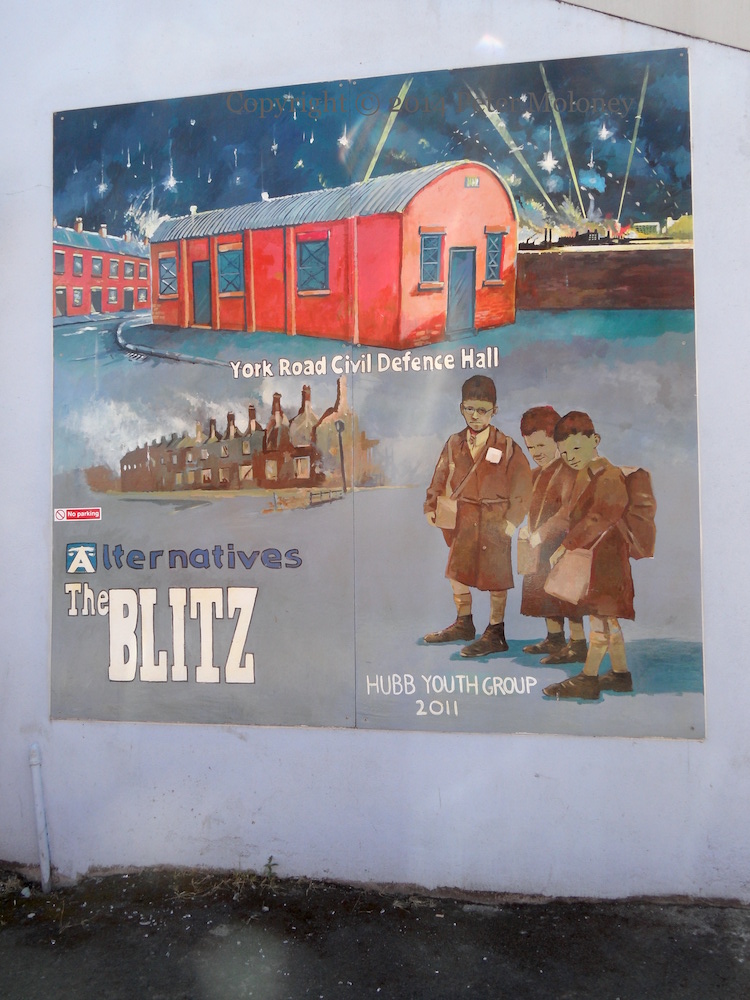
This board is on the end of the Hubb Community Resources Centre and Bowling Club in St. Vincent Street, north Belfast; across the street is Crusaders football ground.

From the Tele: “The building was once the home for local Civil Defence during World War II’s ‘Blitz’. This building is now the one of the last remaining Civil Defence structures in Northern Ireland and has also played home to the local Senior Bowls Club for many years.” The mural also shows bombed-out homes and children going off to the countryside. Short documentary about the 1941 Belfast Blitz (youtube).

Here is a badge of the YRCD & Bowling Club.

Click image to enlarge
Copyright © 2014 Peter Moloney
M11206

The Shankill And The Titanic

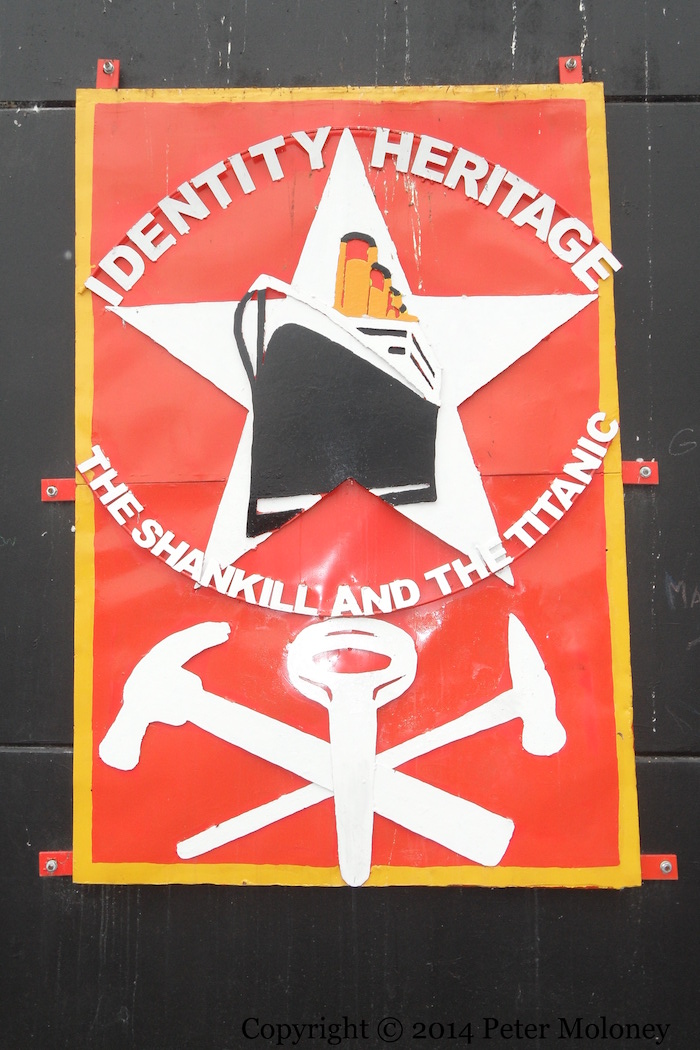
These are two painted metal-worked pieces bolted to the “peace” line on Cupar Way, celebrating “Shankill Ingenuity” and “Identity, Heritage”, while commemorating the lives lost on Titanic.

“1140” p.m. local time, April 14th, 1912, was when the ship hit an iceberg and began sinking. At about 2:20 a.m., in the early hours of the 15th, it went under.

See also: Belfast Inventiveness and Industrial Legacy.

Click image to enlarge
Copyright © 2014 Peter Moloney
M10866 M10867

Lincoln Court

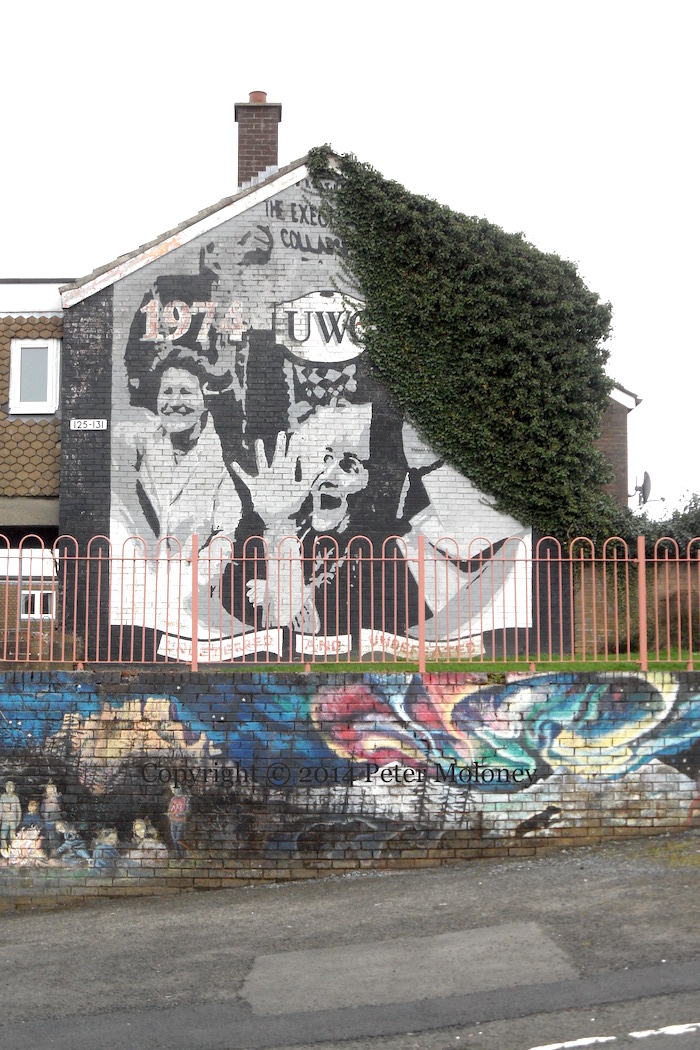
These are end-of-life images of the murals in Lincoln Court. The right-hand member of the pair, now covered by ivy, depicts scenes from the Ulster Workers’ Strike of 1974; of the four boards that made up the Community Spirit piece only the ‘1980s’ one remains.

The wildlife scene on the wall below is called “I’m a local celebrity, get me out of here“.

Click image to enlarge
Copyright © 2014 Peter Moloney
M10819 M10818

Bogside

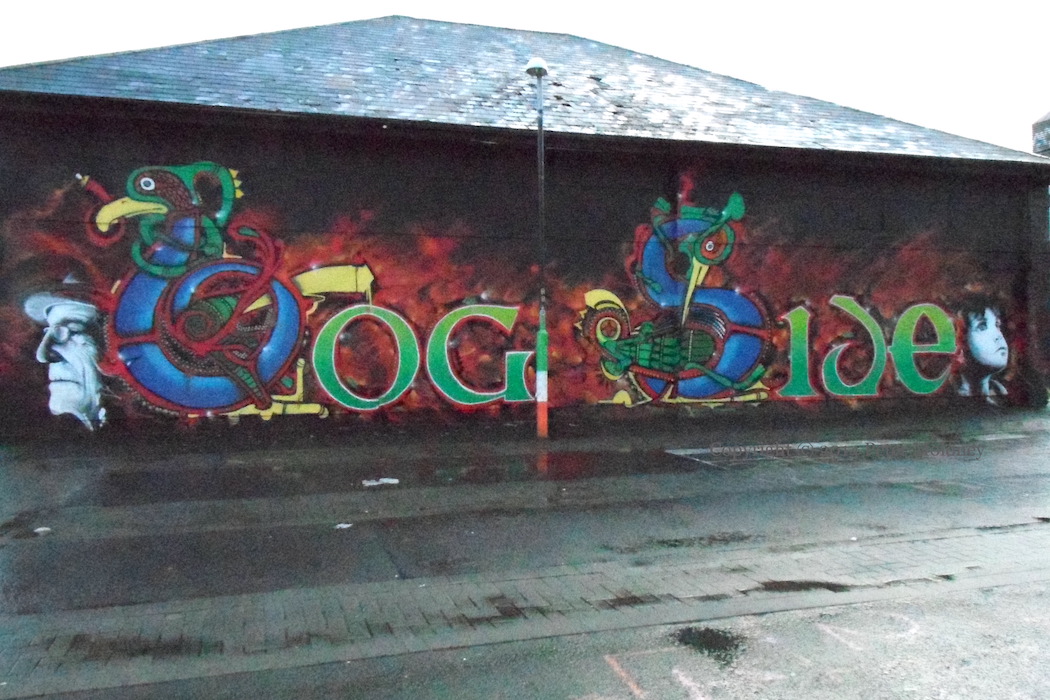
The eastern side of what was the island of Derry is called the Water side and the western side, although originally under water, became the Bog side in about 1600. The mural shown here, by RAZER (ig), is on the back of the shops adjacent to the Bogside Inn. There is an excellent history of the area from 1162 to the construction of Rossville flats in 1966 at the Museum Of Free Derry.

Click image to enlarge
Copyright © 2014 Peter Moloney
M10666

The Way We Were

Includes Rossville Flats, the walls of Derry, ?new buildings in Meenan Square?, the Free Gaza board that moved from the back of Free Derry Corner, to the railings at the bottom of Westland Street, to the Lecky Road underpass, and Free Derry corner before the houses in Lecky Road were demolished.

Click image to enlarge
Copyright © 2014 Peter Moloney
M10662 [M10663] [M10664] [M10665]

Peace Bridge

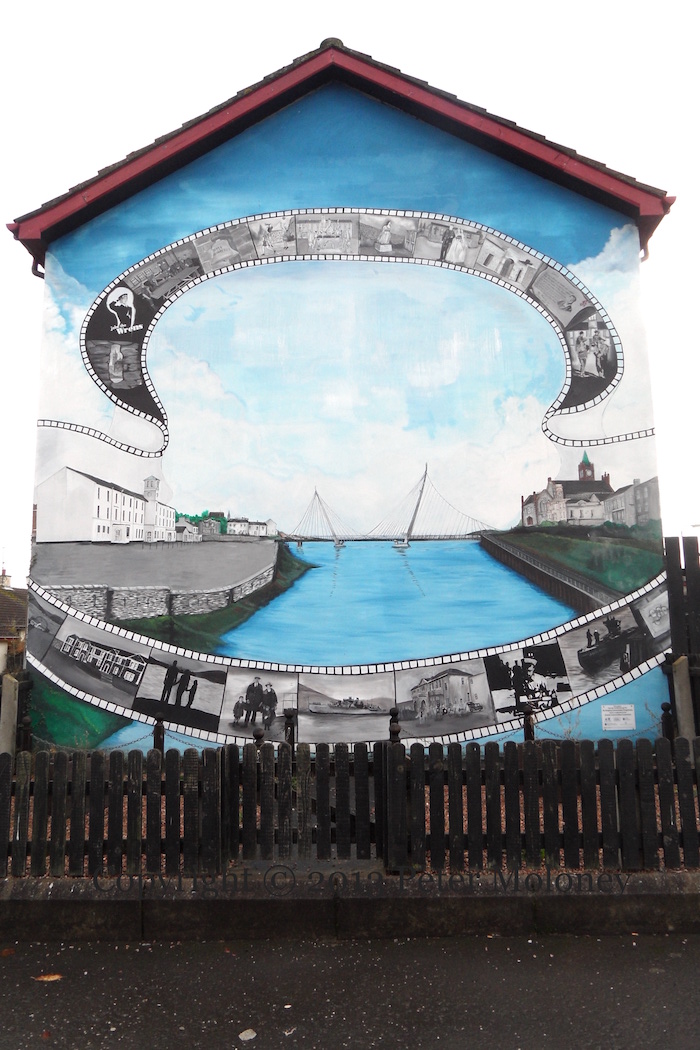
In this Caw mural the Peace Bridge is shown spanning the Foyle between (the former) Ebrington barracks and the Guildhall, with a film-strip of images, many depicting naval and military scenes, above and below. Second from left in the upper ribbon, a poster encourages people to “Join the Wrens [and free a man for the fleet]” (the Women’s Royal Naval Service; see the poster at IWM); there are also soldiers playing ping-pong in their barracks, and the ship’s bell of the HMS Londonderry (which served as a training ship during the Falkland War — WP).

Sperrin Park, Caw, Londonderry

Click image to enlarge
Copyright © 2013 Peter Moloney
M10541 [M10541a]

Joe Cahill Perpetual Cup

“Mol an óıge agus tıocfaıdh sí” – “youth responds to praise”, such as when playing in the annual Easter Gaelic games tournament, now in its eighth year. Joe Cahill (WP) holds the cup aloft.

The group in the bottom left corner are Pat O’Hare, Frank Cahill, Tom Cahill, (the three Cahills were featured in the previous mural) Ned Maguire, Jr., Ned Maguire, Sr., Alec Crowe, Paddy Meenan, Tommy Crowe, Dal Delaney, and Hugh Elliot.

In the crook of Cahill’s arm are Rita McParland, Sean Wallace, Paddy Corrigan, John Pettigrew, and John Stone. None of these adults is still alive; all were from the local area.

The chalet bungalows in the background on the left are gone, but you can see images of them on the Belfast Forum.

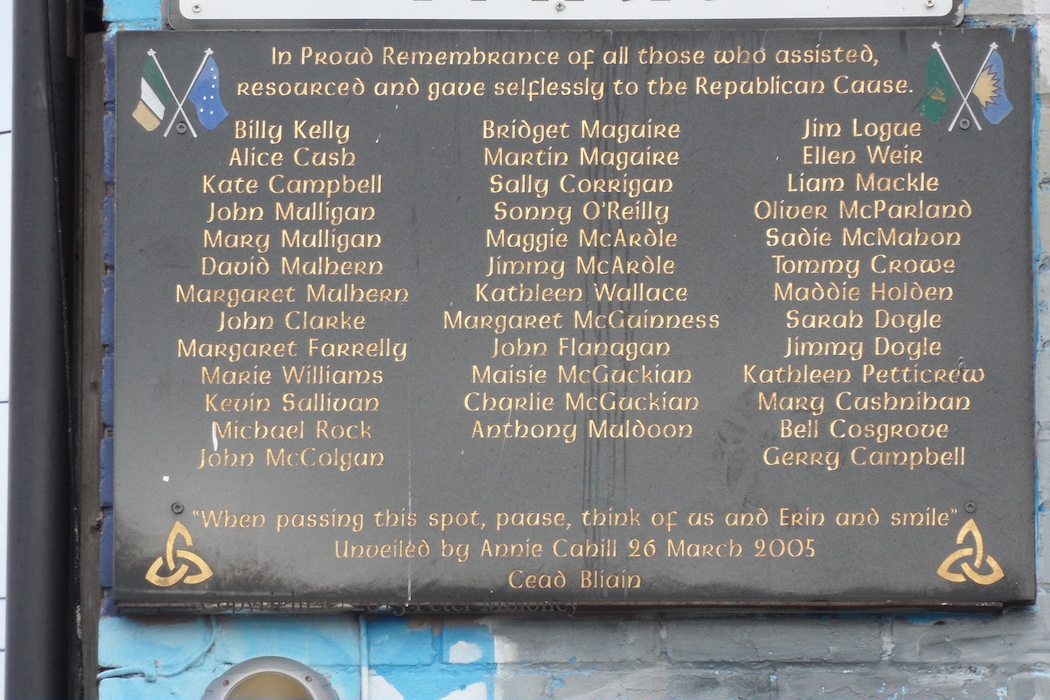
The plaque on the left names others in addition “who assisted, resourced and gave selflessly to the republican cause”: Billy Kelly, Alice Cush, Kate Campbell, John Mulligan, Mary Mulligan, David Mulhern, Margaret Mulhern, John Clarke, Margaret Farrelly, Marie Williams, Kevin Sullivan, Michael Rock, John McColgan, Bridget Maguire, Martin Maguire, Sally Corrigan, Sonny O’Reilly, Maggie McArdle, Jimmy McArdle, Kathleen Wallace, Maragret McGuinness, John Flanagan, Maisie McGuckian, Charlie McGuckian, Anthony Muldoon, Jim Logue, Ellen Weir, Liam Mackie, Oliver McParland, Sadie McMahon, Tommy Crowe, Maddie Holden, Sarah Doyle, Jimmy Doyle, Kathleen Pettigrew, Mary Cushnihan, Bell Cosgrove, Gerry Campbell.

The mural was painted by Lucas Quigley and unveiled on September 2nd by Annie Cahill. (Images of the unveiling from An Phoblacht.) 

Click image to enlarge
Copyright © 2013 Peter Moloney
M10523 [M10524] [M10525] [M10526] M10527
[M12613] [M12614]

For Me There Will Be No More War

Here are three of twenty new panels on the Donegall Road bridge over the railway.

The post on the mural to James Magennis in Tullycarnet provides background information on him.

A letter home from the Somme: “How I love you all. I wonder what you are doing at home. I must not do that. It is hard enough sitting waiting. We may move at any minute. When this reaches you for me there will be no more war, only eternal peace and waiting for you.” July 1st, 1916 saw the start of the Battle Of The Somme. The 36th (Ulster) division lost over 5,000 men in an initial successful attack near Thiepval Wood, but were driven back that evening.

Ulster suffragettes: “Women have been trained to speak softly and carry a lipstick. Those days are over.” (Bella Abzug). The board shows a picture of women drumming up an audience for a suffragette meeting in the Ulster Hall in November 1912. The image in the bottom right is of Emmeline Pankhurst being arrested in London in 1914; the top image is of Pankhurst on tour in the US in 1913 (LoC; see Pieces Of History for a description of the tour; she gave a speech entitled ‘Freedom Or Death’). Pankhurst spoke in Belfast at the 1912 meeting, though the speakers advertised on the placards are “Mrs Charlotte Despard, Miss Irene Miller, Mrs Edith How-Martyn, Miss Alison Neilans“. The first suffrage group in Ireland was the North Of Ireland Women’s Suffrage Society, founded in Belfast in 1872 by Isabella Tod. See also Belfast’s Infamous Prison for information about suffragettes held in Crumlin Road Gaol.

For a complete set of panels, see north side and south side.

Click image to enlarge
Copyright © 2013 Peter Moloney
M10517 M10516 M10515