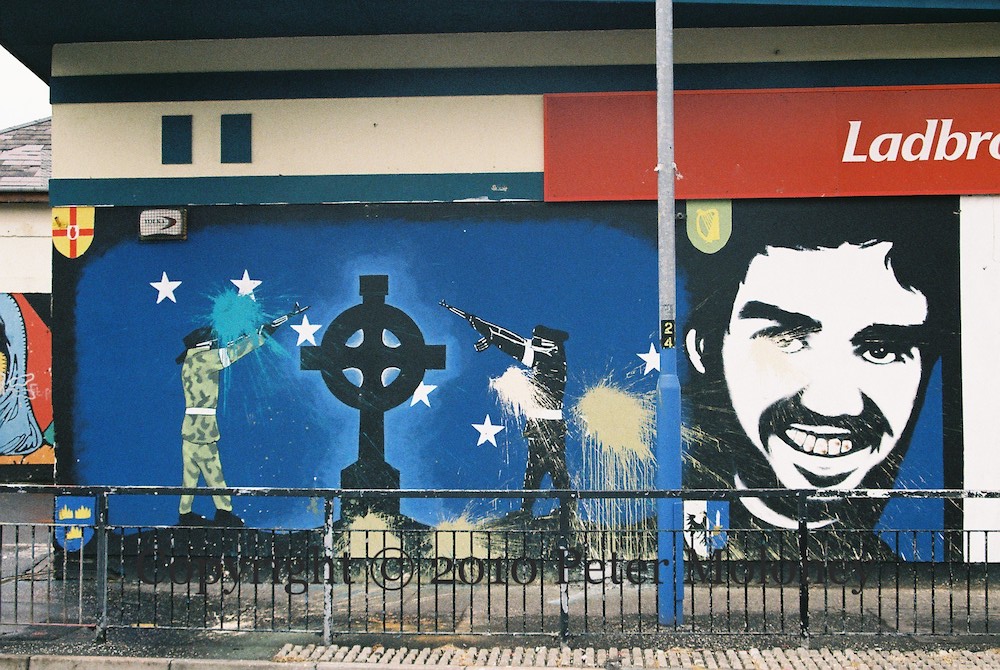
A funeral volley is fired over a Celtic cross representing the grave of INLA hunger striker Patsy O’Hara. Replaces the “Years From Now” version of the mural.
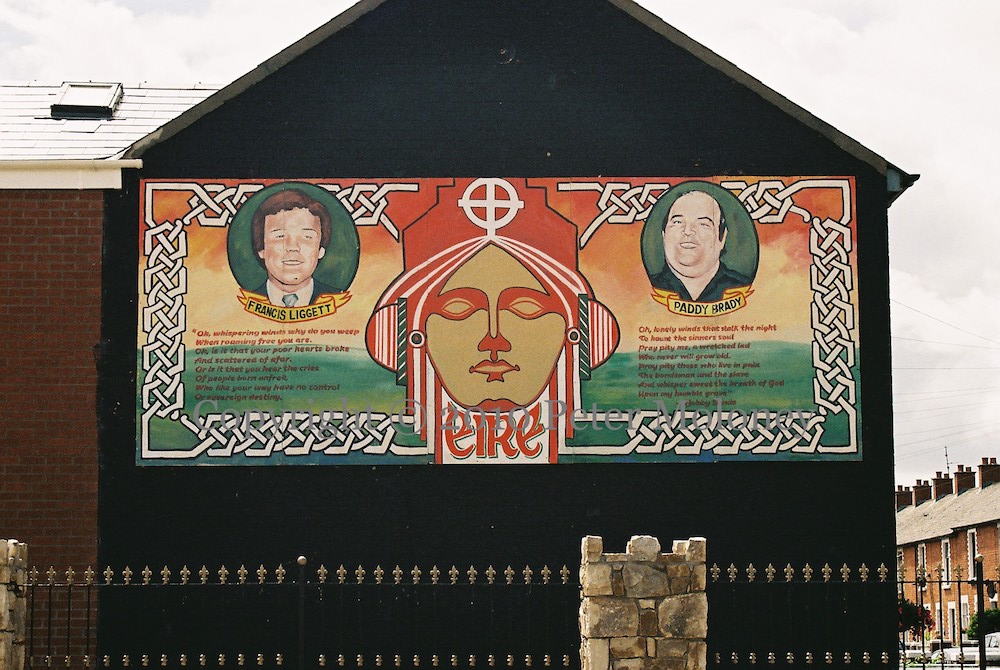
IRA volunteer Francis Liggett was shot by the British Army in January 1973 as he attempted to rob the Royal. One of the images of Gerry Adams in paramilitary beret comes from Liggett’s funeral. Paddy Brady was a Sınn Féın activist shot in 1984 at his work by the UFF (Sutton). Both were from the St James’s area of west Belfast. Their portraits are on either side of Éıre personified. They are also included in the ‘Roll of Honour’ in the memorial garden below them. The verses are from Bobby Sands’s poem Weeping Winds.
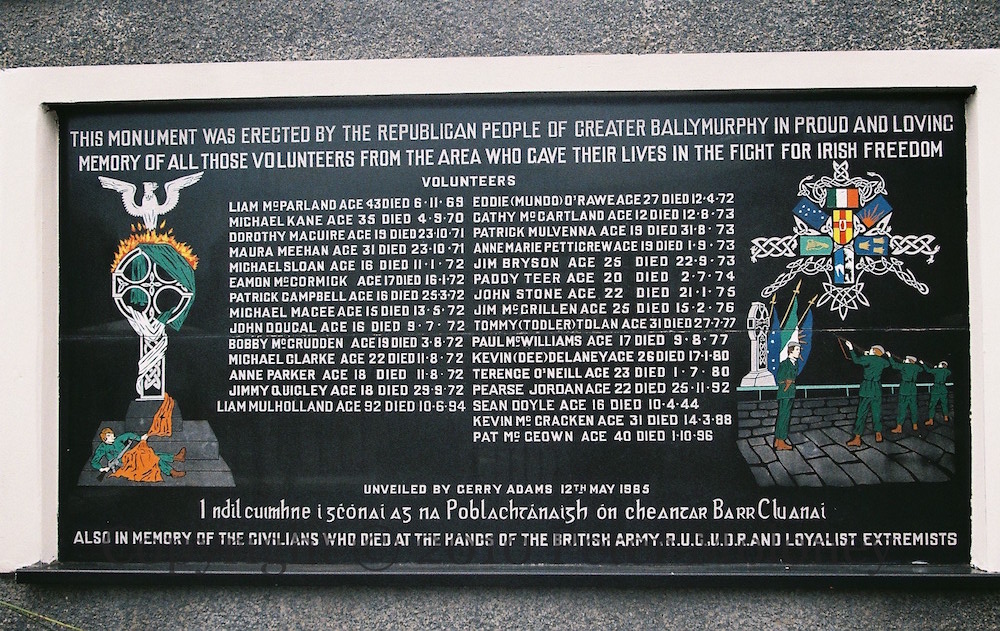
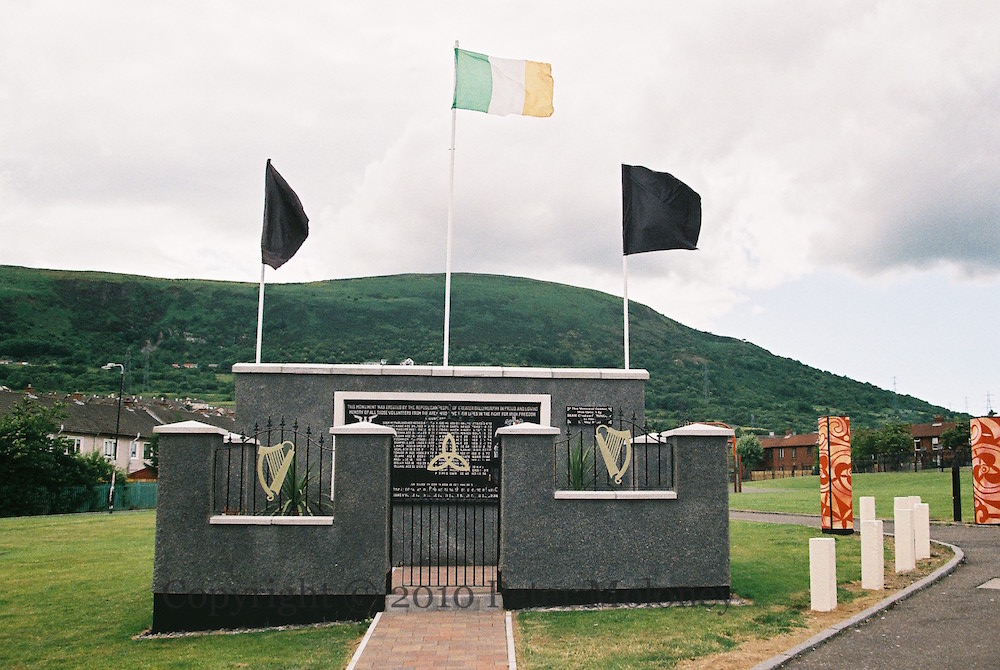
“This monument was erected by the republican people of greater Ballymurphy in proud and loving memory of all those volunteers from the area who gave their lives in the fight for Irish freedom.” Volunteers McParland, Kane, Maguire, Meehan, Sloan, McCormick, Campbell, Magee, Dougal, McCrudden, Clarke, Parker, Quigleey, Mulholland, O’Rawe, McGartland, Mulvenna, Pettigrew, Bryson, Teer, Stone, McGrillen, Tolan, McWilliams, Delaney, O’Neill, Jordan, Doyle, McCracken, McGeown. “Unveiled by Gerry Adams 12th May 1985. I ndıl cuımhne [chuımhne] i gcónaí ag na poblachtánaıgh ón cheantar Barr Cluanaí. Also in memory of the civilians who died at the hands of the British Army, RUC, UDR, and loyalist extremists.” The launch date of 1985 refers to the plaque’s former location in Glenalina Road (seen in 2001 and 2002).
Memorial plaque to Danny Teggart, Noel Phillips, Joan Connolly “Murdered by British paratroopers 9 August 1971” and Joseph Murray “Shot 9 August, died 22 August”, victims of the Ballymurphy Massacre. The plaque is in Springmadden, near the spot where they were shot, opposite the army barracks.
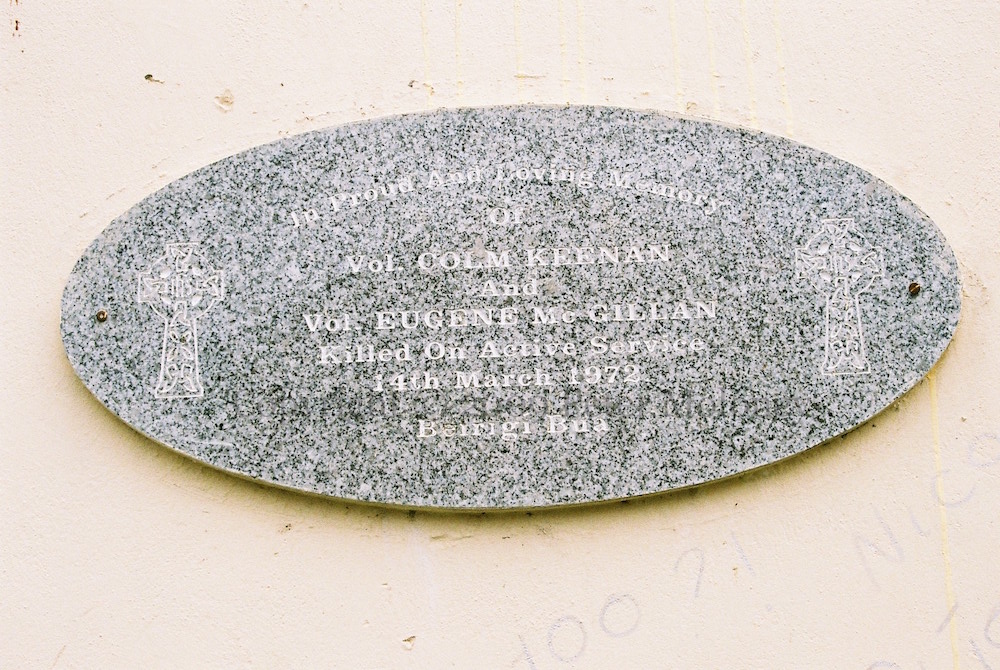
“In proud and loving memory of Vol. Colm Keenan and Vol. Eugene McGillan killed on active service 14th March 1972. Beırıgí bua.” Six weeks after Bloody Sunday, teenagers Keenan and McGillan were shot and killed during a gun battle between the IRA and British Army in which, it is claimed, they were not participants (RN/AP).
“Fuaır sıad bás ar son saoırse na hÉıreann. Óglach Sean Burns, Óglach Gervase McKerr, Óglach Eugene Toman. “But they dared to hold their heads up high and never once did fail to declare their wish for freedom like true sons of the Gael” – The Lurgan Ambush (A poem by Ita Green)”. The IRA volunteers were three of the six people shot in Lurgan in three incidents in November and December of 1982: Seamus Grew, Roddy Carroll, Michael Tighe. The deaths of the six would be investigated by the Stalker Inquiry into the shoot-to-kill policy.
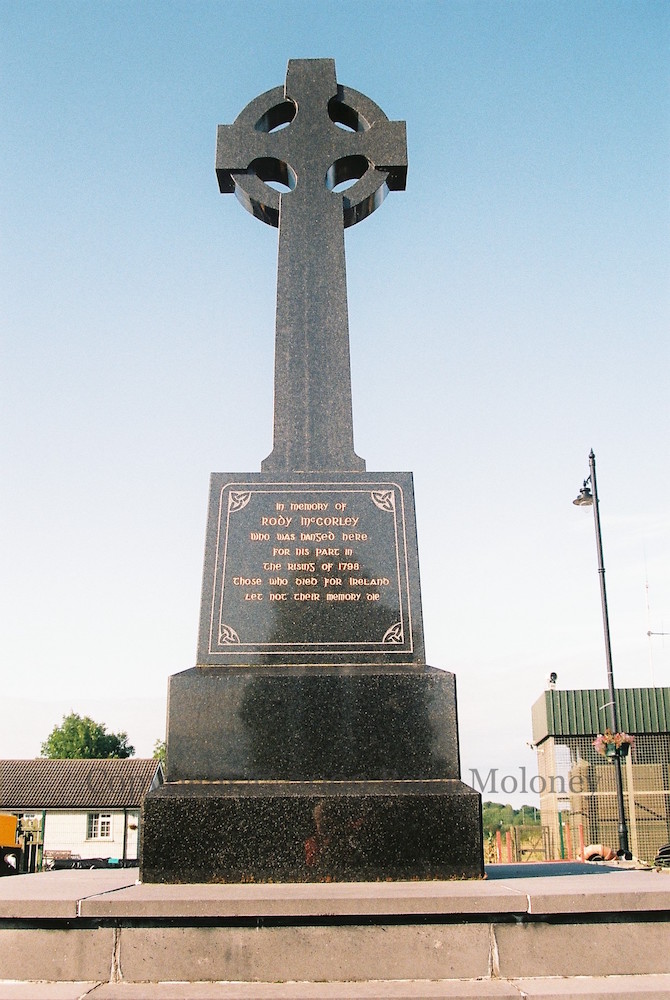
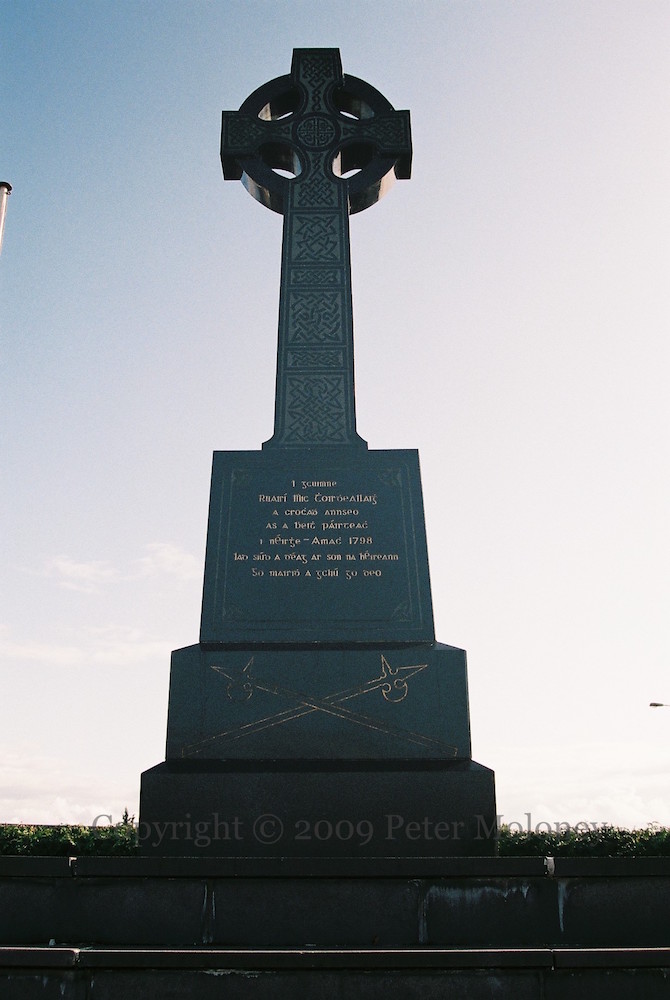
Presbyterian Roddy McCorley was executed on 28 February, 1800, and his name is famous due to a ballad written by Ethna Carbery (sung here by Tommy Makem).
“In memory of Rody McCorley who was hanged here for his part in the Rising of 1798. Those who died for Ireland, let not their memory die.” “I gcuımhne Ruaırí Mhıc Thoırdheallıagh a crochadh annseo as a bheıth páırteach ı nÉırghe Amach 1798. Iad sıúd a dhéag ar son na hÉıreann go mhaırıdh a gchú go deo.”
The river Mourne flows through Strabane town, home to 20 IRA volunteers and Sinn Féin activists who died during the Troubles: Fian Tobias Molloy, Vol. Eugene Devlin, Vol. Seamus Harvey, Vol. Gerard McGlynn, Vol. Jim McGinn, Vol. Neil Lafferty, Vol. Patrick Cannon, Vol. Peter McElchar, Hugh Devine, Vol. Michael Devine, Vol. David Devine, Vol. Charles Breslin, Vol. Josie Connolly, Vol. Danny McCauley, Patrick Shanaghan, Vol Damian Brolloy, Jim McAleer, Ivan Barr, Charlie McHugh.
“You’ve come to know the winds that blow, the glory that surrounds you. You hills that flow from Knockavoe, to wrap their warmth around you; on Irish streets in August heat, thro’ dusky dark December, you lost your lives but will never die, as long as we remember.” The author of the poem is unknown.
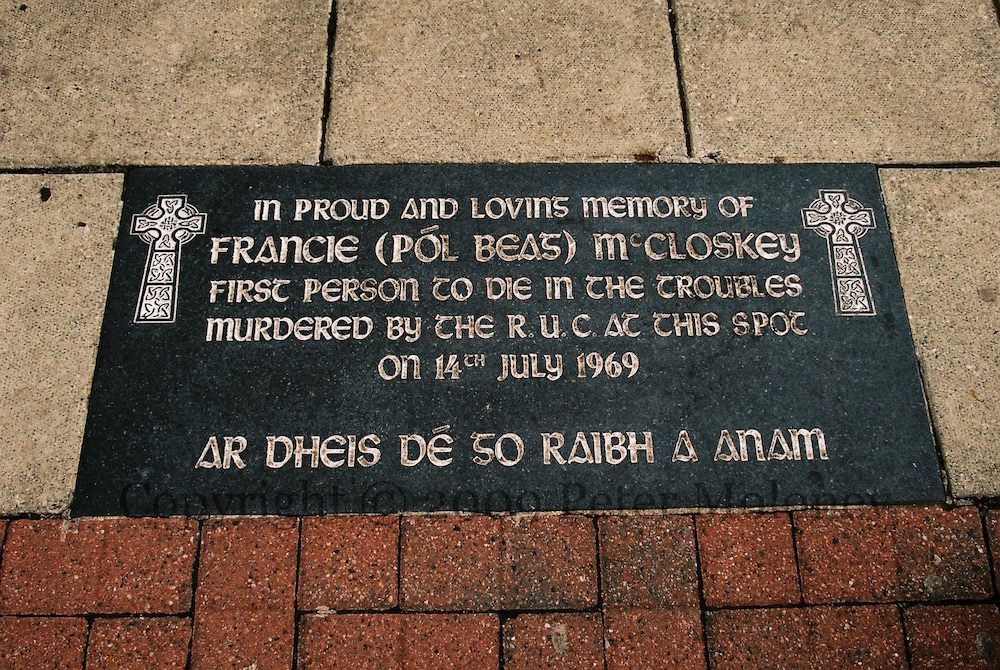
2009 was the fortieth anniversary of the beginning of the Troubles and of the “first person to be killed in the Troubles – murdered by the RUC at this spot [Main Street, Dungiven] on 14th July 1969”: Francie (Pól Beag) McCloskey. McCloskey was a 67 year-old farmer standing in a shop doorway on the 12th (BelTel) or 13th (An Phoblacht) when the RUC charged nationalist rioters attacking the Orange lodge. He would die of a brain haemorrhage on the 14th. “Ar dheıs Dé go raıbh a anam.”
National Hunger Strike Commemoration. Remember the hunger strikers. Tír Eoghaın 2009. Blackflag and torchlight presentation, Anne Street, Dungannon. Main commemoration Galbally community centre.” Placed temporarily on top of Sınn Féın – The Winning Way. The same board was hung in Chapel Road, Dungiven.




 Peter Moloney Collection