“This stone was presented by the Republican Movement, Derry, on the 22nd October 1999 in recognition of those who tend this Republican plot and republican graves in this cemetery.” “Buıoch [= buíochas?] ó Ghluaıseacht na Poblachta.”
These are close-ups of the IRA memorial in Derry’s City Cemetery (“Erected Easter 1975”, with the roll of honour extended around the base and then onto additional stones, and a plaque added in 1991 on the 75th anniversary of the second hunger strike and seen first in 1994). “Arna tógáıl An Cháısc 1975, ag Brıogáıd Dhoıre, Óglaıgh Na hÉıreann ın ómós agus ı gcuımhne ár gcomrádaıthe a rınne a ardíobaırt go saortar ár dtír dhúchaıs.”
All five people included on this plaque – Joe Coyle, Tommy Carlin, Tommy McCool and two daughters Bernadette and Carole – were killed by a premature explosion as bombs were being made in the McCool’s house in Dunree Gardens in Creggan. The plaque is on the side of the community centre in Fanad Drive, Derry.
19 year-old Provisional IRA volunteer Eamonn Lafferty was “killed on active service 18th August 1971”, in a gun-battle with British Army forces who were attempting to dismantle barricades in republican “Free Derry”.
These three IRA gravestones are in Derry City Cemetery. The first is to Hugh and Susan Morrison, IRA and Cumann na mBan members in 1922 (findagrave/Derry Journal). Hugh died from a premature bomb explosion during a gun-battle at Skeog/Skeoge (p. 41 of 1916 Derry Rising Revisited). Brothers John and Hugh Gallagher – John was “killed in June [1920] Derry riots” while Hugh was “shot by Free State soldiers at Drumboe Castle [holding centre]” in 1922. Finally, John Starrs, killed in a gun battle with the British Army in William Street, in 1972.
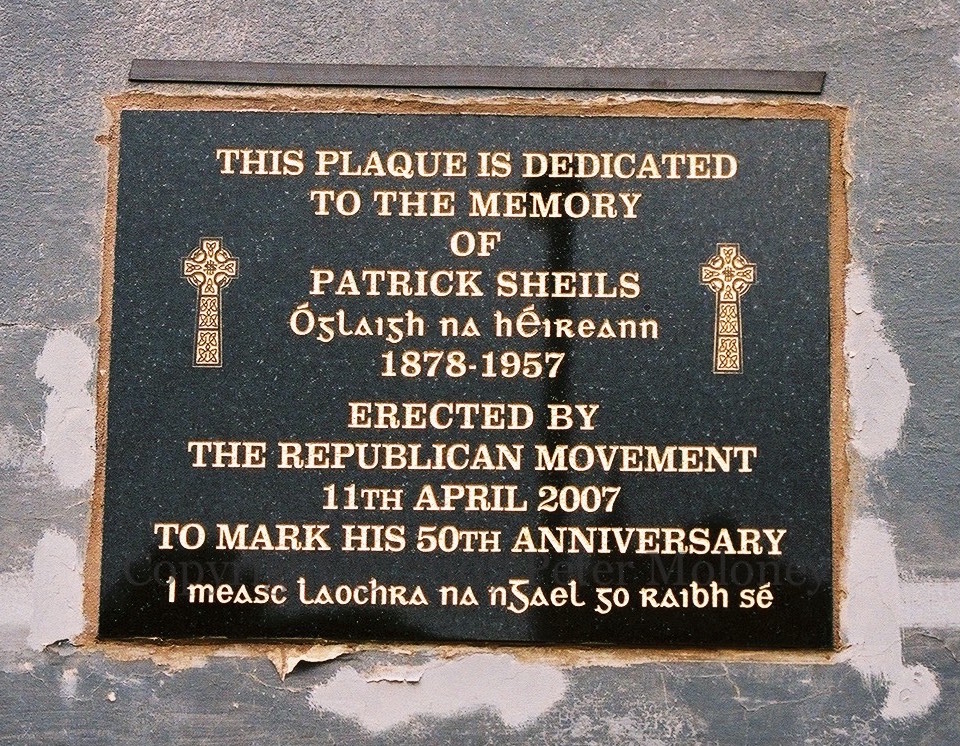
A plaque “dedicated to the memory of Patrick Shiels Óglaıgh Na hÉıreann 1878-1957. Erected by the republican movement 11th April 2007 to mark his 50th anniversary. I measc laochra na nGael go raıbh sé” is added to the Operation Motorman mural in Rossville Street, Derry. Paddy Shiels took part in the Easter Rising and was later Derry OC. See BMH testimony #676 by Liam Brady.
IRA volunteers from the New Lodge are “fondly remembered” in the (second) memorial garden, at the end of Donore Court. The portraits are to the left and the right of the lists of names.
“This plaque commemorates IRA vol. Joe McDonnell who lived in this house prior to his capture on 14th Oct 1976. Joe later died at 5.11 am on 8th July 1981 after 61 days on hunger strike in the h blocks Long Kesh. ‘Let us swear by Joe’s martyred blood never to waver of fail til the true united Irish socialist republic stands forth before the nations, a testimony to the worthiness of our case.’ Óglach calma dobhrıste. [A strong, unbreakable volunteer]”
“I gcuımhne ar Vol. Kieran Doherty TD, [IRA] Brıogáıd Bhéal Feırste, of 54 Commedagh Drive, rugadh 16ú Deıreadh Fómhaır 1955, elected TD for Cavan/Monaghan 18th June 1981, a fuaır bás 2ú Lúnasa 1981, after 73 days on hunger strike in the H-Blocks of Long Kesh. ‘It is not those who can inflict the most, but those who can endure the most, who will conquer in the end.’ [paraphrase of Terence MacSwiney]” The memorial stone is in Commedagh Drive, Belfast, just west of Doherty’s home, where there is a plaque to mark his residence “Vol Kieran Doherty T.D. lived here 16-10-1955 – 2-8-1981 Fuaır sé bás as son saoırse na hÉıreann”.
“Erected by the National Graves Association as a tribute to the bravery of Vol. Frank Ward who of 5th April 1922 at Dunamore gave his life in the execution of his duty as a soldier of the Irish Republic. Ar dheıs Dé go raıbh a anam. ‘While Ireland holds these graves, Ireland unfree shall never be at peace.’ [Patrick Pearse]” Ward was born in Omagh. At age 22, while dismantling a bridge near Dunamore in order to frustrate British movements, he was shot in a gun battle by the B-Specials (FindAGrave). He is buried in Carrickmore, Co. Tyrone.