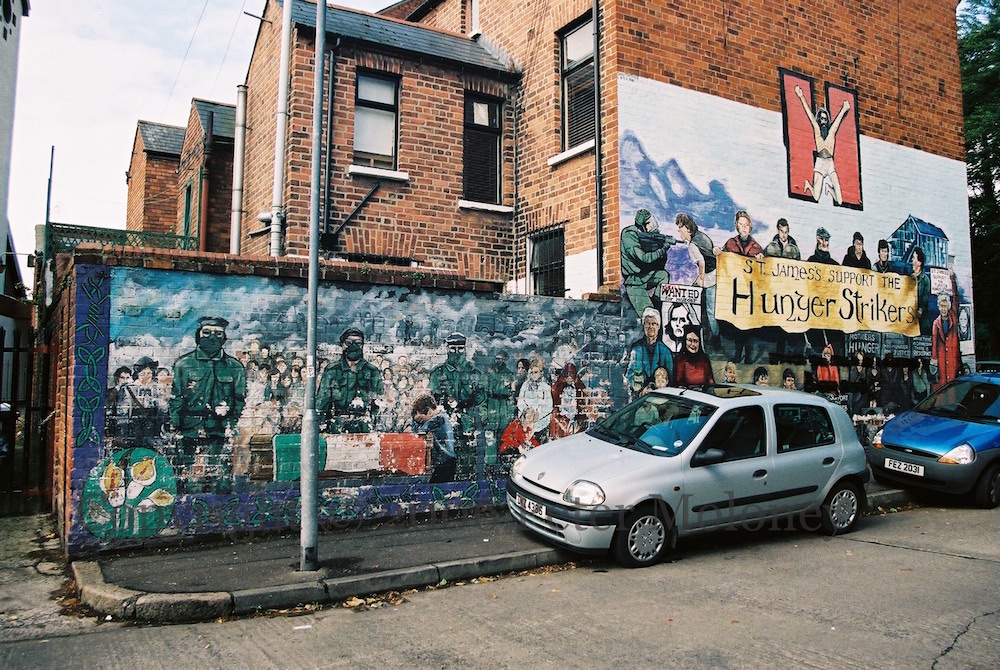
Here is a wide shot and some details of the two-part mural in Hugo Street, seen in progress in 2001 and completed in 2002. On the left is a depiction of the funeral of Joe McDonnell; on the right, posters and protesters from the time of the hunger strikes.
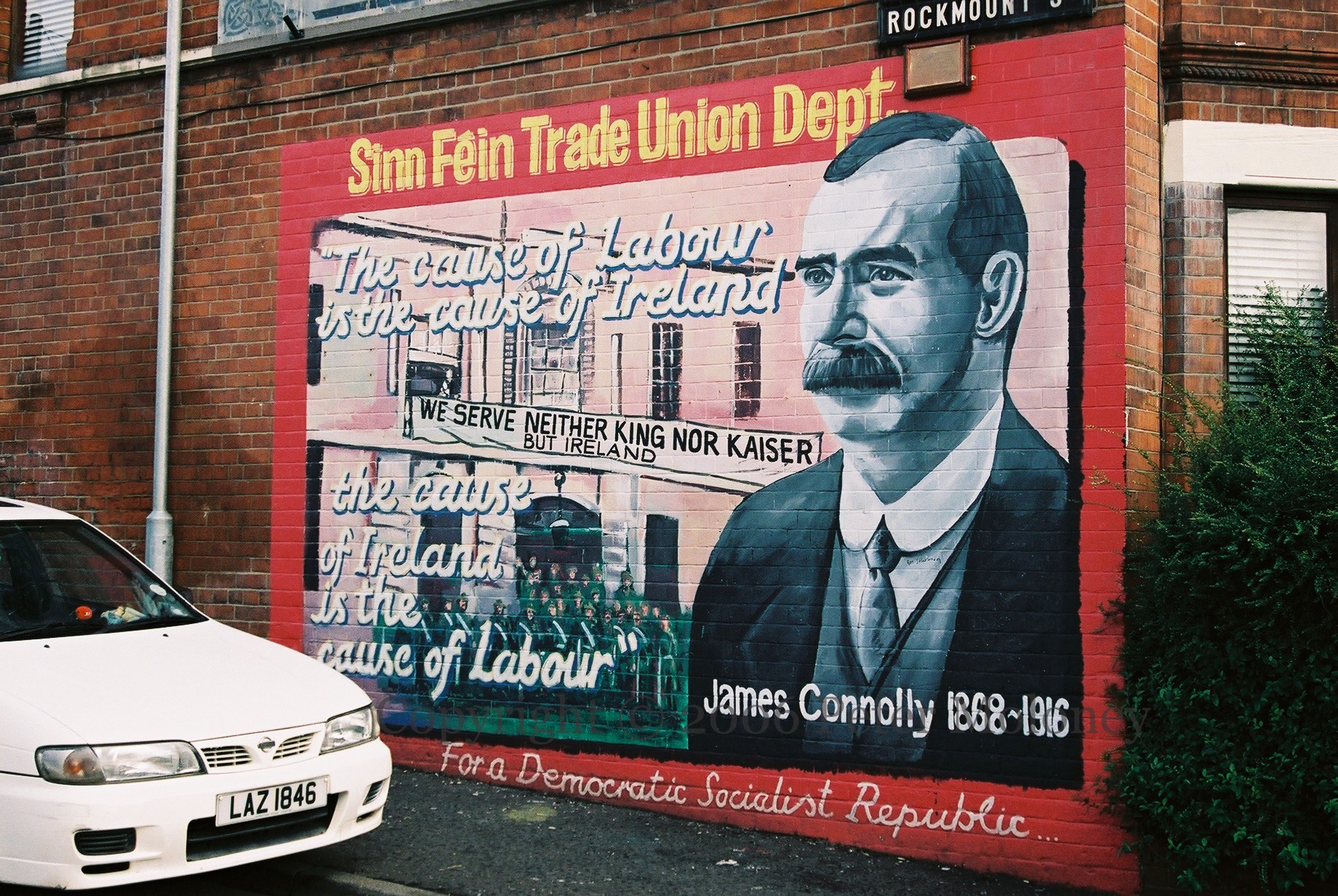
James Connolly (1868-1916) foregrounds Dublin’s Liberty Hall, headquarters of the ITGWU and the ICA (Irish Citizen Army) during WWI and the Rising, flying a banner reading “We serve neither king nor kaiser but Ireland.” The building was destroyed during the Rising. The quote, “The cause of Labour is the cause of Ireland, the cause of Ireland is the cause of Labour.” is from an 1916 article by Connolly, ‘The Irish Flag‘. “For a Democratic Socialist Republic.”
A previous mural to the Gibraltar Three is uncovered by the removal of a board. For an image of the whole mural, see C00895. Stanhope Drive (in the process of becoming Stanhope Street).
“I ndıl gcuımhne [sic] oglach [sic] Sean McCaughey, Gaelgoır [sic] agus muınteıor [sic] [Irish-speaker and teacher]. Fuaır sé bás ar son saoırse na hÉıreann.” “Formerly of Duneden Park, Ardoyne. Died on hunger and thirst strike after 23 days in Portlaoise gaol on May 11th 1946.” “For those who believe no explanation is necessary; for those who don’t believe no explanation is possible.” McCaughey was convicted of kidnapping and torturing IRA chief of staff Sean Hayes, who was suspected of treason. His hunger and thirst strike was preceded by five years on the blanket. “NBCS” = North Belfast Cultural Society.
For the 25th anniversary of the 1981 hunger strike, images from the period are reproduced in a mural sponsored by the “Ardoyne, Bone, Ligoniel 80/81 Commemoration Committee”: the funeral volley over Bobby Sands’s coffin, Derry women protesting conditions in Long Kesh by wearing blankets, women banging bin lids (see United Irishwomen) and protestors outside a polling station.
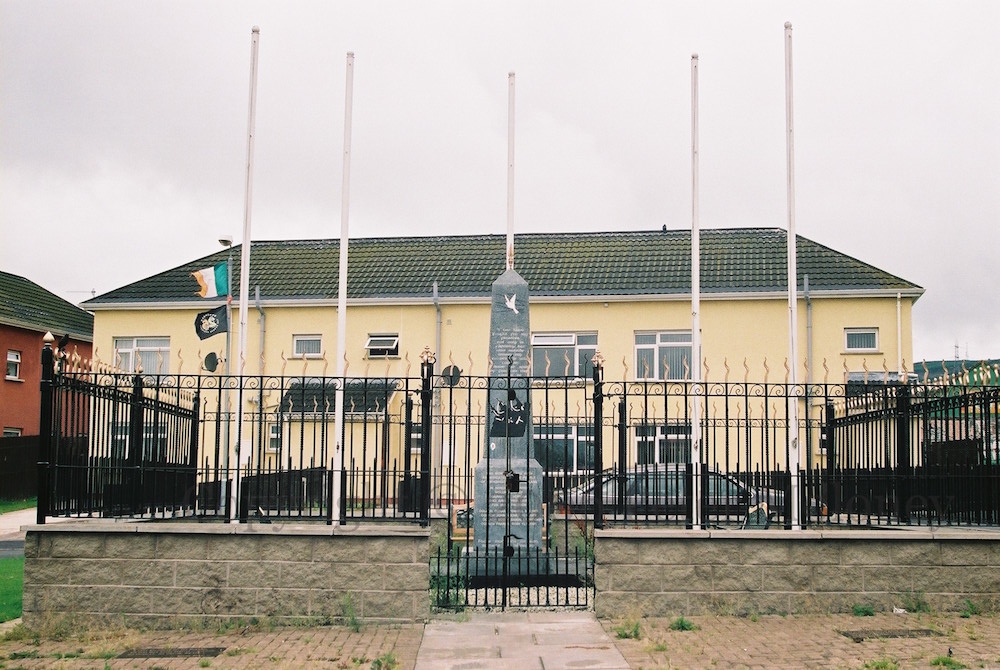
“This monument has been re-dedicated by the people of Twinbrook and Poleglass in honour of those volunteers of Óglaıgh Na hÉıreann who gave their lives for Irish freedom.” Gerard Fennell, John Rooney, Bobby Sands, Frankie Ryan. “Fuaır sıad bás ar son saoırse na hÉıreann”. “[Like the lark,] I too have fought for my freedom not only in captivity [where I now languish] but also [while on the] outside where my country is held captive … I have the spirit of freedom that cannot be quenched.” (Bobby Sands, The Lark And The Freedom Fighter, 1979)
The final image is of the adjacent hunger strikers stone. It will later be moved and repositioned inside the (extended) fencing.
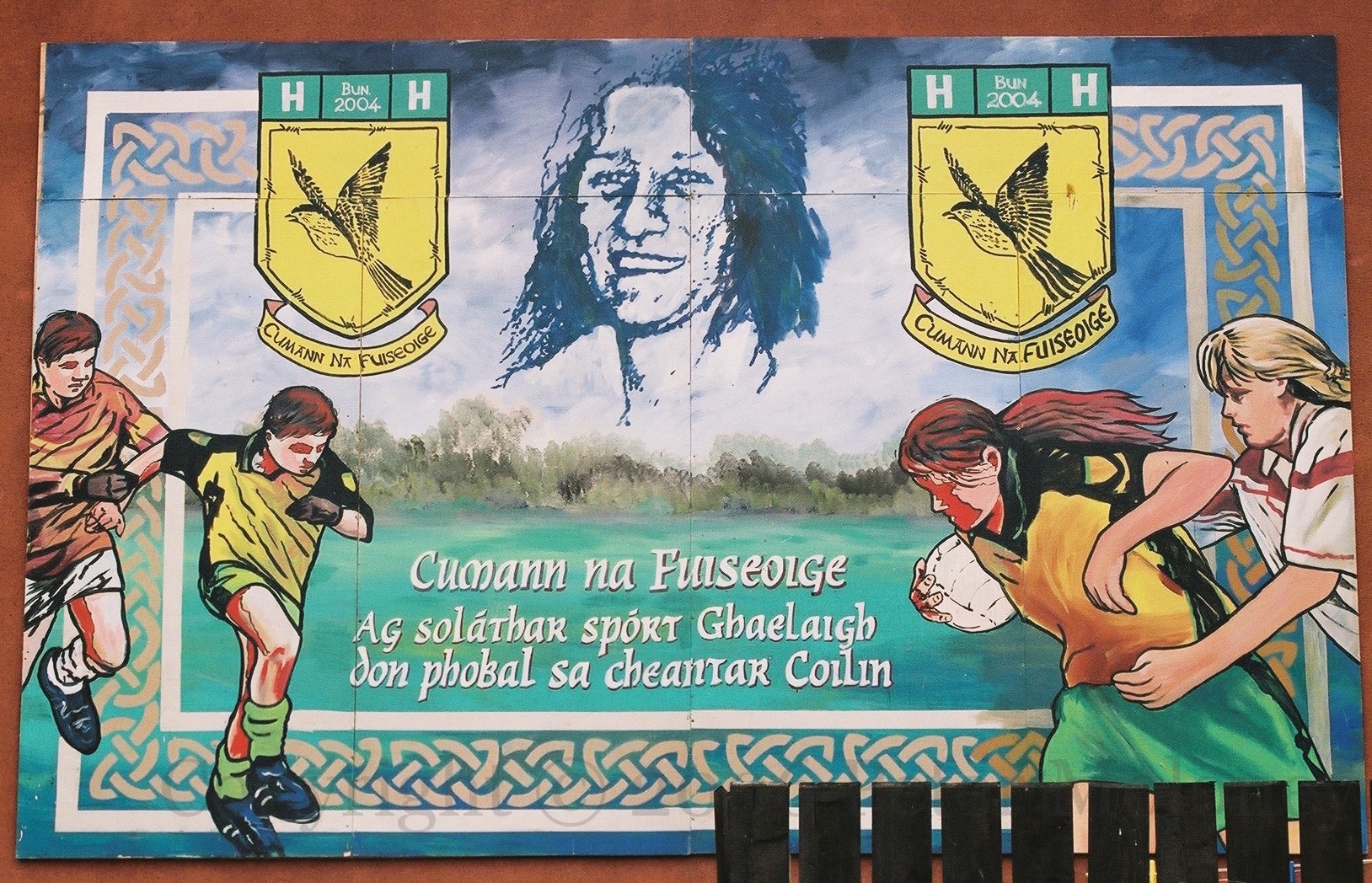
Established in 2004, Cumann Na Fuıseoıge (The Lark) is “ag soláthar spórt Ghaelaıgh don phobal sa cheantar Coılın” [providing Gaelic games to the people in the Colin area]. The club is named after the image of the lark (and barbed wire) used by Bobby Sands in his 1979 article The Lark And The Freedom Fighter. The choice of emblem proved controversial – Slugger.
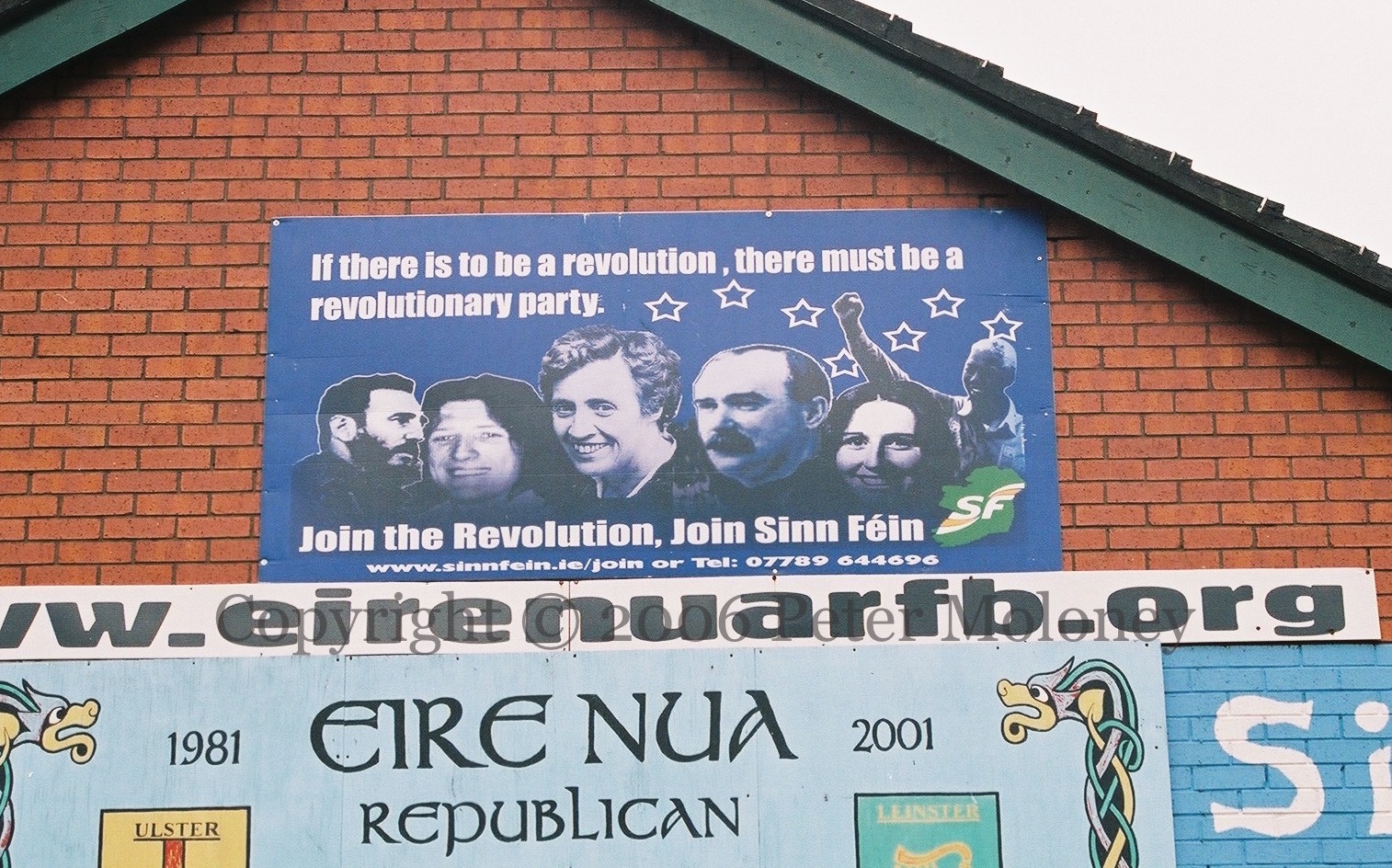
A Sınn Féın centenary (1905-2005) mural is added to the Éıre Nua Flute Band board (seen in 2004). Above them is a Sınn Féın board with Mao’s statement that “If there is to be a revolution, there must be a revolutionary party.” Both the flute band and Sınn Féın have internet addresses.
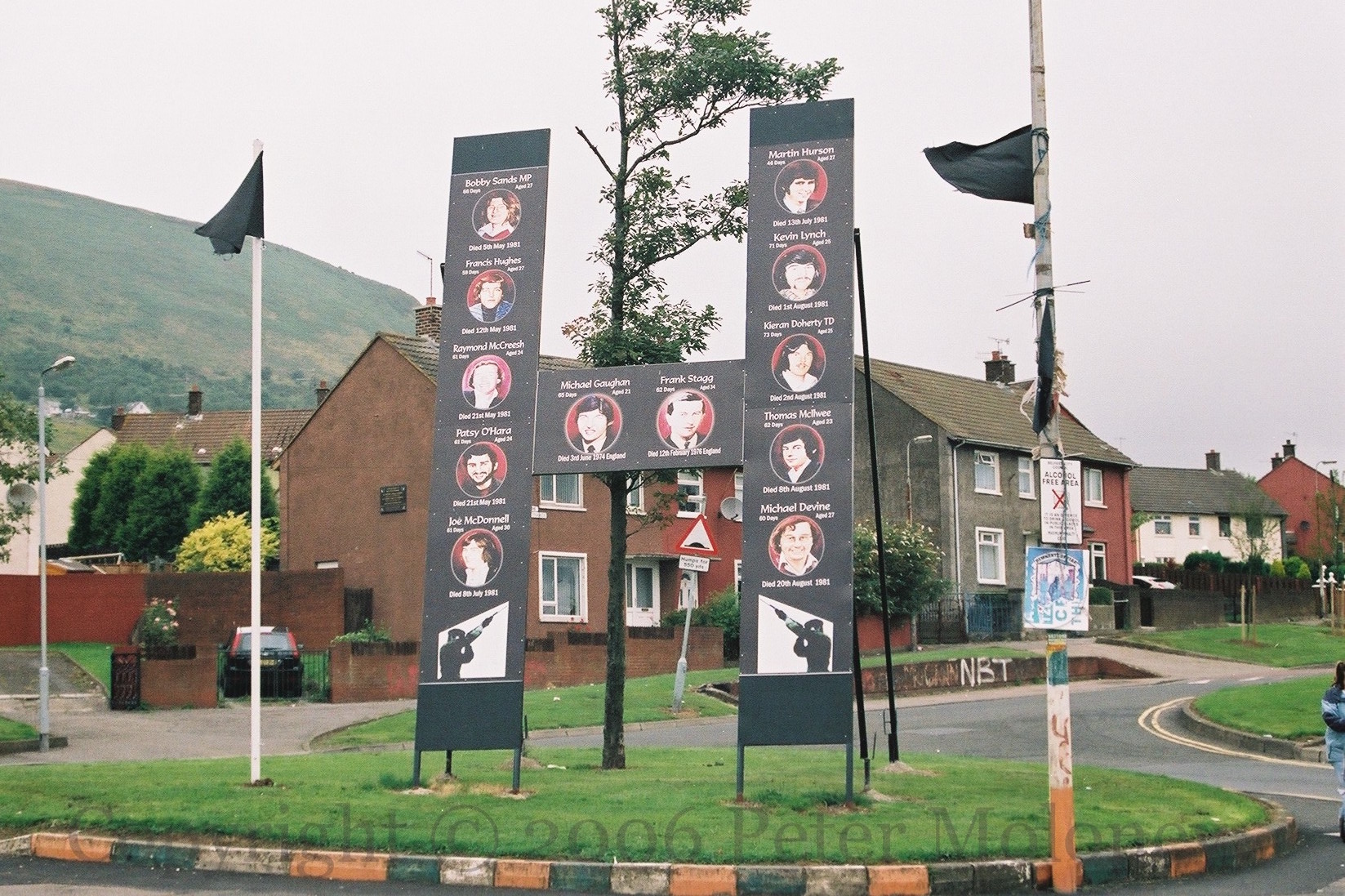
Portraits of the deceased hunger strikers from 1981 and the 1970s (Michael Gaughan, Frank Stagg) are displayed on a large “H” at the top of the Springfield Road.






 Peter Moloney Collection