Doıre Naofa

The Christian missionary Colm Cılle (in Latin, Columba), born in Donegal, founded a monastic settlement on the banks of the Foyle (then still part of Donegal) around 540 AD. The “Doıre” part of the name means “oak grove” and perhaps refers (as the information panel suggests) to “a sacred grove of trees, which may have pre-dated the monastery.” The mural above shows a reconstruction of the Derry monastery c. 700 AD. The name “Londonderry” dates to 1662.

Columba moved on to Scotland circa 563 and founded an abbey on the island of Iona. Among his reputed miracles is the banishment of a great water beast from the River Ness in 565.

“This is a reconstruction of the early Christian monastery at Derry around 700 AD which was founded by St Colum Cille around 546 AD. Colum Cille left his community in Derry in 563 AD with twelve companions to found the great monastery of Iona. He only subsequently returned to Ireland once and died in 593 AD. Although St Colum Cille founded a number of Irish monasteries, it would appear that Derry was his principal residence until he left Ireland. The name itself, Doıre, (sometimes Doıre Colum Cılle) means ‘the oakgrove of Colum Cille’ a sacred grove of trees, which may have pre-dated the monastery.”

“Is athchuthú é seo ar an mhainistir luath-Chríostaí i nDoıre thart ar 700 AD a bhunaigh Naomh Cholm Cıille thart ar 546 AD. D’fhág Colm Cille a phobal ı nDoıre thart ar 563 AD le dáréag eıle le mómhaınıstır oıleán Í a chur ar bun. Níor fhill sé go hÉıreann ach uaır amháın agus fuaır sé bás in AD 593. Cé gur bhunaigh Naomh Cholm Cille roınnt maınıstreacha eıle ı nÉırınn, shocrıgh sé ı nDoıre de réır cosúlachta go dtí gut ımıgh sé. Déanann an t-aınm ‘Doıre Cholmcılle’ tagaırt do dhoıre naofa, a bhí ann roımh an mhaınıstir.”

U Bennett Street, Derry, on the side wall of Tıgh Seoırse.

Click image to enlarge
Copyright © 2015 Peter Moloney
M12523 M12524 M12525
M12522

Ask Gerry

“Sınn Féın protects paedophiles – ask Gerry”. The reference is perhaps to Brendan Curran’s allegations about the party covering up abuse by a Catholic priest (Indo) and the “ask Gerry” part a reference to Liam Adams’s 2013 conviction and the investigation into whether his brother, Gerry Adams, had withheld information about it (Guardian).

Stanley’s Walk, Derry

Click image to enlarge
Copyright © 2015 Peter Moloney
M12520

But What Did They Do?

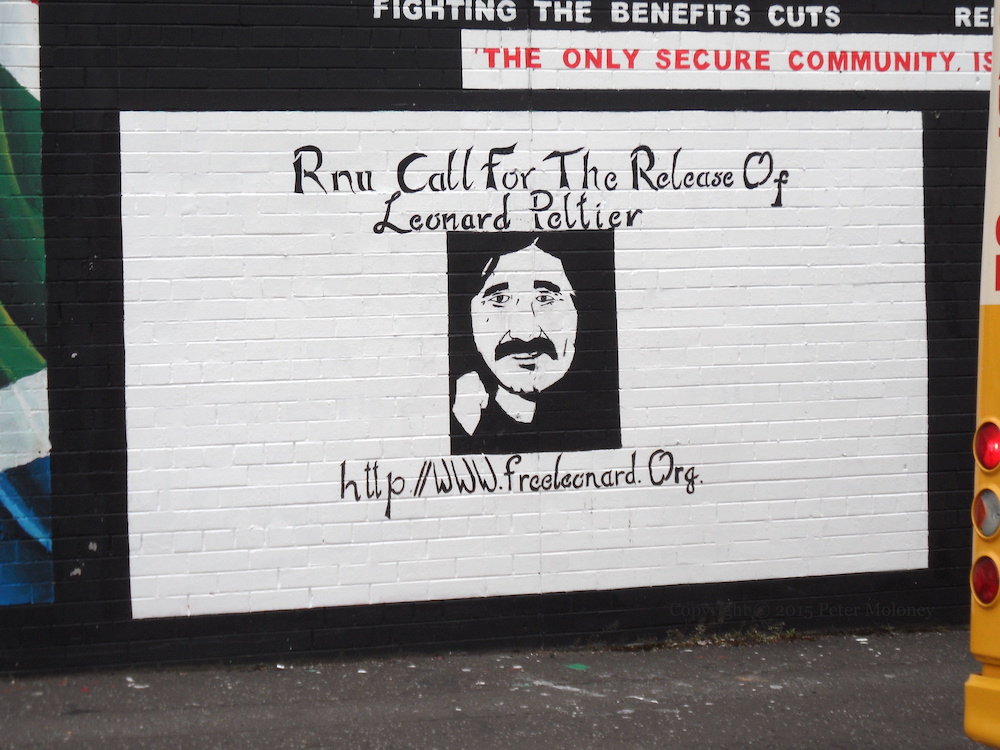
The Craigavon Two – John-Paul Wootton and Brendan McConville – were convicted in 2012 of the 2009 murder of PSNI Constable Steven Carroll (BBC) and sentenced to 18- and 25-year minimums, respectively. The case is under review (Guardian) and a campaign for their release – using the hashtag “#JFTC2” – is under way (Fb).

This supportive graffiti is in Bligh’s Lane, Derry

Click image to enlarge
Copyright © 2015 Peter Moloney
M12519 M12518

Poet, Gaeılgeoır, Revolutionary, IRA Volunteer

April 1st:

The Bobby Sands mural in Sevastopol Street has been given a facelift, including the blocking-up of a vent on Sands’s left cheek. Kieran Doherty and Joe McDonnell have been added in place of the 1798 medallions on each side. On the side-wall are Sean McCaughey, ten doves representing the 1981 hunger-strikers, and Long Kesh. Aerosol‘s accordion-player stencil has been also been retained, on the right.

For a full history of the wall, see the Bobby Sands (Sevastopol Street) Visual History page.

The ‘Slí Na Gaeltachta’ plaque off to the left reads:

Ag sráıd Sevastopol cuımhnıtear ar Bobby Sands ı múrmhaısıú a aithnıtear ar fud an domhaın. Ba scrıbhneoır, file, réabhlóıdí agus díograıseoır Gaeılge é Sands. Fuaır sé bas 5 Bealtaıne 1981 tar éıs 66 lá ar stailc ocraıs. As ucht na dıograıse a thaıspeáın Sands agus a chomhchımí ı leıth fhoglaım na teanga faoı choınníollacha uafásacha Bhlocanna H na Ceıse Fada, spreagadh glúın úr chun dul ı mbun athghabháıl na Gaeılge.

Here at Sevastopol Street Bobby Sands is remembered in a mural which has become world-renowned. Sands, a writer, poet, revolutionary and Gaelic enthusiast, died on May 5th 1981 after 66 days on hunger strike. Sands and his fellow prisoners inspired a new generation to reclaim the Irish language enthusing them by the huge efforts they put into learning Irish in the horrendous conditions on the H Blocks of Long Kesh.

Click image to enlarge
Copyright © 2015 Peter Moloney
M12515 M12502 M12503 [M12504] [M12505] [M12506] [M12507] [M12508] M12509
Slí: M11752 [M12516] [M12517]
in prog: M11749 [M11750] [M11751]

David Ervine

“He had the courage to climb out of the traditional trenches, meet the enemy in no man’s land and play ball with him.” David Ervine was a UVF member, arrested in 1974 and served six years in the Maze before turning to politics: he first ran for office in 1985 and represented East Belfast in the NI Assembly from 1998 until his death in 2007. The board shows Ervine’s silhouette in a wreath of poppies along with pictures of and information about his life, including a photograph of Ervine with Gusty Spence, who is shown holding a pipe.

Ervine’s own pipe is included among the items on the “Memory Chair” sculpture by Ross Wilson, along with a ticket for the Titanic and a little (prayer?) book with a poppy on the cover. The prayer book would be for Protestantism, the poppy for loyalism and service in WWI, and the ticket for the shipyard. The boots like the pipe are personal effects of Ervine’s.

“David Ervine 21st July 1953 – 8th January 2007 David Ervine was born in nearby Chamberlain Street, the youngest of five children. A lifelong supporter of Glentoran Football Club he was a true son of East Belfast. David attended Avoniel Primary School and Orangefield Boys High School. Leaving school before his fifteenth birthday he began his working life in an atmosphere of tension and violent confrontation. At nineteen he joined the UF. He was arrested in 1974 and served five years in Long Kesh, a wasteland that he and other prisoners transformed into a place of personal and political growth and development. A founding member of the Progressive Unionist Party and its most articulate spokesperson, he was elected to the Northern Ireland Forum, Belfast City Council and the Northern Ireland Assembly. David Ervine was a truly inspirational leader. With vision and courage he led his community from violence to peace, winning the respect of friend and foe alike. He gave voice to the common man and woman acting always in the interest of peace and his beloved Ulster.”

Click image to enlarge
Copyright © 2015 Peter Moloney
M11780 [M11781] M11782 M11783 M11784 [M11785] M11786 [M11787] [M11788] [M11789] M11790

John Bunting

“John Bunting MI5 tout”. This Tiger’s Bay placard is an indicator of the continued tensions within the North Belfast UDA that first came to public attention in December 2013. John Bunting was arrested in September (2014) and charged with the attempted murder of John Borland and Andre Shoukri, from the opposing faction.

(See Split for links to articles from 2013; for the latest, see Belfast Daily and Belfast Live.)

Mervue Street, north Belfast

Click image to enlarge
Copyright © 2015 Peter Moloney
M11771

Whiterock Flute Band

This is the post-launch version of the Whiterock flute band’s history wall (as compared to the partially completed wall from last year, before the launch). At the top, we now have a gold disc and orange lily, and, around the doorway on the far right, a list of members, photographs from years gone by, and an account of the launch, which took place on June 14th, 2014.

The final image is from July, by which time “Whiterock F.B.” in bold, white, lettering along the top right had been added.

Click image to enlarge
Copyright © 2015 Peter Moloney
M11725
M11930 [M11931] [M11932] M11933 M11934 M11935 M11936 M11937
M11929

Big Willie

This is the new plaque to “William Morgan (Big Willie). Will always be remembered and sadly missed by all his mates in Tiger’s Bay. Murdered by cowards 11th July 2002. You will never be forgotten ‘big man’.”

Morgan was struck by a hit-and-run car on July 6th, 2002 and died in hospital five days later. The car is reported to have deliberately mounted the kerb where he was walking on North Queen Street and the attack was thought to have been sectarian, as the alleged driver and passenger were republicans and the car was found burned out in the New Lodge (NewsLetter | IndyMedia).

For the old plaque, see William Morgan.

Click image to enlarge
Copyright © 2015 Peter Moloney
M11770