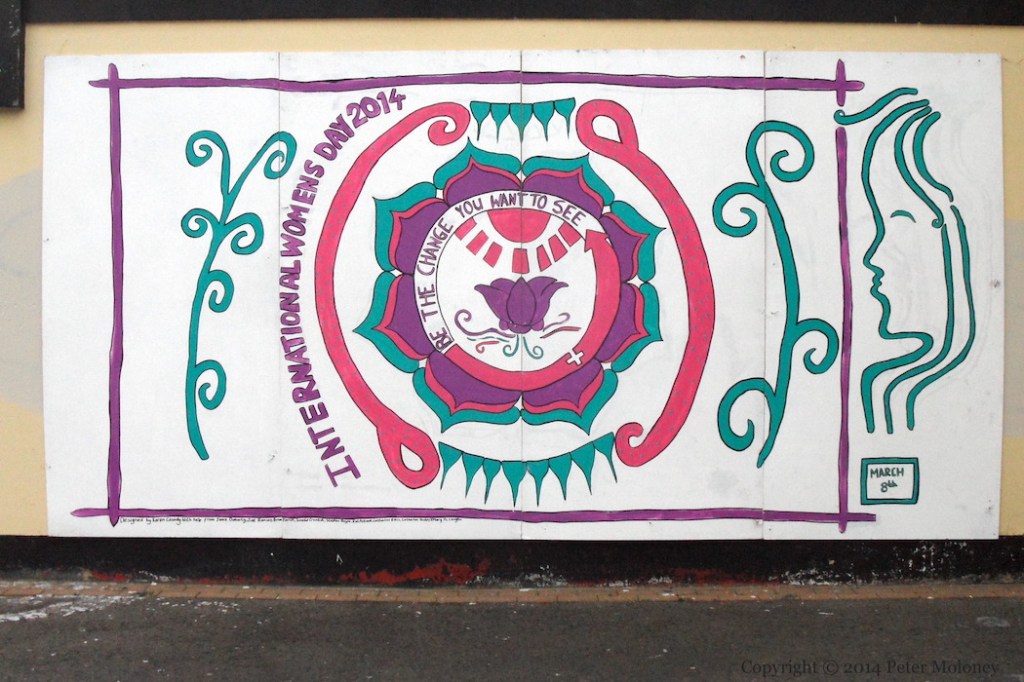
International Women’s Day, which dates as far back as 1909, is celebrated every year on March 8th. Above is the 2014 mural marking the day, in the complex of shops behind the Bogside Inn.
These Kilburn Street boards commemorate the “Young Citizen Volunteers Of Ireland” and the battle of the Somme. The text in the side-wall board (shown below) is from the diary of a Somme soldier: “We surge forward. Bayonets sparkle and glint. Cries and curses rent the air. Chums fall, some without a word … and others … Oh, my God! May I never hear such cries again! There goes the YCV flag tied to the muzzle of a rifle. That man had nerve! Through the road just ahead of us we had crossed the sunken road. We could see khaki figures rushing the German front line. The Inniskillings had got at them.”
The larger board, on the right, describes the transition from rebels in 1912 to British Army soldiers in 1914: “On the 17th May 1914 the Young Citizen Volunteers became a battalion of the Belfast regiment of the Ulster Volunteer Force. This formed part of the Ulster Division authorised on 28th October 1914 which officially became the 14th battalion of the Royal Irish Rifles, part of the 109th brigade. The 14th saw action throughout the First World War.”
It includes a quote from Edward Carson, “You will find in your ranks men with the same ideals, men with the same loyalty and the same determination to uphold the rights of their country”, and a quote from VC winner William Fredrick McFadzean, “You people at home make me feel quite proud when you tell me I am the soldier boy of the McFadzeans. I hope to play the game and if I don’t add much lustre to it I certainly will not tarnish it.”
After the Saville report (gov.uk) was published in 2010 and the victims of Bloody Sunday were vindicated (see Vindicated/Ceartaıthe), the PSNI took up its own investigation into the events of Bloody Sunday (January 30th, 1972), which is still on-going. The hoarding above – appealing for “any civilians and former soldiers” who gave evidence to Saville – appeared in Letterkenny Road, Derry.
Zombie-skeleton Eddie The Trooper rides a black steed in Londonderry’s Fountain area. There’s no explicit reference to loyalist paramilitarism here, though he will readily be understood to be hunting Catholics rather than charging Russians at Balaclava. For background, including the connection to Iron Maiden, see the Visual History page on Eddie.
The mural above uses the text of the Ulster Covenant, signed in September, 1912, as a backdrop to a composite of two photographs from 1914, showing Edward Carson speaking and a row of Ulster Volunteers, which were formed in January 1913.
Alain Miossec/Murals Irlande Du Nord has an image of the previous printed version, which is almost identical, apart from Stormont as a backdrop rather than the text of the Covenant.
Painted by Dee Craig (Fb) in Carnhill Walk, Castlemara, Carrickfergus.
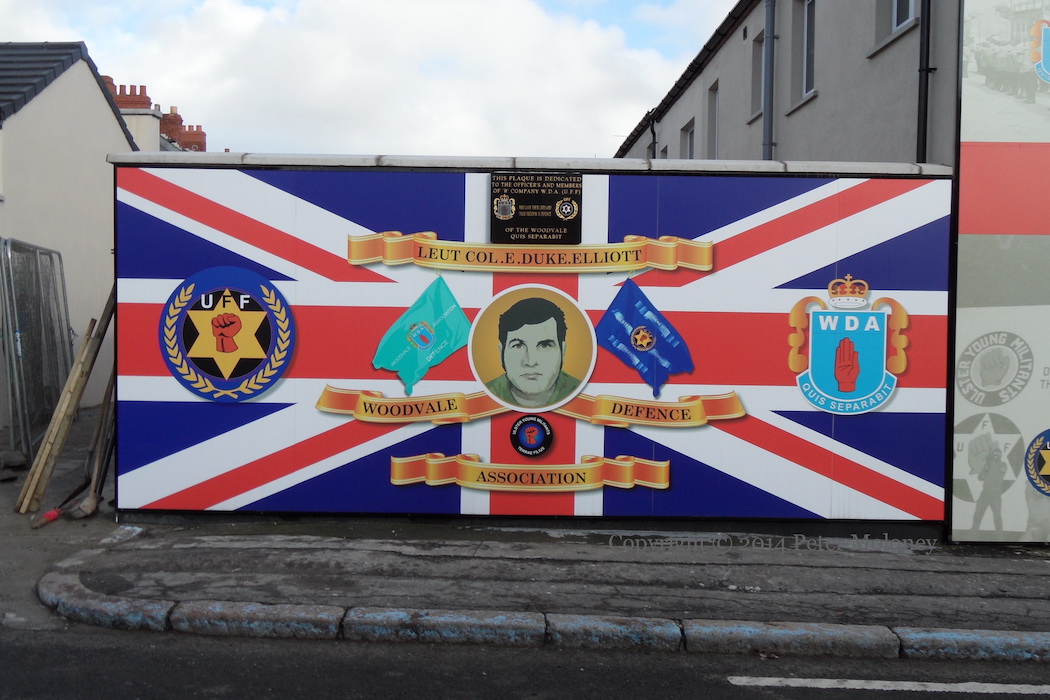
The gable wall at the end of Columbia Street (on Ohio Street) has been rebuilt and the old WDA/Duke Elliott mural has been replaced. The right side of the piece describes the transition from the Woodvale Defence Association to the Ulster Defence Association to the Ulster Freedom Fighters, and grounds all three in the Ulster Defence union of 1893. Ernie “Duke” Elliott was killed in 1972, at age 28, in a dispute with other UDA members; he lived one street over from the site of these new boards, in Leopold Street (WP).
Here is a gallery of (post-Agreement) republican graffiti in the Brandywell, including “$inn £einn”, “Remember the 14” victims of Bloody Sunday, and a quote from Patrick Pearse: “Beware of the thing that is coming”, from the poem ‘The Rebel’, which ends “And I say to my people’s masters: Beware,/Beware of the thing that is coming, beware of the risen people,/Who shall take what ye would not give.”
This installation of information and photographs relating to Operation Motorman and the killing of Seamus Bradley is next to the memorial to Bradley on the path running through Bishop’s Field (which contains complete information about his death).
Here is a gallery of (post-Agreement) republican graffiti from Creggan, including references to the 14 deceased of Bloody Sunday (1972), republican prisoners, and possible (non-)prosecution of British soldiers.