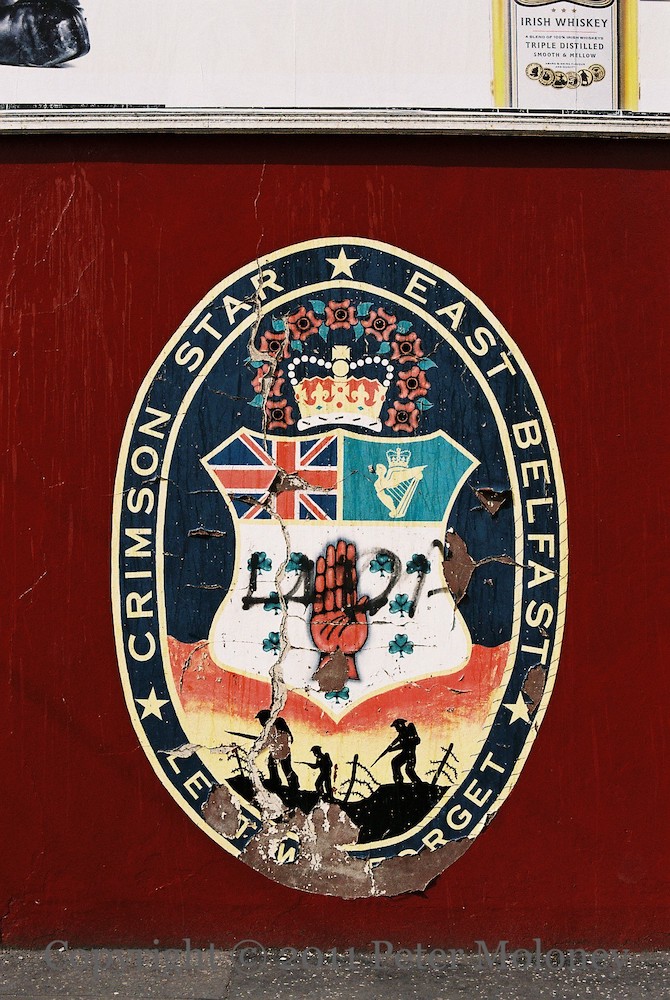
This Hillborough Drive stencil dates back to the ceasefire and the Agreement, when the release of political prisoners was a prominent issue in negotiations on both sides. Republicans had a “green ribbon” campaign; loyalists used the the stencil shown here, which has fared better than the plaster it is painted on.
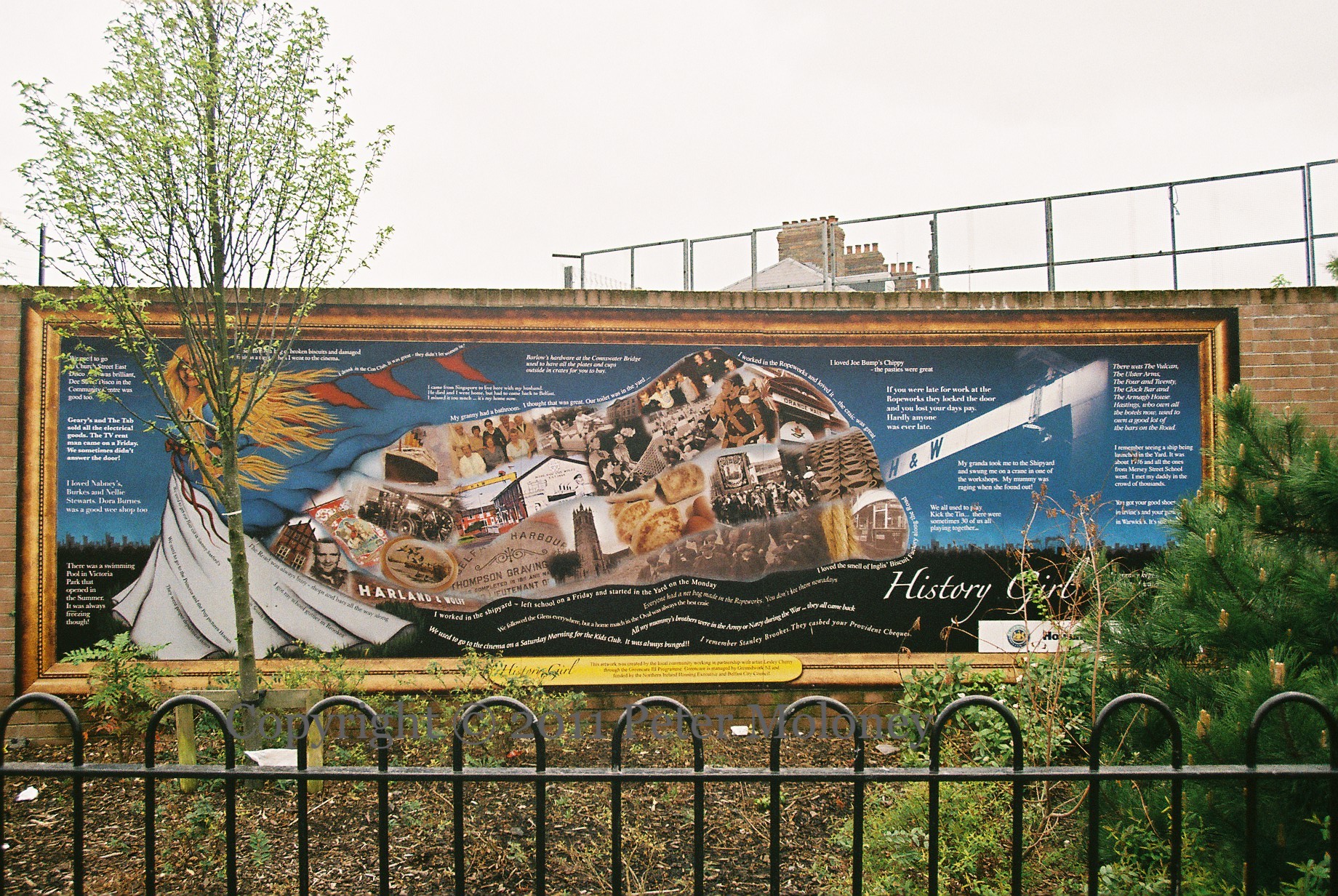
Memories from the History Girl mural in east Belfast’s Thistle Court. (By Lesley Cherry, and with support from the Housing Executive.)
We used to go to Church Street East Disco … It was brilliant. Dee Street Disco in the Community Centre was good too.
Geary’s and The Tab sold all the electrical goods. The TV rent man came on a Friday. We sometimes didn’t answer the door!
I loved Nabney’s, Burkes and Nellie Stewarts. Dora Burnes was a good wee shop too.
There was a swimming pool in Victoria Park that opened in the summer. It was always freezing though!
I used to buy a bag of broken biscuits and and damaged fruit as a treat, when I went to the cinema.
We used to get our hair cut in Sammy Sanford’s.
The Road was always busy – shops and bars all the way along.
Barlow’s hardware at the Conswater Bridge used to have all the plates and cups outside in crates for you to buy.
I drank in the Con Club. It was great – they didn’t let women in!
I came from Singapore to live here with my husband. He died and I went home, but had to come back to Belfast. I missed it too much … it’s my home now.
My granny had a bathroom. I thought that was great. Our toilet was in the yard …
I worked in the Ropeworks and love it … the craic was great.
I loved Joe Bump’s chippy – the pasties were great.
If you were late for work at the Ropeworks they locked the door and you lost your pay. Hardly anyone was ever late.
My grandpa took me to the shipyard and swung me on a crane in one of the workshops. My mummy was raging when she found out!
We used to play Kick the Tin … there were sometimes 30 of us all playing together …
I loved the smell of Inglis’ Biscuit Factory along the Road.
The was The Vulcan, The Ulster Arms, The Four and Twenty, The Clock Bar and The Armagh House. Hastings, who own all the hotels now, used to own a good lot of the bars on the Road.
I remember seeing a ship being launched in the yard. It was about 1976 and all the ones from Mersey Street School went. I met my daddy in the crowd of thousands.
You got your good shoes in Irvine’s and your gutties in Warwick’s. It’s still there.
My granny kept her milk in a bucket of water because she had no fridge.
I worked in the shipyard – left school on a Friday and started in the Yard on Monday.
Everyone had a net bag made in the Ropeworks. You don’t see them nowadays.
We followed the Glens everywhere, but a home match in the Oval was always the best craic.
All my mummy’s brothers were in the Army or Navy during the War … they all came back.
I remember Stanley Brookes. They cashed your Providence Cheques.
We used to go to the cinema on a Saturday morning for the Kids Club. It was always bunged!!
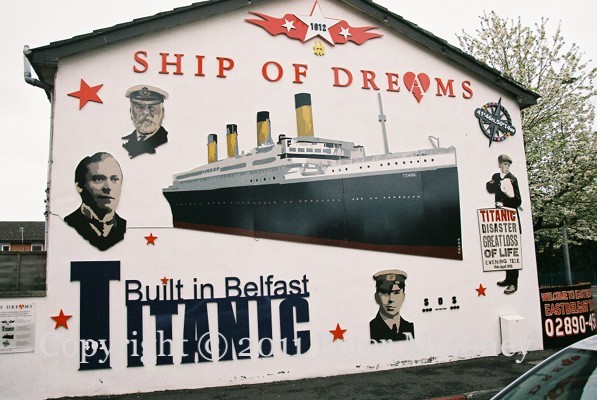
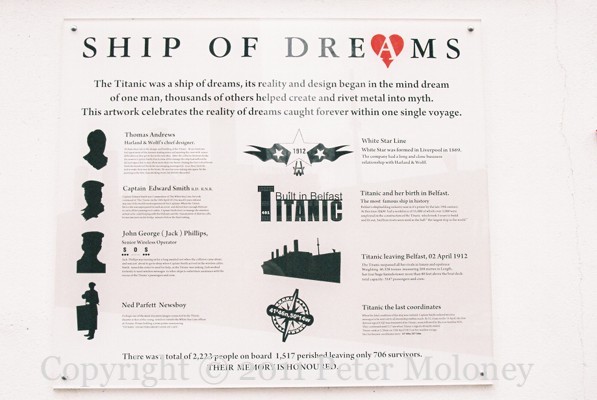
“Built in Belfast”. The White Star Line ship Titanic sank in the Atlantic in the early morning of April 15th, 1912, a thousand miles from New York (the co-ordinates are given in the top right), having been launched from Belfast’s Harland & Wolff shipyard, which is near this mural just off the Newtownards Road in east Belfast. The portraits are of Captain Edward Smith, architect Thomas Andrews, Jack Phillips (wireless officer), and paperboy Ned Parfett.
A boy in blue and girl in green, from opposite communities in east Belfast, shake hands against the backdrop of the Harland & Wolff cranes. The poem “No More” in the middle of the mural is by community worker Jim Wilson, whose grandson Dylan is shown on the left. A smaller version of this mural, without the poem, is in Short Strand’s Edgar Street – see No More.
“No more bombing, no more murder No more killing of our sons No more standing at the grave side Having to bury our loved ones No more waking up every hour Hoping our children, they come home No more maimed or wounded people Who have suffered all alone No more minutes to leave a building No more fear of just parked cars No more looking over our shoulders No more killing in our bars No more hatred from our children No more. No more. No more!”
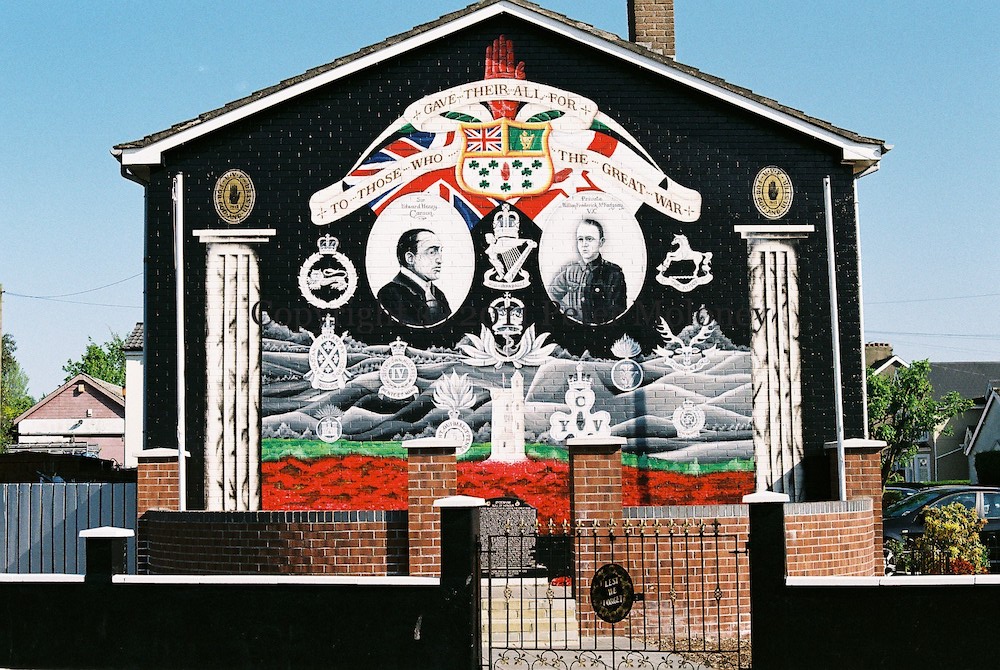
The portraits are of Edward Henry Carson and Private William McFadzean VC; the stone is a “Sydenham Roll Of Honour”. The insignia of various British Army units are shown over the hills around Thiepval and a sea of poppies. Seen previously from a distance in 2010.
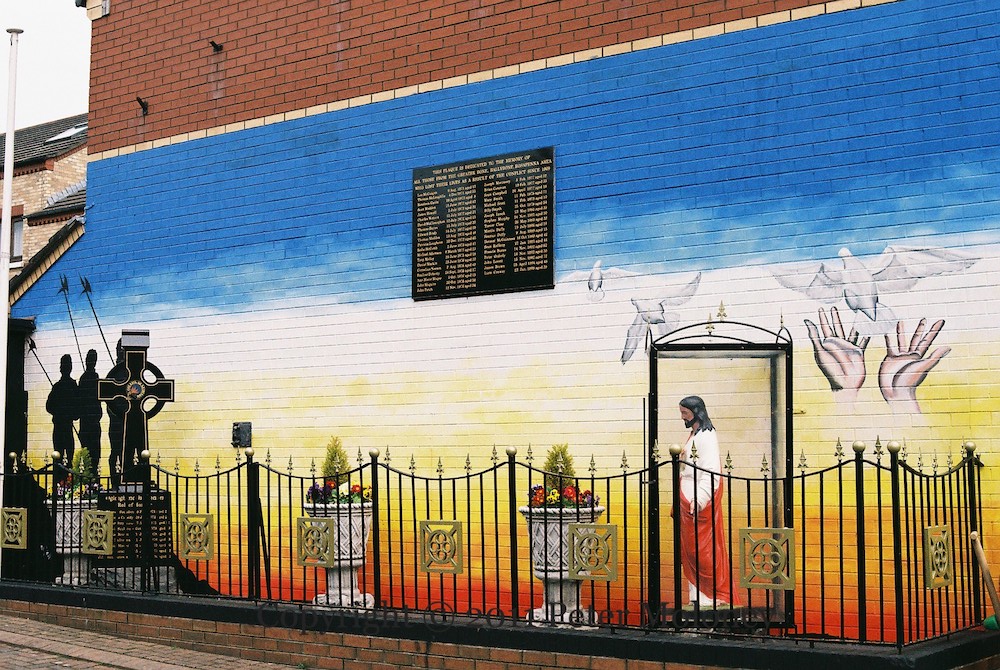
A mural of hands releasing doves is added to the memorial garden in Clós Ard An Lao, in Ardoyne (and a lower plaque is removed). In the middle is a plaque in remembrance of 38 local people (“from the greater Bone, Ballybone, Rosapenna area”) who died during the troubles, on the left, next to the pikemen, is a celtic cross with an Óglaıgh Na hÉıreann roll of honour; on the right is a statue of Jesus with a sacred heart.
In addition to three plaques, a wrought-iron head-piece, multiple flag-pole holders and railings fencing in a small area, this mural in Clós Ard An Lao/Ardilea Close in Ardoyne uses painted discs for each of the twelve hunger strikers (the ten in Long Kesh 1981 and two from the 70s in English prisons, Michael Gaughan and Frank Stagg – the twelve also featured in Derry’s Spirit Of Freedom mural), rather than painting their likenesses directly onto the wall. The two quotes are from Bobby Sands “Let our revenge by the laughter of our children” and Michael Gaughan “Let there be no bitterness on my behalf to achieve a united Ireland”.
The items above the mural are new, compared to 2010. The plaque on the left is to people who died “in defence of the area” and on the right to those who died “of natural causes” who endured discrimination, hardship, suffering, imprisonment.




 Peter Moloney Collection