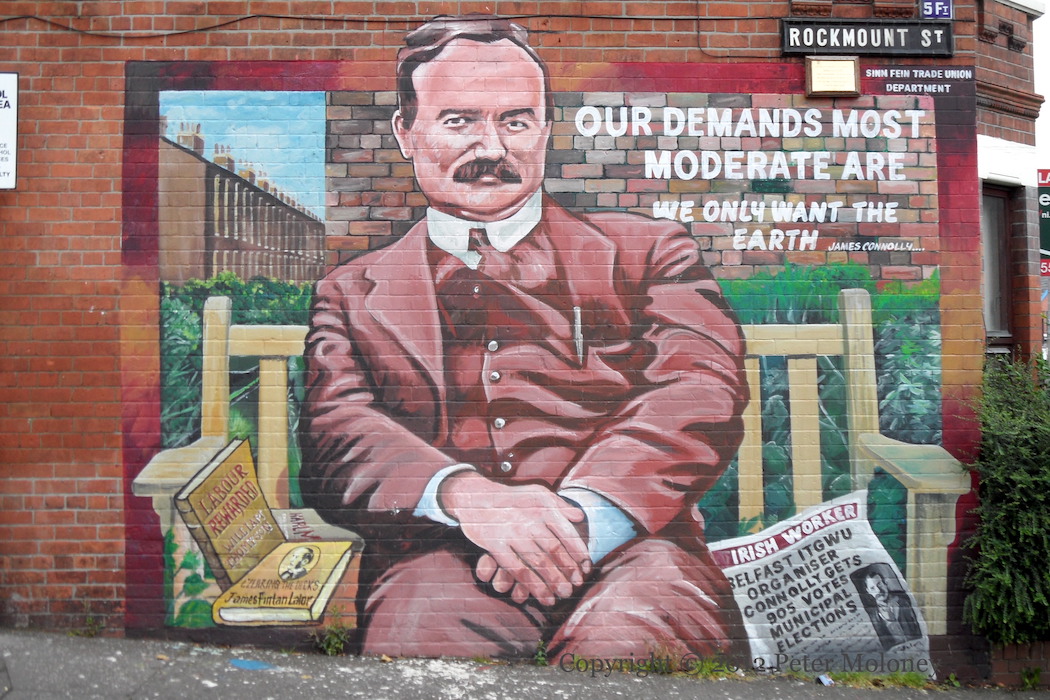
The sixteen-year old Sınn Féın Trade Union Dept mural has been replaced (though the plaque remains in the top right-hand corner) with another mural featuring James Connolly but with a new quote, from his 1907 poem: “Our demands most moderate are/We only want the earth.” The Irish Worker headline reads “Belfast ITGWU organiser Connolly gets 905 votes municipal elections”, referring to the municipal elections of 1913 – Connolly stood in the Dock Ward (SIPTU).
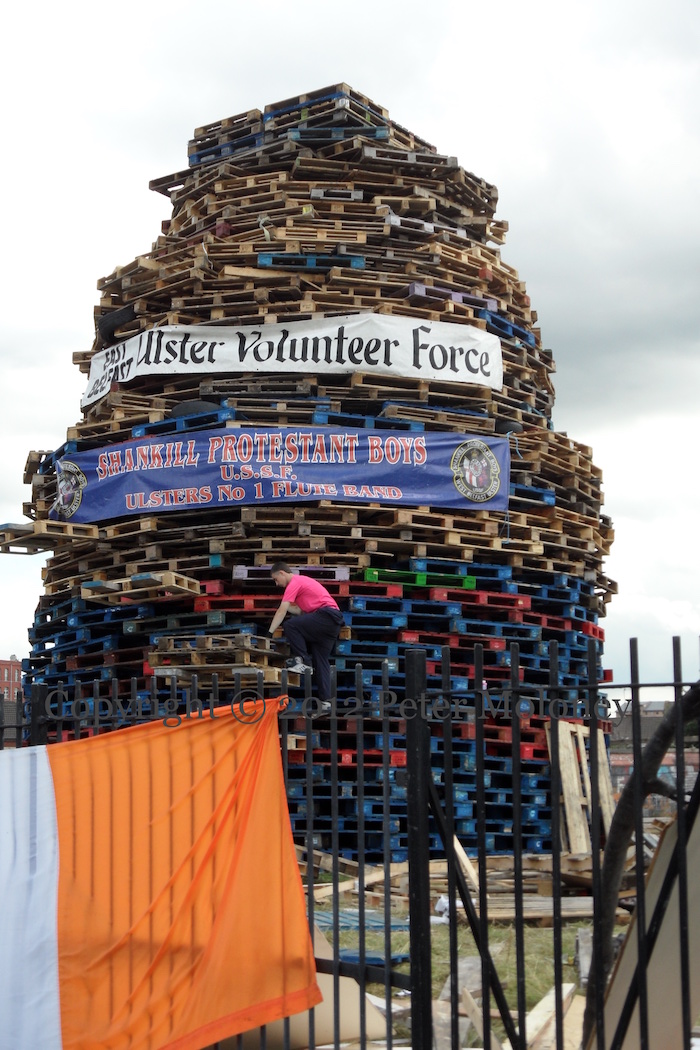
Two PUL banners are added to the internment bonfire in Divis: the upper one says “East Belfast Ulster Volunteer Force”, while the latter reads “Shankill Protestant Boys [Fb] USSF Ulsters No 1 flute band.” On the top is a Drumcree Orange Order flag: “Civil and religious liberty”; “Here we stand, we can do no other”.
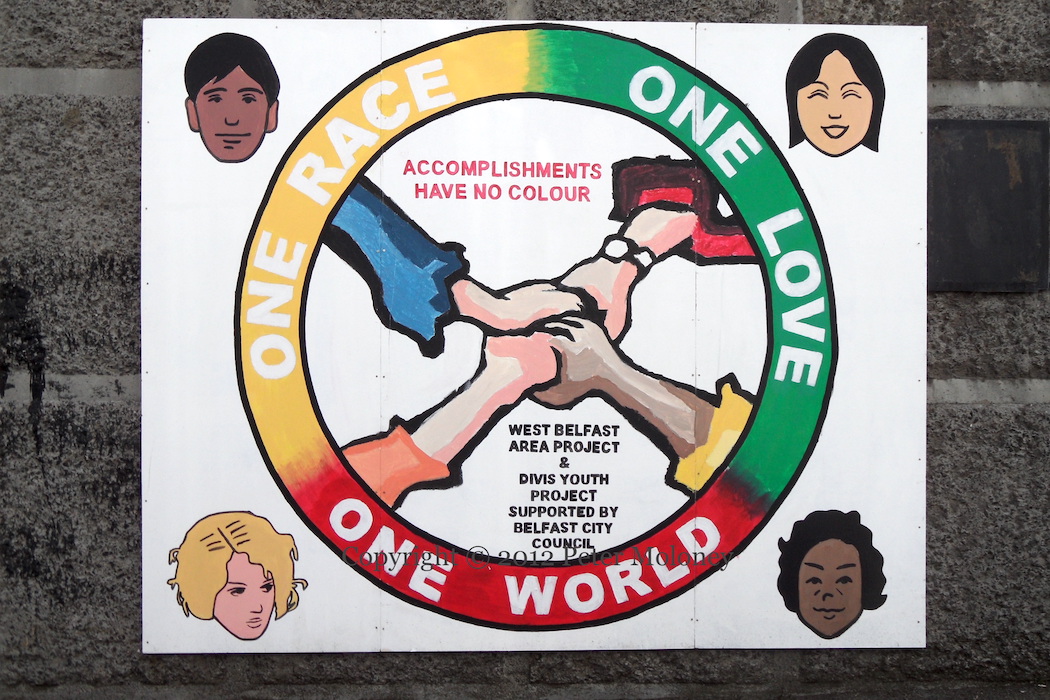
“One race – one love – one world. West Belfast Area Project & Divis Youth Project supported by Belfast City Council.” A wheel of hands from children of different races exhorts residents to overlook differences in skin-tone.
Marty Lyons is shown adding the WARN emblems to an otherwise-completed mural on the International Wall, Divis Street.
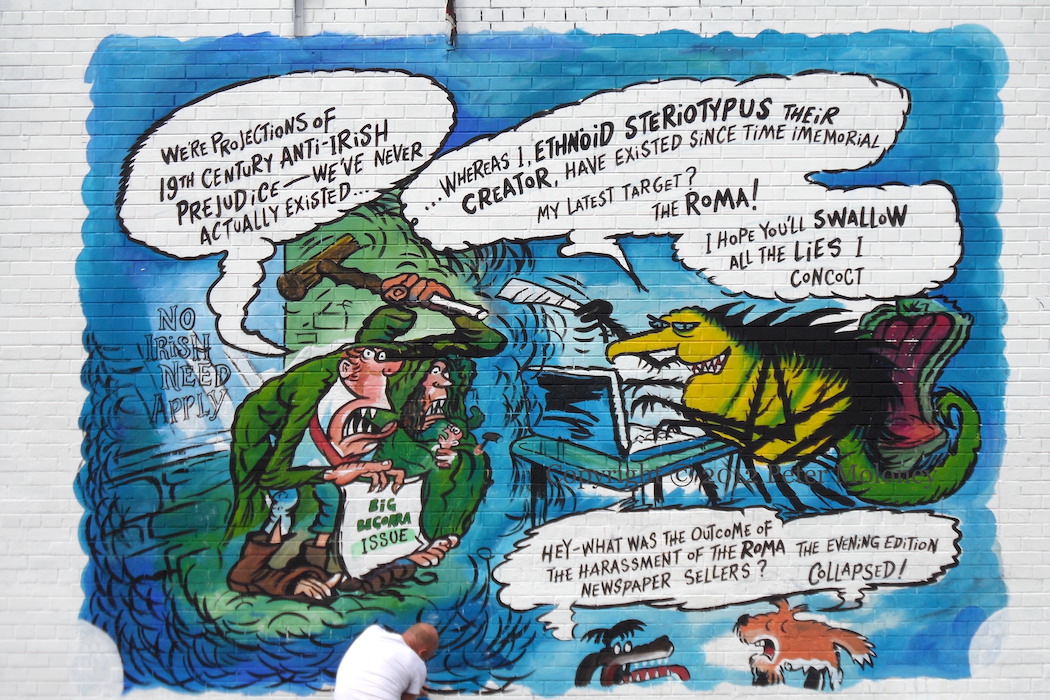
On the left, an Irish family in front of a window reading “No Irish need apply” is stereotyped as jagged-toothed, shillelagh-wielding hunch-backs in the style of Punch and other magazines’ portrayal of the Irish. The Punch portrayal is described, and Punch named explicitly, in the song ‘Do Me Justice’ a.k.a. ‘Here I Am From Donegal’. (Lyrics | audio: Frank Harte (full song) | Len Graham (clip).) They also carry a copy of “The Big Begorra” – a play on The Big Issue, a newspaper published on behalf of, and sold by, homeless people. “We’re projections of 19th century anti-Irish prejudice—we’ve never actually existed.”
The treatment of the Irish is used as an anology for the the Roma (WP): “Whereas I, ethnoid steriotypus their creator, have existed since time immemorial. My latest target—the Roma! I hope you’ll swallow all the lies I concoct.”
“Hey—what was the outcome of the harassment of the Roma newspaper sellers?” “The evening edition collapsed!” – this is a reference to the Belfast Telegraph‘s decision to cease printing an evening edition.
In the lower right is the signature of political cartoonist Ian Knox, a.k.a. Blotski (WP) – Marty Lyons and a Short Strand artist were also involved – and date (9 August, 2012 – for Féile 2012 (pictures of the launch).
“Get the real story – local history from local people – take a black taxi tour – West Belfast Taxi Association – 40 years unbroken service”. The tours of “local” history are of course aimed at non-locals as part of the ‘dark tourism’ or ‘Troubles tourism’ boom.
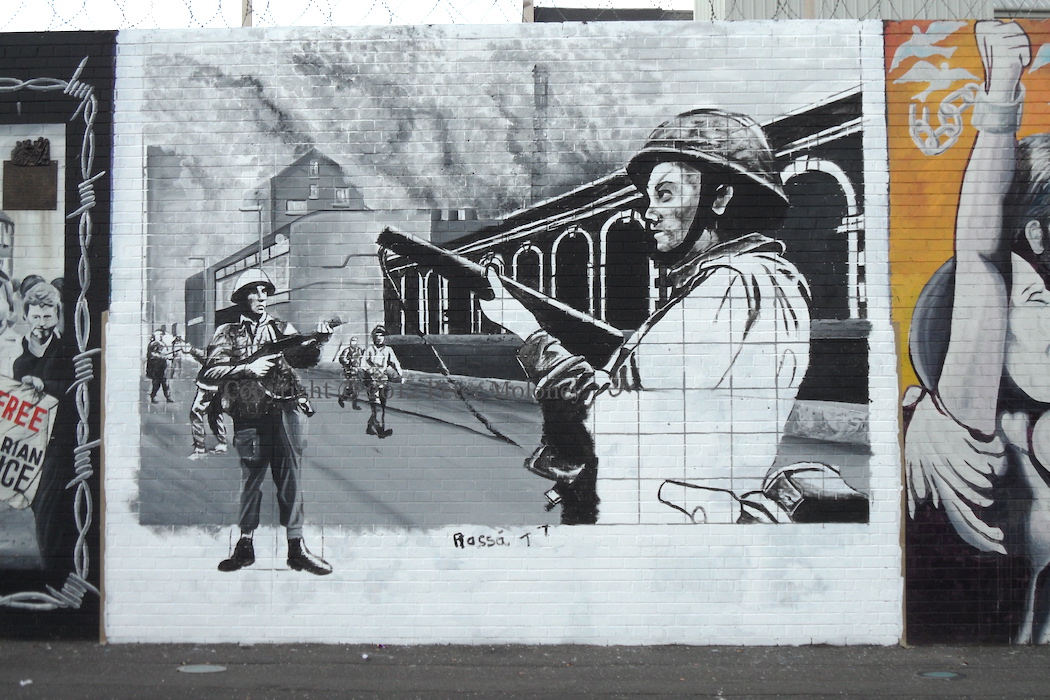
Here is the Getty Images photo of British Army soldiers on the Falls Road in 1969, on which the mural is based.
This mural expresses solidarity between Irish republican and Palestinian prisoners of war. It was painted by Carlos Latuff, a Brazilian political cartoonist, in collaboration with a local artist. There’s a picture of them in front of the mural, as well as Latuff’s cartoon version, here. He also drew a cartoon on the wall of a café in Belfast and visited Derry.
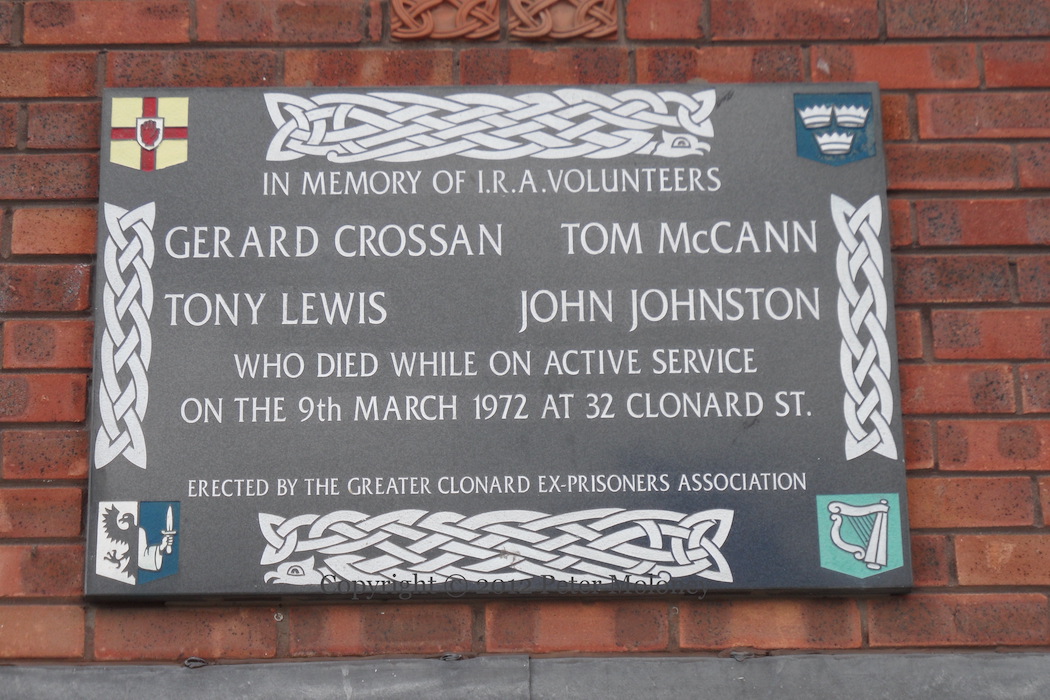
“In memory of IRA volunteers Gerard Crossan, Tom McCann, Tony Lewis, John [Sean] Johnston, who died while on active service on the 9th March 1972 at 32 Clonard St. Erected by the Greater Clonard Ex-Prisoners Association.” The four died in a premature explosion (“active service”) presumably at the home of Lewis, who lived in Clonard Street. Crossan and Johnston were 19, McCann and Lewis were 20 (The Troubles 11).
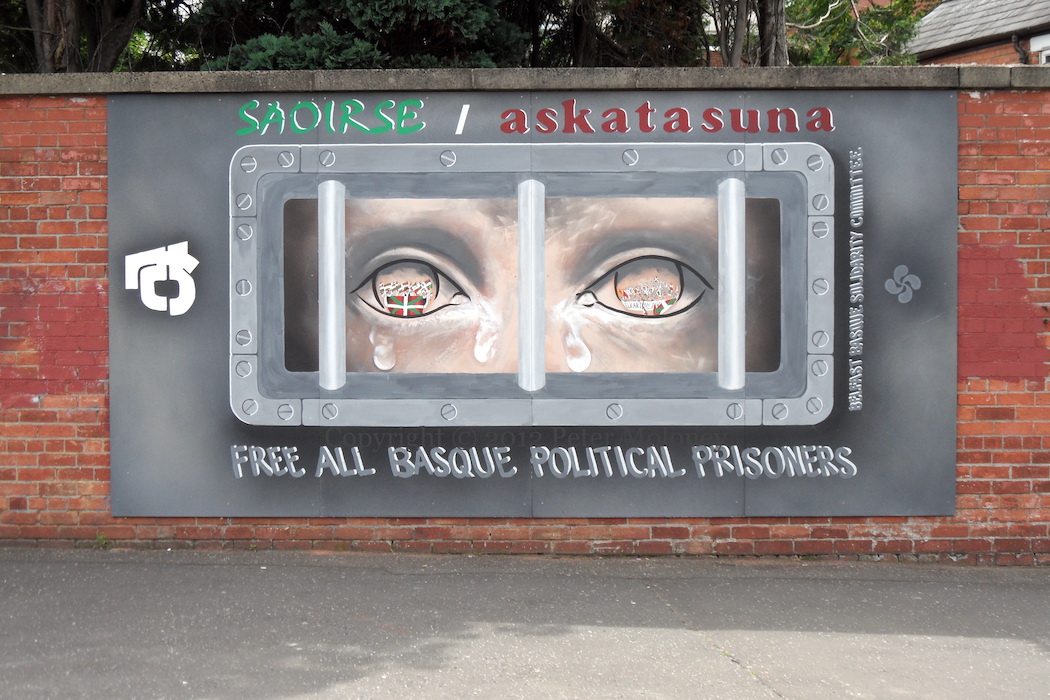
“Free all Basque political prisoners” – a new mural launched during Féıle 2012 in Beechmount Avenue, Belfast.
The symbol on the left represents amnesty for Basque prisoners (BasqueMurals). On the right, next to “Basque Belfast Solidarity Committee” (Fb) is the Basque cross of Lauburu (WP).
Ballymurphy, The Aftermath was first produced for Féile in 2011 and returned for Féile 2012, running for a week in the Conway Mill. The play was written by Brenda Murphy and directed by Pam Brighton (An Phoblacht | Ballymurphy Massacre | BBC).






 Peter Moloney Collection