The Parades Commission (web) ruled in 2013 – and in 2014 and now again in 2015 – that the Orange Order could not parade past the Ardoyne shops. A legal bid to reverse the decision was rejected by.a High Court judge (BBC).
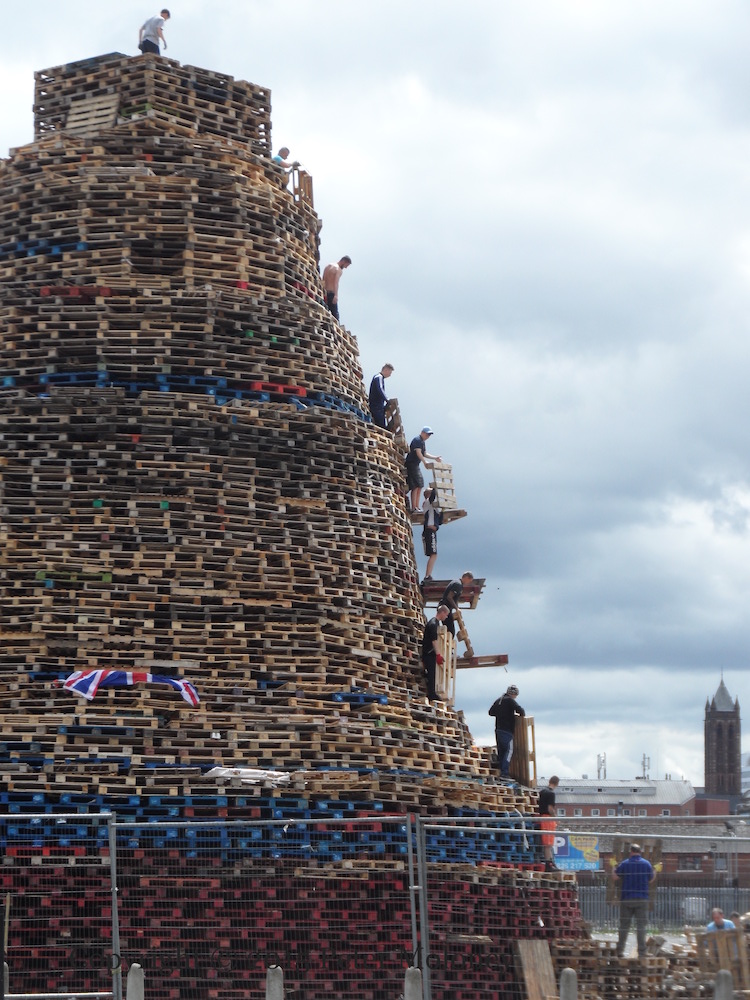
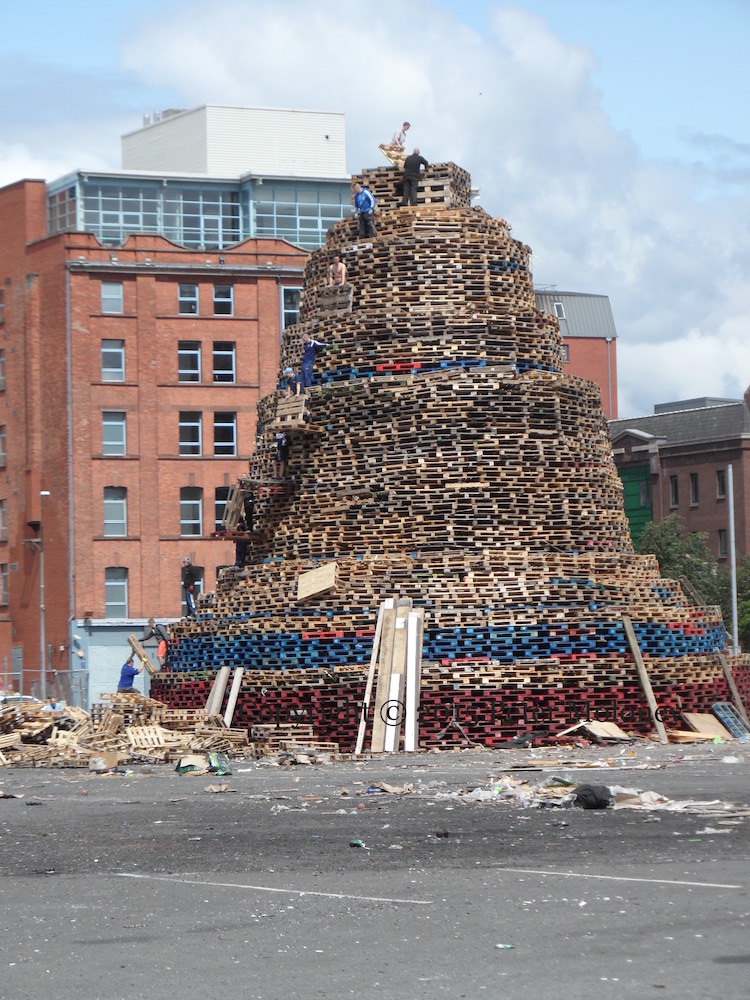
In protest, a giant Tricolour with the words “These are the colours of the Parades Commission” have been added to the side of the Sandy Row bonfire (in the Days Hotel car-park) that is due to be lit this evening – Eleventh Night.
This is a second repainting of the King Billy mural in Donegall Pass. The note in the corner says that this and the 2002 repainting (which added the painting of the Lindsay Street arch) were by “MW”, and the original mural painted in 1989 by “H. Gibson”.
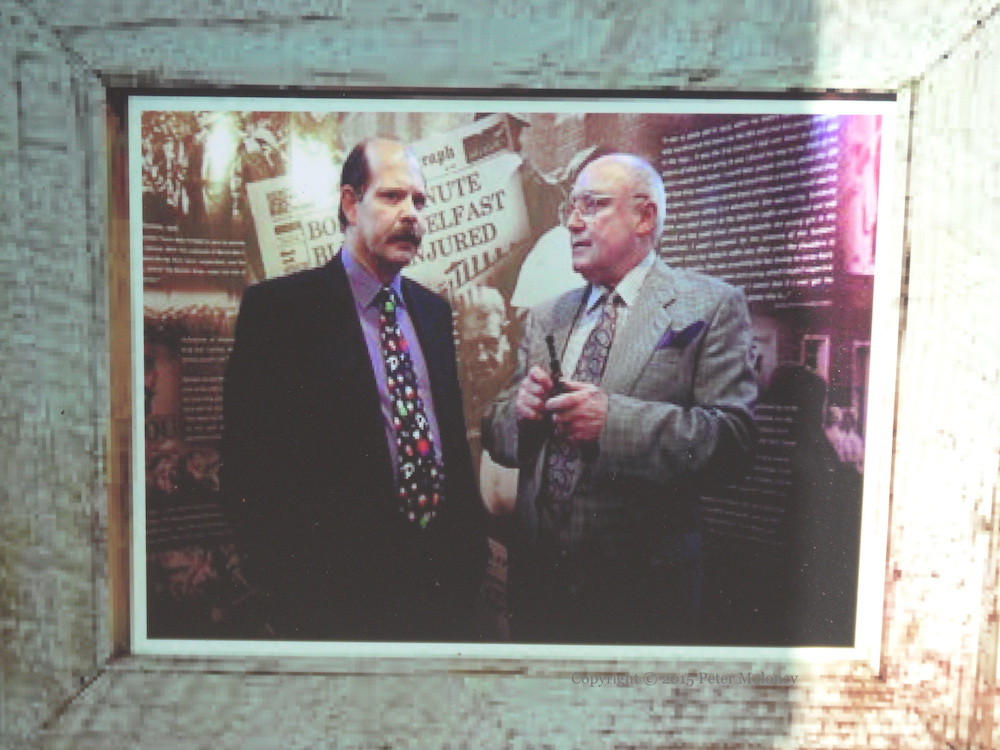
“He had the courage to climb out of the traditional trenches, meet the enemy in no man’s land and play ball with him.” David Ervine was a UVF member, arrested in 1974 and served six years in the Maze before turning to politics: he first ran for office in 1985 and represented East Belfast in the NI Assembly from 1998 until his death in 2007. The board shows Ervine’s silhouette in a wreath of poppies along with pictures of and information about his life, including a photograph of Ervine with Gusty Spence, who is shown holding a pipe.
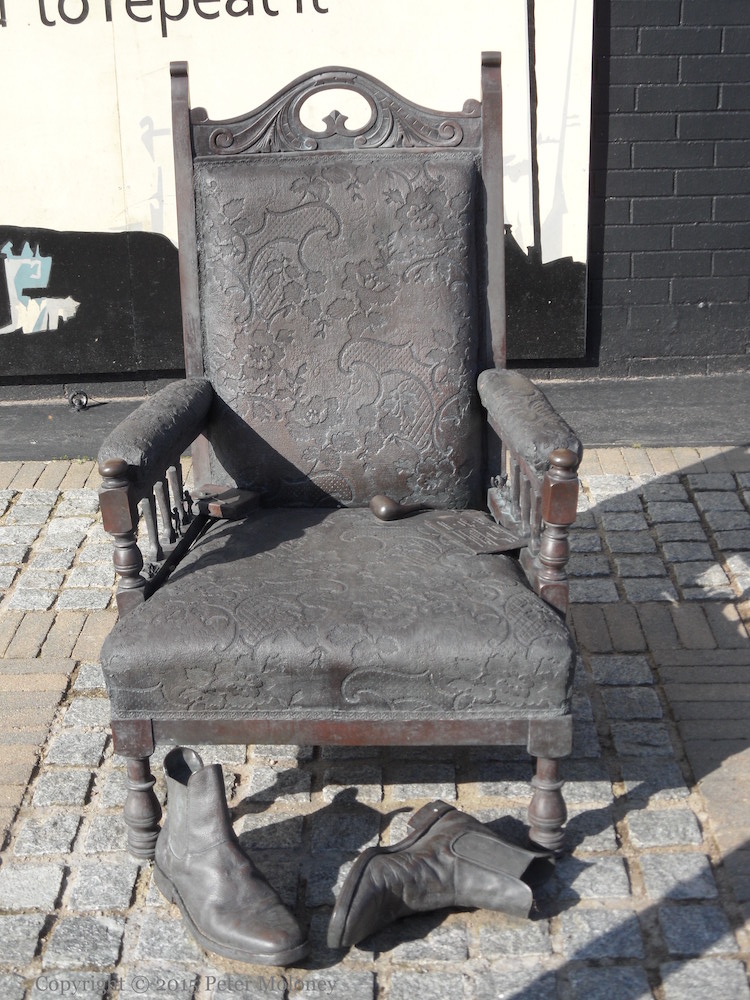
Ervine’s own pipe is included among the items on the “Memory Chair” sculpture by Ross Wilson, along with a ticket for the Titanic and a little (prayer?) book with a poppy on the cover. The prayer book would be for Protestantism, the poppy for loyalism and service in WWI, and the ticket for the shipyard. The boots like the pipe are personal effects of Ervine’s.
“David Ervine 21st July 1953 – 8th January 2007 David Ervine was born in nearby Chamberlain Street, the youngest of five children. A lifelong supporter of Glentoran Football Club he was a true son of East Belfast. David attended Avoniel Primary School and Orangefield Boys High School. Leaving school before his fifteenth birthday he began his working life in an atmosphere of tension and violent confrontation. At nineteen he joined the UF. He was arrested in 1974 and served five years in Long Kesh, a wasteland that he and other prisoners transformed into a place of personal and political growth and development. A founding member of the Progressive Unionist Party and its most articulate spokesperson, he was elected to the Northern Ireland Forum, Belfast City Council and the Northern Ireland Assembly. David Ervine was a truly inspirational leader. With vision and courage he led his community from violence to peace, winning the respect of friend and foe alike. He gave voice to the common man and woman acting always in the interest of peace and his beloved Ulster.”
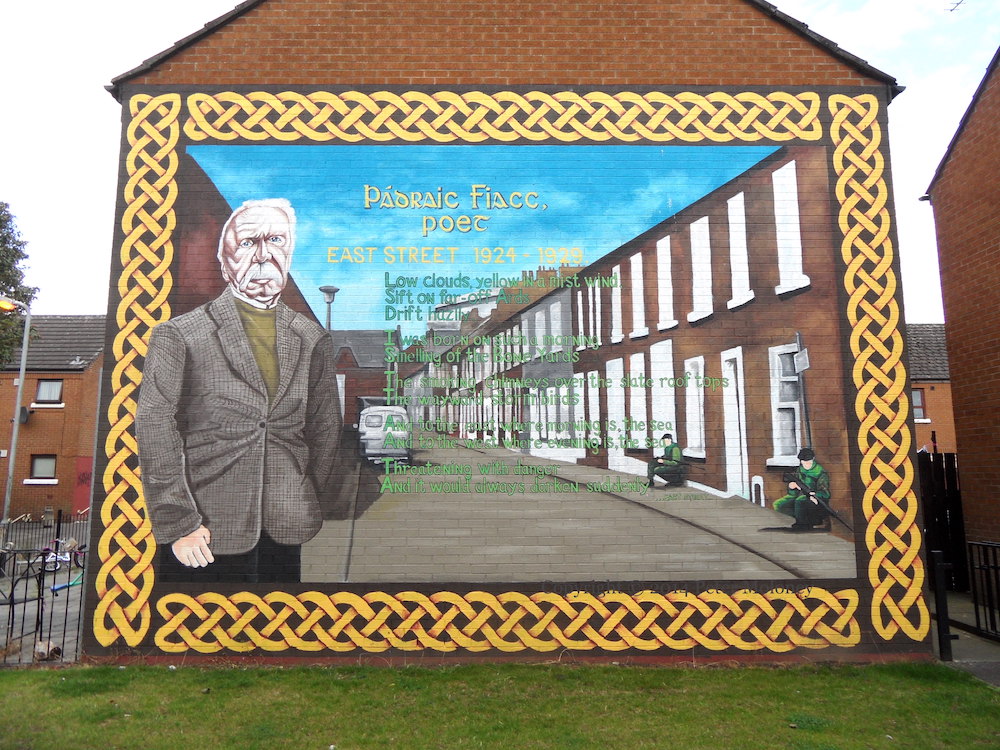
Patrick O’Connor was born on April 15th, 1924, on the lower Falls but after his father emigrated he spent his early years – until age 5 – with his grandparents in East Street in the Markets. It was as a high-schooler in New York that he adopted the name Pádraıc Fıacc (“fıach dubh” is “raven”) and began writing poetry. He settled in Glengormley upon his second and final return; it is not clear that he ever saw East Street lined with British Army soldiers, as shown in the mural above. He wrote of his early life in ‘First Movement’:
Low clouds, yellow in a mist wind Sift on far-off Ards Drift hazily … I was born on such a morning Smelling of the bone yards The smoking chimneys over the slate top roofs The wayward storm birds And to the east where morning is, the sea And to the west where evening is, the sea Threatening with danger And it would always darken suddenly
Some of Fıacc’s poems are in the TroublesArchive. There are two videos below. The first is an interview with NVTv’s Bernard Conlon; the second is of a reception in Belfast City Hall.
“The Market community supports Palestine – End the siege on Gaza – Free Palestine”. Tears of blood flow from a boy’s face, shrouded by a Palestinian flag and behind barbed wire. Along the bottom, in red lettering, is a quote from Malcolm X’s autobiography: “If you’re not careful, the newspapers will have you hating the [people who are being] oppressed and loving the oppressor [the people who are doing the oppressing].”
“To the memory of Gareth Keys – Mural artist of original artwork Walnut Street, Donegall Pass.” This is a printed version of the YCV mural that was on the side of the Ivy bar in Donegall Pass. The bar closed in 2010 and sat vacant until it was demolished in 2014. The new print has been added below the roll of honour on the side of the Lookout on the next street over (Pine St).
There is a new ‘Young Conquerors flute band’ mural in Pine Street, south Belfast, connecting the band to local soldiers who died in WWI. (Previous mural.)
The photograph on the left of the main panel is of the original Donegall Pass Defenders flute band, which lasted a short time in the 1970s before the formation of the Conquerors in 1977 (Fb). On the right is the patch of the band.
The small board reads “DPYM” – perhaps “Donegall Pass Young Militia”
Here are three boards in Lindsay Street, south Belfast, chronicling the 1912 Covenant and the lives lost (by the 36th Division) in the Great War 1914-1918.
“It is needful that we knit together as one man, each strengthening the other, and not holding back of counting the cost” – Ulster [Unionist] Council Resolution 1912.” “Ulster’s solemn league and covenant. Ulster Day 28th September 1912.” The Council met on September 23rd and 471,000 people signed the covenant (figures here) on or around the 28th – Ulster Day – led by Sir Edward Carson.
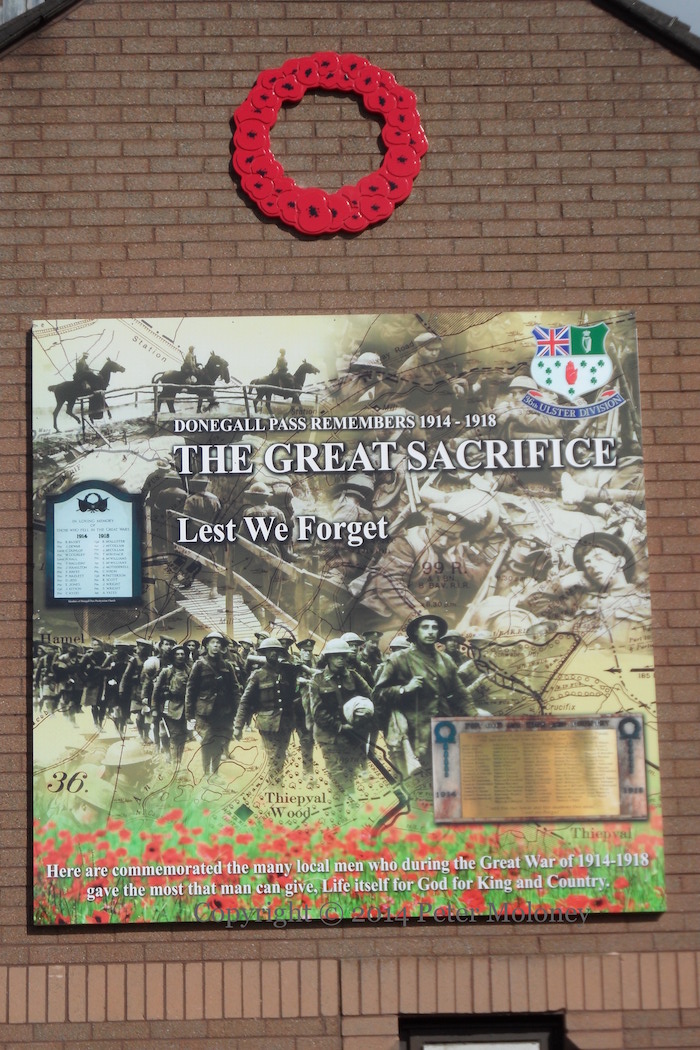
“Donegall Pass remembers 1914-1918 – the great sacrifice. Lest we forget. Here are commemorated the many local men who during the Great War of 1914-1918 gave the most that man can give: life itself for God for King and Country.” With a map of the northern end of the Western Front and images of soldiers marching, on horseback, and in the trenches.
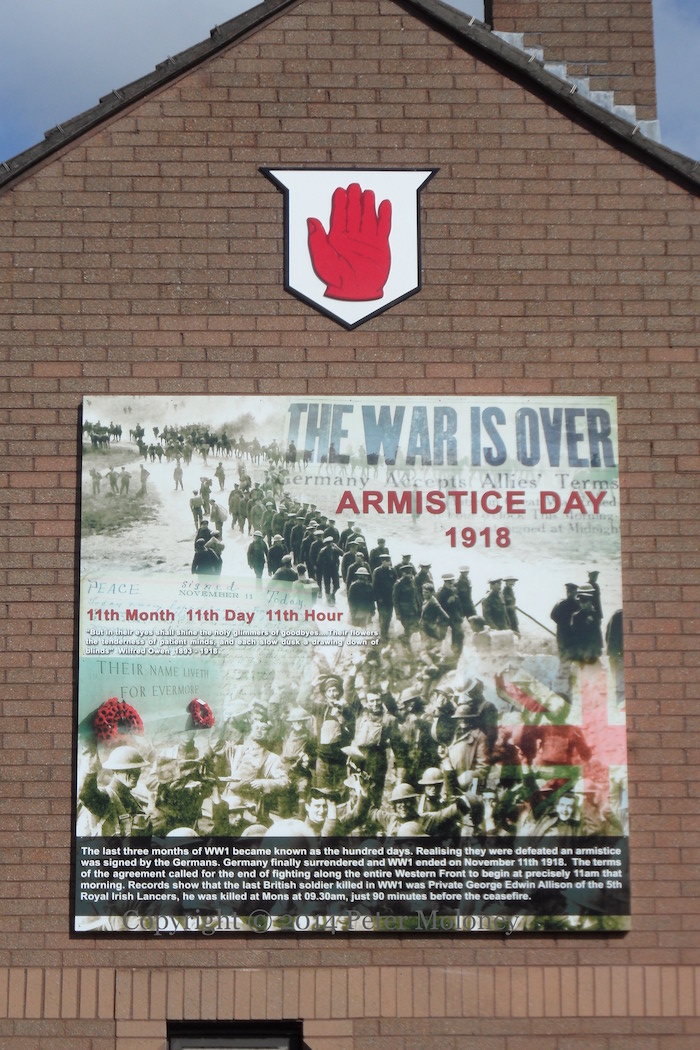
“The war is over. Armistice Day 1918. 11th month, 11th day, 11th, hour.” “But in their eyes shall shine the holy glimmers of goodbyes … Their flower the tenderness of patient minds, and each slow dusk a drawing down of blinds.” Lines from Wilfred Owens’ (1893-1918) ‘Anthem For Doomed Youth‘.
At the bottom: “The last three months of WWI became known as the hundred days. Realising they were defeated an armistice was signed by the Germans. Germany finally surrendered and WWI ended on November 11th 1918. The terms of the agreement called for the end of fighting along the entire Western Front to begin a precisely 11 am that morning. Records show that the last British soldier killed in WWI was Private George Edwin Allison of the 5th Royal Irish Lancers. He was killed at Mons at 09:30 am, just 90 minutes before the ceasefire.”
These Kilburn Street boards commemorate the “Young Citizen Volunteers Of Ireland” and the battle of the Somme. The text in the side-wall board (shown below) is from the diary of a Somme soldier: “We surge forward. Bayonets sparkle and glint. Cries and curses rent the air. Chums fall, some without a word … and others … Oh, my God! May I never hear such cries again! There goes the YCV flag tied to the muzzle of a rifle. That man had nerve! Through the road just ahead of us we had crossed the sunken road. We could see khaki figures rushing the German front line. The Inniskillings had got at them.”
The larger board, on the right, describes the transition from rebels in 1912 to British Army soldiers in 1914: “On the 17th May 1914 the Young Citizen Volunteers became a battalion of the Belfast regiment of the Ulster Volunteer Force. This formed part of the Ulster Division authorised on 28th October 1914 which officially became the 14th battalion of the Royal Irish Rifles, part of the 109th brigade. The 14th saw action throughout the First World War.”
It includes a quote from Edward Carson, “You will find in your ranks men with the same ideals, men with the same loyalty and the same determination to uphold the rights of their country”, and a quote from VC winner William Fredrick McFadzean, “You people at home make me feel quite proud when you tell me I am the soldier boy of the McFadzeans. I hope to play the game and if I don’t add much lustre to it I certainly will not tarnish it.”










 Peter Moloney Collection