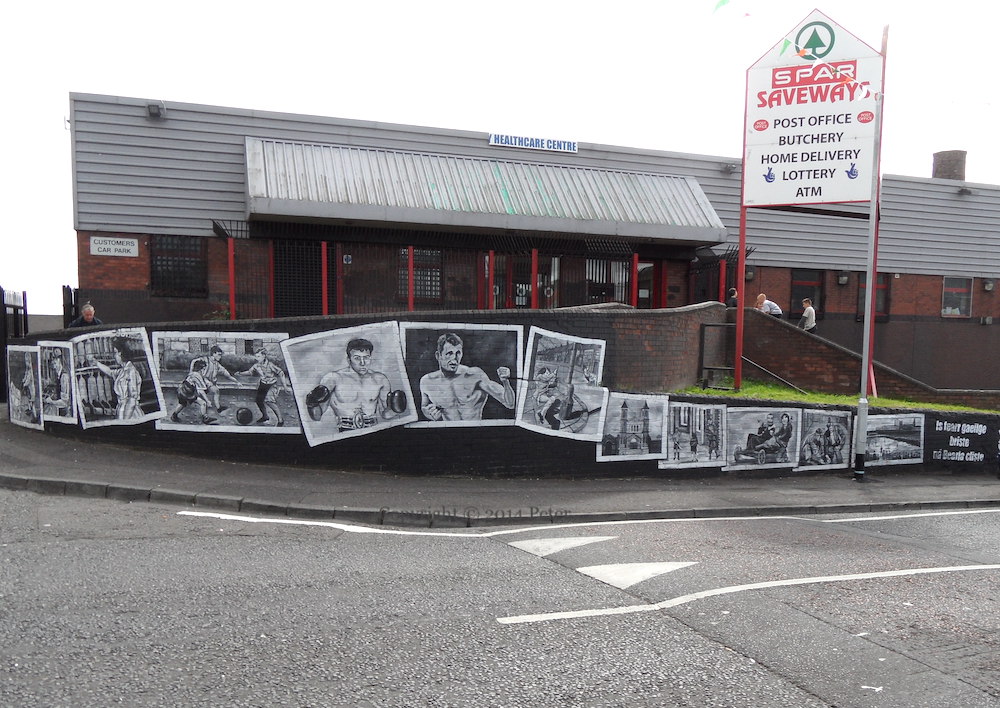
This is an end-of-life image – or perhaps a preparation-for-repainting image – of the mural at the corner of Ardoyne Avenue. The mural is still is reasonable shape (compared to 2008) but the 34 medallions with portraits to local volunteers and activists have been removed.
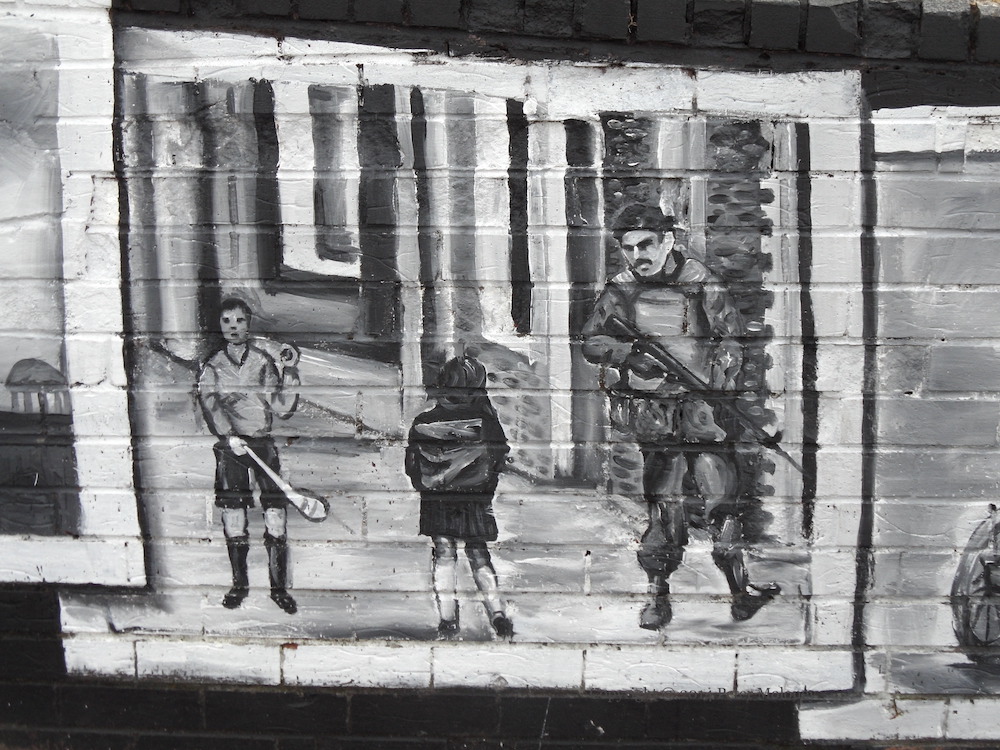
A British soldier patrols the streets while a girl walks home from school and a boy plays hurley. This is one of the panels in the long mural at the shops on Ardoyne Avenue.
The “Welcome” verbiage is just out of shot on the left-hand side; on the right is “Is fearr Gaeılge brıste ná Béarla clıste” [Broken Irish is better than clever English] and (out of shot) some Celtic knotwork. For close-ups of all of the panels, see Growing Up Too Fast.
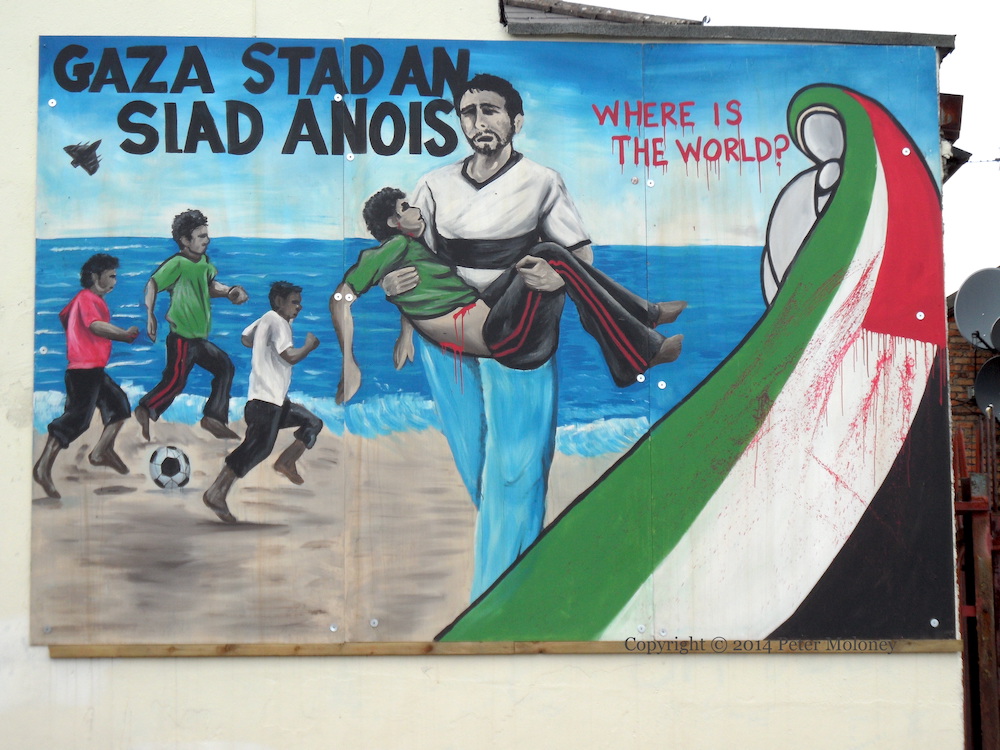
This is a new board at the Crumlin end of Brompton Park – launched on August 6th by Gerry Kelly and members of the Cliftonville football team – in support of Palestine and Gaza, and in particular protesting the deaths of the four Bakr children on the beach at the port of Gaza on July 16th (see Child Killers). The image of the man carrying the boy is from Reuters.
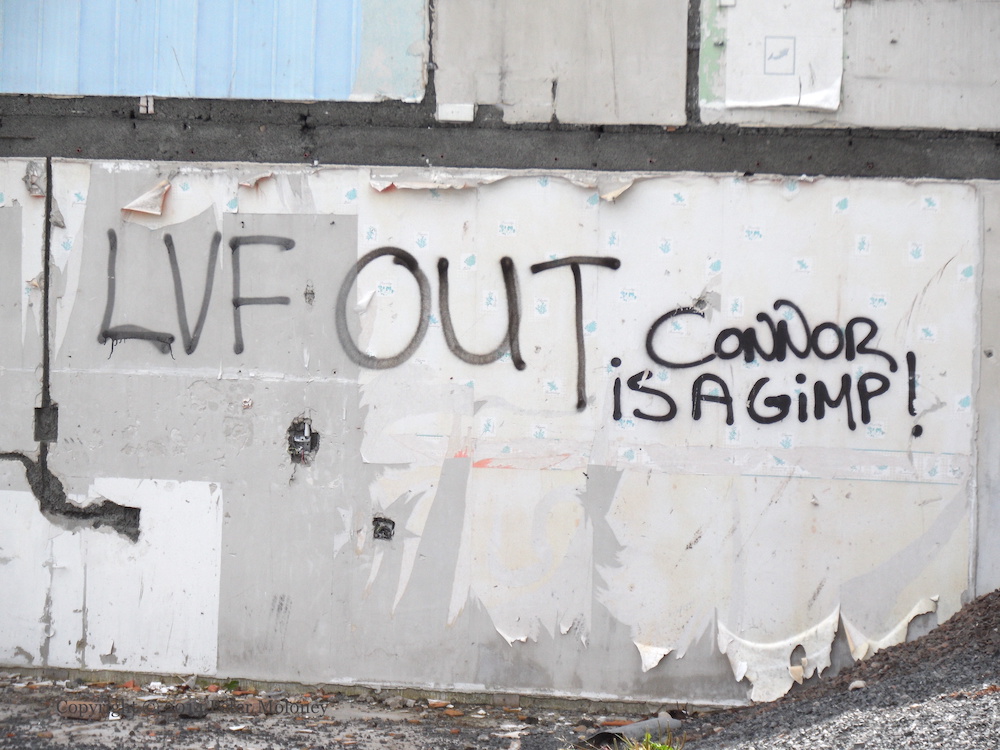
The fairy-tale covering painted over an LVF “North Belfast Rat Pack” mural is fading away to reveal the previous work. For the original LVF mural, see D01199.
The graffiti on the wall – Welcome to LVF Land – has itself been scored out, and there is also a piece of anti-LVF graffiti in the street.
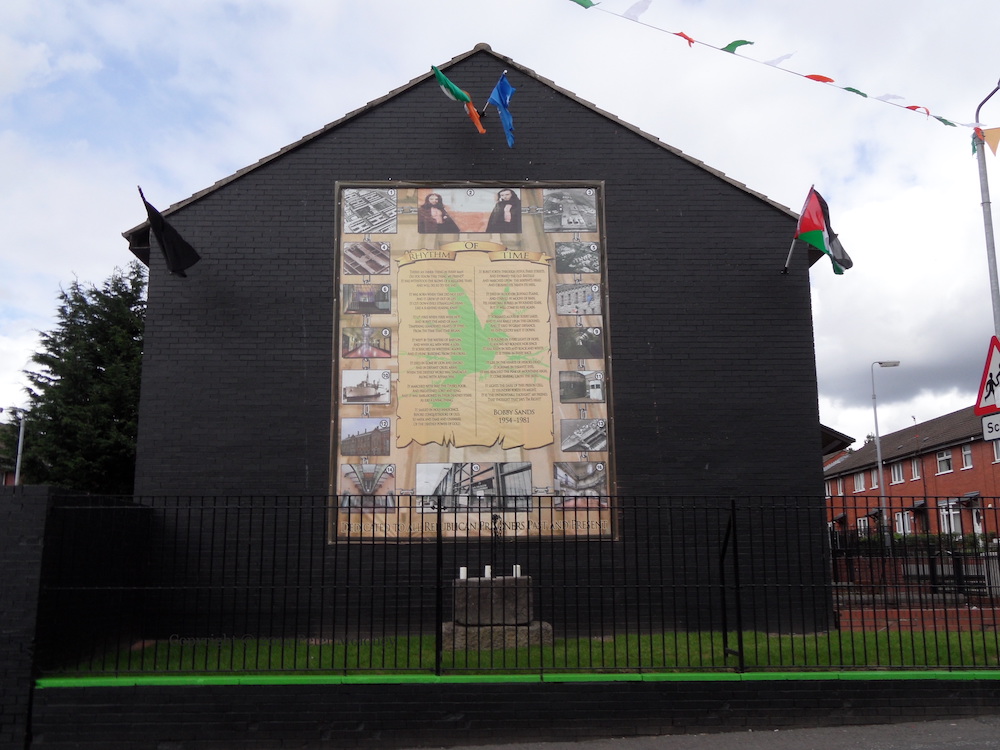
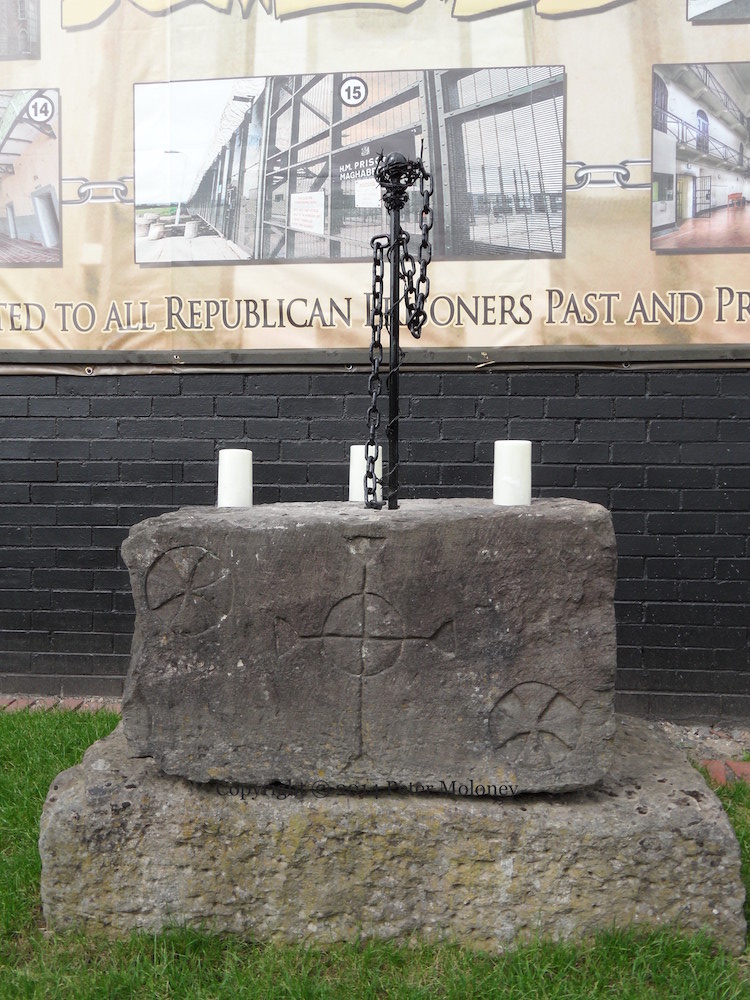
“Dedicated to all republican prisoners past and present.” Bobby Sands’s poem The Rhythm Of Time, published in 1981 as part of Prison Poems, is printed in full along with images of Long Kesh and other prisons in which republican prisoners were held.
The tarp was launched 2014-08-10, to coincide with the anniversary of the introduction of interment in 1971 (see e.g. this BBC news report).
The local New Lodge GAA club Cumman An Phıarsaıgh is named in honour of Patrick Pearse, executed after the 1916 rising. The club’s new mural features footballers contesting a ball and Pearse’s image appears at the centre of a Celtic cross along with part of his 1912 poem Mıse Éıre in the bottom corner (shown in the close-up).
Painted by Lucas Quigley and Michael Doherty. Replaces ‘New Lodge 2000‘.
Mıse Éıre: Sıne mé na an Chaılleach Bhéarra. Mór mo ghlóır: Mé a rug Cú Chulaınn croga. Mór mo náır: Mo chlann féın a dhíol a máthaır. [Mór mo phıan: Bıthnaımhde do mo shíorchıapadh. Mór mo bhrón: D’éag an dream ınar chuıreas dóchas.] Mıse Éıre: Uaıgní mé ná an Chaılleach Bhéarra.
I am Ireland: I am older than the old woman of Beare. Great my glory: I who bore Cuchulainn, the brave. Great my shame: My own children who sold their mother. [Great my pain: My irreconcilable enemy who harasses me continually. Great my sorrow: That crowd, in whom I placed my trust, died.] I am Ireland: I am lonelier than the old woman of Beare.
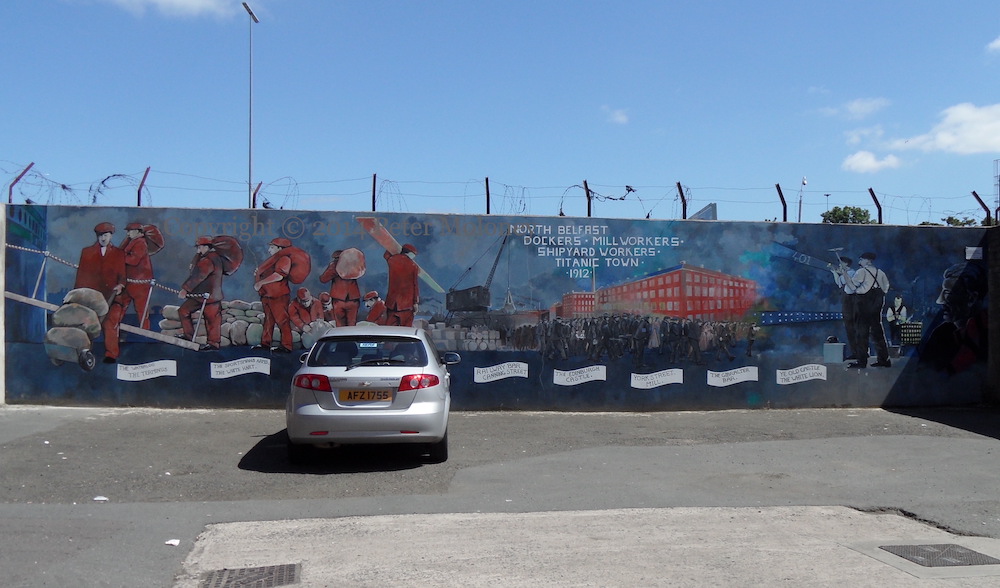
The mural presents a montage of images of “North Belfast dockers, millworkers, shipyard workers” working in “Titanic town 1912”. Along the bottom are the names of various Belfast pubs and other businesses: The Waterloo, The Terminus, The Sportsman’s Arms, The White Hart, The Bowling Green, The City Arms, The Orpheus – York Street, Railway Bar – Canning Street [image from 1970], The Edinburgh Castle [the boat of the Union-Castle line, launched 1910, built at H&W?], York Street Mill, The Gibralter [sic] Bar [whose then-owner was killed in 1972], Ye Old Castle [a bar (and restaurant?) bombed in 1971], The White Lion.
The plaque on the right-hand side reads: “This mural was developed under Belfast City Council’s Titanic community engagement project, with support from Titanic Foundation. Thanks go to Jim Crothers and The Hubb Community Resource Centre.”
St. Vincent Street, north Belfast. For a wide shot without vehicles, see X01139.
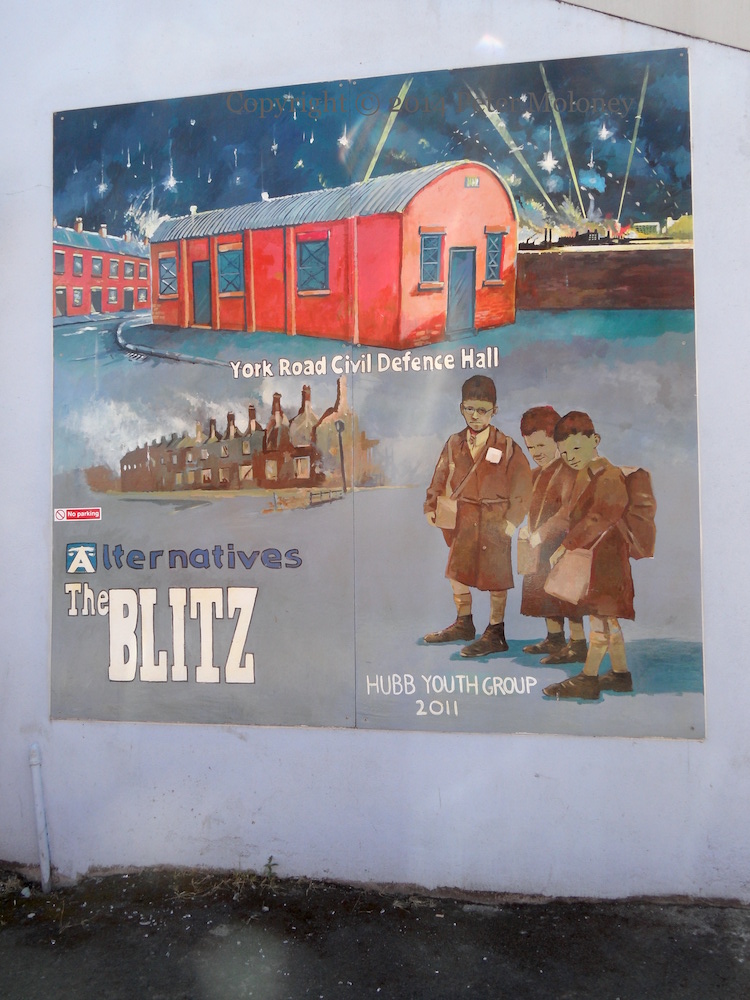
This board is on the end of the Hubb Community Resources Centre and Bowling Club in St. Vincent Street, north Belfast; across the street is Crusaders football ground.
From the Tele: “The building was once the home for local Civil Defence during World War II’s ‘Blitz’. This building is now the one of the last remaining Civil Defence structures in Northern Ireland and has also played home to the local Senior Bowls Club for many years.” The mural also shows bombed-out homes and children going off to the countryside. Short documentary about the 1941 Belfast Blitz (youtube).
HMS Caroline’s connection to Belfast is that she served as the headquarters for the Royal Naval Reserve in Alexandra Dock. Originally built in 1914, she served in the Grand Fleet and took part in the battle of Jutland on May 31st, 1916, as shown in the image above. She was decommissioned in 2011; it is hoped to open her as a museum and visitor attraction by the time of the centenary of the battle (WP). The Daily Mail has a gallery of images of the ship in its current state. Also present at the battle of Jutland, as captain of HMS Nestor, was Commander (later Sir) Edward Bingham.
By Jim Russell in St. Aubyn’s Street, north Belfast
“Justice for the Craigavon 2” – this is the second piece in the Peter Moloney Collection about the campaign to release Brendan McConville and John Paul Wootton, the pair convicted for their part in the 2009 killing of Stephen Carroll (BBC) – the first was a piece of graffiti in Ardoyne in 2013.