Images of the Somme and of ERII flank the traditional image of King William at the Boyne in the Orange arch on My Lady’s Road, Belfast. (The small tarps are sponsored by the East Belfast Historical And Cultural Society and the Lagan Village Cultural Society.) On top are the holy Bible and the crown, with the ladder and the star to either side.
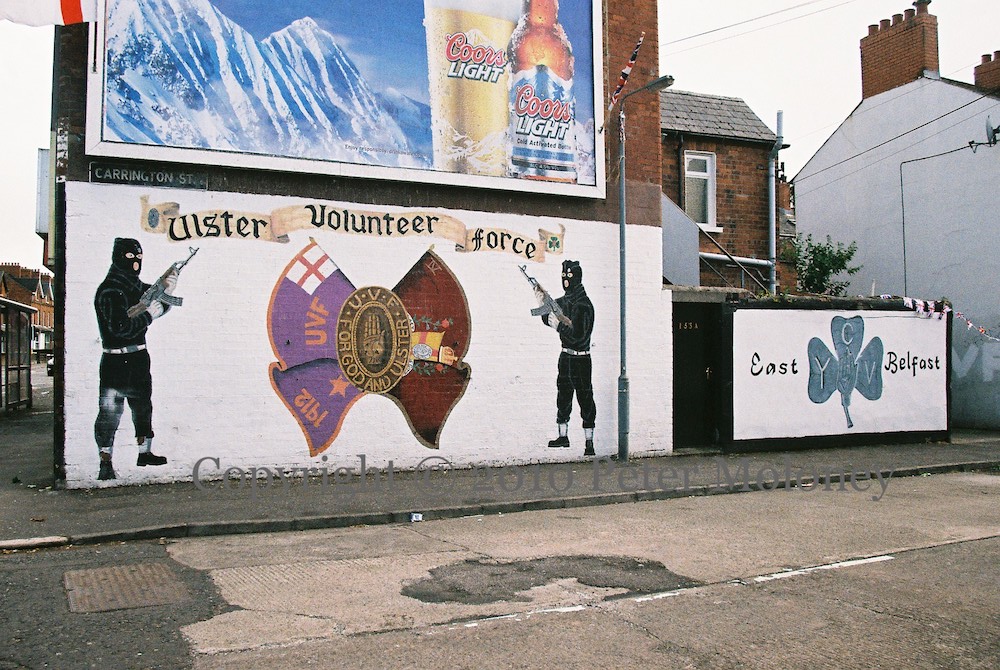
UVF/YCV mural in Carrington Street, Belfast, with two masked gunmen. The mural dates back to before the peace agreement. The flag on the left is an Ulster Special Service Force flag.
Although Titanic was built at Harland & Wolff in Belfast, it was registered in Liverpool. It sank on the night of April 14th, 1912: “Survivors – Men 130 Women 324 Children 56 Crew 195. Perished – Men 638 Women 112 Children 56 Crew 703.”
“Understand the past – and build a better future le chéıle Catholic, Protestant and Dissenter.” “The past” in this case is the Battle Of St Matthew’s (“Chath Naomh Máıtıú”), one of the formative events of the Provisional IRA (“Óglaıgh Na hÉıreann”) (WP). The “better future” is symbolised by the dove and the absence of a weapon in the arms of the central figures – compare to this Derry mural from 1985. The mural was unveiled as part of the commemorative events to mark the 40th anniversary of the Battle.
“Cuıreadh an leac seo ın aırde ı ndíl [ndıl] chuımhne ar na daoıne ó pharóıste Naomh Maıtıú, a thug a gcuıd ama, a saoırse agus a mbeo leıs an cheantar seo agus a phobal a chosaınt, go mórmhór le lınn luatha tréımhse na coımhlınte seo. Ar an dóıgh chéanna lean sıad traıdısıún a thoısıgh sna 1920aí ı ndıaıdh críochdheıghılt ı gceantar macasamhaıl Baıle Mhıc Aırt an fód ın aghaıdh leatroım, an ıdırdhealaıthe agus ın éadan bagaırt an bháıs orthu. Tháınıg sıad le chéıle le sábháılteacht a muıntıre féın a chınntıú. Tá roınnt de na laochra sıúd ar shlí na fırınne anoıs, ach maıreann a gcrógacht agus a gcríonnacht go fóıll agus beıdh cuımhne agaınn ar an héachtraí a rınne sıad go deo na ndeor.”
This is the scene in Templemore Avenue during the Twelfth season, 2010. The post box and lamp-posts are painted in red, white, and blue, and Orange Lodge banners hang from the cross-bars.
The theme “Remember the fallen from war” is illustrated by a bombed-out Ballymacarret library on Templemore Avenue and St. Patrick’s church, which is just across the street from the mural, both of which were hit during the blitz in 1942, a police land rover perhaps indicates the dead during the Troubles, while Cuchulainn stands for the IRA (and/or for the UDA?). The word “peace” appears next to an image of Stormont (bottom right) painted in white rather than grey.
We are supposed to remember the dead because (perhaps) their deaths were unnecessary and misguided as means to peace, at least according to the saying along the bottom (sometimes attributed to Einstein): “Peace cannot be kept by force; it can only be achieved by understanding” – understanding of the Nazis during the blitz, it seems, and of loyalists during the Troubles. If you have a better interpretation, please (please!) leave a comment.
The mural was imitated on the hoarding around the Cultúrlann on the Falls Road during its renovation, though this version does not mention the blitz and seems to be lamenting the CNR dead and calling for understanding of the CNR community (sc. by Britain and the Orange state) – see X01279.
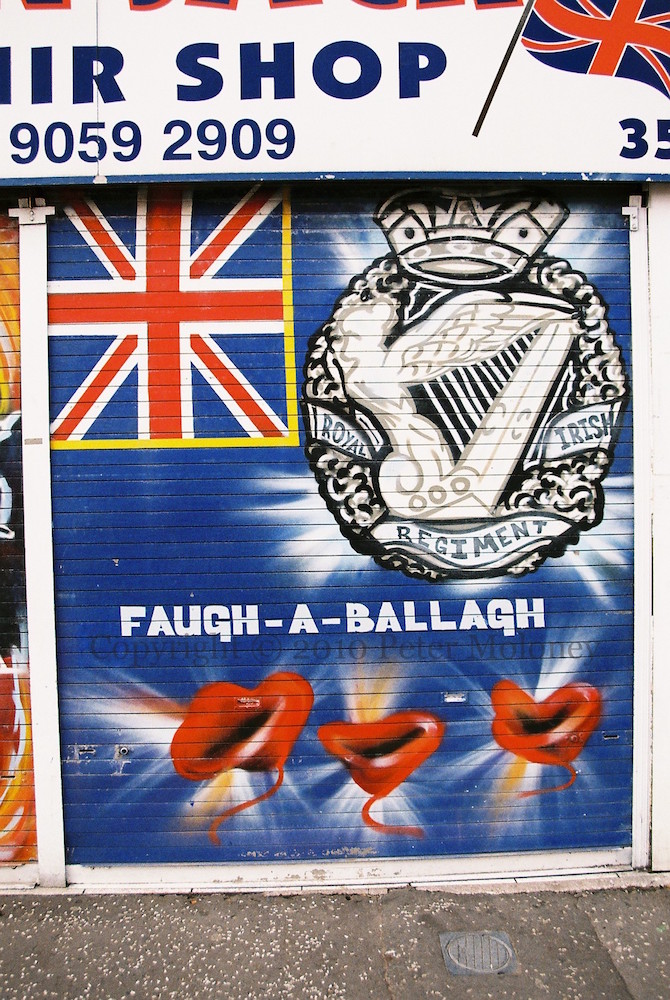
The shutters of the Union Jack Souvenir Shop on the Newtownards Road are painted with 36th (Ulster) Division and Royal Irish Regiment murals. The motto of the latter is “faugh-a-ballagh” an Anglicization of “fág an bealach” [leave the road].
The side wall, which specifically named JJ Gray and Rab Brown (see the previous (2005) version) is repainted in favour of a generic memorial: “This mural is in memory of our fallen comrades. We forget them not. Q[uis] S[eparabit]”.




 Peter Moloney Collection