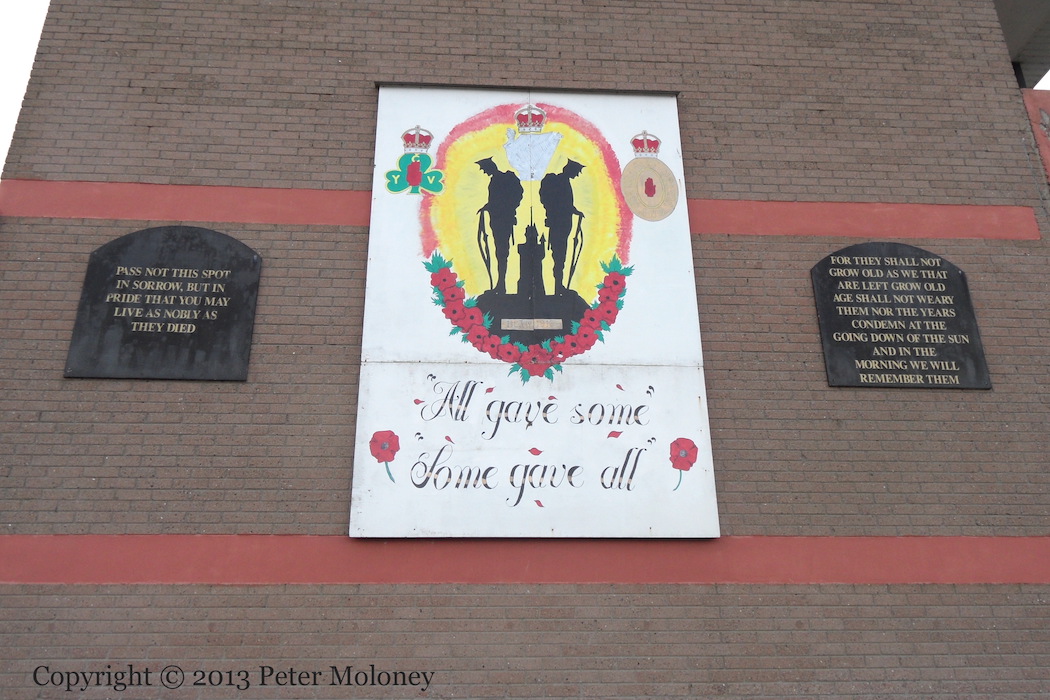
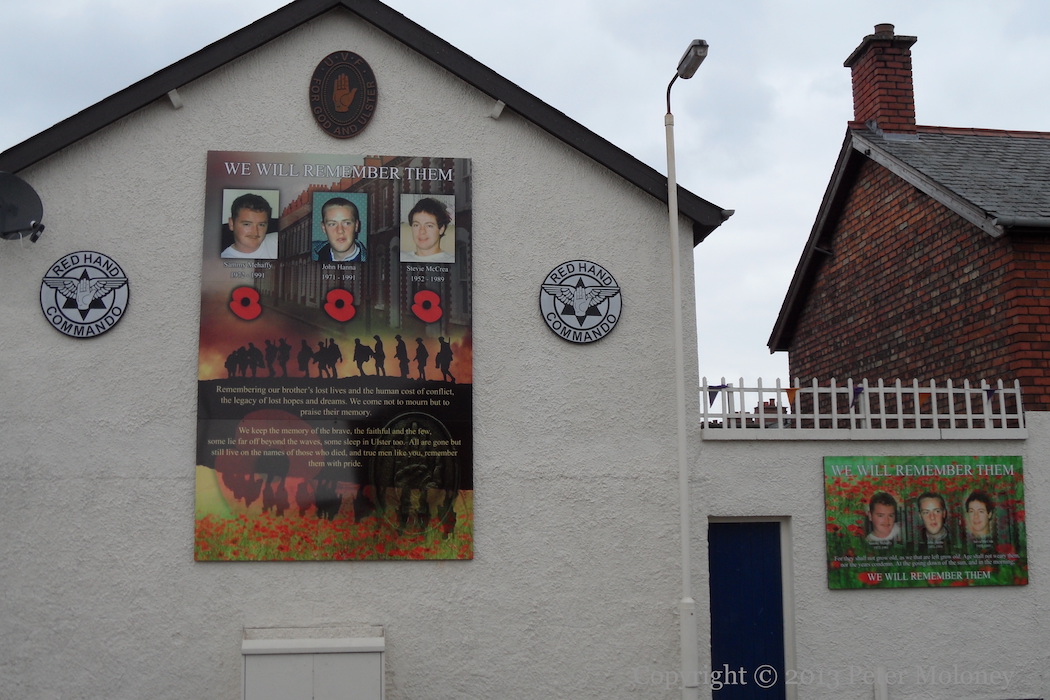
On the right: “They shall not grow old as we that are left grow old./Age shall not weary them nor the years condemn./At the going down of the sun and in the morning, we will remember them.” from Binyon’s For The Fallen.
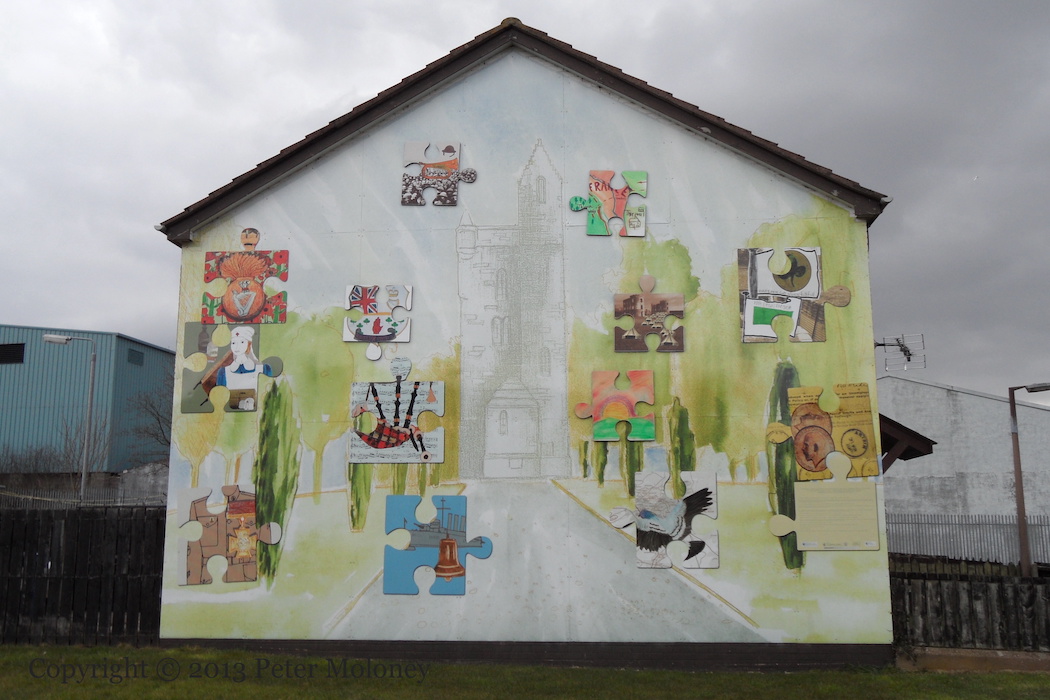
Ulster Tower in Thiepval, France, provides a background for 13 jigsaw pieces with partial images relating to the Great War, including a uniform with a Victoria Cross and badge of the 36th (Ulster) Division, the 10th (Irish) Division, the 16th (Irish) Division, and the Royal Irish Fusiliers (and a fourteenth piece for information).
Kilgreel Road, Antrim. The mural is more than a decade old and is bleached from the sun (the pinks were formerly brown); on the former site of The People’s Army (a UVF board).
“This artwork, commemorating the sacrifices made during the Great War and subsequent conflicts, was produced by the young people of Parkhall Youth & Community Club and was completed in 2010. It is part of a larger Re-imaging project undertaken by Parkhall Cultural Awareness Association & Parkhall Community Association. 14 jigsaw pieces are representated as that was the age of the youngest soldier to die on the Somme. The Royal Irish Fusiliers, who recruited in the Antrim area, served with the 10th Irish Division and 36th Ulster Division during World War I. The cap badge is surrounded with poppies. The poppy is an international symbol commemorating the sacrifices of members of the armed forces and of civilians specifically since the Great War. Birds were used extensively during World War I delivering important logistic message from the front line. HMS Antrim served in the Great War and survived. After the war she became the first ship to be fitted with an experimental sonar system in 1920. Her bell can presently be viewed in Antrim Civic Centre. The grounds of Shane’s Castle in Antrim were used as a training ground and a campsite for the 36th Ulster Division prior to their deployment to France. Of all bell tents and parachutes during the Great War 90% were made from Irish Linen. During the Great War a service man’s basic wage was one shilling a day (5 pence). The sound of the bugle was heard throughout each day in the trenches, starting with Reveille to rouse you from slumber. ‘Flowers of the Forest’, a powerful Scottish lament, is often played by a lone piper at services of Remembrance. “I am not an Ulsterman but yesterday, the 1st July, as I followed their amazing attack, I felt that I would rather be an Ulsterman than anything else in the world.” Extract from the speech by Captain Wilfred [Wilfrid] Spencer 2st July 1916. Men from the 36th Ulster Division received 9 Victoria Crosses. Women played a vital role in field hospitals during the Great War caring for the injured, from the front line. The flags of the 16th and 10th Irish Divisions. 36th Ulster division. The Ulster Tower is a memorial to the men of the 36th Ulster Division. It is situated near the entrance to Thiepval Wood, France.
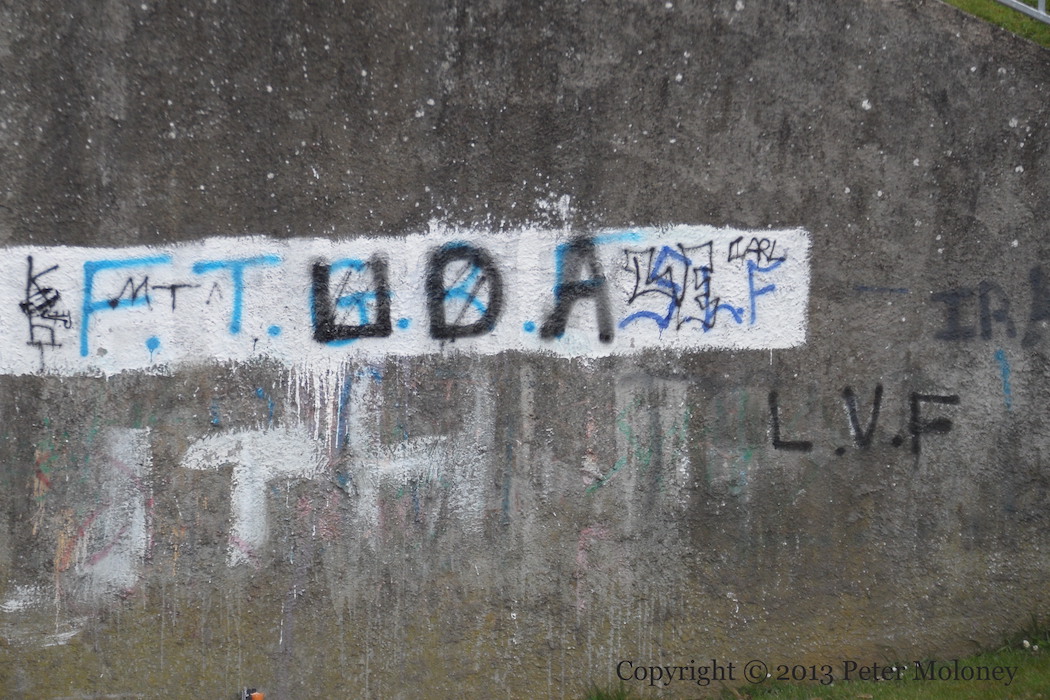
This is a selection of small UDA boards and graffiti from the lower section of Parkhall estate in Antrim. The 90th anniversary board was seen previously in 2009.
Donegore Road, Oriel Park, Fountain Hill, Kilbeg Walk
While the demolition of the last house in the row is under way, the pair of boards on the gable wall (seen in 2012) has been mounted on some scaffolding, with their order reversed – Covenant Day on the left, Somme trench on the right.
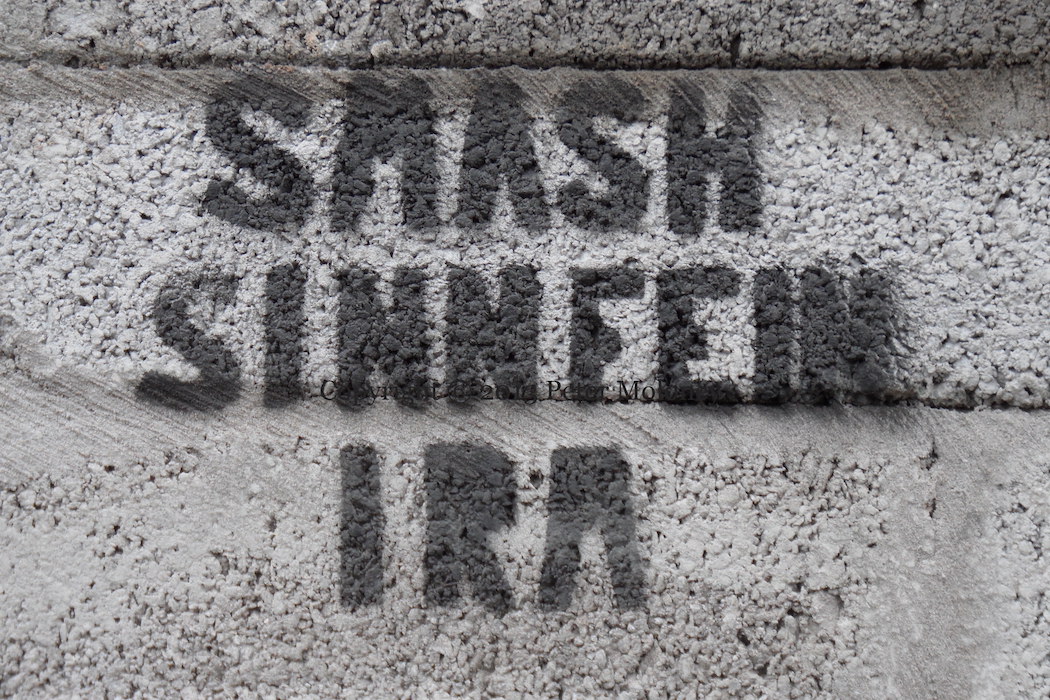
Also included is a “Smash Sinn Fein IRA” stencil in the area.
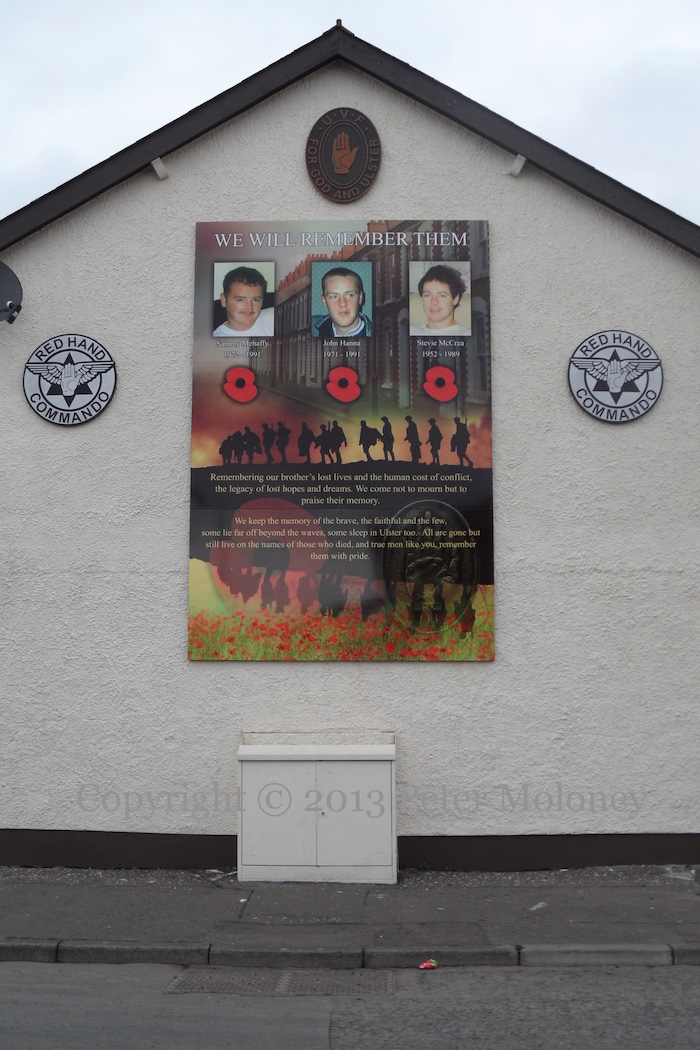
A board to slain UVF/RHC members John Hanna (died 1991-09-10), Stevie McCrea (1989-02-18) and Sammy Mehaffy (1991-11-13), with poppies and image of WWI soldiers.
“Remembering our brother’s lost lives and the human cost of conflict, the legacy of lost hopes and dreams. We come not to mourn but to praise their memory. We keep the memory of the brave, the faithful and the few, some lie far off beyond the waves, some sleep in Ulster too. All are gone but still live on the names of those who died, and true men like you, remember them with pride.”
“36th ulster division, for they shall not grow old, as we that are left grow old, age shall not weary them nor the years condemn, at the going down of the sun and in the morning we will remember them.”
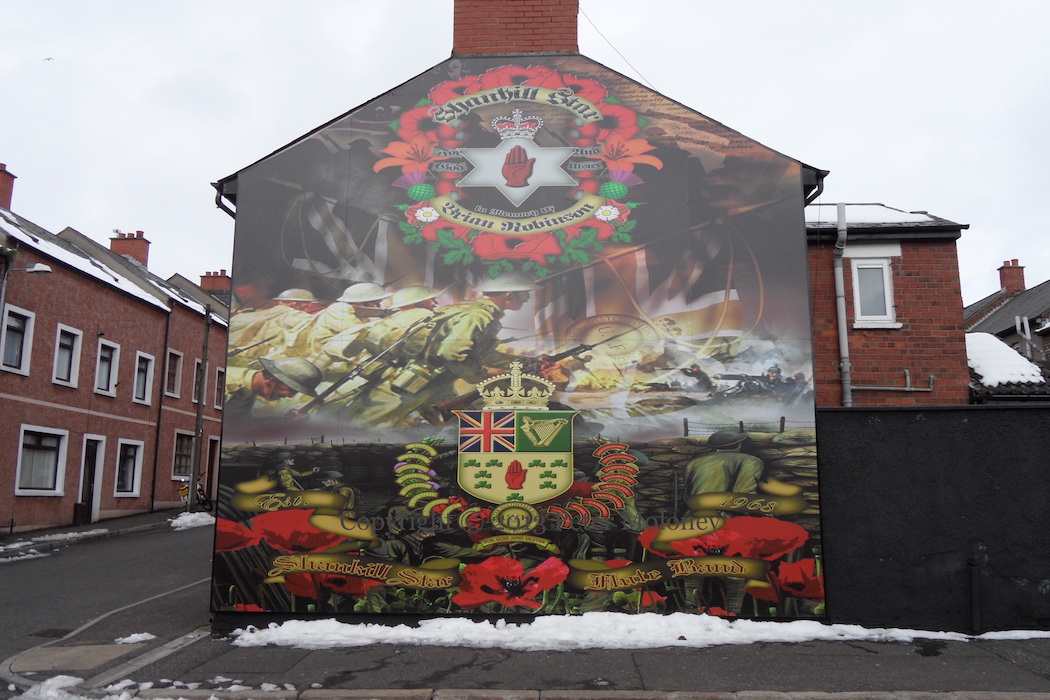
“Shankill Star [flute band Fb] in memory of Brian Robinson”. A brand new piece (unveiled March 2, 2013) to Brian Robinson and/sponsored by the Shankill Star Flute Band, in Disraeli Street – where Robinson grew up – replete with images from the first World War such as soldiers (both British and German), trenches and poppies. Robinson was killed on 2 Sept., 1989 by an army undercover unit moments after he had shot and killed a Catholic named Patrick McKenna (WP). This is the second mural on the street to Robinson – see M08248. The piece is not paint, but printed boards, and the image has been generated by computer.
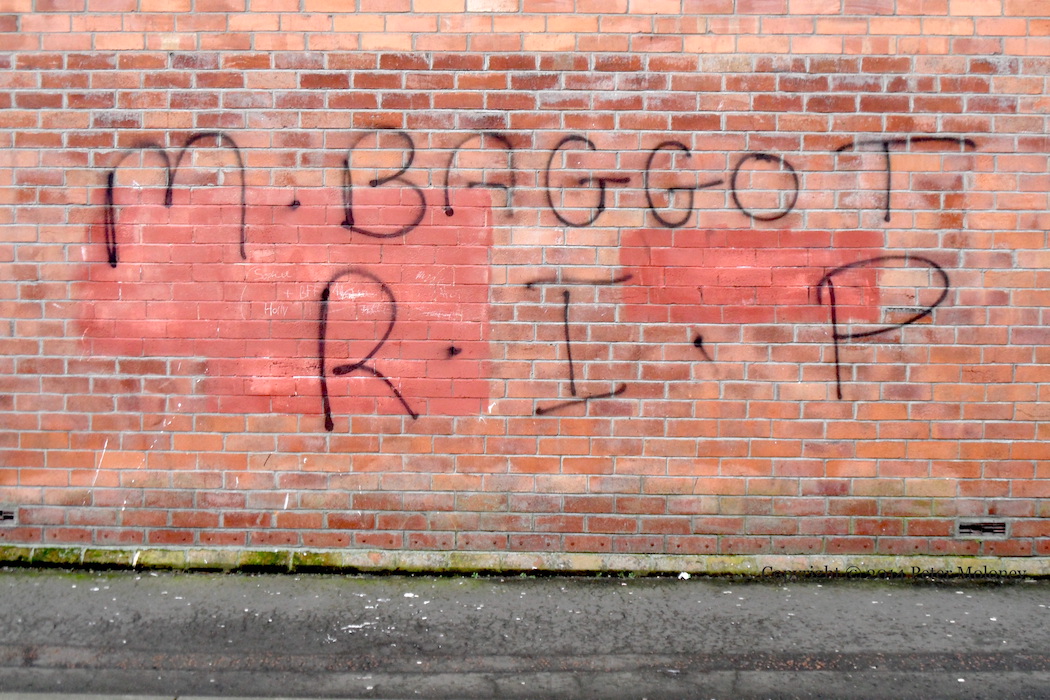
PSNI Chief Constable Matt Baggott (here “Baggot”, with only one “T”) in January announced that he would retire from the force in September of this year (2014), after heading the organisation for five years (Guardian). He, and the PSNI generally, will not be missed in Bray Street (first three) and Rathlin Street (final four), Woodvale, west Belfast.
(Update: The date was moved up – Baggott quit at the end of June. BBC)
“PSNI stay out”, “PSNI no go zone”, “PSNI keep out!!!”, “Fuck the Pope”, “PSNI targets”, “KAT”
“100 years of the Ulster Solemn League and Covenant. ‘We will not have home rule.’ The lions of Ulster.”
“West Belfast Athletic & Cultural Society – breaking down barriers through sport and cultural exchange. This mural was dedicated by Alderman Hugh Smyth O.B.E. on Friday the 21st September 2012 to commemorate the centenary of the signing of Ulster’s Solemn League and Covenant.”
The eight plaques (from left to right) are to Major Fredrick H Crawford, Volunteer Robert J Adgey, James Craig, the Ulster Covenant, Sir Edward Henry Carson, Sir George Lloyd Reilly Richardson, Captain Wilfrid Spender, Ulster Volunteer Force.
The Ulster Volunteers of 1912 joined the 36th Division of WWI. After the war, many of them joined the B Specials, which was disbanded in 1970 and the UDR created. The modern UVF was formed in 1965. There is a Willowfield UVF memorial garden in Cherryville St (M04070).
“In memory of Thomas (Tom) McDonald, murdered aged 15, 4th September 2001. Also William James (Jimmy) Frazer, murdered aged 12, 14th July 1989. Gone but not forgotten.” McDonald was pursued and knocked off his bike by a driver at whose car he had thrown a brick (Irish Times). Frazer (aged 42) was beaten, along with a friend, by three men from Bawnmore and died of his injuries five days later (Lost Lives 3046).








 Peter Moloney Collection