Above is a local interpretation of Robert Ballagh’s 1970 rendering of Goya’s The Third Of May 1808 in Glenfada Park, Derry/Doıre, site of four deaths on Bloody Sunday, 1972.
The original commemorates Spanish resistance to the forces of Napoleon (WP). For this Derry version, features from the city’s skyline – the Guildhall, St. Columb’s Cathedral, and an intact Governor Walker column – have replaced the original’s outline of Madrid, and an insignia of the Paras appears on the arm of a soldier.
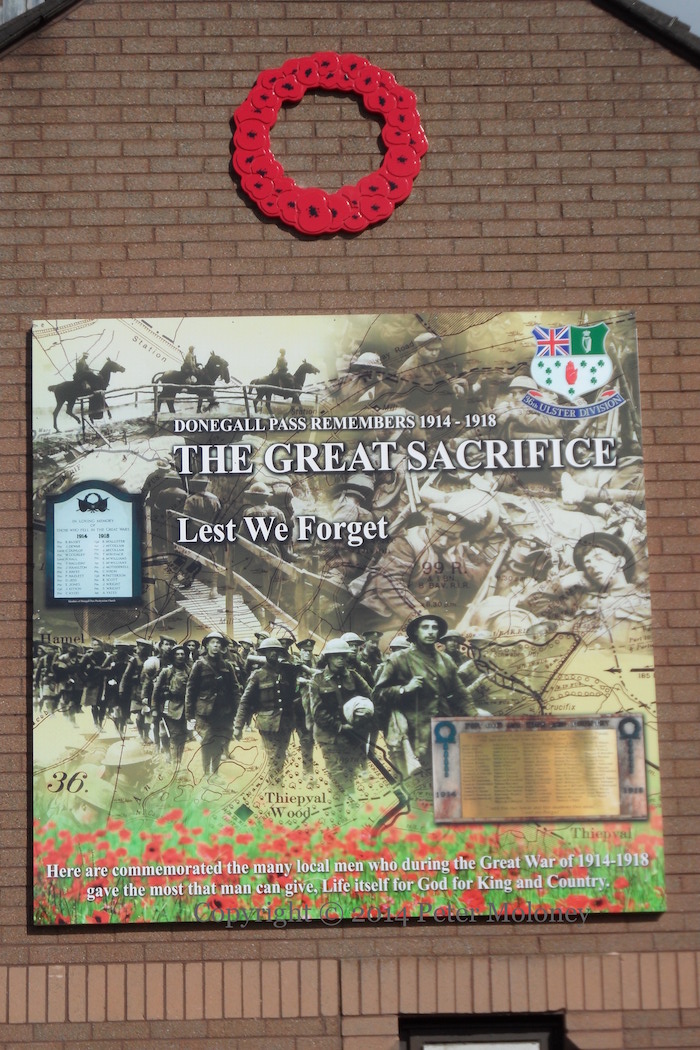
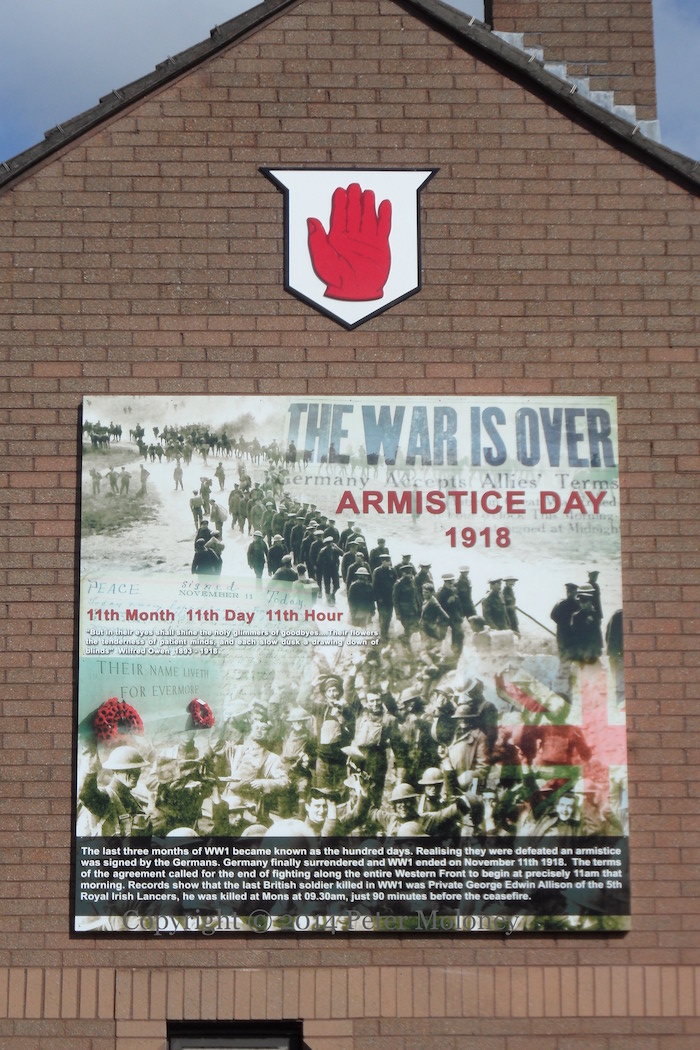
Here are three boards in Lindsay Street, south Belfast, chronicling the 1912 Covenant and the lives lost (by the 36th Division) in the Great War 1914-1918.
“It is needful that we knit together as one man, each strengthening the other, and not holding back of counting the cost” – Ulster [Unionist] Council Resolution 1912.” “Ulster’s solemn league and covenant. Ulster Day 28th September 1912.” The Council met on September 23rd and 471,000 people signed the covenant (figures here) on or around the 28th – Ulster Day – led by Sir Edward Carson.
“Donegall Pass remembers 1914-1918 – the great sacrifice. Lest we forget. Here are commemorated the many local men who during the Great War of 1914-1918 gave the most that man can give: life itself for God for King and Country.” With a map of the northern end of the Western Front and images of soldiers marching, on horseback, and in the trenches.
“The war is over. Armistice Day 1918. 11th month, 11th day, 11th, hour.” “But in their eyes shall shine the holy glimmers of goodbyes … Their flower the tenderness of patient minds, and each slow dusk a drawing down of blinds.” Lines from Wilfred Owens’ (1893-1918) ‘Anthem For Doomed Youth‘.
At the bottom: “The last three months of WWI became known as the hundred days. Realising they were defeated an armistice was signed by the Germans. Germany finally surrendered and WWI ended on November 11th 1918. The terms of the agreement called for the end of fighting along the entire Western Front to begin a precisely 11 am that morning. Records show that the last British soldier killed in WWI was Private George Edwin Allison of the 5th Royal Irish Lancers. He was killed at Mons at 09:30 am, just 90 minutes before the ceasefire.”
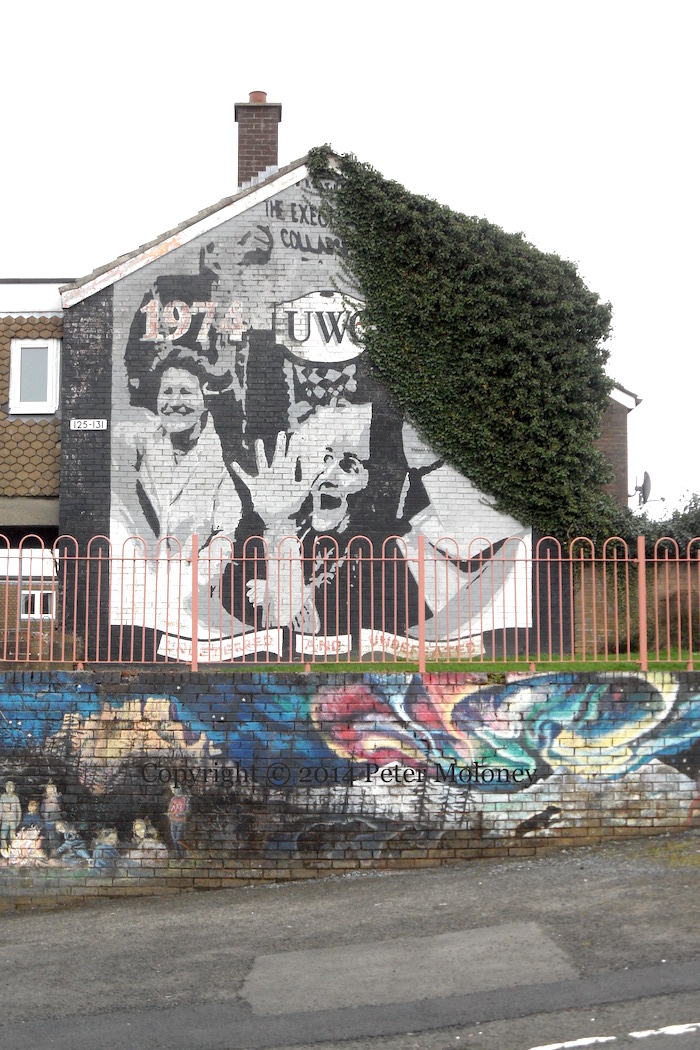
These are end-of-life images of the murals in Lincoln Court. The right-hand member of the pair, now covered by ivy, depicts scenes from the Ulster Workers’ Strike of 1974; of the four boards that made up the Community Spirit piece only the ‘1980s’ one remains.
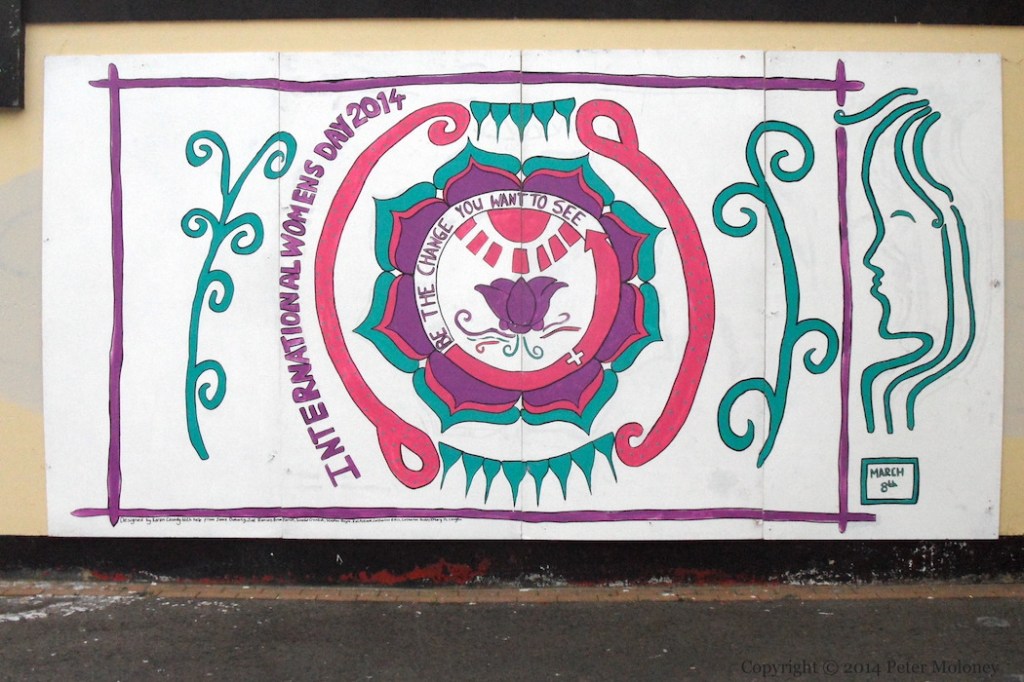
International Women’s Day, which dates as far back as 1909, is celebrated every year on March 8th. Above is the 2014 mural marking the day, in the complex of shops behind the Bogside Inn.
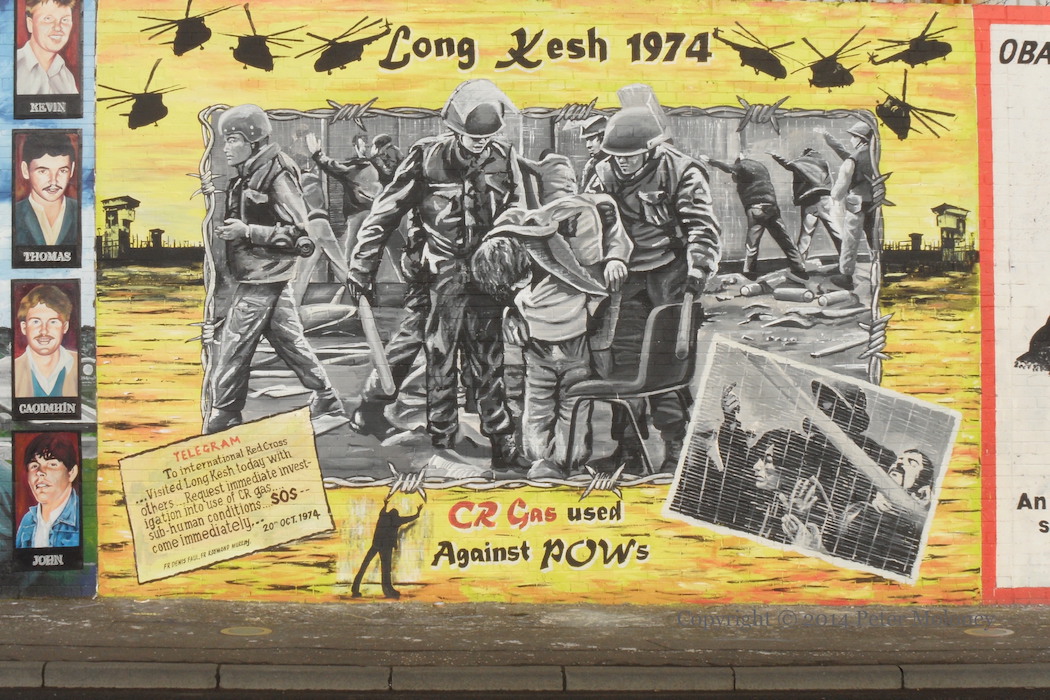
A new mural, above, on the International Wall commemorates the fortieth anniversary this year of the ‘Burning Of Long Kesh’ or the ‘Battle Of Long Kesh’, which took place on the night of October 15, 1974 and day of the 16th (when British Army units retook the camp).
The most comprehensive account available on-line of the conditions at the camp prior to the riot, the burning, and the battle on the morning of the 16th appears to be this 2004 piece in An Phoblacht by Joe Doherty and Christy Keenan. (For a virtual tour of the camp, see this video. Seamus Keenan’s Over The Wire (on again this month at the Derry Playhouse) attempts to recreate the scene.) Other accounts include those by Ronan Bennett, another inmate, in The Guardian. Here is a brief BBC News report from the 16th.
All accounts mention the use of gas and republican accounts state that CR was used on the morning of the 16th in addition to CS, dropped from helicopters as at the top of the mural. The Guardian, in 2005, confirmed that CR had been authorized for use in controlling riots and was available at the prison. CR is a carcinogen (WP) and in a post on his blog (now removed) Mairtin Óg Meehan suspects that exposure to CR is a cause of recent cancers among former prisoners.
In the lower left corner is a quoted telegram from Fr. Denis Faul, Fr. Raymond Murray: “To international Red Cross … Visited Long Kesh today with others … Request immediate investigation into use of CR gas … sub-human conditions … SOS … come immediately …” 20 Oct. 1974. These two wrote an 80-page report on the conditions at the camp following the event, entitled The Flames Of Long Kesh. See this 1999 An Phoblacht page for an image of the shelters constructed after the battle.
Actor and activist Margaretta D’Arcy (here, “Margaritta” D’Arcy) was arrested in October, 2012, for climbing the perimeter of Shannon airport and standing on the runway, in protest at the use of the airport by US military planes. She was jailed – aged 79 – for nine-and-a-half weeks in 2014. (Irish Times | Journal)
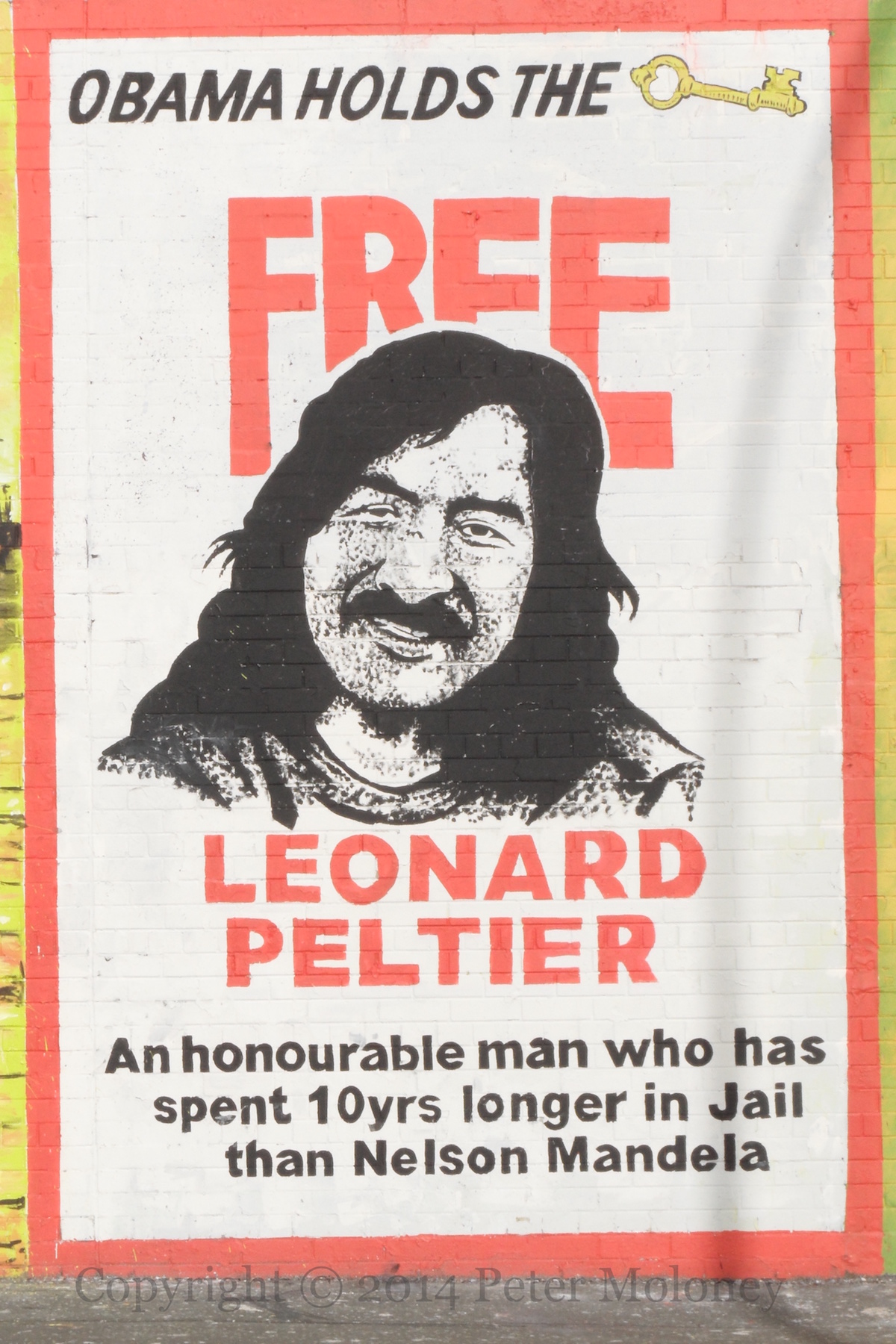
“Free Leonard Peltier – An honourable man who has spent 10yrs longer in jail than Nelson Mandela”. Peltier has been in jail since 1977, convicted of killing two FBI agents (WP).






 Peter Moloney Collection