Niall And Macha

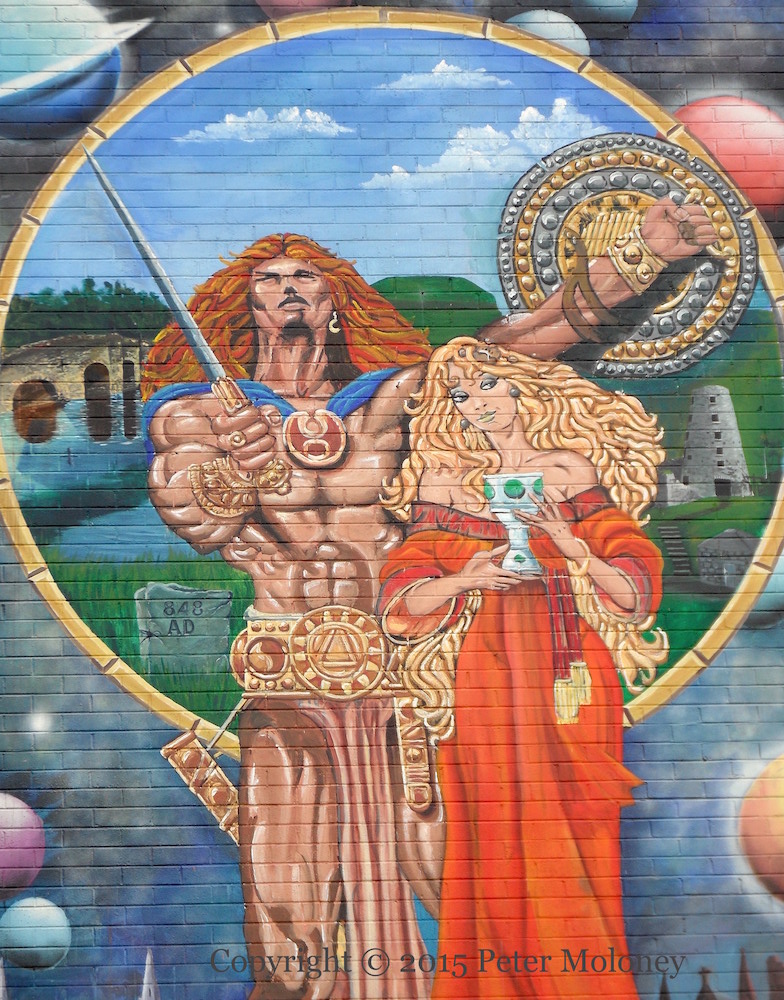
This is a mural of King Niall (Nıall Caılle, Niall of the Callan) and Queen Macha. Niall was high king of Ireland (in competition with Fedelmıd of Munster WP) who held off the Vikings in the late 800s (WP) and died in 846 by drowning in the Callan river. Macha is a much earlier and mythological queen, and gives her name to the town: Ard Mhacha.

The central figures reproduce paintings by Jim Fitzpatrick (Visual History). The Niall figure comes from Nemed The Great but the Macha figure comes from a label Fitzpatrick produced in 1988 for Rosc “mead”, even though Macha (one of them, at least) was the wife of Nemed and there is a female figure in Nemed The Great.

Below the planets and stars, St Patrick’s (Catholic) Cathedral is on the left (WP) and St Patrick’s (CofI) Cathedral is on the right (WP).

In the border, clockwise from left to right, we see: the Tandragee Idol (WP), Naomh Bríd/St Brigid’s, St Patrick preaching the trinity, Irish dancing, Gaelic football, Armagh Harps, “Ard Mhacha”, the Armagh county crest in colour in the apex (Club & County), “Armagh”, Na Pıarsaıgh Óga, hurling/camogie, Cú Chulaınn’s, mummers (perhaps specifically the Armagh Rhymers), Jonathan Swift, a steam locomotive (perhaps representing the Armagh rail disaster of 1889, in which 80 people died WP); a vintage image of Callan Street is depicted along the bottom (History Armagh).

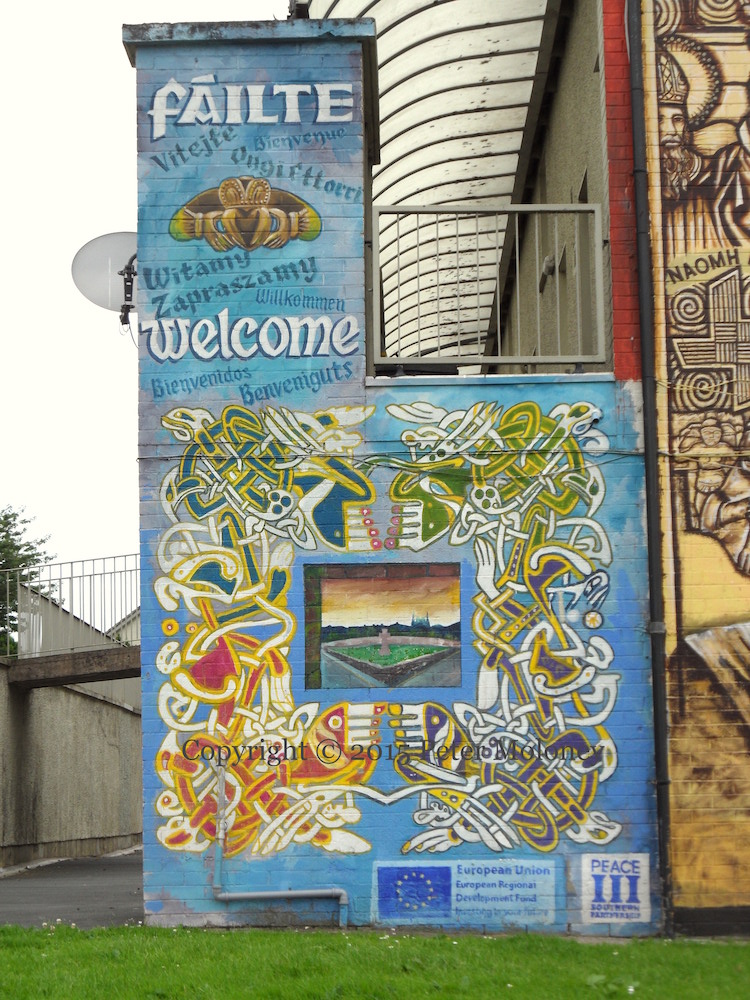
The side-wall features the word “welcome” in many languages, and Celtic knot-work surrounding an image of the Celtic Cross below St Patrick’s, perhaps inspired by this 1903 photograph (Flickr).

Painted by a crew of Belfast artists – Danny D and Mark Ervine, along with Lucas Quigley, Marty Lyons, Micky Doherty – organised by the Callan Street Residents’ Association, with funding from the European Union’s Peace III initiative.

Culdee Crescent/Callan Street, Armagh

Click image to enlarge
Copyright © 2015 Peter Moloney
M12742 M12743 M12744 M12745 M12746

McGerrigan – Hughes

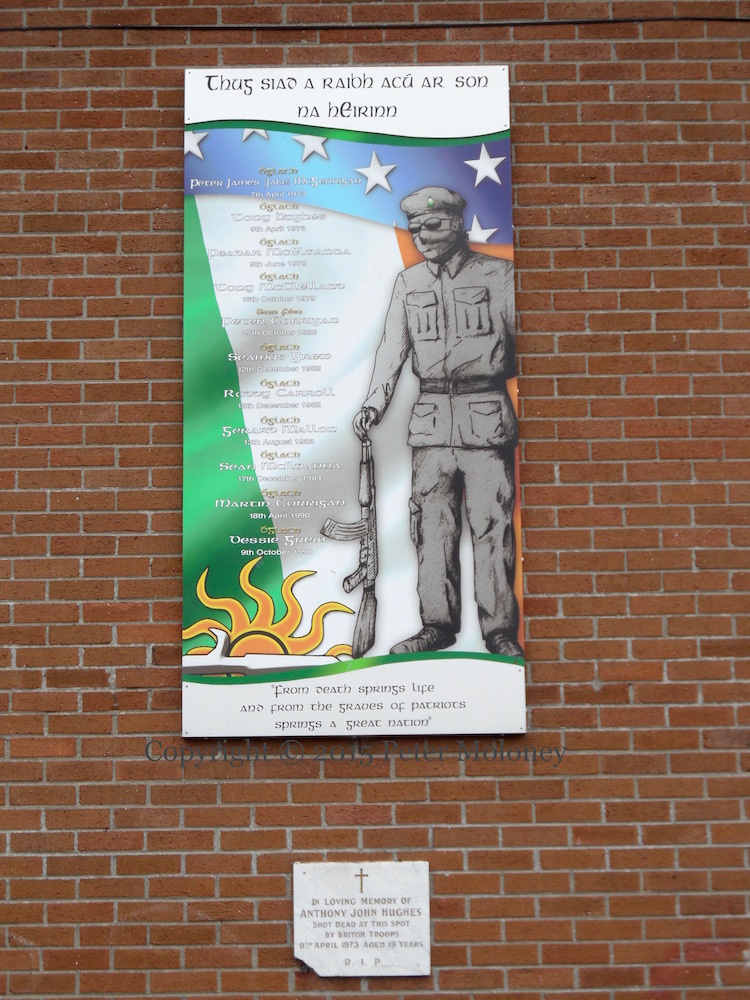
“1973-2013” Jake McGerrigan and Tony Hughes of the OIRA were both shot and killed by British forces in the Windmill Hill area of Armagh in a 48-hour period spanning April 7th and 9th, 1973. (Lost Lives #791 incorrectly gives March 7th for McGerrigan.) The board shown above was mounted in Navan Street for the 40th anniversary of their deaths, in 2013. The larger portraits on either side are of McGerrigan and Hughes; between them are (left) Peadar McElvanna, Roddy Carroll, Gerard Mallon, Martin Corrigan, (middle) Peter Corrigan, (right) Tony McClelland, Seamus Grew, Sean McIlvanna [McIlvenna], Dessie Grew.

There is an individual plaque to Hughes at the spot where he was shot, at the bottom of the second image below a board listing the same names (seen previously in 2012). “Thug sıad a raıbh acú [sic] ar son saoırse na hEırınn [sic].” “From death springs life and from the graves of patriots springs a great nation. [from Pearse’s oration at O’Donovan Rossa’s funeral].” There is stone to both McGerrigan and Hughes in the same alley (see McGerrigan – Hughes); there is also a stone to McGerrigan in Windmill Avenue.

Navan Street/Ogle Street, and Emania Terrace, Armagh

Click image to enlarge
Copyright © 2015 Peter Moloney
[M12727] M12728 [M12729] [M12730] [M12731] [M12732] [M12733] [M12734] [M12735] [M12736] [M12737] [M12738] [M12739] [M12740]
M12741

Belfast Dockers

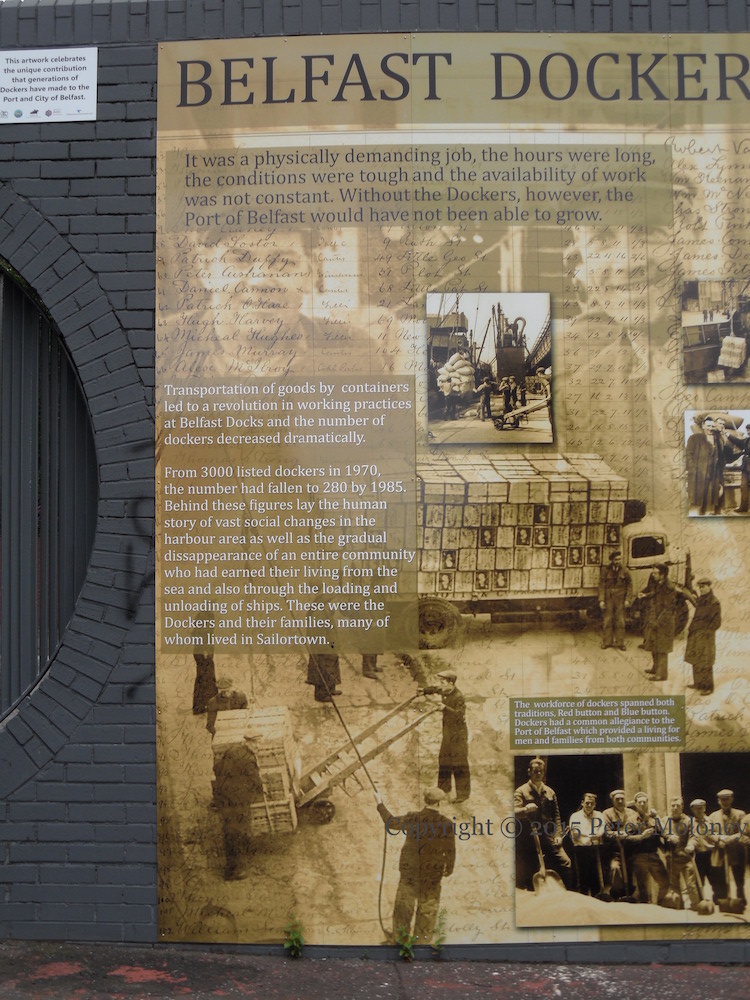
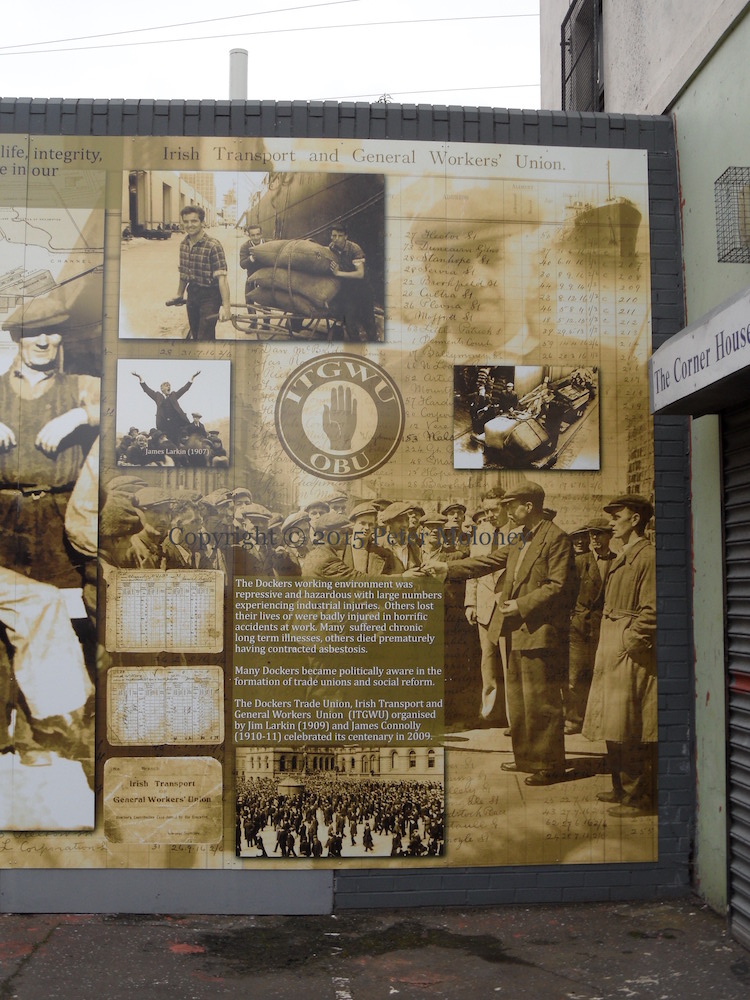
Every day, men would line up in schooling pens on the various docks of the port of Belfast to be hired by foremen. As mentioned on the left-hand side of the board above (recently erected on the New Lodge side of the Duncairn “peace” line) the rise of the shipping container in the 1970s spelled the end of the docker: “from 3000 listed dockers in 1970, the number had fallen to 280 by 1985.” Author and poet John Campbell recalls his first day on the docks in 1952, unloading cement, in this NVTv video.

“This artwork celebrates the unique contribution that generations of dockers have made to the port and City of Belfast.”

“It was a physically demanding job, the hours were long, the conditions were tough and the availability of work was not constant. Without the Dockers, however, the Port of Belfast would not have been able to grow. / Transportation of goods by containers led to a revolution in working practices at Belfast Docks and the number of dockers decreased dramatically. From 3000 listed dockers in 1970, the number had fallen to 280 by 1985. Behind these figures lay the human story of vast social changes in the harbour area as well as the gradual dissappearance [sic] of an entire community who had earned their living from the sea and also through the loading and unloading of ships. These were the Dockers and their families, many of whom lived in Sailortown. / The workforce of dockers spanned both traditions. Red button and Blue button. Dockers had a common allegiance to the Port of Belfast which provided a living for men and families from both communities. / The work was backbreaking, yet the Docks educated us about life, integrity, discipline, about standing up for our rights, about having pride in our identity as working men, as Dockers. / The Dockers[‘] working environment was repressive and hazardous with large numbers experiencing industrial injuries. Others lost their lives or were badly injured in horrific accidents at work. Many suffered chronic long term illnesses, others died prematurely having contracted asbestosis. Many Dockers became politically aware in the formation of trade unions and social reforms. The Dockers Trade Union, Irish Transport and General Workers[‘] Union (ITGWU) organised by Jim Larkin (1909) and James Connolly (1910-11) celebrated its centenary in 2009.”

Click image to enlarge
Copyright © 2015 Peter Moloney
M12719 M12720 M12721 M12722 M12723 M12724 [M12725] [M12726]

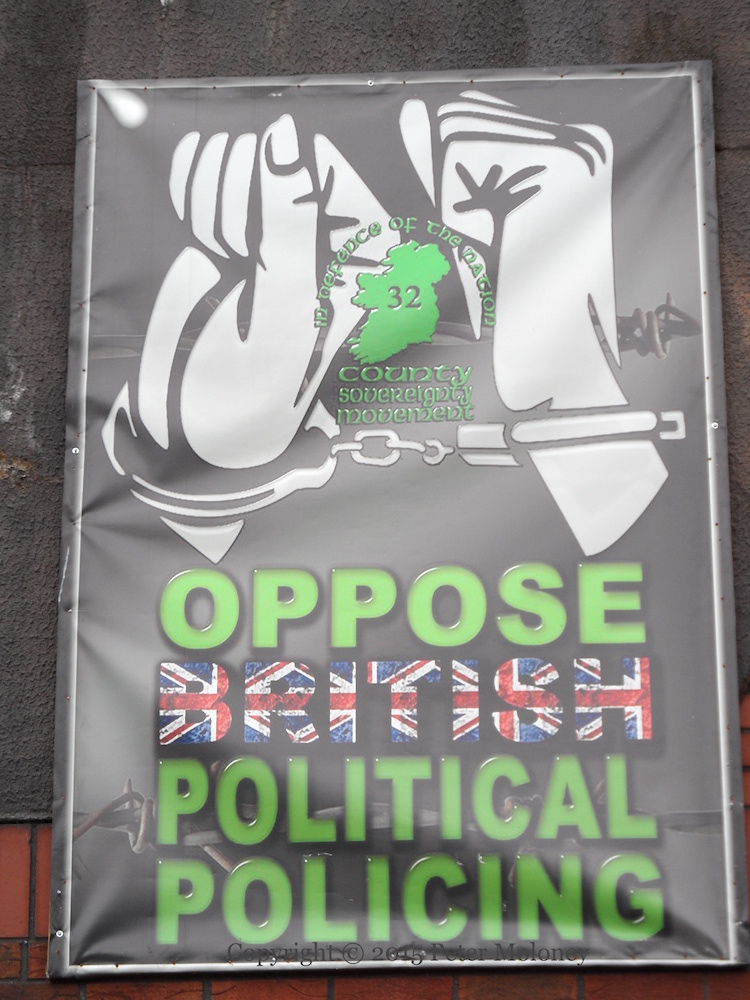
Oppose British Political Policing

“In defence of the nation – 32 County Sovereignty Movement [web] – opposed British political policing”.

32CSM’s statement on political policing can be found at its web-site.

Divis Street, west Belfast

Click image to enlarge
Copyright © 2015 Peter Moloney
M12715 [M12716] [M12717] [M12718]

Respect Equality

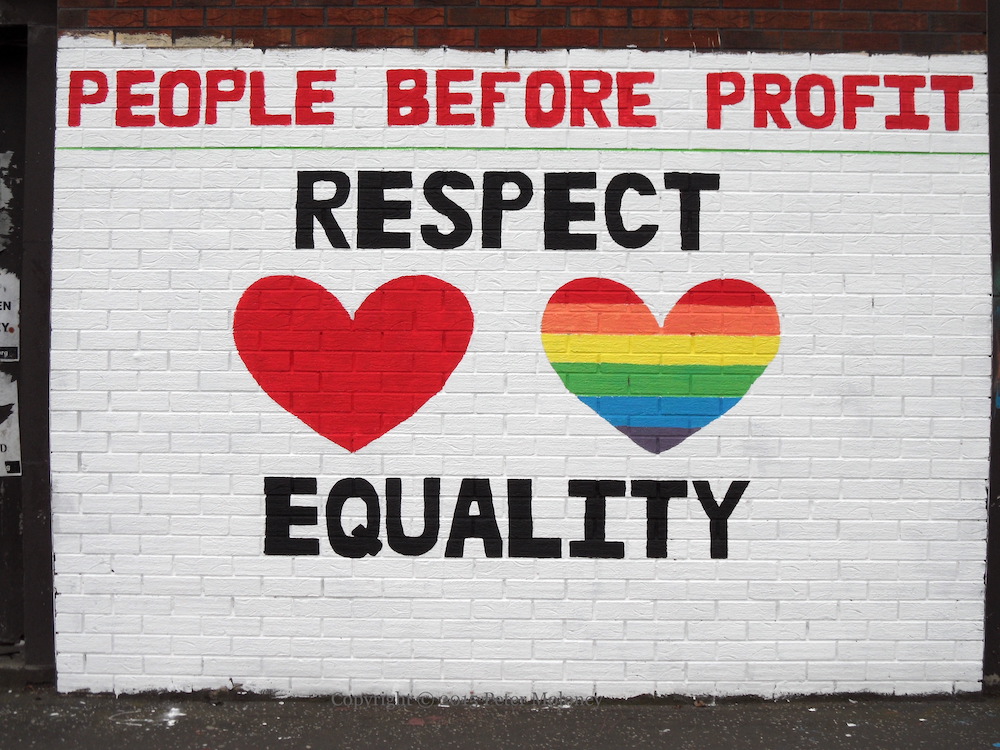
The People Before Profit Alliance is an all-Ireland political party closely related to the Socialist Workers Party. In the north, candidate Gerry Carroll was elected to Belfast City Council in 2014, representing Black Mountain. Gay rights does not seem to form an explicit part of the platform, but the mural above, featuring a heart with the rainbow colours, appeared on Divis St in time for the Pride parade on August 1st.

See also: Cherish from Sınn Féın.

Divis Street, west Belfast

Click image to enlarge
Copyright © 2015 Peter Moloney
M12714

Ballymurphy March

The QR code in the second image takes one to an interactive walking tour (“Walk Of Truth”) of sites associated with the Ballymurphy Massacre; the walk was launched on August 8th, one of a number of Féile 2015 events (web) which included a photographic exhibition in St Mary’s and the march announced in the first image, from Springfield Park to O’Donnell’s GAA club.

Bombay Street, Northumberland Street

Click image to enlarge
Copyright © 2015 Peter Moloney
M12678 M12711

RIP Vol Tommy Crossan

“Rest easy, big man”, “Justice will be done”.

Tommy Crossan, a former leader of the CIRA, was shot and killed, perhaps by former comrades, on Friday (April 18th, 2014 – Good Friday) (Guardian | BBC).

He was also active in elections in 2001 and in 2004.

Springfield Rd, west Belfast, close to where he was shot

Click image to enlarge
Copyright © 2015 Peter Moloney
M12700

Free Stephen Kaczynski

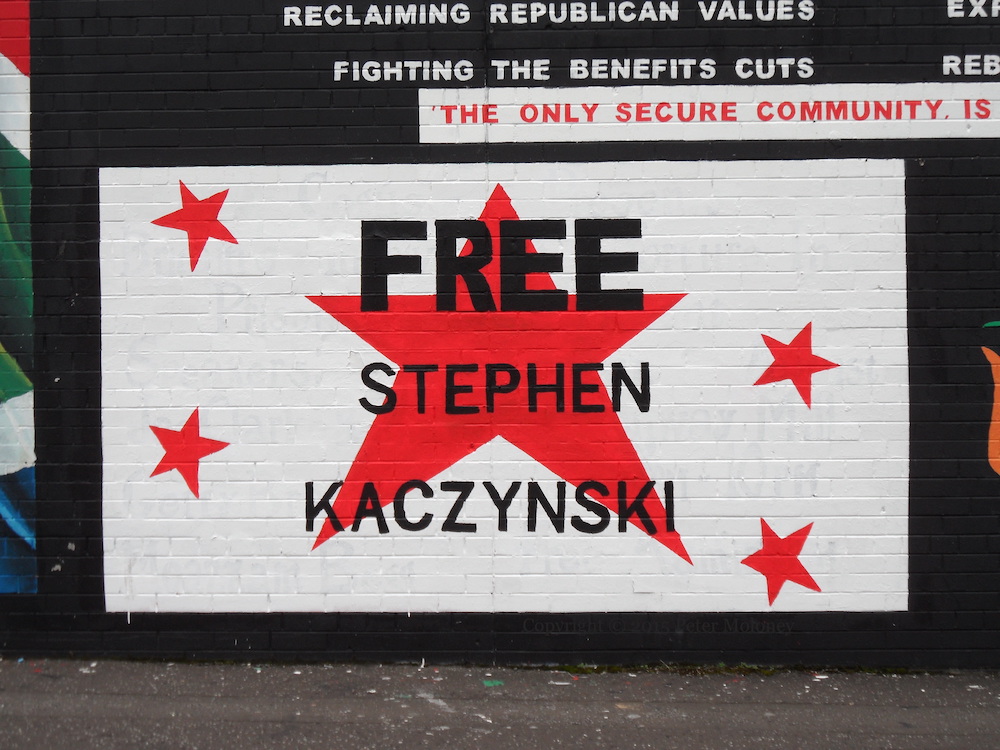
Stephen (or Stephan) “Steve” Kaczynski will go before a Turkish court on September 18th on charges of membership of the Marxist-Leninist ‘Revolutionary People’s Liberation Party-Front’ (DHKP-C). (WP) In April, members of the group took over a courtroom and held a state prosecutor hostage; when special forces stormed the building, the hostage and two of his captors died. (Independent) Kaczynski, a freelance journalist from Scotland, is alleged to be instrumental in financing the group. Alternatively, (according to various newspaper reports) he is an undercover agent of the Germans (Daily Sabah) or the British (Brian Haw). He has been on hunger-strike in protest at the conditions in Maltepe #3 since June 25th.

Replaces the announcement of a talk about torture in prisons. For the wider frame, see The Only Secure Community Is An Organised One.

Click image to enlarge
Copyright © 2015 Peter Moloney
M12710

The Priest And The Cobbler

This new mural pays tribute to two long-time residents of Clonard. On a good day, Noel Fitzpatrick, a cobbler with a little shop on the corner of Odessa and Clonard streets, would take his chair out into the street and play the uıleann pipes. Looking down from above is Alec Reid, the Redemptorist priest who spent 40 years at Clonard monastery and played an important role in the peace process. He died in 2013 at age 82. (WP)

Painted by Marty Lyons & Mickey Doc in Springfield Drive. For the large ‘flower’ mural to the left of this mural (which imitates the stained glass in the cathedral), see C01044.

Click image to enlarge
Copyright © 2015 Peter Moloney
M12697 M12698 M12699

Topper Thompson

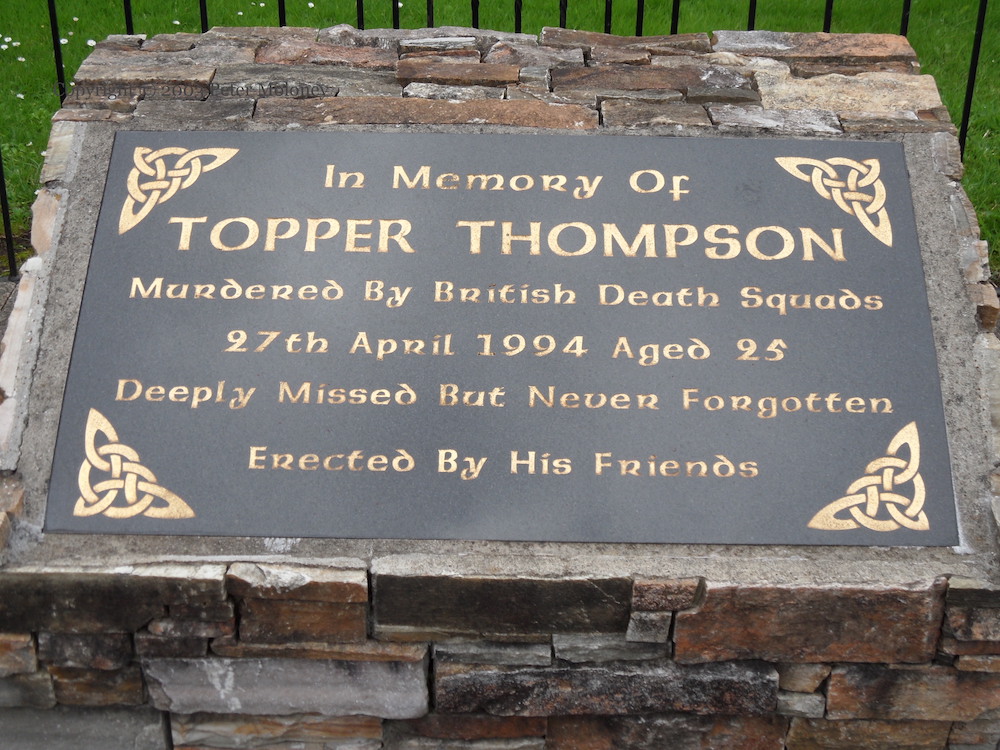
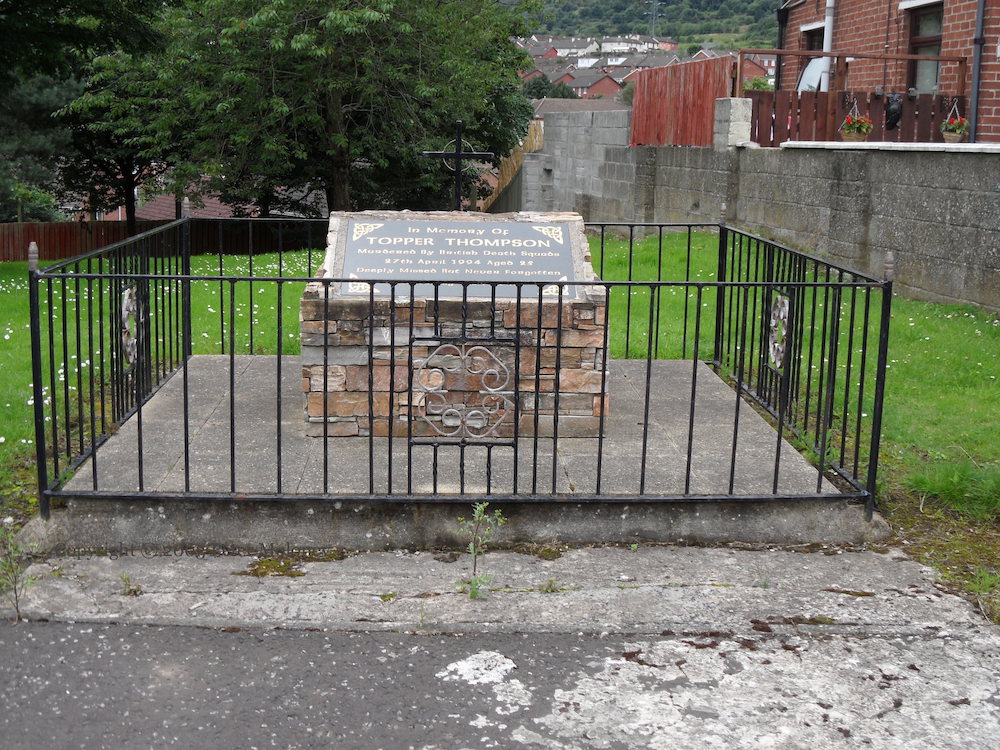
“In memory of Topper Thompson, murdered by British death squads, 27th April 1994 aged 25. Deeply missed by never forgotten. Erected by his friends.” Paul Thompson was shot by a UDA gunman through a hole that had been cut in the security fence and about which the RUC had been notified earlier in the day (Relatives For Justice).

This is the second memorial to Thompson in Springfield Park, west Belfast. See the illustrations to chapter seven of Painting My Community for photos of the original memorial and of a march alleging collusion in Thompson’s killing.

Click image to enlarge
Copyright © 2015 Peter Moloney
M12696 M12695