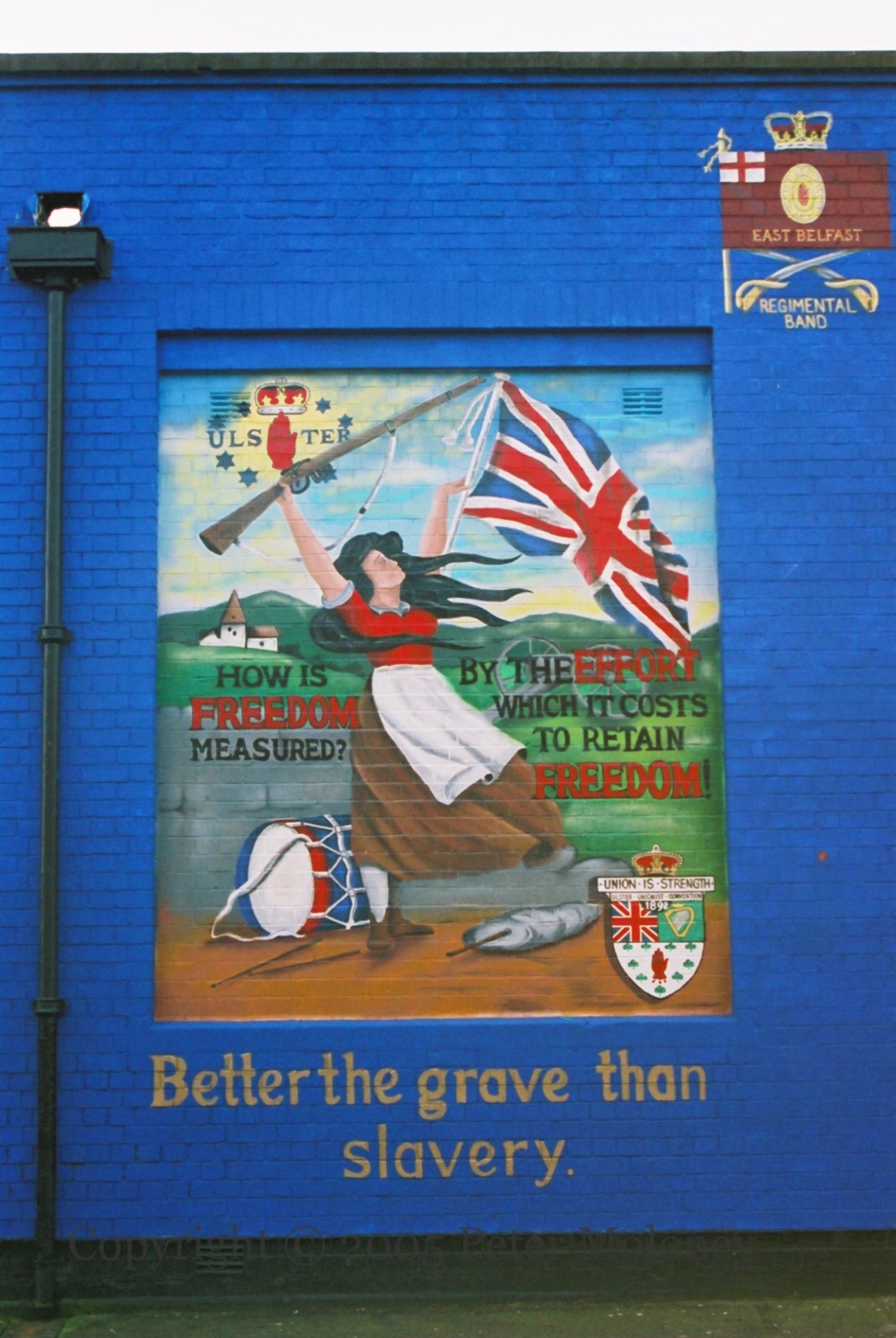
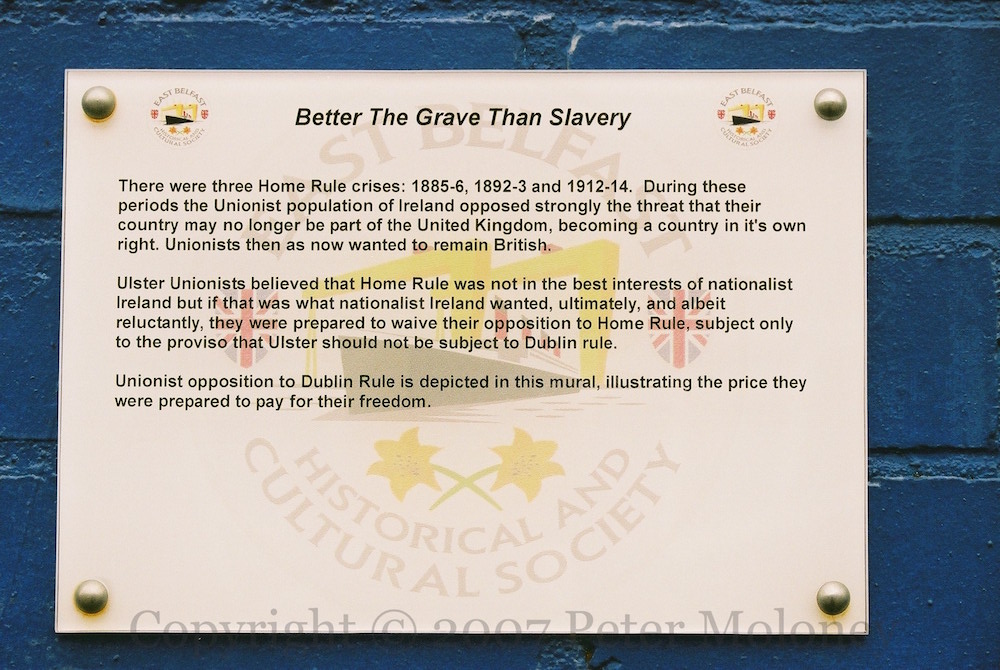
Better The Grave Than Slavery

“How is freedom measured? By the effort which it costs to retain freedom!” (See also How Is Freedom Measured? and Deserted! Well – I Can Stand Alone) “Union is strength”. “There were three Home Rule crises: 1885-6, 1892-3 and 1912-14. During these periods the unionist population of Ireland opposed strongly the threat that their country may no longer be part of the United Kingdom, becoming a country in it’s own right. Unionists then as now wanted to remain British. Ulster Unionists believed that Home Rule was not the best interests of nationalist Ireland but if that was what nationalist Ireland wanted, ultimately, and albeit reluctantly, they were prepared to waive their opposition to Home Rule, subject only to the proviso that Ulster should not be subject to Dublin rule. Unionist opposition to Dublin Rule is depicted in this mural, illustrating the price they were prepared to pay for their freedom.”

According to this BBC page, the mural is rather a postcard from WWI, showing a woman exhorting Ulstermen to sign up for service in the British forces.

With the emblem of the East Belfast Regimental Band.

One of fourteen panels in Thorndyke Street, east Belfast. For a list of entries for each panel, see East Belfast Historical And Cultural Society.

Click image to enlarge
Copyright © 2005/2007 Peter Moloney
M02302 M03631

Civil And Religious Liberty For All

“Dan Winter’s cottage, Co Armagh. Dan Winter was one of the founders of the Orange Order.” “For many, perhaps even most, Orangemen the Order is primarily a religious organisation. As as organisation it is not anti-Roman Catholic; it is a Protestant organisation. The Orange Hall, the meeting place for Orangemen has long occupied a central place in the social life of the community. They serve as venues for a much wider range of gatherings than those, which are strictly Orange. The Orange Order is also a cultural organisation, transmitting a culture and heritage – whether it is banner painting, sustaining a great musical tradition or teachings its ritual – from one generation to the next. It also remains the most cohesive force in Ulster Protestant society and the essential expression of the culture and heritage of the Ulster Protestant people.” Fourth panel on Thorndyke Street, Belfast. With emblem of Pride of the Raven (flute band).

One of fourteen panels in Thorndyke Street, east Belfast. For a list of entries for each panel, see East Belfast Historical And Cultural Society.

Click image to enlarge
Copyright © 2005/2007 Peter Moloney
M02301 M03633 [M08004]

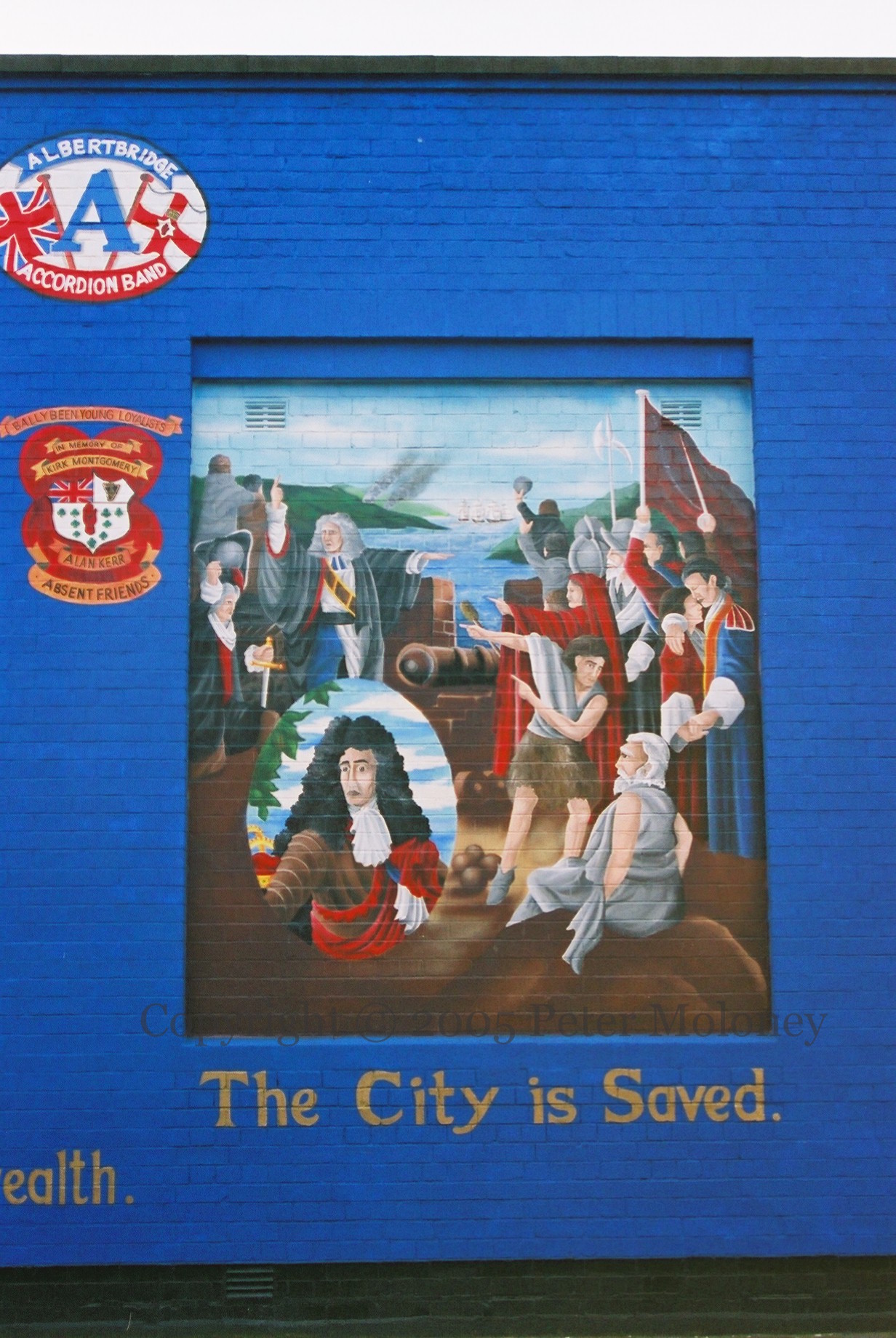
The City Is Saved

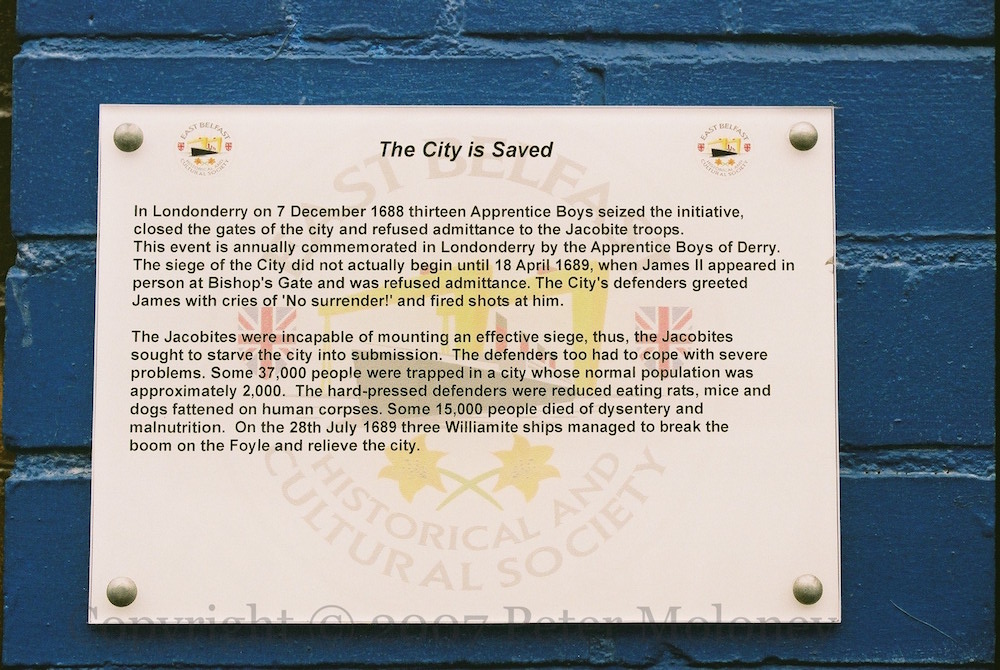
“In Londonderry on 7 December 1688 thirteen Apprentice Boys seized the initiative, closed the gates of the city and refused admittance to the Jacobite troops. This event is annually commemorated in Londonderry by the Apprentice Boys of Derry. The siege of the City did not actually begin until 18 April 1689,when James II appeared in person at Bishop’s Gate and was refused admittance. The City’s defenders greeted James with cries of ‘No surrender!’ and fired shots at him. The Jacobites were incapable of mounting an effective siege, thus, the Jacobites sought to starve the city into submission. The defenders too had to cope with severe problems. Some 37,000 people were trapped in a city whose normal population was approximately 2,000. The hard-pressed defenders were reduced to eating rats, mice and dogs fattened on human corpses. Some 15,000 people died of dysentery and malnutrition. On the 28th July 1689 three Williamite ships managed to break the boom on the Foyle and relieve the city.”

One of fourteen panels in Thorndyke Street, east Belfast. For a list of entries for each panel, see East Belfast Historical And Cultural Society.

Click image to enlarge
Copyright © 2005/2007 Peter Moloney
M02300 M03634

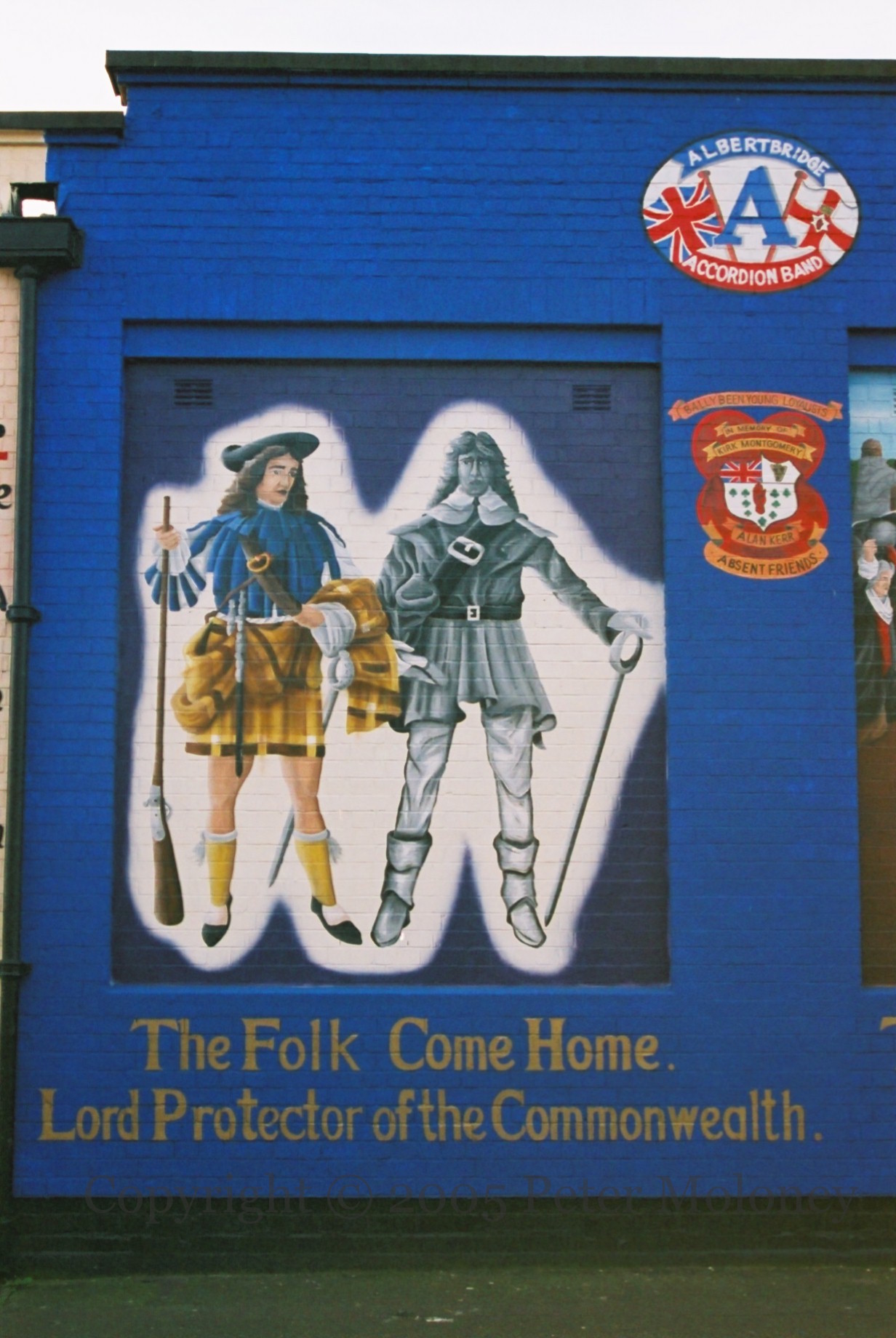
The Folk Come Home

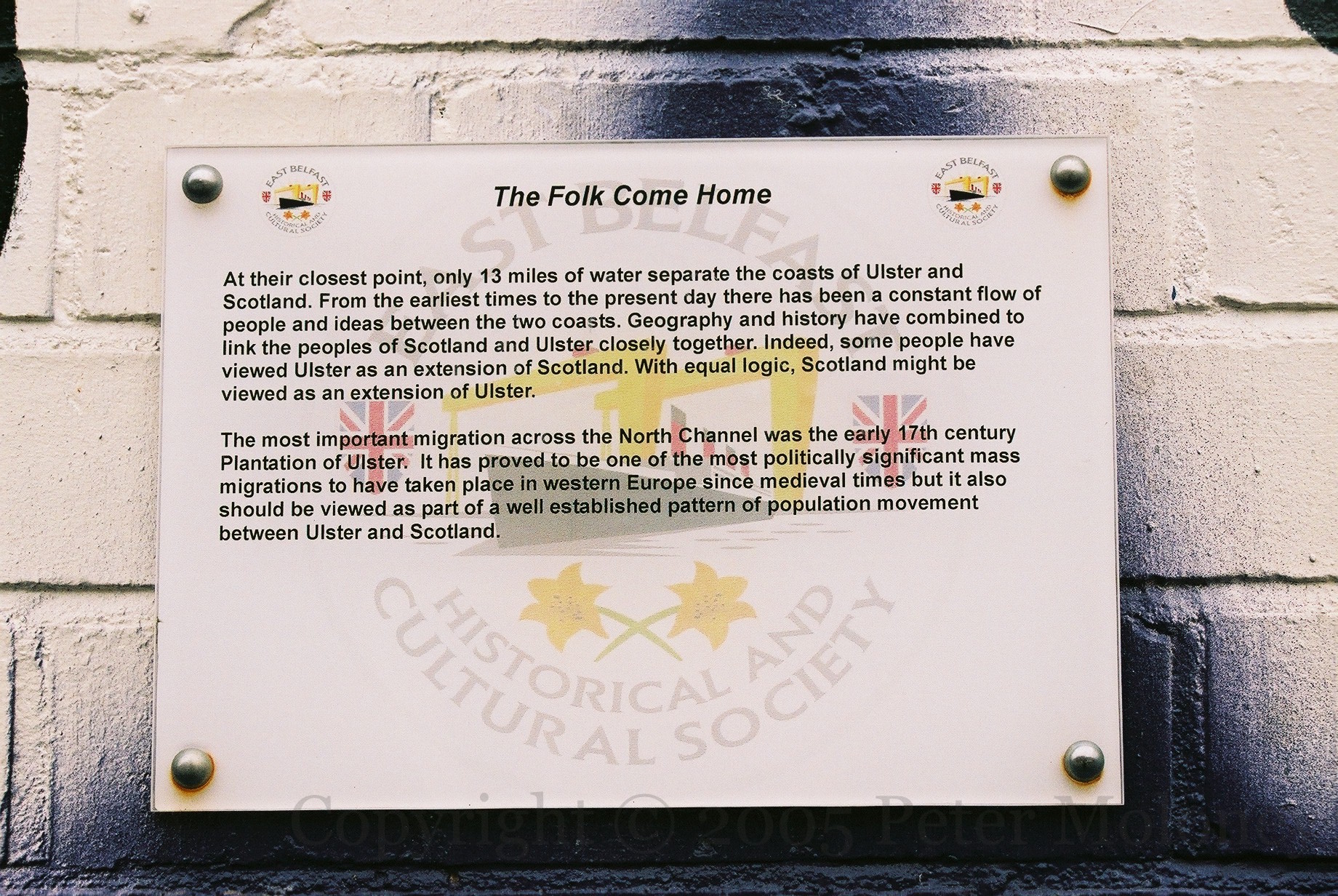
“At the closest point, only 13 miles of water separate the coasts of Ulster and Scotland. From the earliest times to the present day there has been a constant flow of people and ideas between the two coasts. Geography and history have combined to link the peoples of Scotland and Ulster closely together. Indeed, some people have viewed Ulster as an extension of Scotland. With equal logic, Scotland might be viewed as an extension of Ulster. The most important migration across the North Channel was the early 17th century Plantation of Ulster. It has proved to be one of the most politically significant mass migrations to have taken place in western Europe since medieval times but it also should be viewed as part of a well established pattern of population movement between Ulster and Scotland.” Second panel in the Thorndyke Street, Belfast, series. The “Lord Protector of the Commonwealth” is Oliver Cromwell, who put down Irish rebellion (and allied Royalists) in 1650. With emblems of Albertbridge Accordion Band and Ballybeen Young Loyalists.

One of fourteen panels in Thorndyke Street, east Belfast. For a list of entries for each panel, see East Belfast Historical And Cultural Society.

Click image to enlarge
Copyright © 2005/2007 Peter Moloney
M02299 M03636 M03635

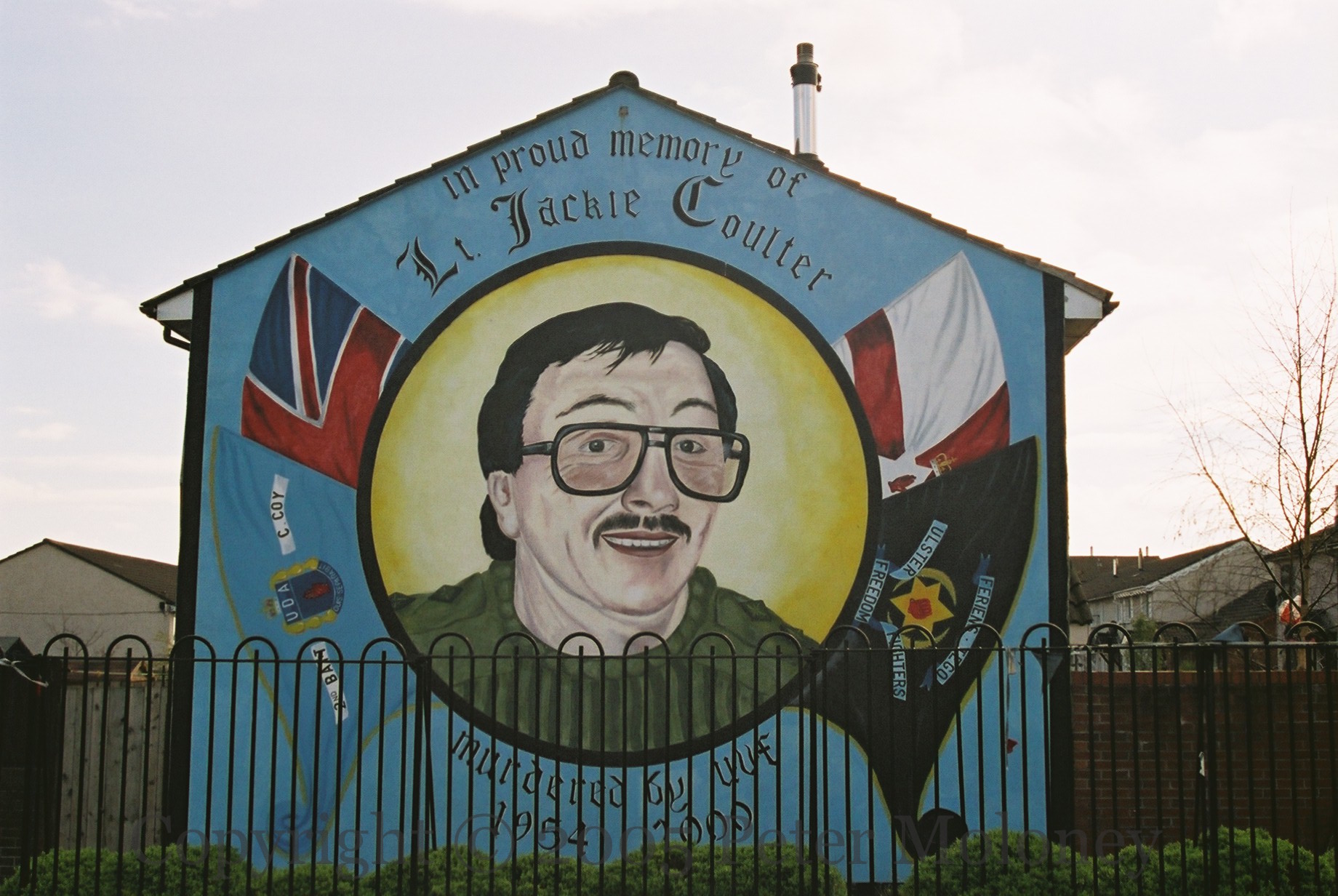
Lt Jackie Coulter

UDA lieutenant Jackie Coulter was killed, along with Bobby Mahood, as part of the UVF-UDA feud of 2000. The earliest date we have for this mural is 2001, which would mean that it was painted separately from the Johnny Adair C Coy murals of 2000 and 2002.

Shankill Parade, west Belfast

Click image to enlarge
Copyright © 2005 Peter Moloney
M02477

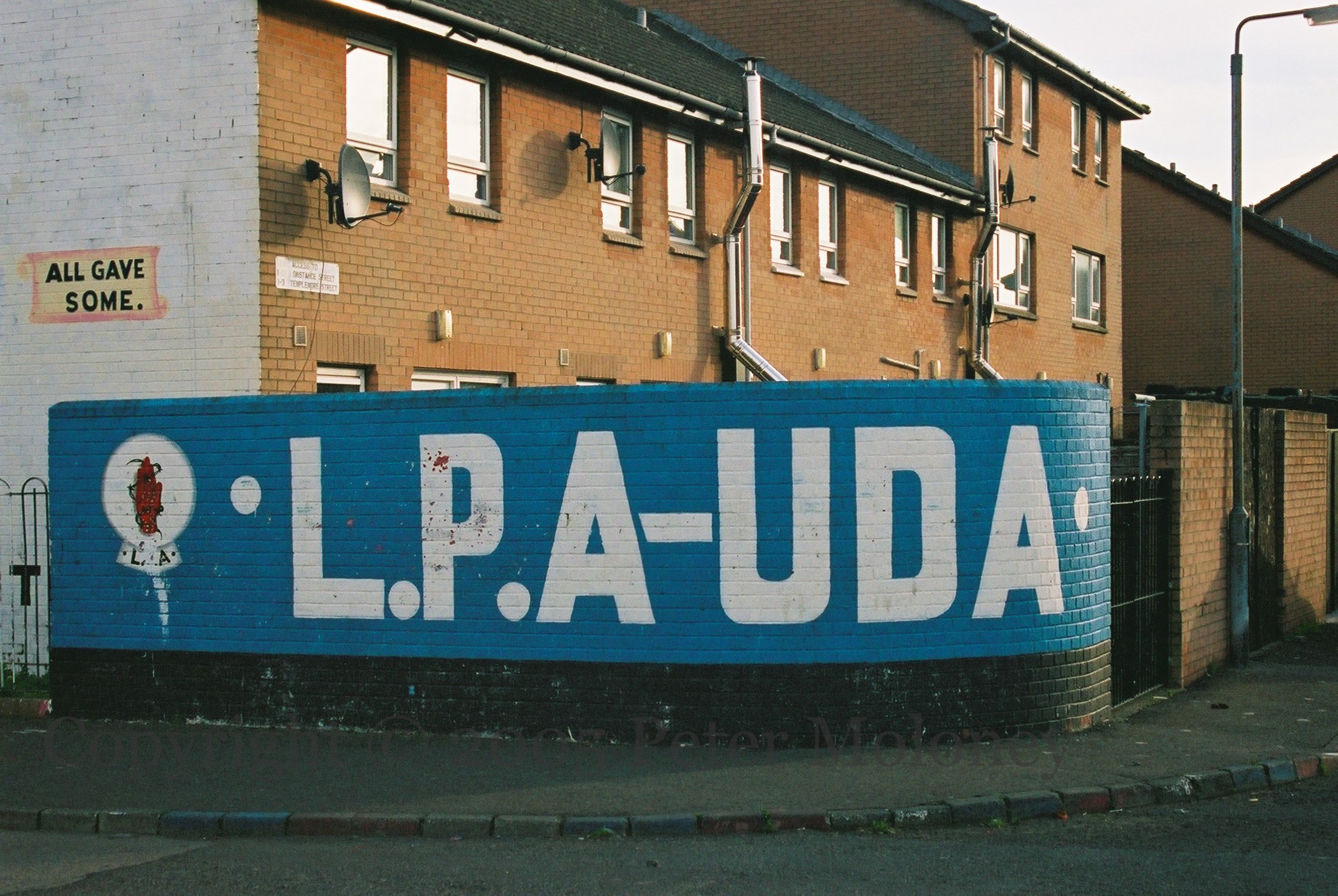
Some Gave All, All Gave Some

“Free our prisoners.” “LPA” is the “Loyalist Prisoners Association”. Its symbol (in the second image) is a red hand in barbed wire. In the main mural, a pair of red hands are in shackles and the fences of the Maze are superimposed on an outline of Northern Ireland filled in with the walls of the Maze/Long Kesh.

Lord Street, east Belfast

Click image to enlarge
Copyright © 2005 Peter Moloney
M02291 M02292

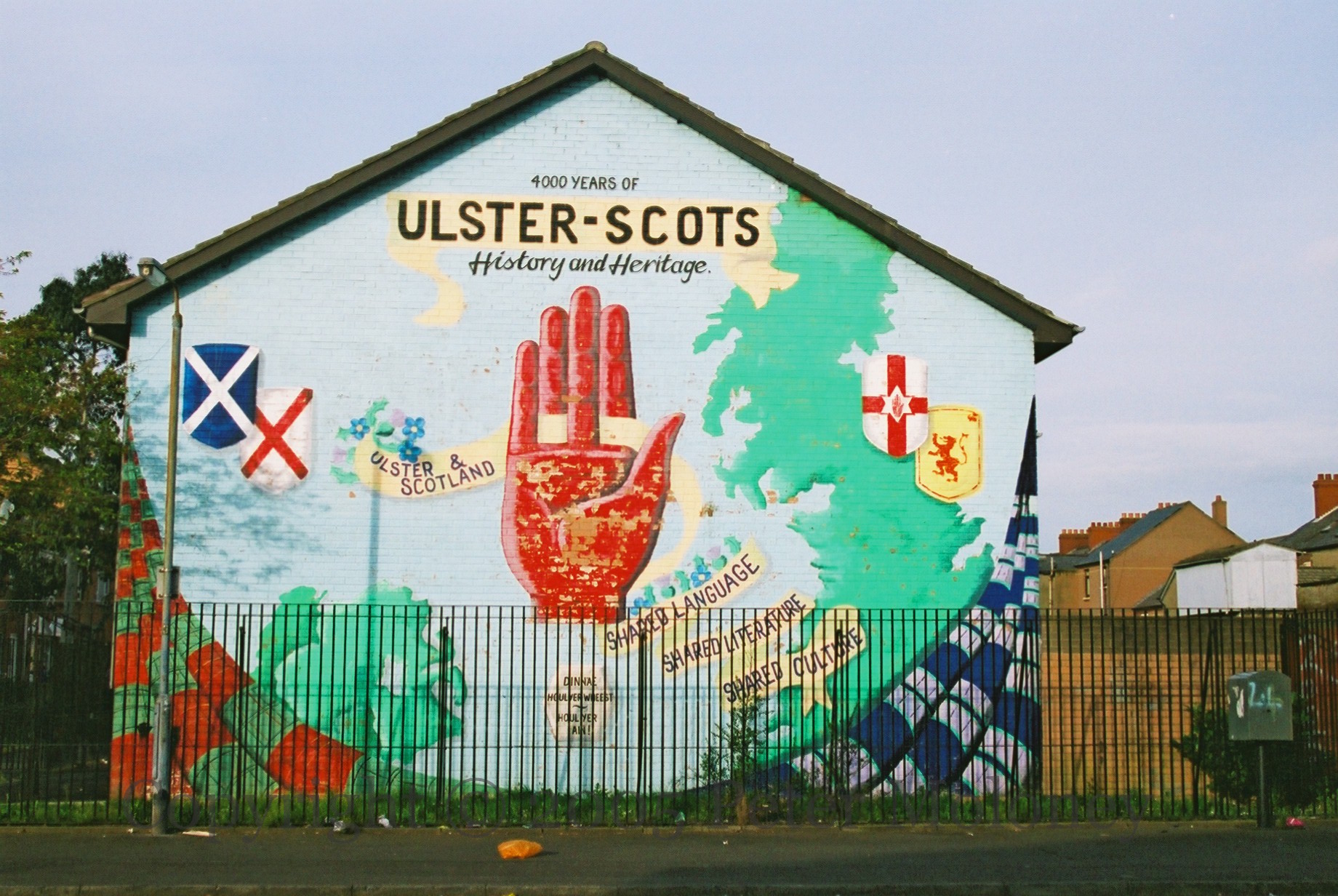
4000 Years Of Ulster Scots

“4000 years of Ulster-Scots history and heritage. Ulster & Scotland – shared language, shared literature, shared culture.” 400 years takes us back to the plantation; 4000 years suggests an even deeper connection.

Ulster-Scots was included in the 1998 Good Friday Agreement under the principle of support for “linguistic diversity”. This mural celebrating Ulster-Scots and ties between Northern Ireland and Scotland dates to 1999, with the crests of St Andrew and St Patrick on the left, and an Ulster Banner and Scottish lion rampant on the right.

“Dinnae houl yer wheest, houl yer ain!” [Don’t hold your tongue, hold your own!]

Templemore Street, east Belfast

Click image to enlarge
Copyright © 2005 Peter Moloney
M02321

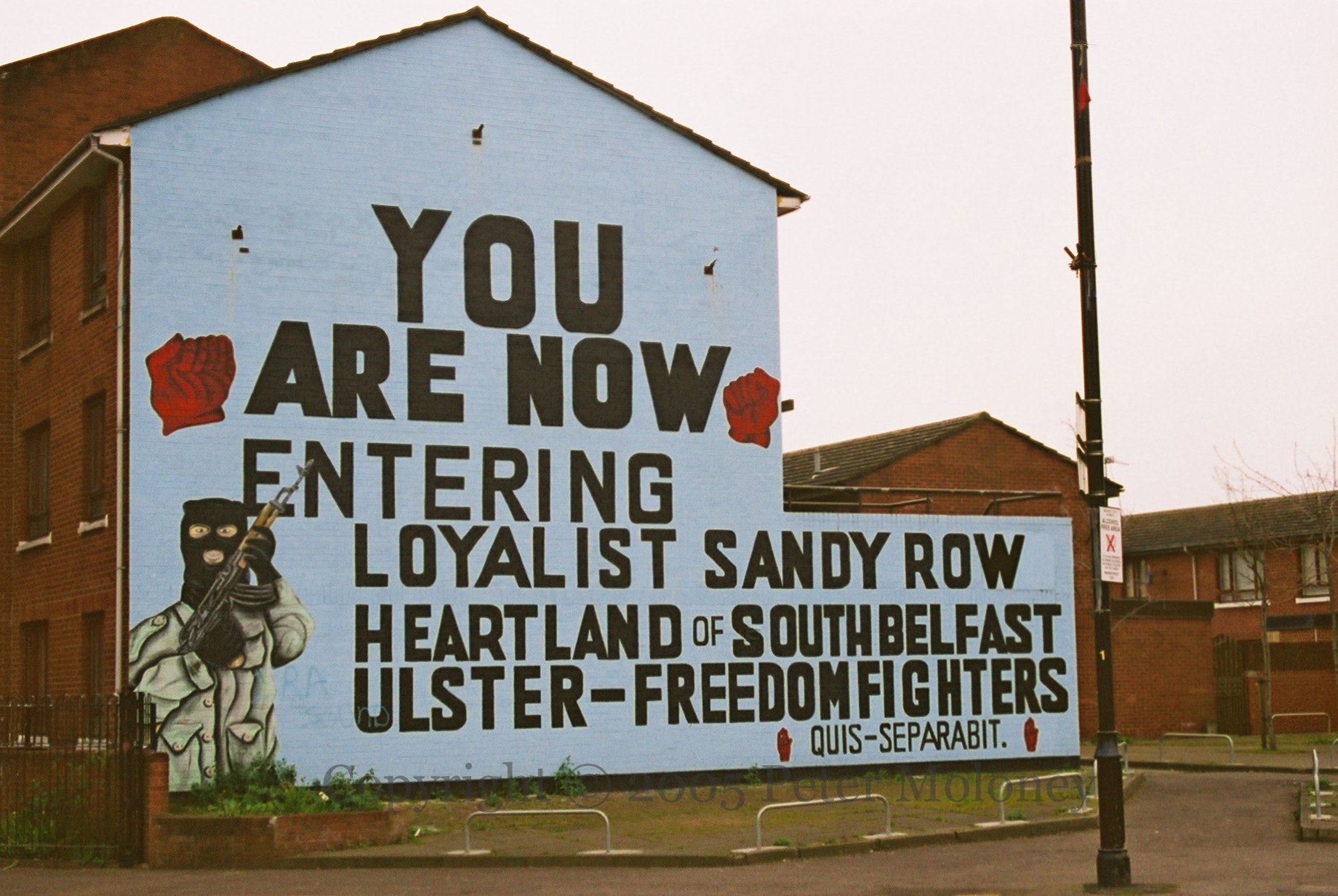
You Are Now Entering Loyalist Sandy Row

M02970+.JPG

“You are now entering loyalist Sandy Row, heartland of South Belfast Ulster-Freedom [sic] Fighters”. The background of the large mural at the junction of Linfield Road and Sandy Row, Belfast, is repainted blue (from its original yellow.)

Click image to enlarge
Copyright © 2005 Peter Moloney M02286
Copyright © 2006 Peter Moloney M02970

Free Ireland

Bouquets of tricoloured flowers are placed on the Free Ireland mural at the corner of Beechmount Avenue and Falls Road, Belfast. A hand clasping an Easter lily is manacled by bonds “Made in Britain”. The mural is now in its fifteenth year. For the plaque, see the original 1990 post.

Click image to enlarge
Copyright © 2005 Peter Moloney
M02284

Live Free!

Joe Cahill joined the Fianna in 1937 and was involved in the republican movement from then until his death in 2004, including being in Tom Williams’s company in 1942 and later a founder member and Chief of Staff of the Provisional IRA. In the centre of the image he is at the end of the table at the August 13, 1971, press conference to comment on the introduction of internment (CAIN). He is honoured in the mural above alongside his brothers Tom and Frank Cahill. (Pat O’Hare is painted between Tom and Frank.)

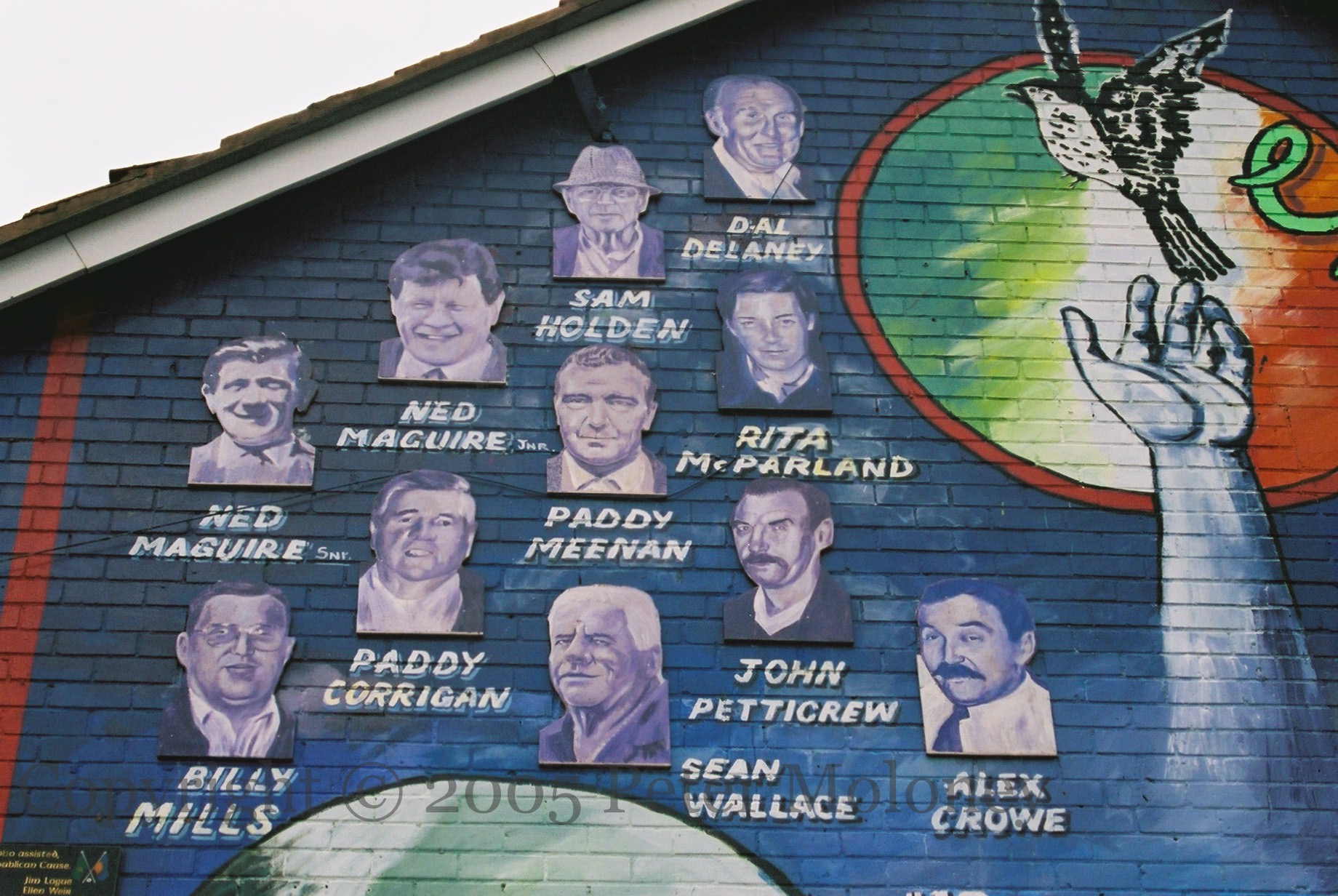
In the top left are small boards with portraits of Ned Maguire Snr, Ned Maguire Jnr, Sam Holden, Dal Delaney, Rita McParland, Paddy Meenan, Paddy Corrigan, Sean Wallace, John Petticrew, Alex Crowe.

“Never will they label our liberation struggle as criminal – Bobby Sands [March 6th Diary].”

Click image to enlarge
Copyright © 2005 Peter Moloney
M02280 M02282