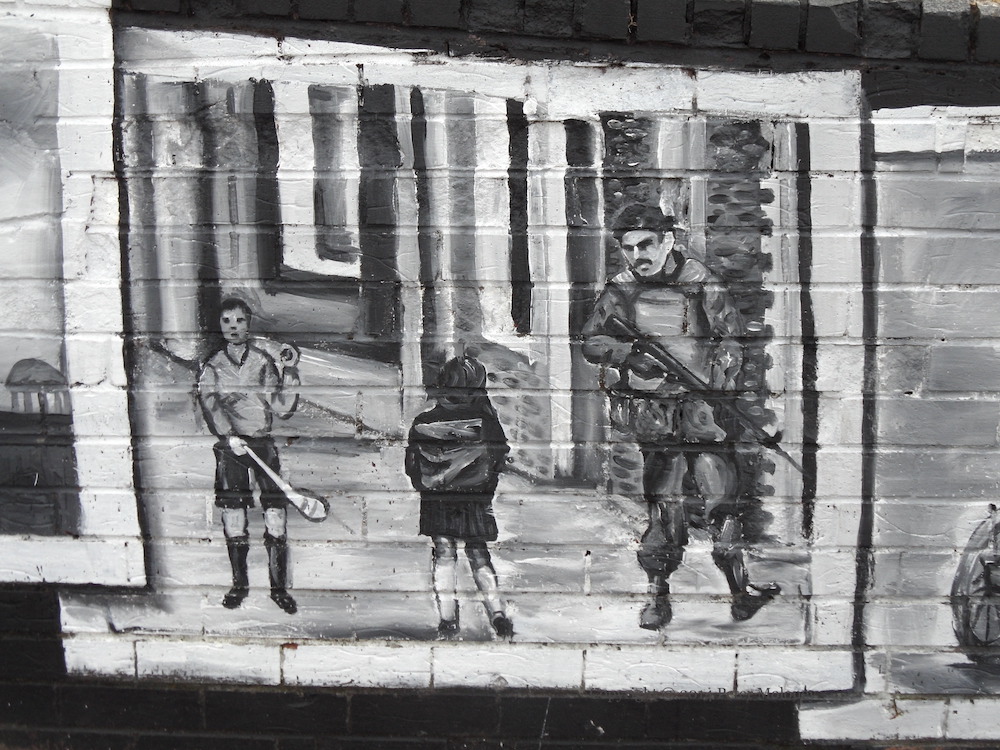
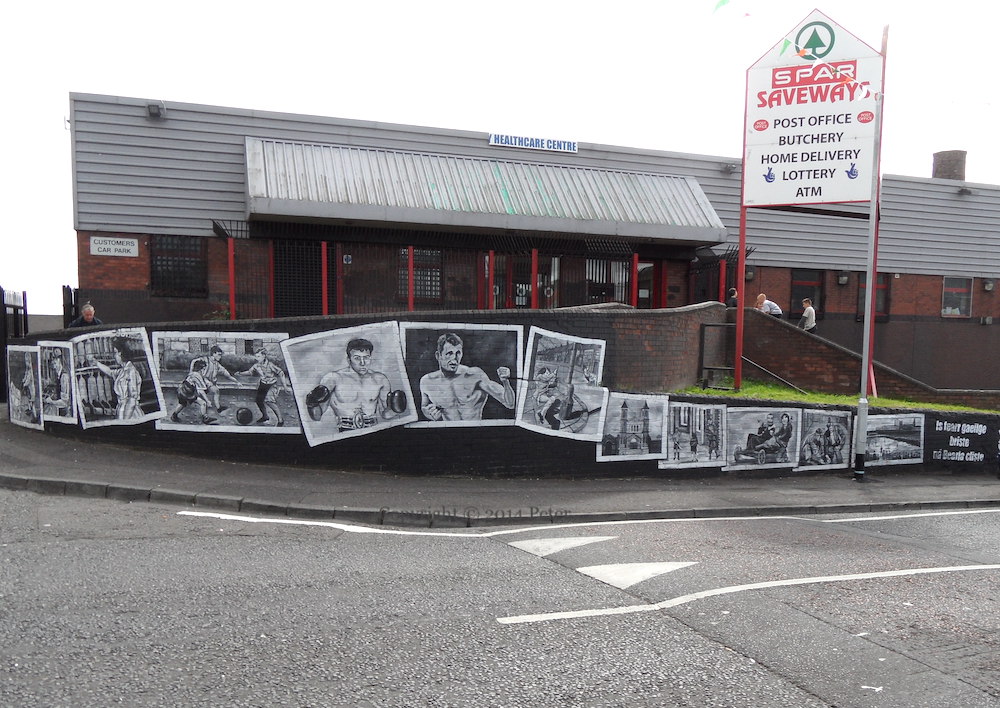
A British soldier patrols the streets while a girl walks home from school and a boy plays hurley. This is one of the panels in the long mural at the shops on Ardoyne Avenue.
The “Welcome” verbiage is just out of shot on the left-hand side; on the right is “Is fearr Gaeılge brıste ná Béarla clıste” [Broken Irish is better than clever English] and (out of shot) some Celtic knotwork. For close-ups of all of the panels, see Growing Up Too Fast.
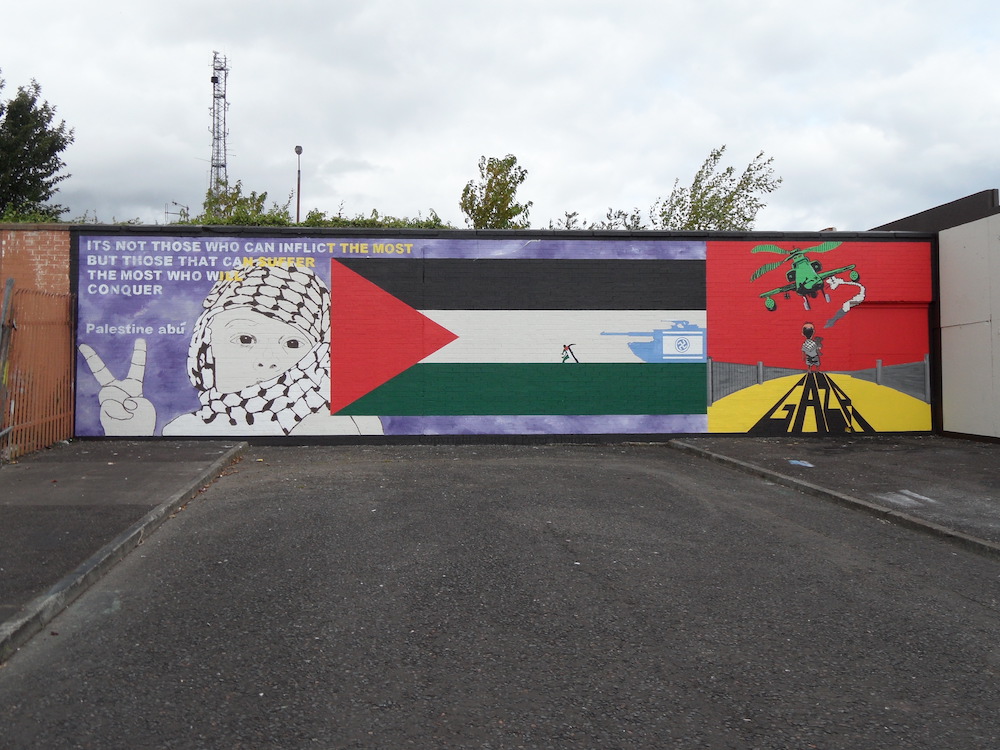
This is a large mural is by Gerard “Mo Chara” Kelly‘s (video) new work at the top of Springhill Avenue, where it is blocked off from the Springfield Road.
On the left, a figure in a black-and white keffiyeh give the two-finger ‘V for victory’ sign beneath the Terence McSwiney (WP) quote: “It is not those who can inflict the most but those that can suffer the most who will conquer.”
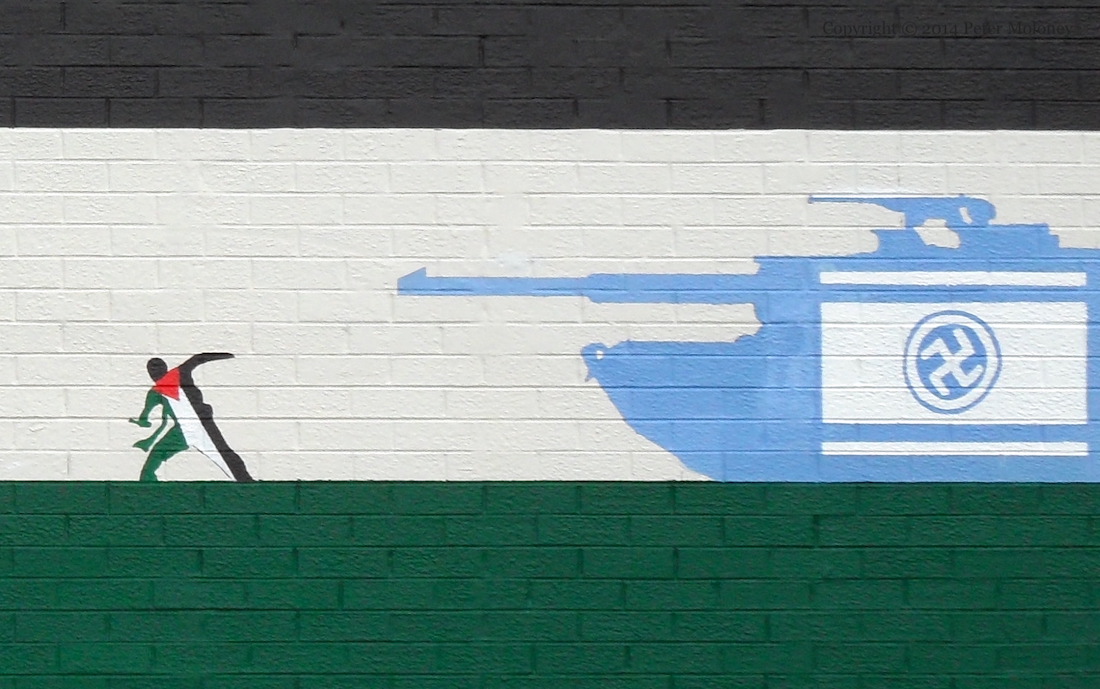
In the middle, a protestor stands up to an Israeli tank with a swastika. (See the adjacent mural in Palestinian Territory.)
On the right, an Israeli Apache helicopter fires a Hellfire missile at a young Gazan boy carrying a teddy-bear (originally a Carlos Latuff (ig) poster).
“Belfast’s Bloody Sunday. On the 9th July 1972 the British Army murdered 5 Irish citizens and severely wounded 2 others. It’s time for the truth.”
This is a mural by Mo Chara Kelly (with DD Walker, Michael Kelly, and Ta Heath) commemorating the deaths of five people shot by British Army snipers in 1972: Paddy Butler (39), David McCafferty (15), Margaret Gargan (13), John Dougal (16), Fr Noel Fitzpatrick (40). The snipers fired from JP Corry’s timber yard (shown on the right) and at the time the Westrock bungalows were still standing (shown lower left).
Here is a set of pro-Palestinian murals at the top of Springhill, inspired by recent events in Gaza.
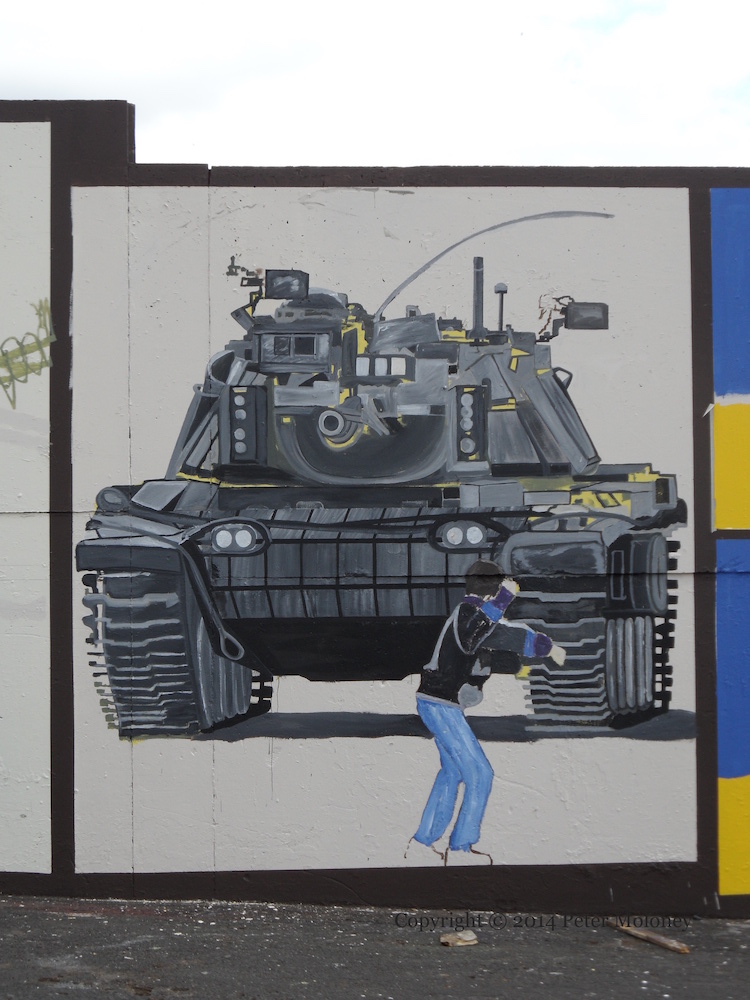
The second (from left to right) shows Palestinian teenager Faris Odeh throwing a rock at an Israeli tank; Odeh was shot and killed a few days later (WP). The AP photograph on which the mural is based can be seen in this May 2012 edition of (the Pakistani) The Nation.
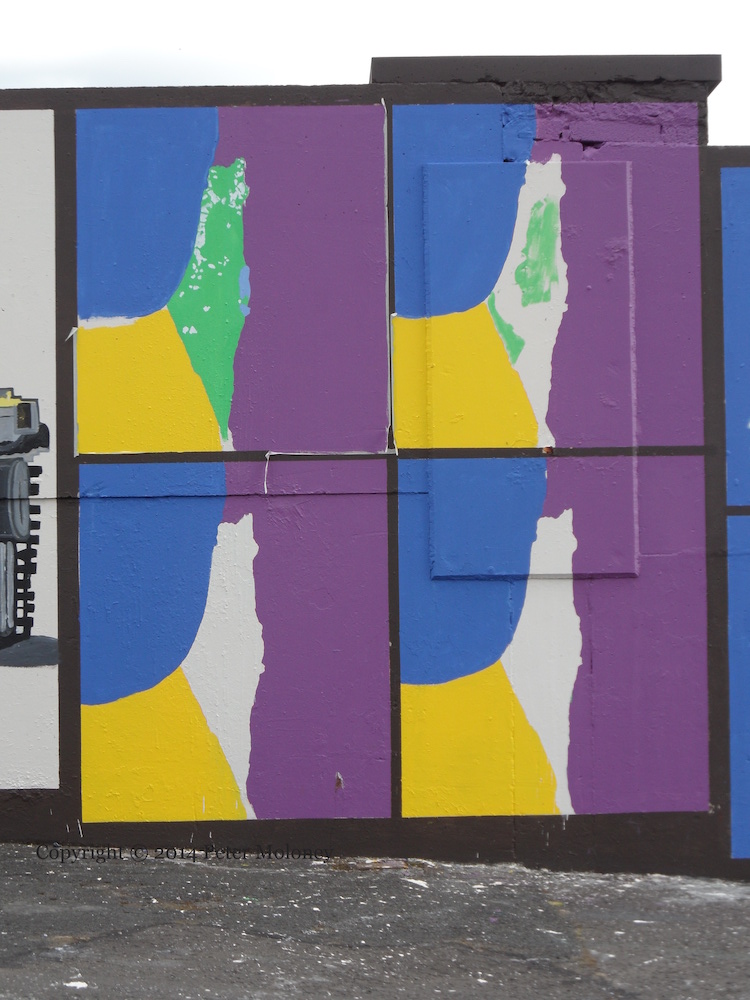
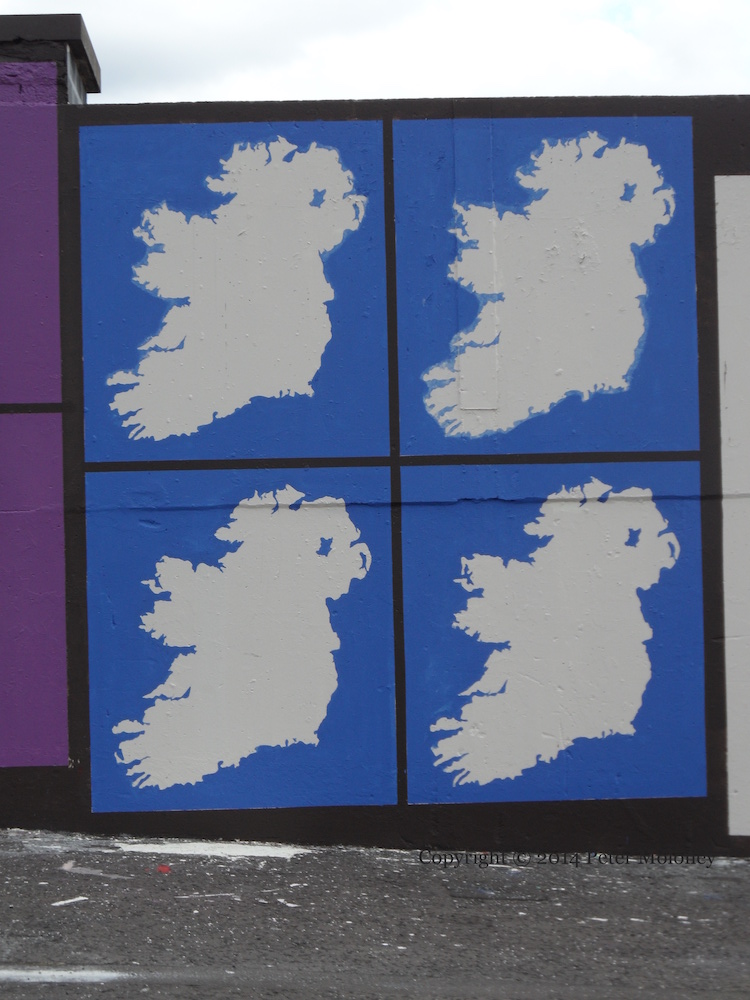
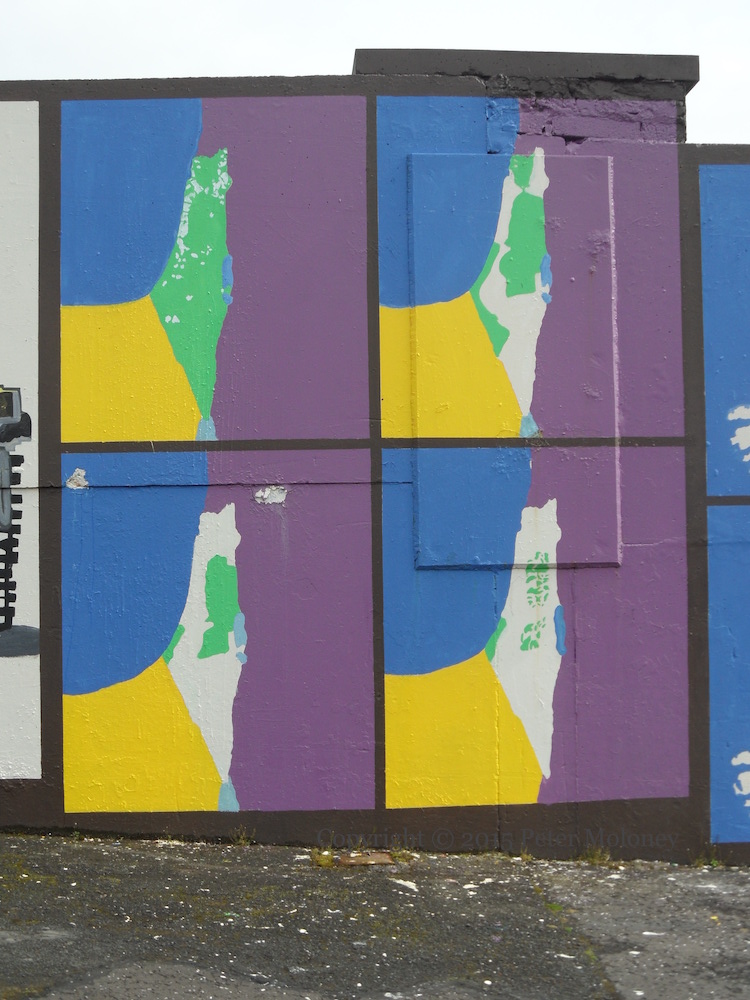
The final two are intended to show four stages of the disappearing Palestinian territories (on the left) and four stages of the disappearing Irish gaeltacht (on the right). The Palestinian one was completed – see below – but the Irish one never was.
The fairy-tale covering painted over an LVF “North Belfast Rat Pack” mural is fading away to reveal the previous work. For the original LVF mural, see D01199.
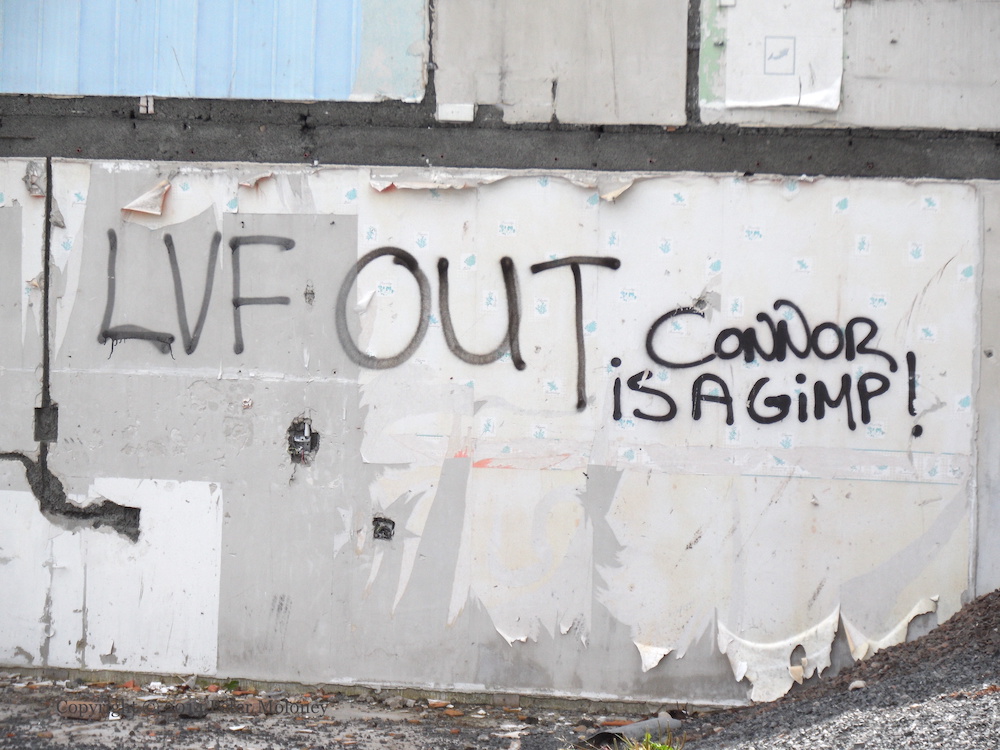
The graffiti on the wall – Welcome to LVF Land – has itself been scored out, and there is also a piece of anti-LVF graffiti in the street.
The local New Lodge GAA club Cumman An Phıarsaıgh is named in honour of Patrick Pearse, executed after the 1916 rising. The club’s new mural features footballers contesting a ball and Pearse’s image appears at the centre of a Celtic cross along with part of his 1912 poem Mıse Éıre in the bottom corner (shown in the close-up).
Painted by Lucas Quigley and Michael Doherty. Replaces ‘New Lodge 2000‘.
Mıse Éıre: Sıne mé na an Chaılleach Bhéarra. Mór mo ghlóır: Mé a rug Cú Chulaınn croga. Mór mo náır: Mo chlann féın a dhíol a máthaır. [Mór mo phıan: Bıthnaımhde do mo shíorchıapadh. Mór mo bhrón: D’éag an dream ınar chuıreas dóchas.] Mıse Éıre: Uaıgní mé ná an Chaılleach Bhéarra.
I am Ireland: I am older than the old woman of Beare. Great my glory: I who bore Cuchulainn, the brave. Great my shame: My own children who sold their mother. [Great my pain: My irreconcilable enemy who harasses me continually. Great my sorrow: That crowd, in whom I placed my trust, died.] I am Ireland: I am lonelier than the old woman of Beare.
“The Market community supports Palestine – End the siege on Gaza – Free Palestine”. Tears of blood flow from a boy’s face, shrouded by a Palestinian flag and behind barbed wire. Along the bottom, in red lettering, is a quote from Malcolm X’s autobiography: “If you’re not careful, the newspapers will have you hating the [people who are being] oppressed and loving the oppressor [the people who are doing the oppressing].”
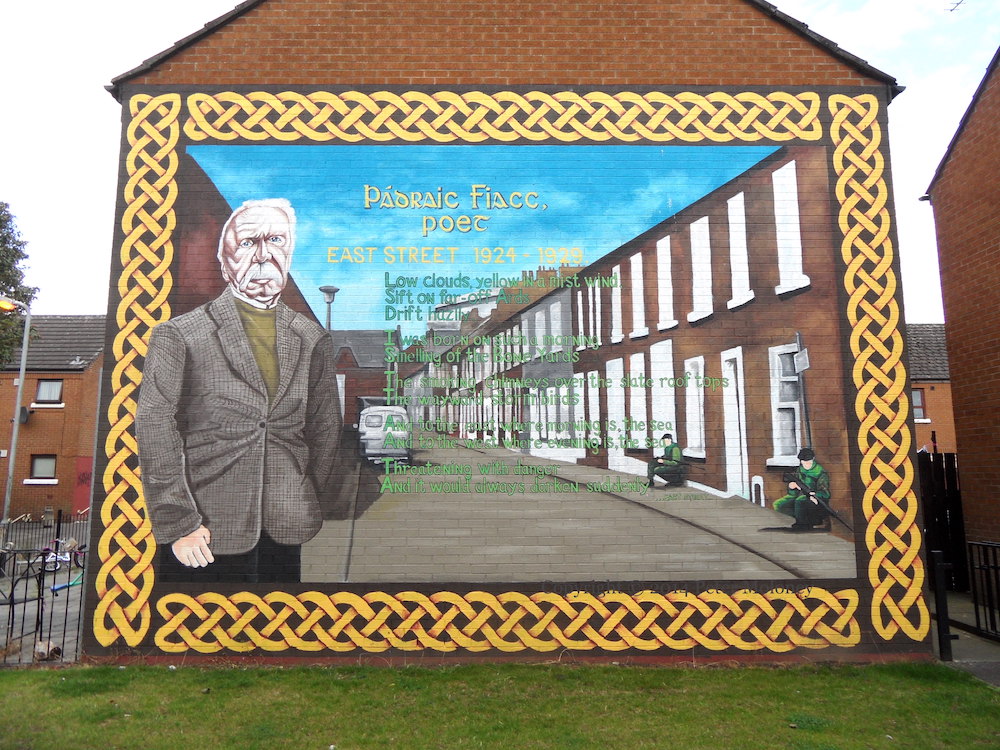
Patrick O’Connor was born on April 15th, 1924, on the lower Falls but after his father emigrated he spent his early years – until age 5 – with his grandparents in East Street in the Markets. It was as a high-schooler in New York that he adopted the name Pádraıc Fıacc (“fıach dubh” is “raven”) and began writing poetry. He settled in Glengormley upon his second and final return; it is not clear that he ever saw East Street lined with British Army soldiers, as shown in the mural above. He wrote of his early life in ‘First Movement’:
Low clouds, yellow in a mist wind Sift on far-off Ards Drift hazily … I was born on such a morning Smelling of the bone yards The smoking chimneys over the slate top roofs The wayward storm birds And to the east where morning is, the sea And to the west where evening is, the sea Threatening with danger And it would always darken suddenly
Some of Fıacc’s poems are in the TroublesArchive. There are two videos below. The first is an interview with NVTv’s Bernard Conlon; the second is of a reception in Belfast City Hall.
This is a mural in support of travellers’ right, featuring horseshoes, musical notation, and a child looking out of a vintage caravan. Sponsored by West Against Racism Network (WARN) and Springfield Charitable Association (SCA – web)
The image that the artists were working from for central portion of the mural – a 2009 photograph by Mark Stedman – can be seen still taped to the wall.
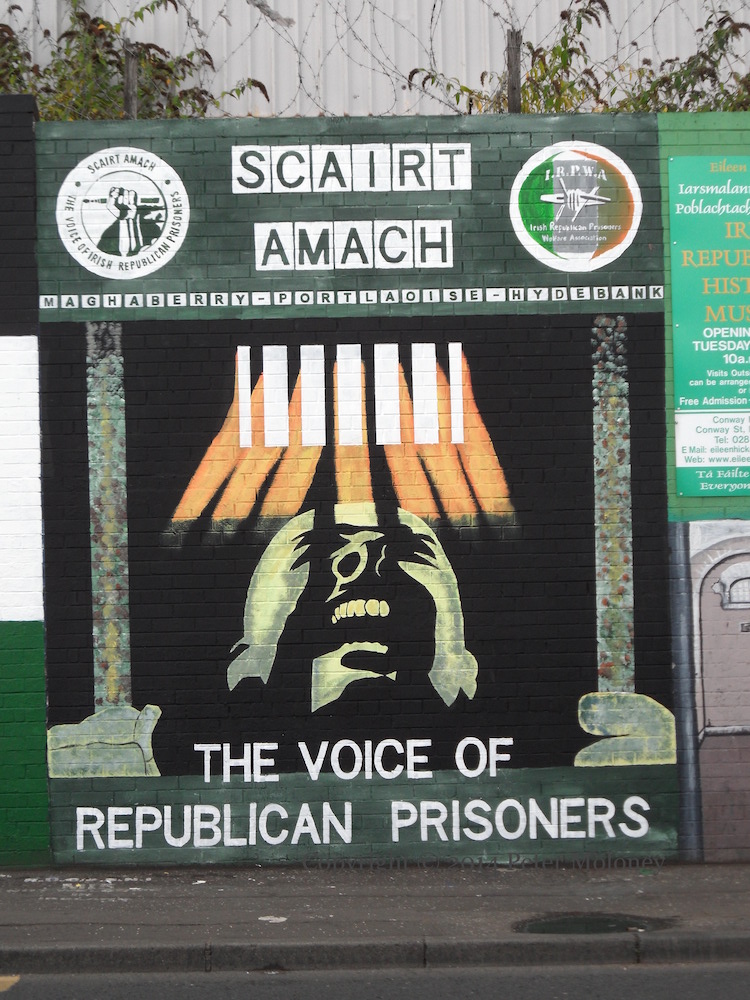
“Scaırt Amach – the voice of Irish republican prisoners – Maghaberry, Portlaoise, Hydebank”. Scaırt Amach (“Shout Out”) is a magazine containing articles by republican prisoners in the three prisons.
This IRPWA (web) mural reproduces the cover of the magazine, on the International Wall, Divis Street (Visual History), west Belfast.









 Peter Moloney Collection