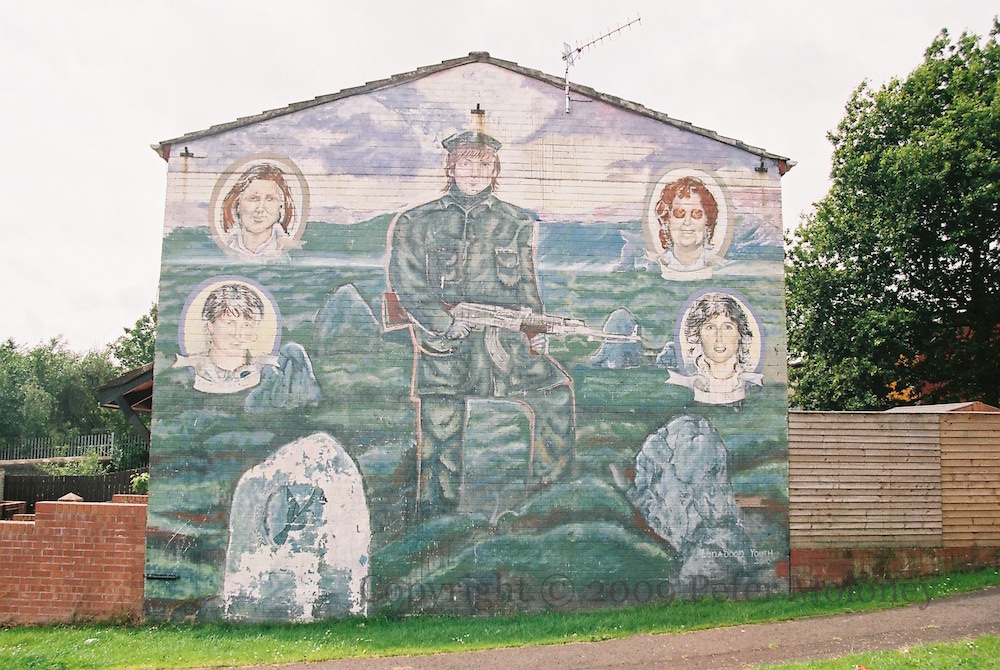
Local female IRA volunteers Laura Crawford, Patricia Black, Bridie Quinn, Maıréad Farrell and a generic female volunteer with assault rifle on manoeuvres in an Irish landscape strewn with standing stones. “Lenadoon Youth 2000”
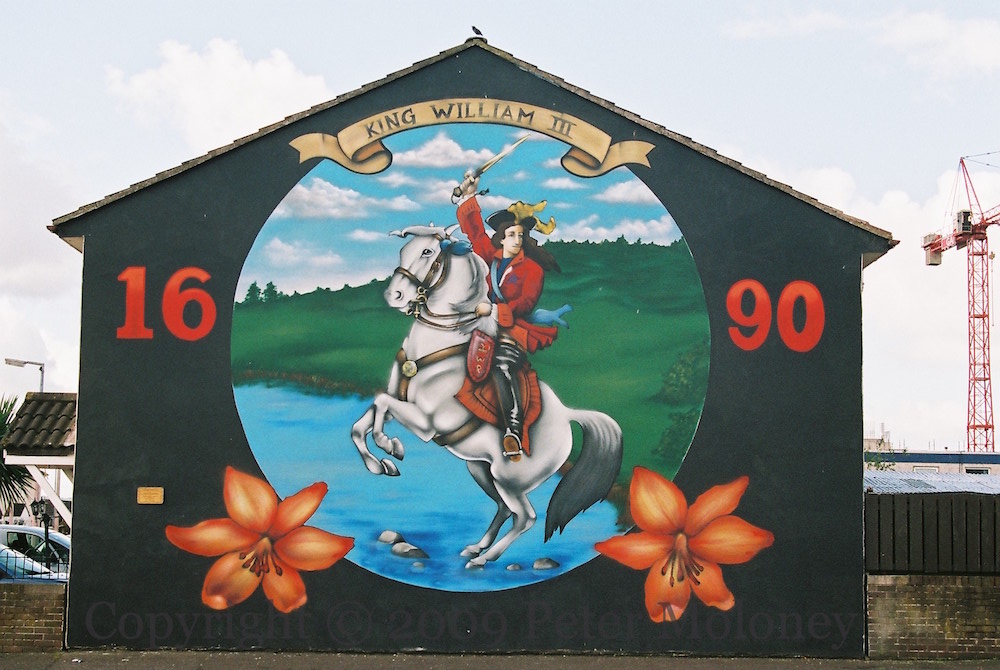
“This mural is dedicated to the past, present & future members of Clifton St Orange Orders from Pride Of The West flute band & Lower Shankill community. REM 1690. Officially opened by Billy Lochrie.” King Billy is shown moving (unusually) from right to left, with orange lilies below.
“Hier stehe ich, Ich kann nich anders, Gott helfe mir.” Martin Luther 1483-1546. Unhappy with many of the Catholic church’s practices, Martin Luther, a monk, wrote what became know as ‘the 95 theses’. These challenged the authority of the church and were spread quickly around Europe via a new invention, the printing press. Keen to get luther to recant, the general assembly of the Holy Roman Empire summoned Luther to the town of Worms on the Rhine in 1521. An unapologetic Luther is said to have uttered this famous phrase which, translated means ‘Here I stand, I can do no other. God help me. Amen’. Thus began the Protestant Reformation.
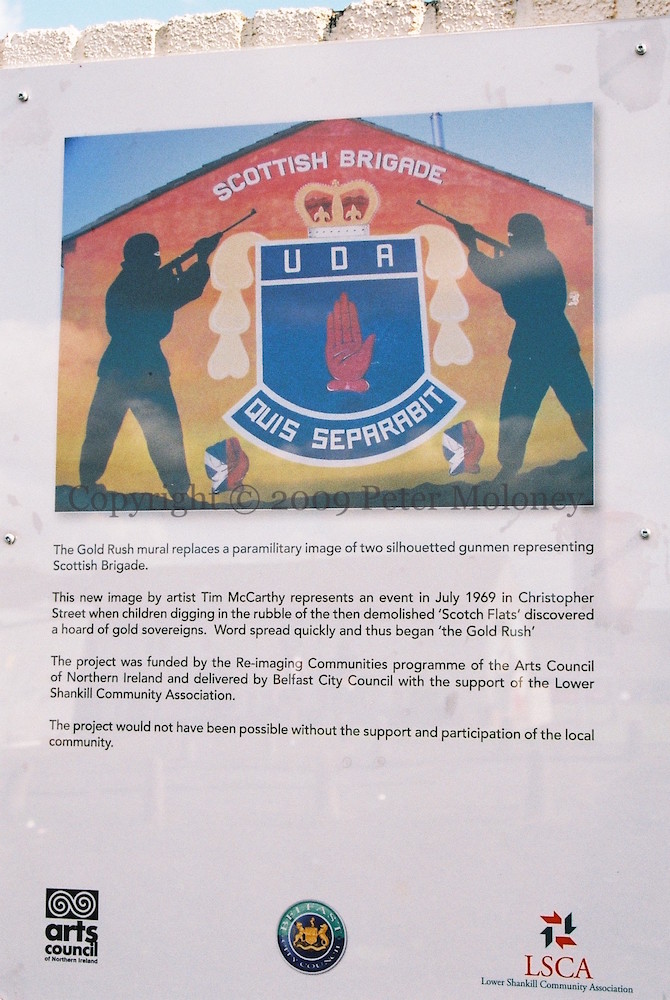
From the info board, later added to the left: “The Gold Rush mural replaces a paramilitary image of two silhouetted gunmen representing Scottish Brigade. This new image by artist Tim McCarthy represents an event in July 1969 in Christopher Street when children digging in the rubble of the then demolished ‘Scotch Flats’ discovered a hoard of gold sovereigns. Word spread quickly and thus began ‘the Gold Rush’.
The project was funded by the Re-imaging Communities programme of the Arts Council of Northern Ireland and delivered by Belfast City Council with the support of the Lower Shankill Community Association. The project would not have been possible without the support and participation of the local community.”
With support from the Arts Council, Belfast City Council, and Lower Shankill Community Association. By Tim McCarthy/Verz in Hopewell Crescent, Belfast.
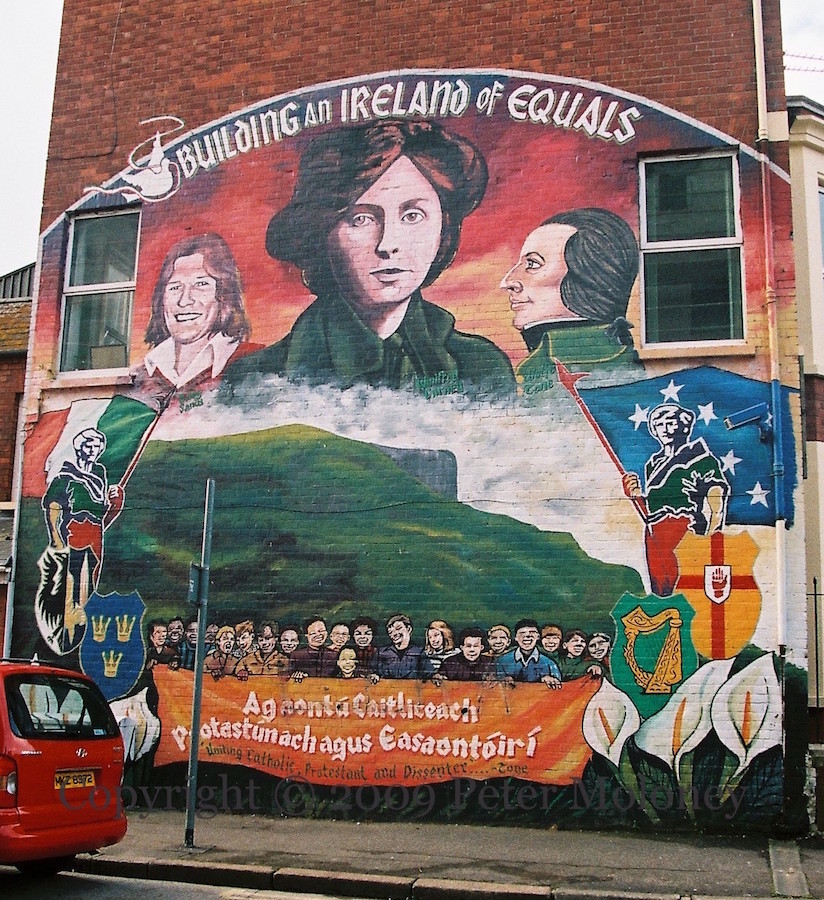
“Ag aontú Caıtlıceach, Protastúnach agus Easaontóırí.” – “Uniting Catholic, Protestant, and Dissenter.” In An Argument On Behalf Of The Catholics Of Ireland (1791), Wolfe Tone of the United Irishmen wrote, “To subvert the tyranny of our execrable government, to break the connection with England, the never-failing source of all our political evils, and to assert the independence of my country, these were my objects. To unite the whole people of Ireland, to abolish the memory of past dissensions, and to substitute the common name of Irishman, in place of the denominations of Protestant, Catholic and Dissenter, these were my means.”
With portraits of Bobby Sands, Wolfe Tone, and in the centre, Winifred Carney.
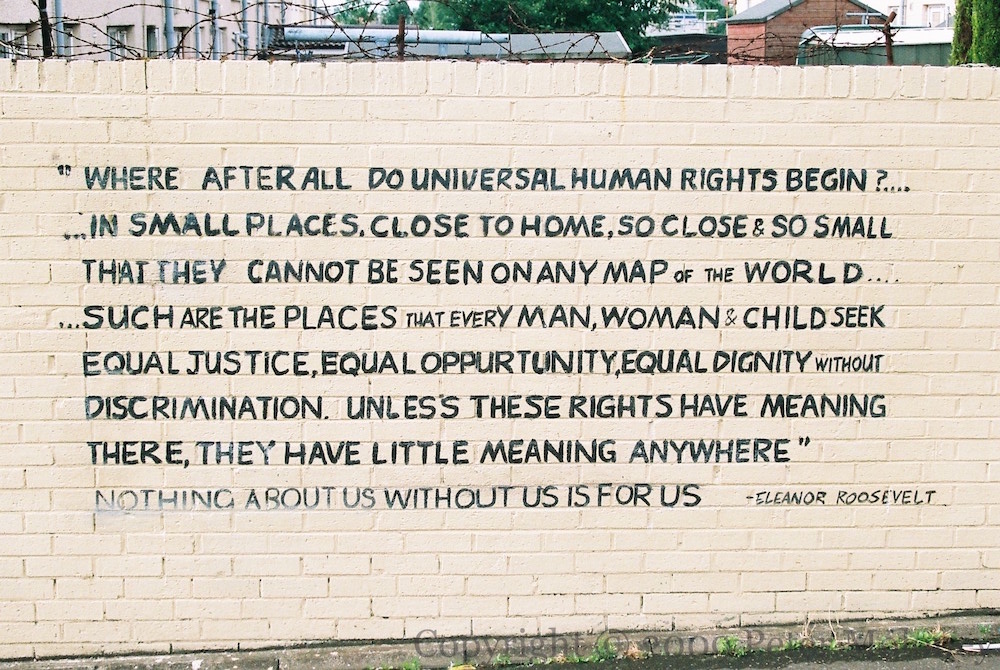
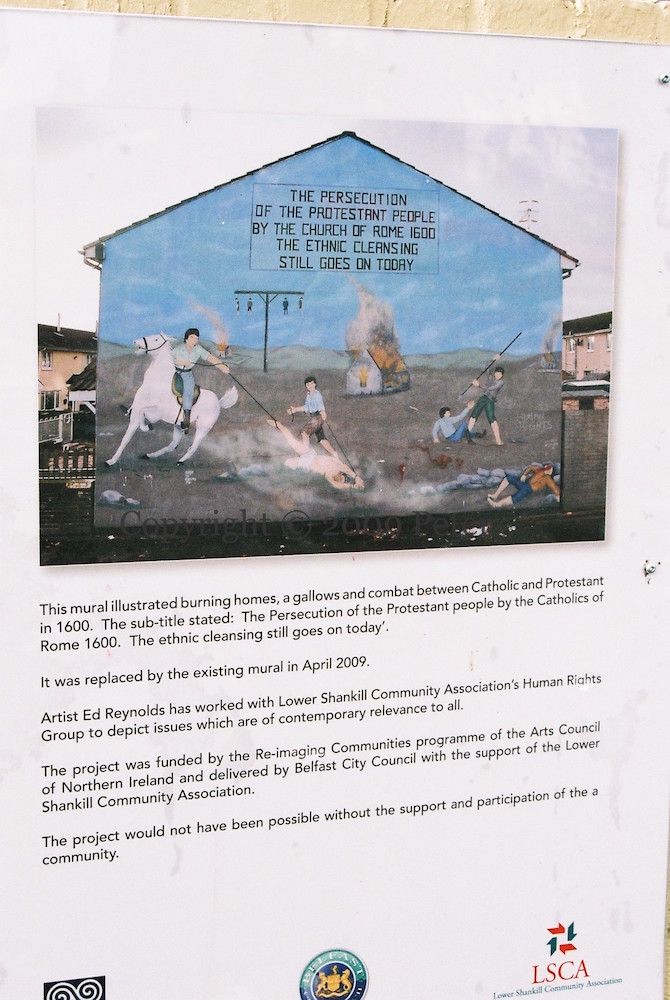
“Where after all do universal human rights begin? In small places, close to home, so close & so small that they cannot be seen on any map of the world. Such are the places that every man, woman & child seek equal justice, equal opportunity, equal dignity without discrimination. Unless these rights have meaning there, they have little meaning anywhere.” – Eleanor Roosevelt. “Nothing about us without us is for us.” Artist Ed Reynolds (steadyhanded.com) replaces the ‘Protestant Ethnic Cleansing‘ mural with one about human rights. With the Lower Shankill Community Association.
“The young do not know enough to be prudent and therefore they attempt the impossible and achieve it … generation after generation – Pearl S Buck” “Adults do not perceive children as a minority group but as helpless, inexperienced, defenseless young people who need protection … This attitude must be confronted, challenged and refuted if young people are to secure their political rights. – Bob Franklin”. The info board describes the history of the wall, from Eddie to Can It Change? to the current re-imaging. Painted by Ed Reynolds. With support from the Arts Council, Belfast City Council, and the Lower Shankill Community Association.
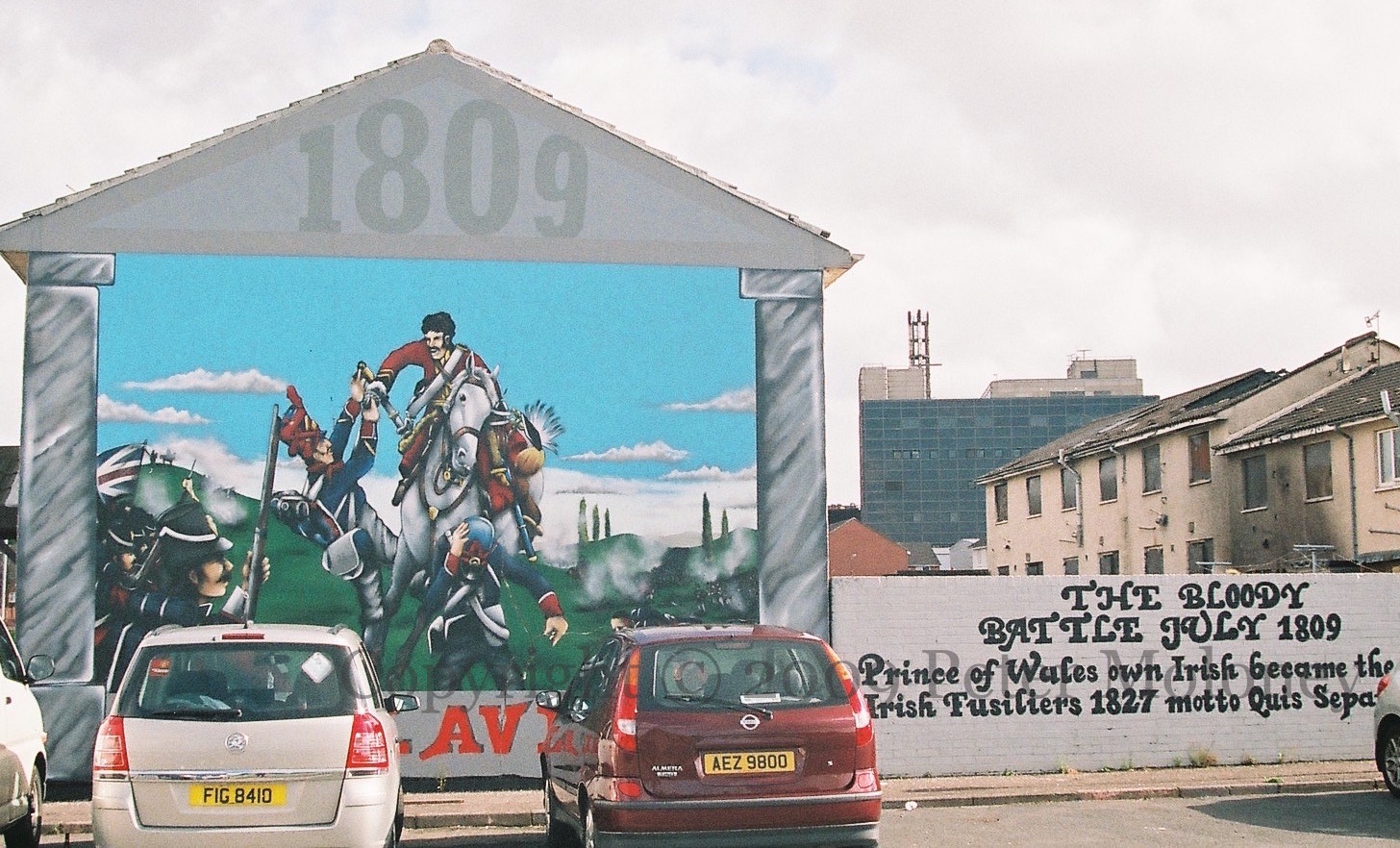
“The Bloody Battle, July 1809. Prince of Wales own Irish became the Royal Irish Fusiliers 1827 motto Quis Separabit.” Completed version of the 2008 in-progress The Battle Of Talavera. Hopewell Crescent, Belfast.
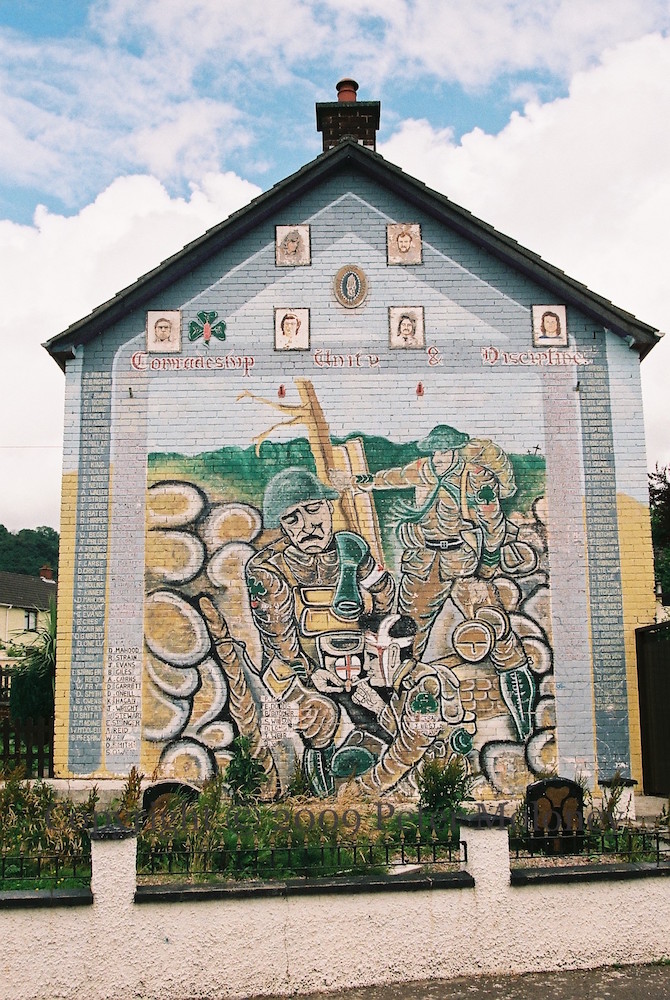
A mixture of modern and latter-day Ulster Volunteers: the names of WWI dead are listed on both sides, while six modern volunteers are portrayed above the central panel of soldiers in a trench. J1835 lists the men in the previous version of the mural as J. Shaw, T. Mawhinney, J. Cordner, C. Logan, S. McCrea, W. Millar.





 Peter Moloney Collection