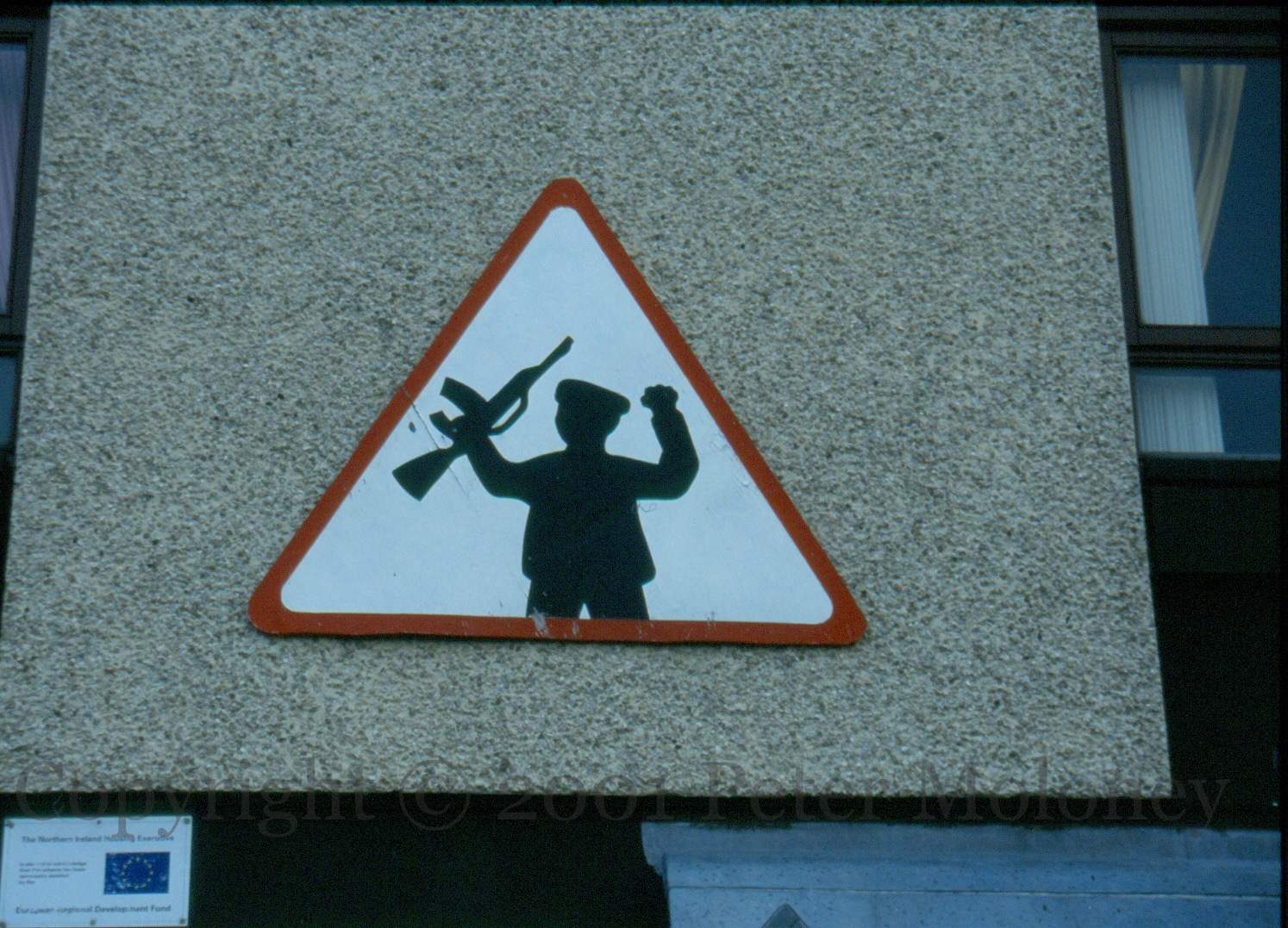
The Housing Executive/European Regional Development Fund plaque is presumably not for this “road sign” of the celebrating sniper! See previously: Free Derry Corner 1996 | The Boys Are Back.
“Stand firm – break the bigots back” – a fist smashes a Nazi swastika. Next to the Stephen Lawrence – Robert Hammil board. For both boards in better condition, see Same Story, Same Bigotry. Artana Street, Belfast.
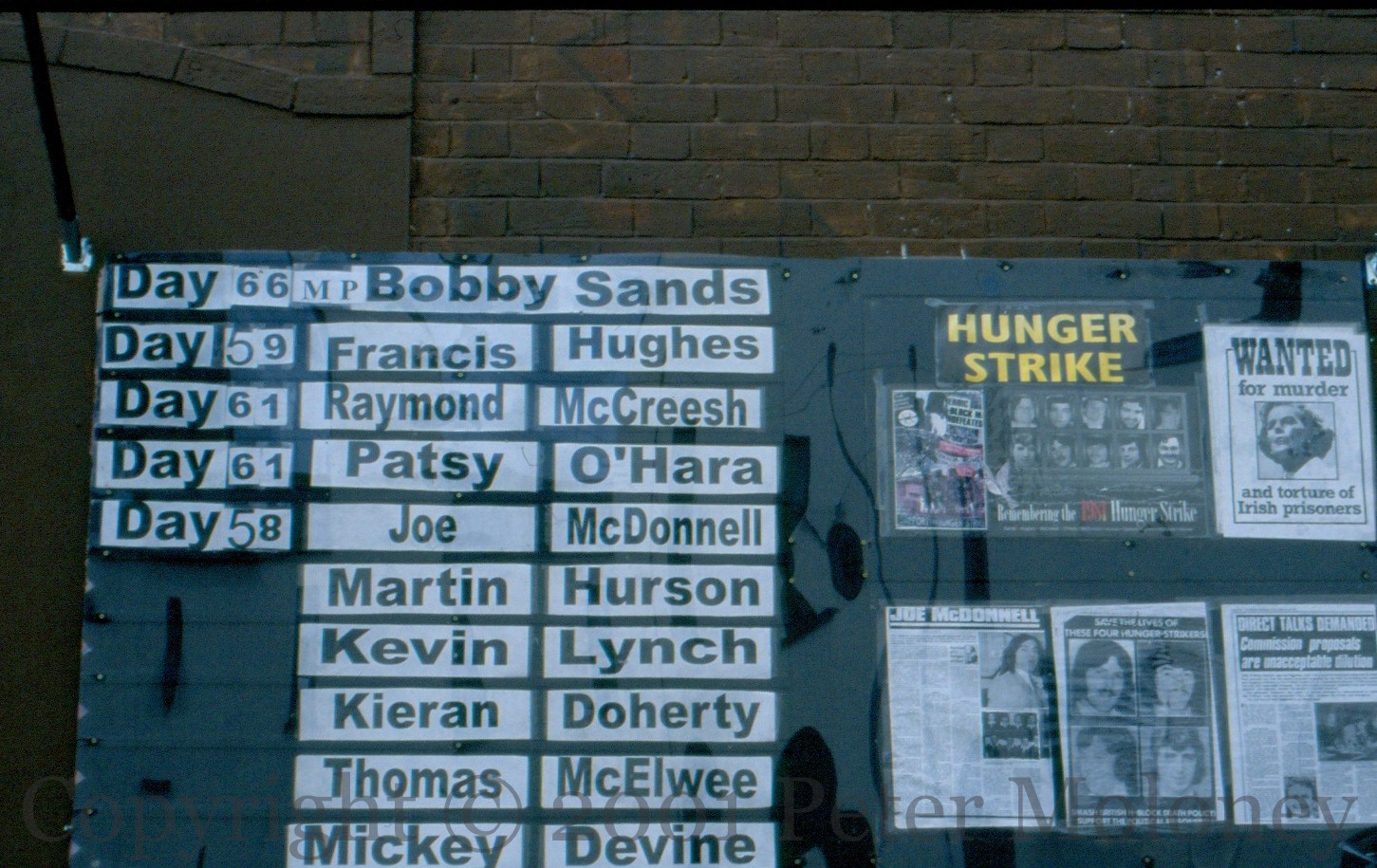
Twentieth anniversary retrospective board on Ormeau Road, Belfast, with posters and news articles from the 1981 hunger strike, as well as the names of the ten who died.
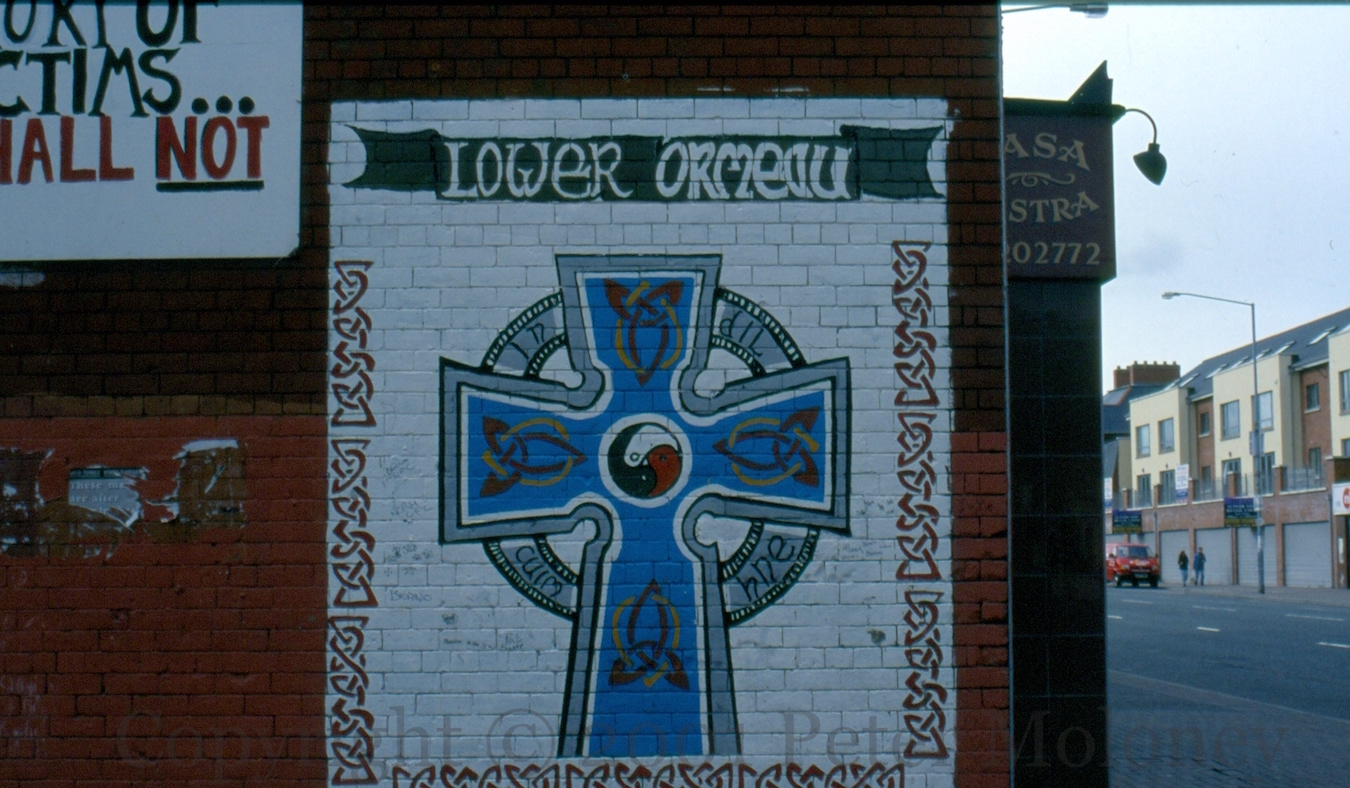
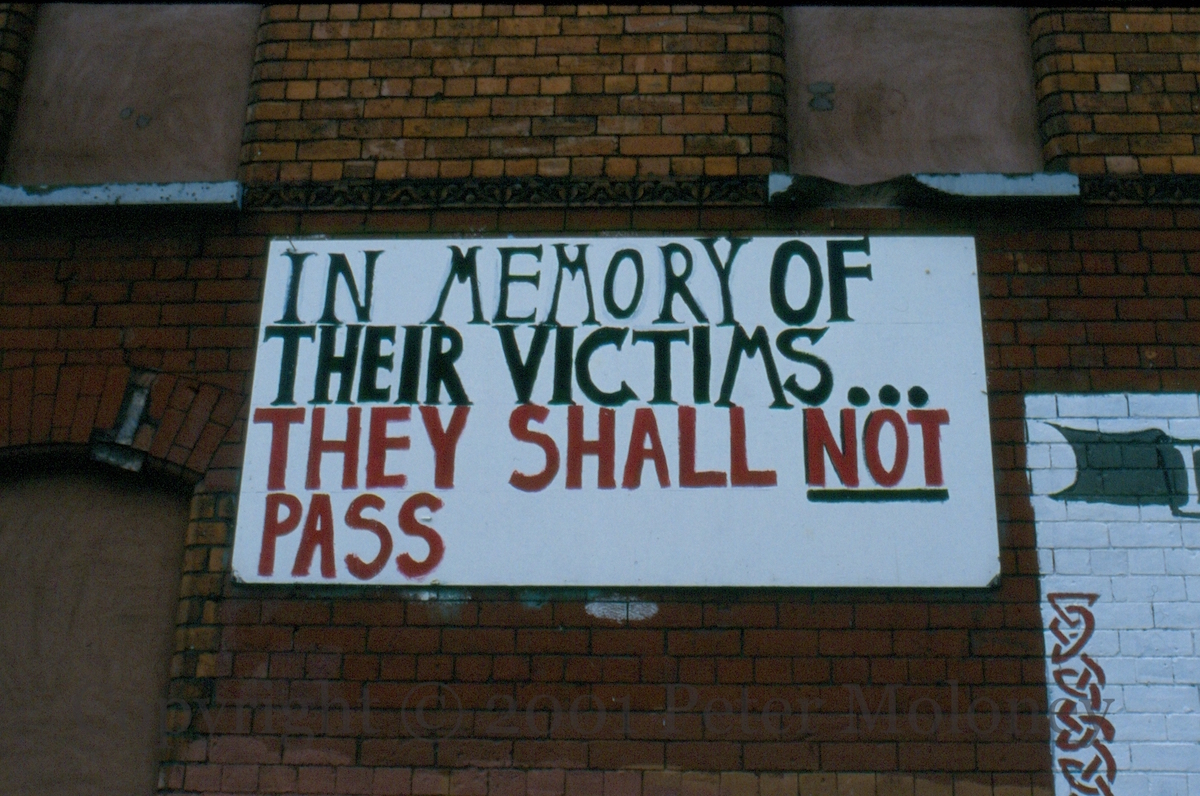
“In memory of their victims … they shall not pass.” An elaborate celtic cross in memory (i ndil cuimhne) of Troubles victims from Catholic south Belfast and a promise to block Orange Order parades in the lower Ormeau.
“‘My forefathers were … the men who had followed Cromwell and who shared in the defence of Derry, and in the victories of Aughrim and the Boyne.’ – President Theodore Roosevelt, 20th US president, 1901-1904.” The “shutting of the gates” of Derry is represented in the bottom left.
The quote is derived from Volume 1, Chapter 5 of Roosevelt’s The Winning Of The West (available at Project Gutenberg), though he is describing the forefathers of the Scotch-Irish, rather than his own forefathers (who, as the name suggests, were Dutch).
He writes, “The Presbyterian Irish were themselves already a mixed people. Though mainly descended from Scotch ancestors—who came originally from both lowlands and highlands, from among both the Scotch Saxons and the Scotch Celts—many of them were of English, a few of French Huguenot, and quite a number of true old Milesian Irish extraction. They were the Protestants of the Protestants; they detested and despised the Catholics, whom their ancestors had conquered, and regarded the Episcopalians by whom they themselves had been oppressed, with a more sullen, but scarcely less intense, hatred. They were a truculent and obstinate people, and gloried in the warlike renown of their forefathers, the men who had followed Cromwell, and who had shared in the defence of Derry and in the victories of the Boyne and Aughrim.”
Some sources claim that an ancestor(s) on his mother’s side emigrated from Gleno, Co Antrim in 1729, but this seems to be her great-great-grandfather James, who was Scots (WP) but appears to have emigrated directly from Scotland, specifically Baldernock, in 1728 or 1729 (WikiTree | Friends Of Bulloch). The search for a connection continues, according to Irish Central.
This mural is one (and perhaps the first to be painted) in the series “From pioneers to presidents”. For more such murals, see the Visual History page about Ulster-Scots murals.
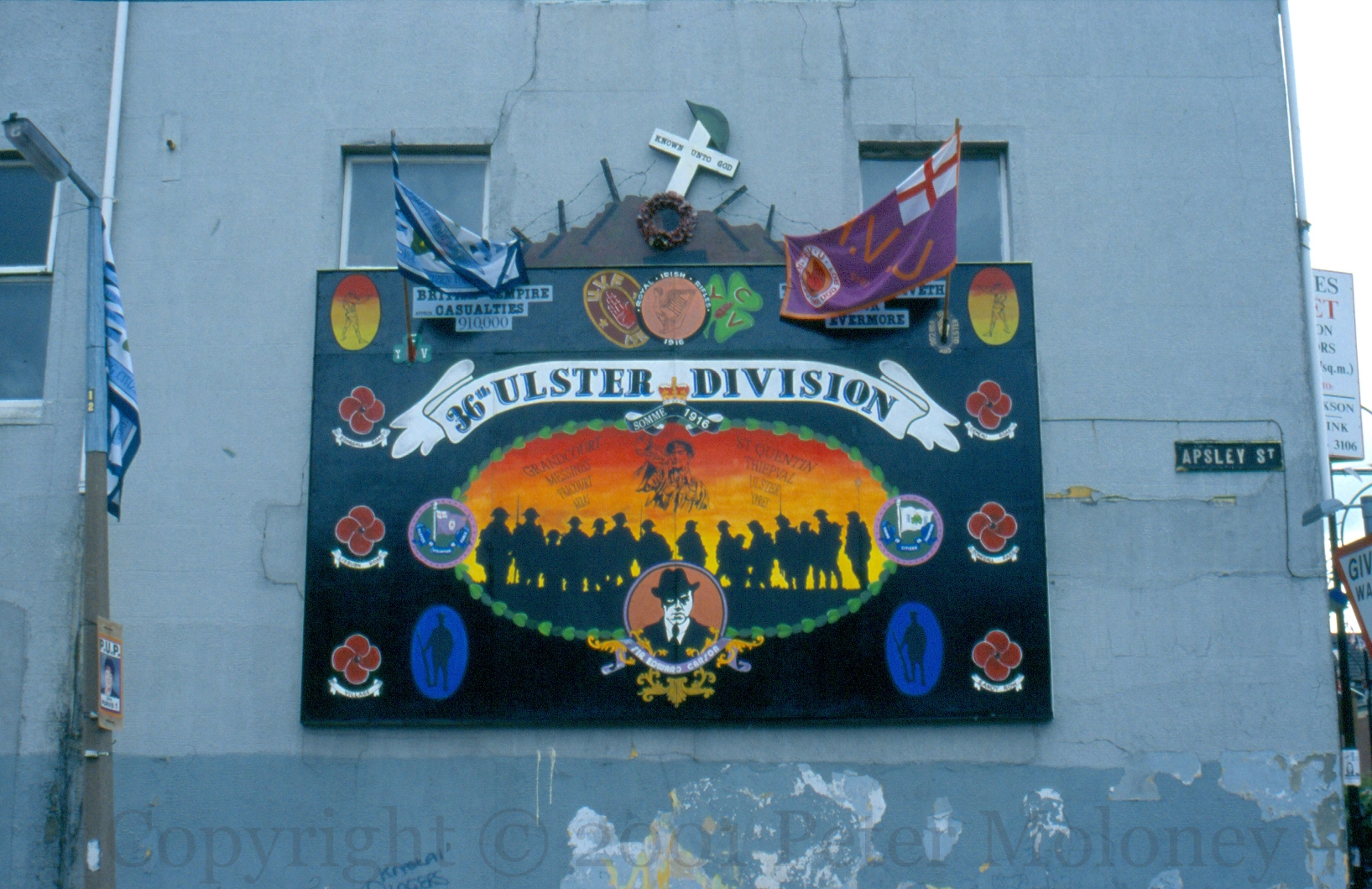
Boards in Charlotte Street, clockwise from left to right around giant YCV [Young Citizen Volunteers] lettering in red, white, and blue: Union flag, Ulster Banner, 36th (Ulster) Division, St Andrew’s Saltire, Union flag.
The apocryphal book of the Bible Ecclesiasticus reads “their bodies are buried in peace, but their name liveth for evermore” (44:14), which is here applied to 910,000 “British empire casualties” from the Great War, including the Ulster Volunteers and Young Citizen Volunteers raised by “Sir Edward Carson” which became the 36th (Ulster) Division and particularly the Royal Irish Rifles and fought at the Somme 1916.




 Peter Moloney Collection