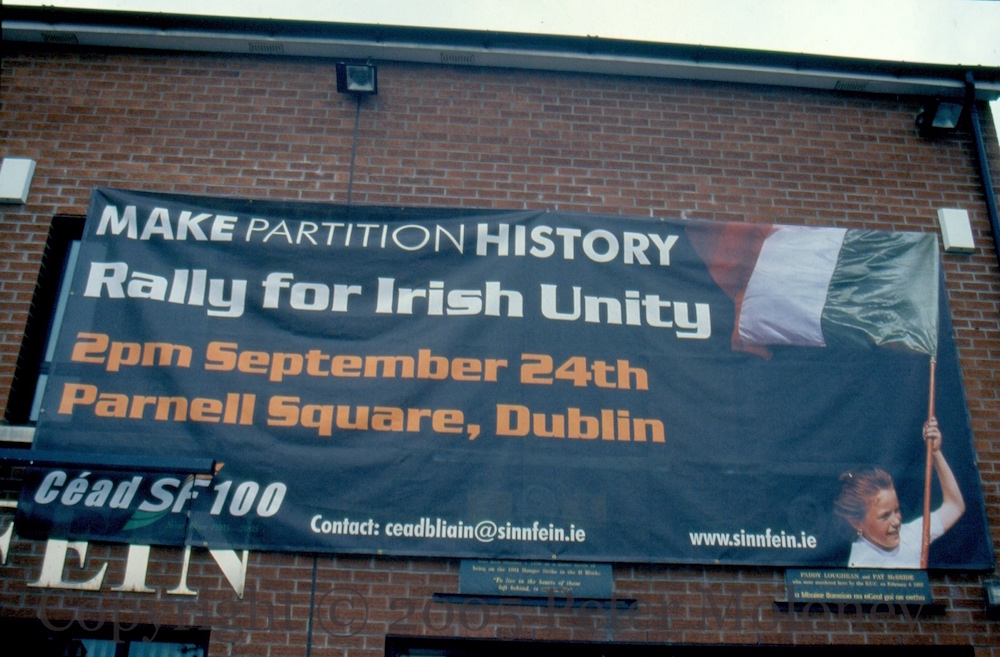
“Make partition history”. Sınn Féın, celebrating its 100th anniversary, puts out a call for a march in Dublin.
Falls Road, west Belfast
Click image to enlarge
Copyright © 2005 Peter Moloney
M02564
“Make partition history”. Sınn Féın, celebrating its 100th anniversary, puts out a call for a march in Dublin.
Falls Road, west Belfast
Click image to enlarge
Copyright © 2005 Peter Moloney
M02564

IRA volunteer Kieran (here Cıarán) Nugent spent nine months in Long Kesh as a Special Category prisoner in 1975. When he was arrested again in 1976 and sent to the H Blocks, the status no longer existed and he could no longer wear his own clothes. He refused to wear a prison uniform and spent his first night naked. On the next day he was given a blanket and so became the first blanket man.
Rockville Street, west Belfast
Click image to enlarge
Copyright © 2005 Peter Moloney
M02550 [M02551]
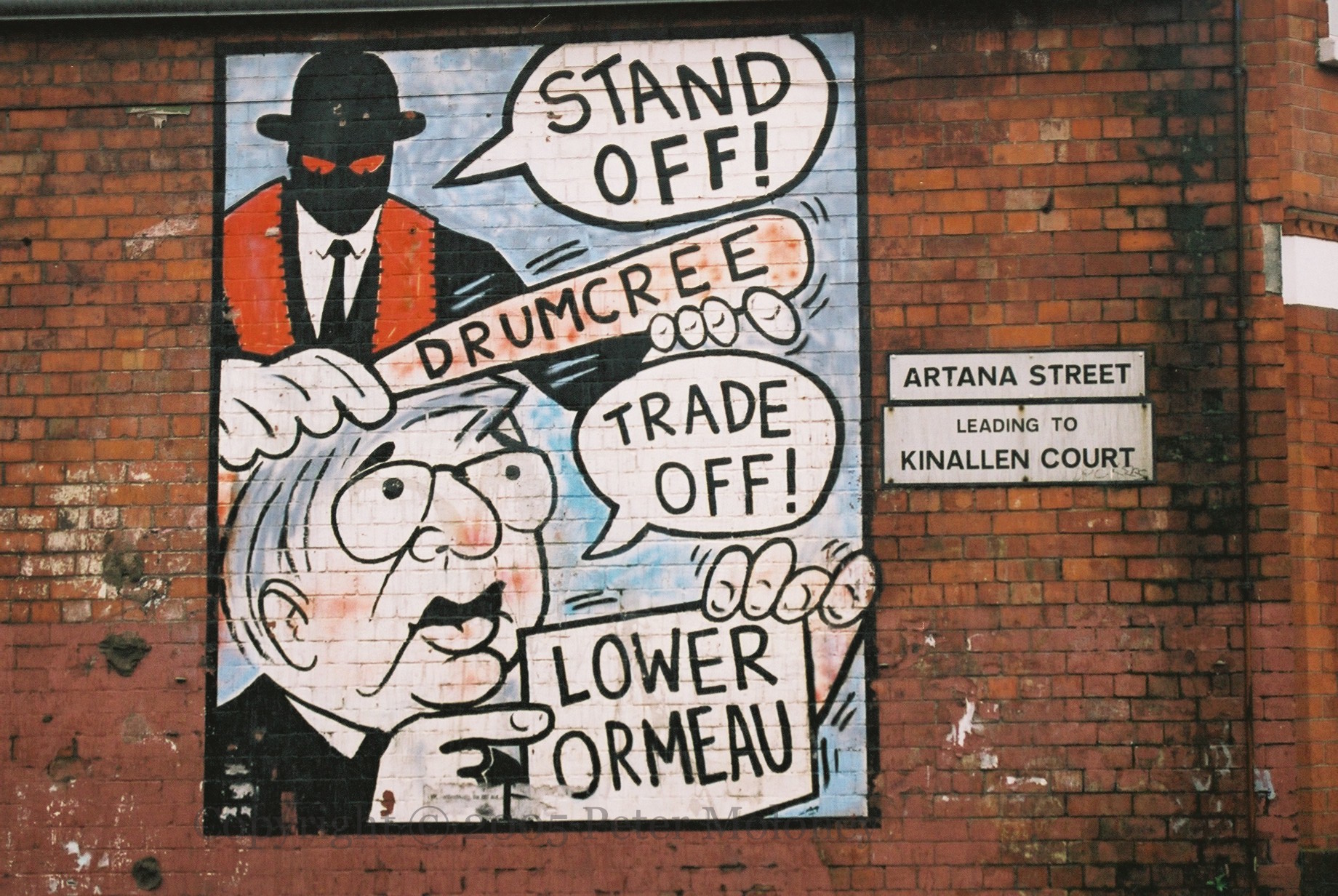
The “stand-off, trade-off” mural reappears in Artana Street, Belfast, previously covered by Stand Firm. The mural dates to 1998, when an Orange Order march was allowed to parade along Ormeau Road. Parades Commission chairman Alistair Graham (pictured in the mural beneath the evil-eyed OO member) “insisted that the Ormeau Road decision “was not a simple trade-off for our earlier decision on Drumcree”” (Irish Times). Painted by Troy Garity, recreating an Ian Knox cartoon (Belfast Media).
Click image to enlarge
Copyright © 2005 Peter Moloney
M02530
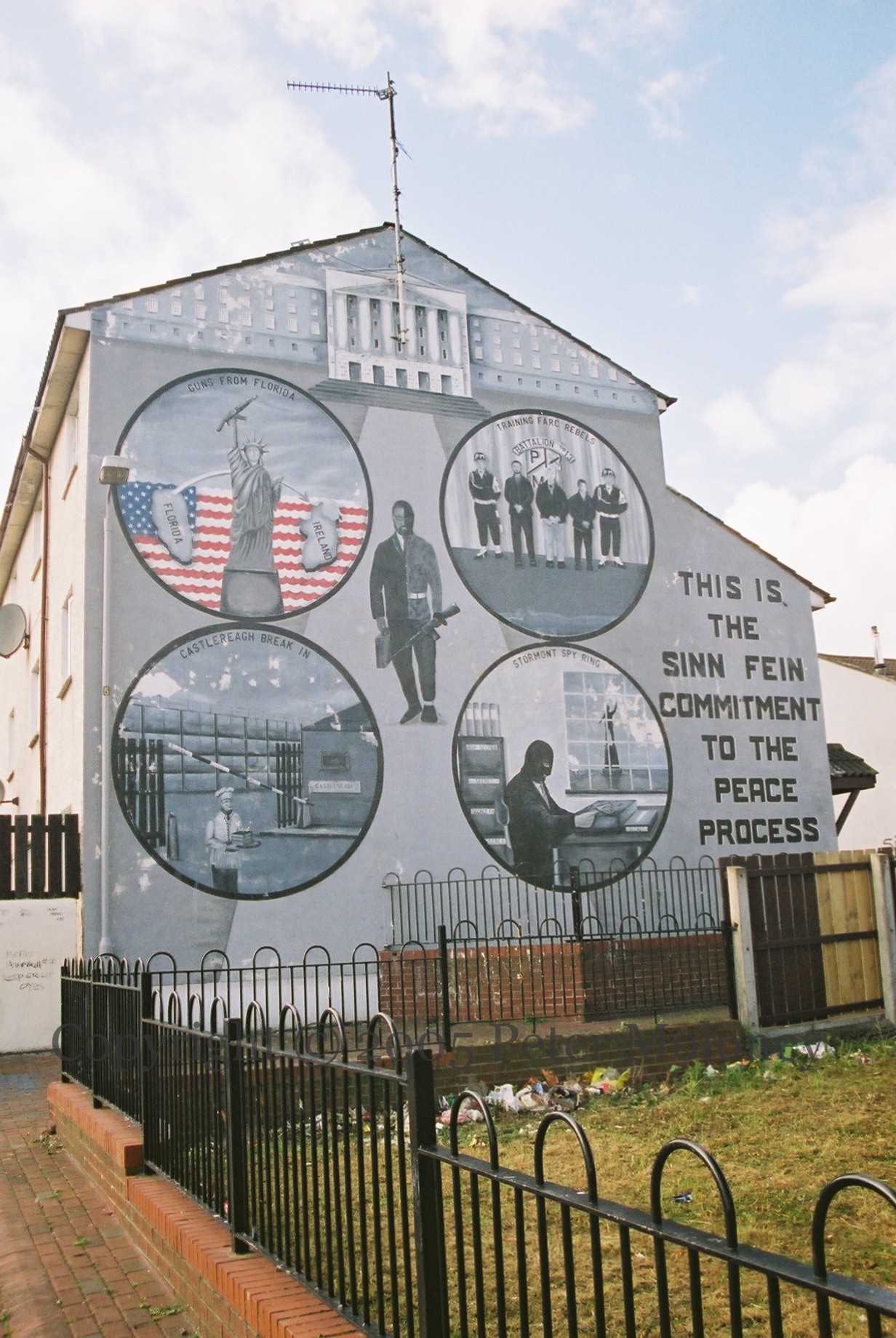
“This is the Sinn Fein commitment to the peace process: guns from Florida, training FARC rebels, Castlereagh break-in [the chef is Larry Zaitschek but see Independent and Guardian], Stormont spy-ring [Stormontgate].”
Boundary Way, lower Shankill, west Belfast
Click image to enlarge
Copyright © 2005 Peter Moloney
M02468


These three murals are at the Rex Bar (Moscow Street, Belfast), celebrating resistance to Home Rule – Covenant Day September 28th 1912; the formation of the Ulster Volunteers, being reviewed at Fernhill House in Glencairn Park by Edward Carson; “Deserted! Well I can stand alone”; and (in post-partition Northern Ireland) “a [masked!] Protestant farmer’s wife guards her husband against sectarian attack from across the border”.
Click image to enlarge
Copyright © 2005 Peter Moloney
M02454 M02453 M02452 [M02451] [M02450]
Copyright © 2010 Peter Moloney
[M05722] [M05723] [M05748] [M05749]
(close-ups of the small boards along the top)
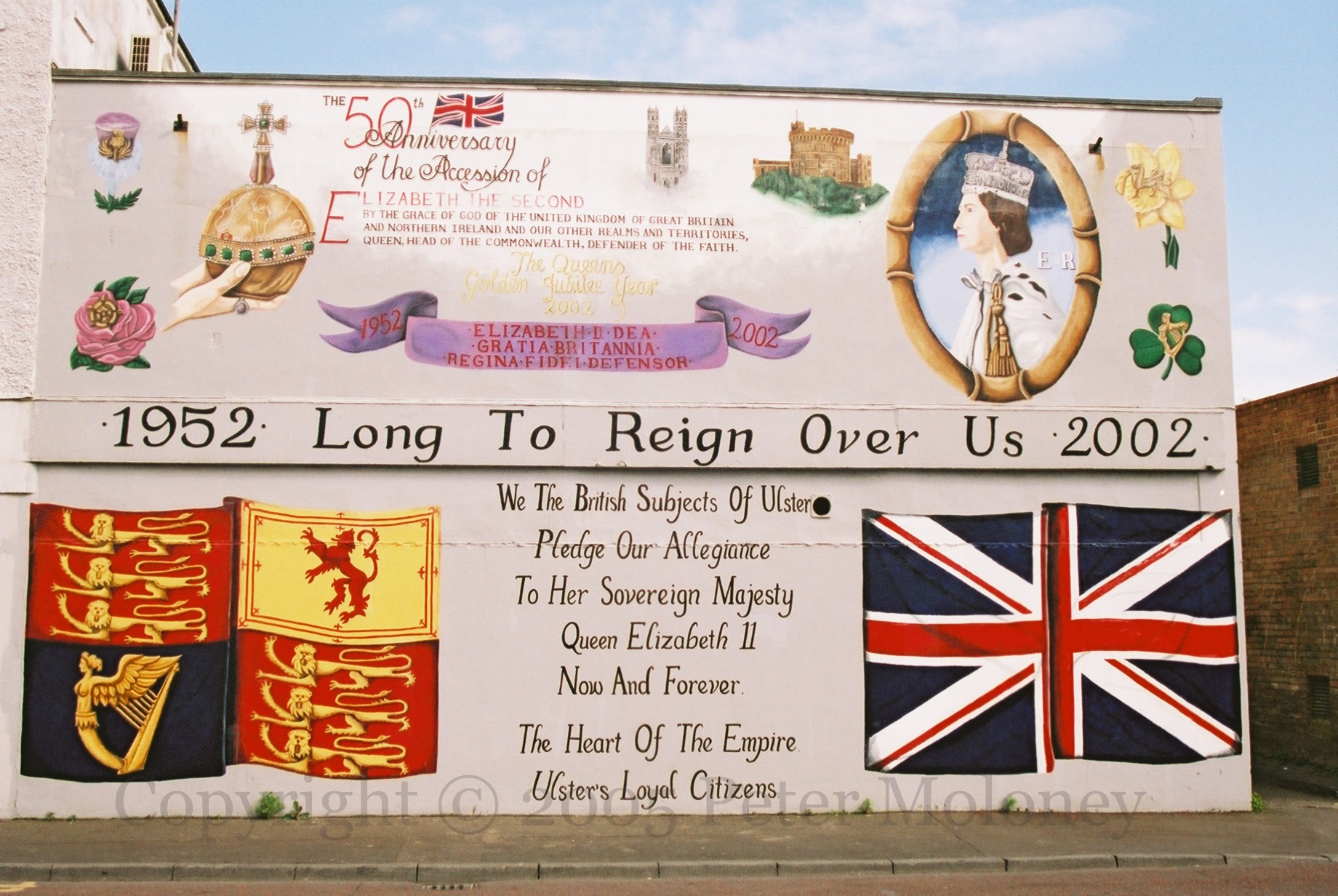
“Elizabeth the second by the grace of God of the United Kingdom of Great Britain and Northern Ireland and our other realms and territories, queen, head of the commonwealth, defender of the faith.” “Elizabeth II dea [sic] gratia Britannia regina fidei defensor”. “We the British subjects of Ulster pledge our allegiance to her sovereign majesty Queen Elizabeth II now and forever. The heart of the empire Ulsters loyal citizens.” Elizabeth Alexandra Mary Windsor acceded to the throne of the United Kingdom in 1952 (she was crowned in 1953). 2002 was her golden jubilee year.
North Howard Street, west Belfast
Click image to enlarge
Copyright © 2005 Peter Moloney
M02455
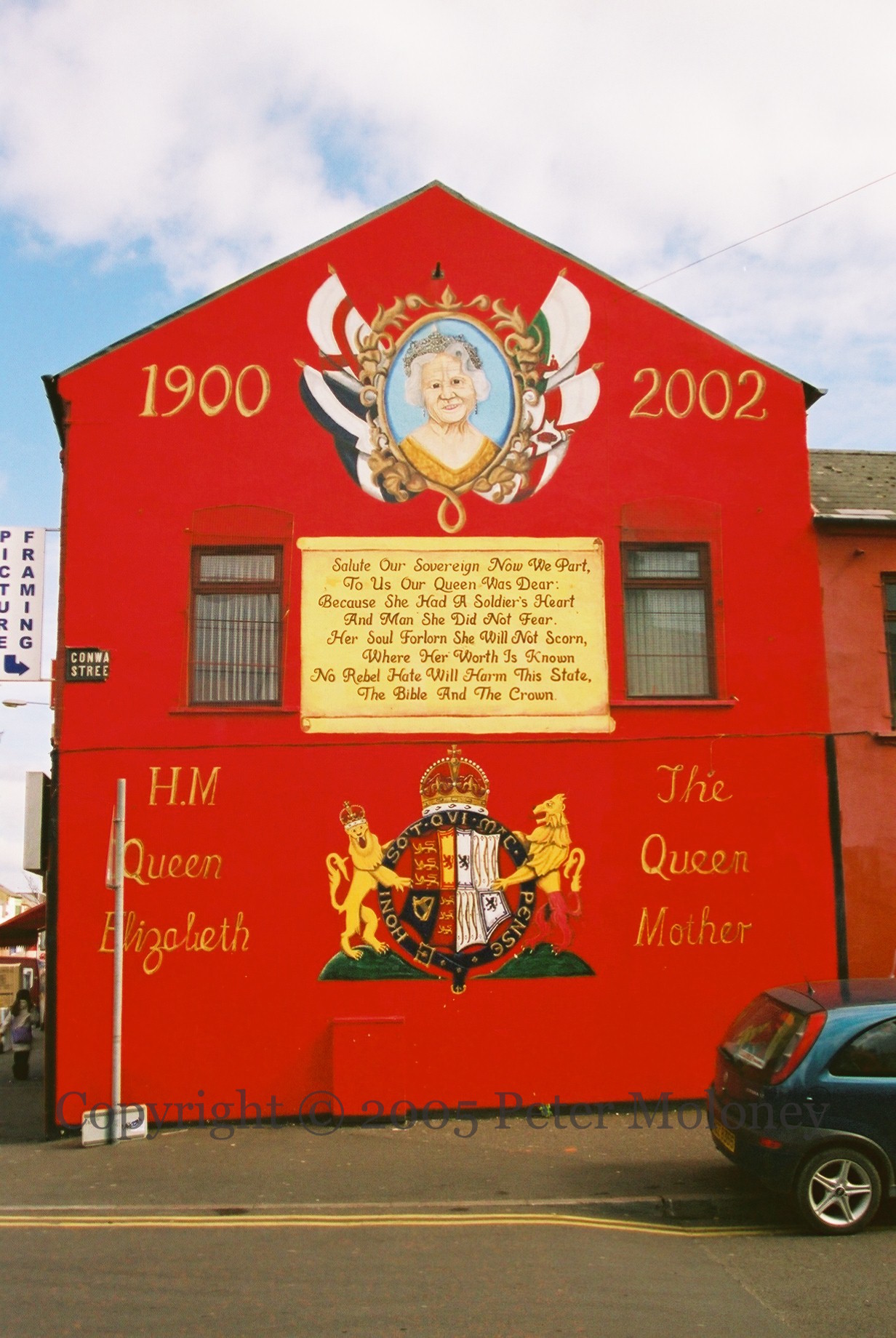
“HM Queen Elizabeth The Queen Mother.” The mural includes a portrait of Elizabeth Angela Marguerite Bowes-Lyon, wife of George VI and mother of Elizabeth II, her coat of arms (see also Honi Soit Qui Mal Y Pense), and a verse (sightly modified) from the Orange song The Bible And The Crown: “Salute our sovereign now we part/To us our Queen was dear/Because she had a soldier’s heart/And man she did not fear.//Her soul forlorn she will not scorn,/Where her worth is known/No rebel hate will harm this state,/The bible and the crown.” She died in 2002 at age 101. The four flags are those of England, Scotland, Wales, and Northern Ireland.
Conway Street, west Belfast
Click image to enlarge
Copyright © 2005 Peter Moloney
M02444
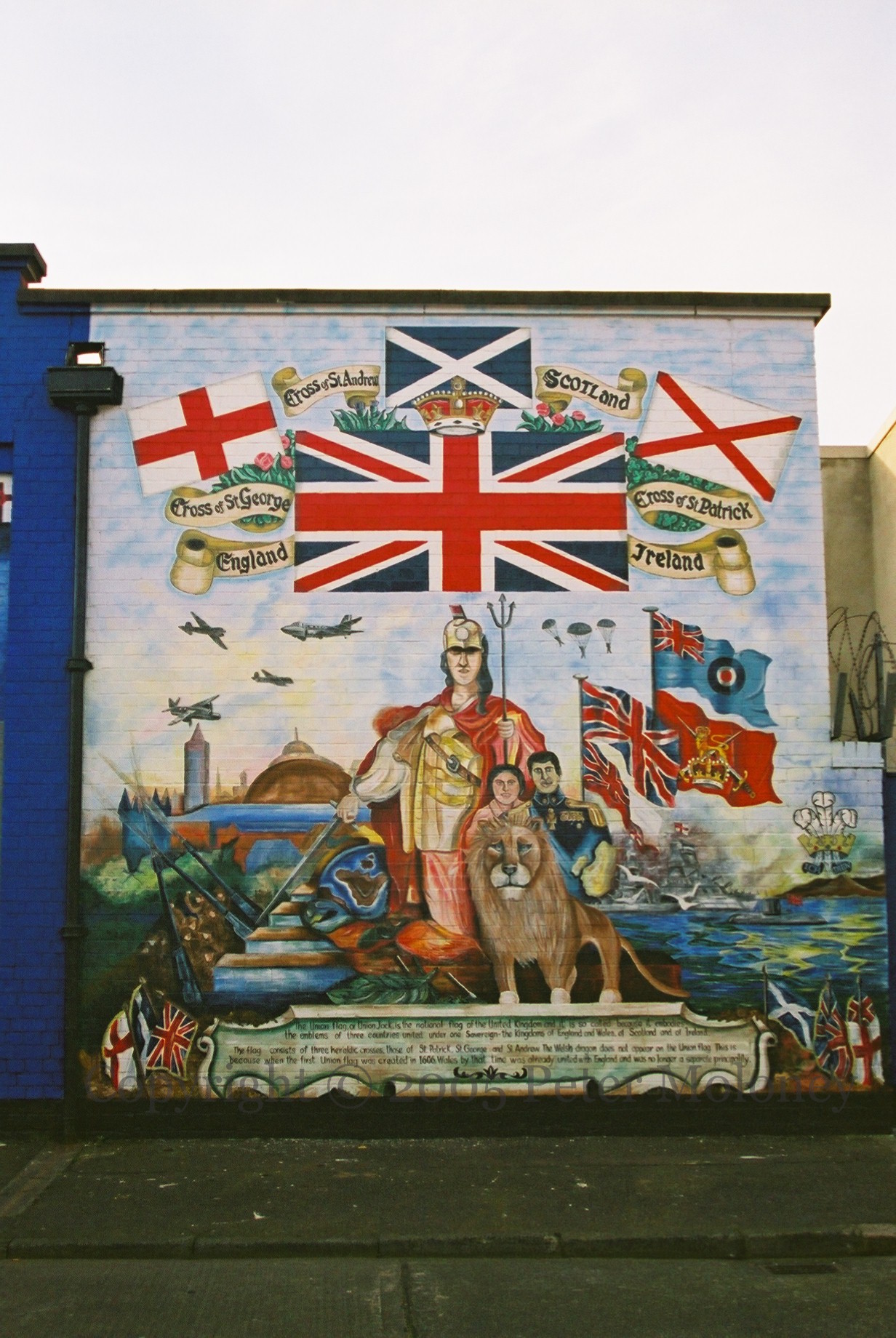
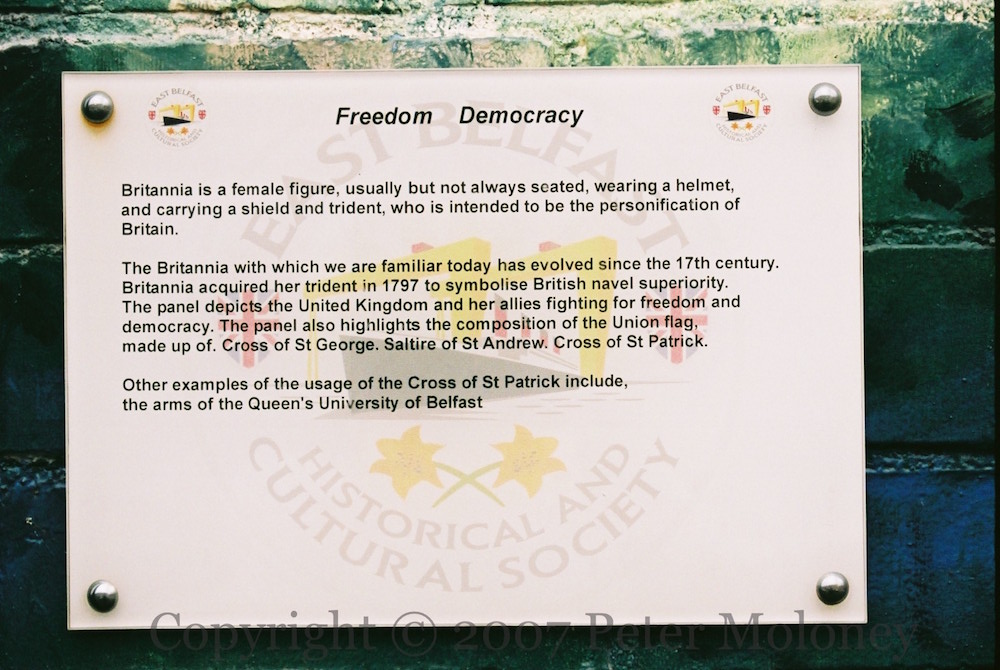
“Britannia is a female figure, usually but not always seated, wearing a helmet, and carrying a shield and trident, who is intended to be the personification of Britain. The Britannia with which we are familiar has evolved since the 17th century. Britannia axquired her trident in 1797 to symbolise British naval superiority. The panel depicts the United Kingdom and her allies fighting for freedom and democracy. The panel also highlights the composition of the Union flag, made up of. Cross of St George. Saltire of St Andrew. Cross of St Patrick. Other examples of the usage of the Cross of St Patrick include, the arms of the Queen’s University of Belfast.”
One of fourteen panels in Thorndyke Street, east Belfast. For a list of entries for each panel, see East Belfast Historical And Cultural Society.
Click image to enlarge
Copyright © 2005 Peter Moloney
M02311 M03625
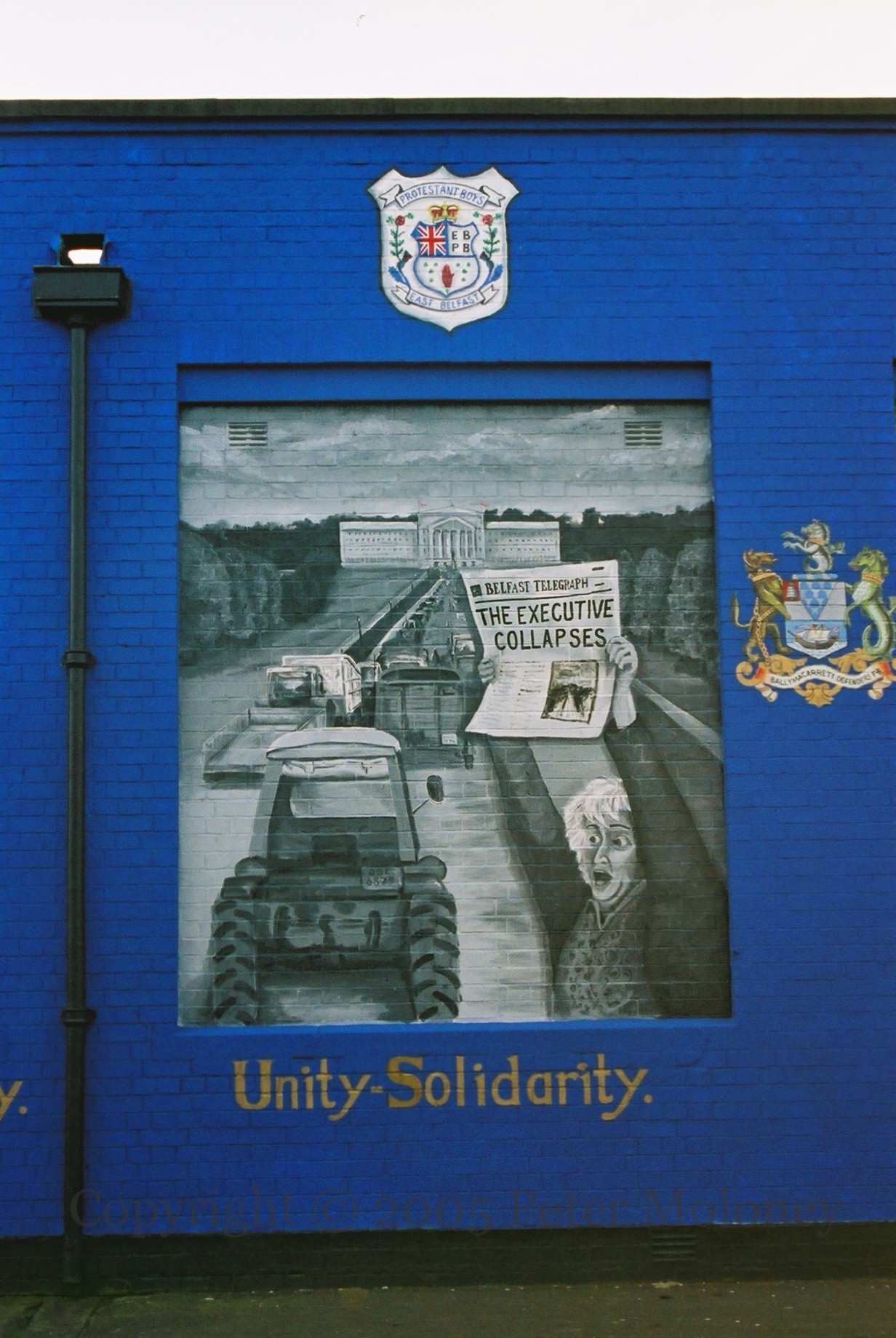
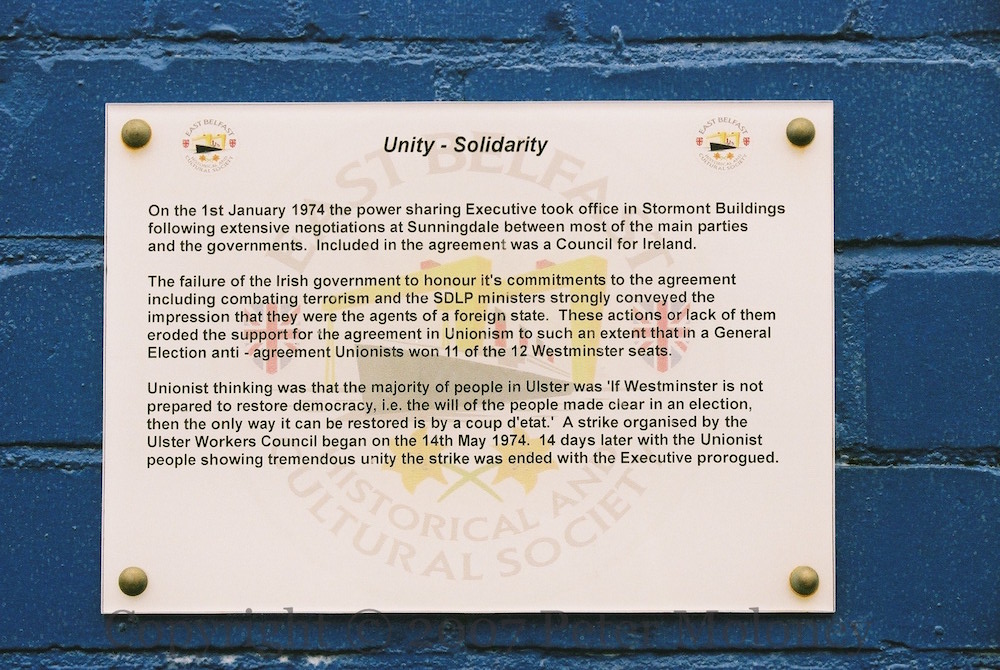
“On the 1st January 1974 the power sharing Executive took office in Stormont Building following extensive negotiations at Sunningdale between most of the main parties and the governments. Included in the agreement was a Council for Ireland. The failure of the Irish government to honour it’s commitments to the agreement including combating terrorism and the SDLP ministers strongly conveyed the impression that they were the agents of a foreign state. These actions or lack of them eroded the support for the agreement in Unionism to such an extent that in a General Election anti – agreement Unionists won 11 of the 12 Westminster seats. Unionist thinking was that the majority of people was ‘If Westminster is not prepared to restore democracy, i.e. the will of the people made clear in an election, then the only way it can be restored is by a coup d’etat.’ A strike organised by the Ulster Workers Council began on the 14th May 1974. 14 days later with the Unionist people showing tremendous unity the strike was ended with the Executive prorogued.” 10th panel on Thorndyke Street, Belfast. With emblems of the East Belfast Protestant Boys flute band and the Ballymacarrett Defenders flute band.
One of fourteen panels in Thorndyke Street, east Belfast. For a list of entries for each panel, see East Belfast Historical And Cultural Society.
Click image to enlarge
Copyright © 2005 Peter Moloney
M02308 M03628
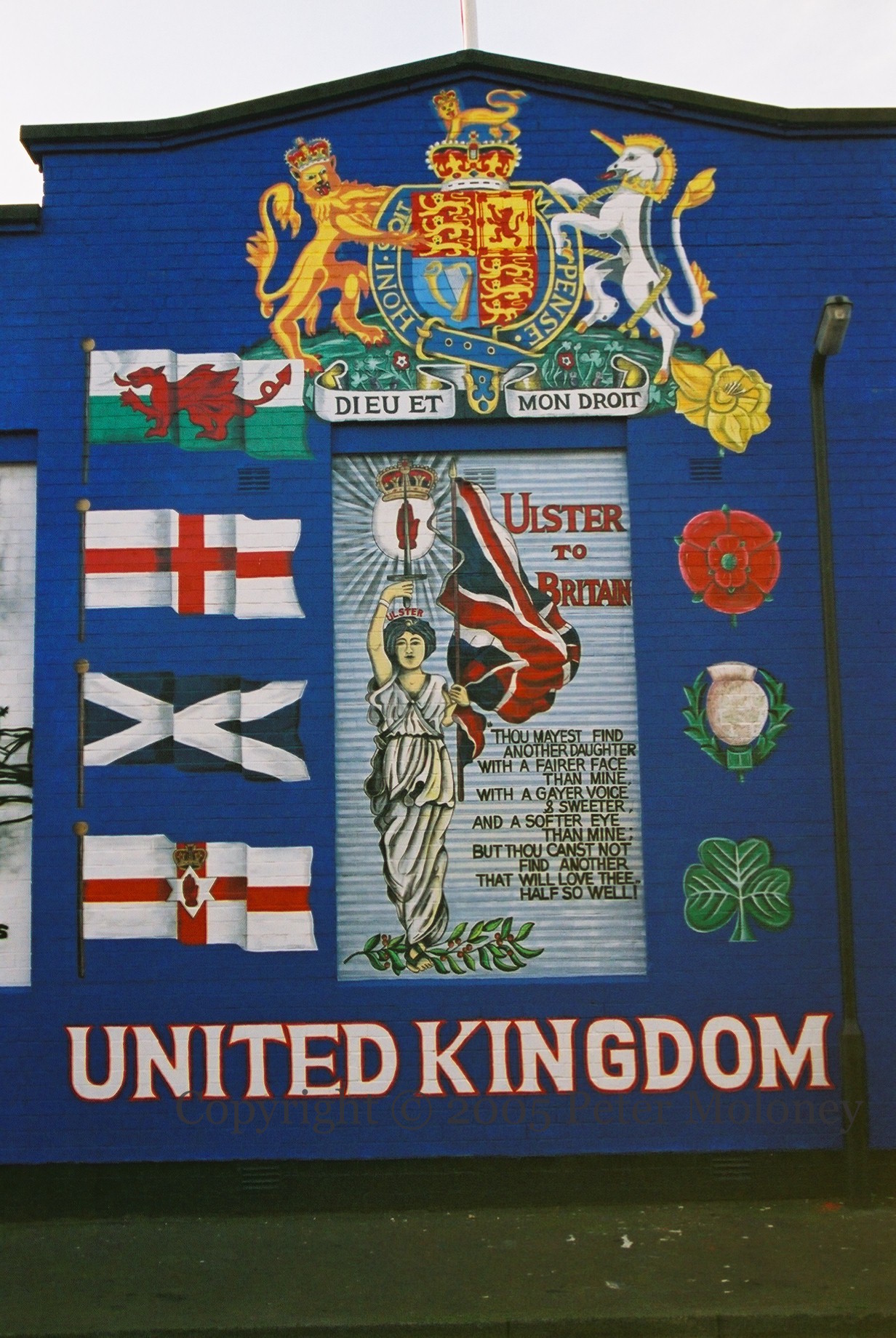
The central panel in Thorndyke Street, Belfast, reproduces a postcard from during the Home Rule debate: “Ulster to Britain: thou mayest find another daughter with a fairer face than mine, with a gayer voice and sweeter and a softer eye than mine; but thou canst not find another that will love thee half so well!” The Ulster Banner (a flag of Northern Ireland) is used to represent Ireland in the quartet of flags while the shamrock stands alongside daffodil, rose, and thistle. For the Anglo-Norman French around the crown’s coat of arms, see Honi Soit Qui Mal Y Pense.
One of fourteen panels in Thorndyke Street, east Belfast. For a list of entries for each panel, see East Belfast Historical And Cultural Society.
Click image to enlarge
Copyright © 2005 Peter Moloney
M02304
 Peter Moloney Collection