A Christian cross was added (in early 2015?) to the dove and oak leaf on Rossville Street, Derry. For a 2013 image of the previous version, see Dove Of Peace.
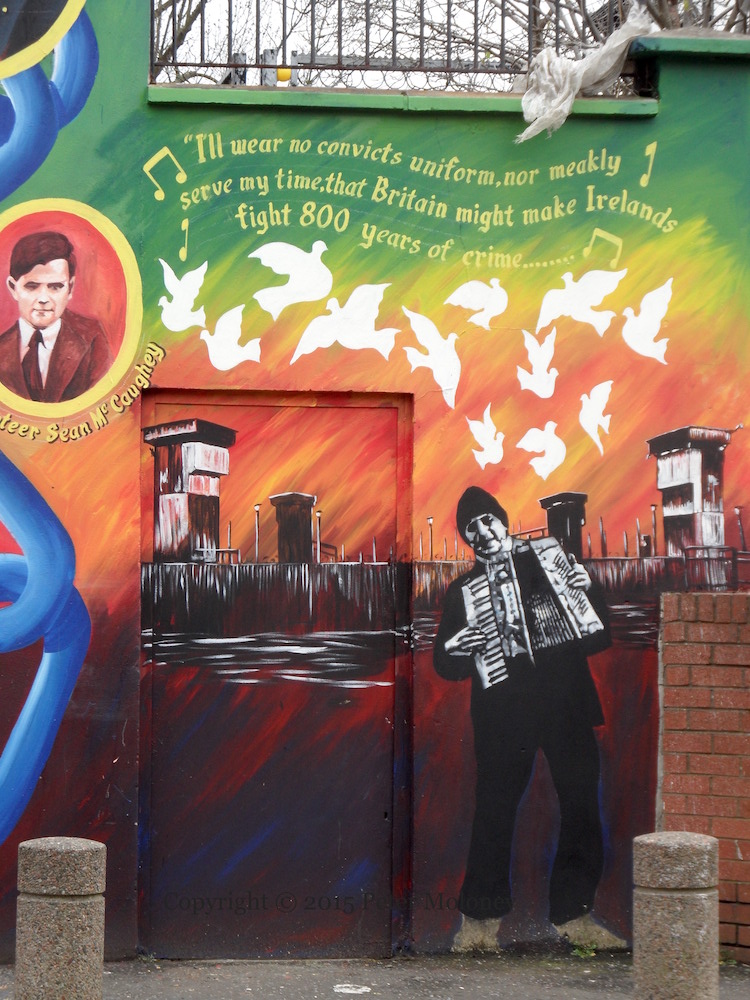
The Bobby Sands mural in Sevastopol Street has been given a facelift, including the blocking-up of a vent on Sands’s left cheek. Kieran Doherty and Joe McDonnell have been added in place of the 1798 medallions on each side. On the side-wall are Sean McCaughey, ten doves representing the 1981 hunger-strikers, and Long Kesh. Aerosol‘s accordion-player stencil has been also been retained, on the right.
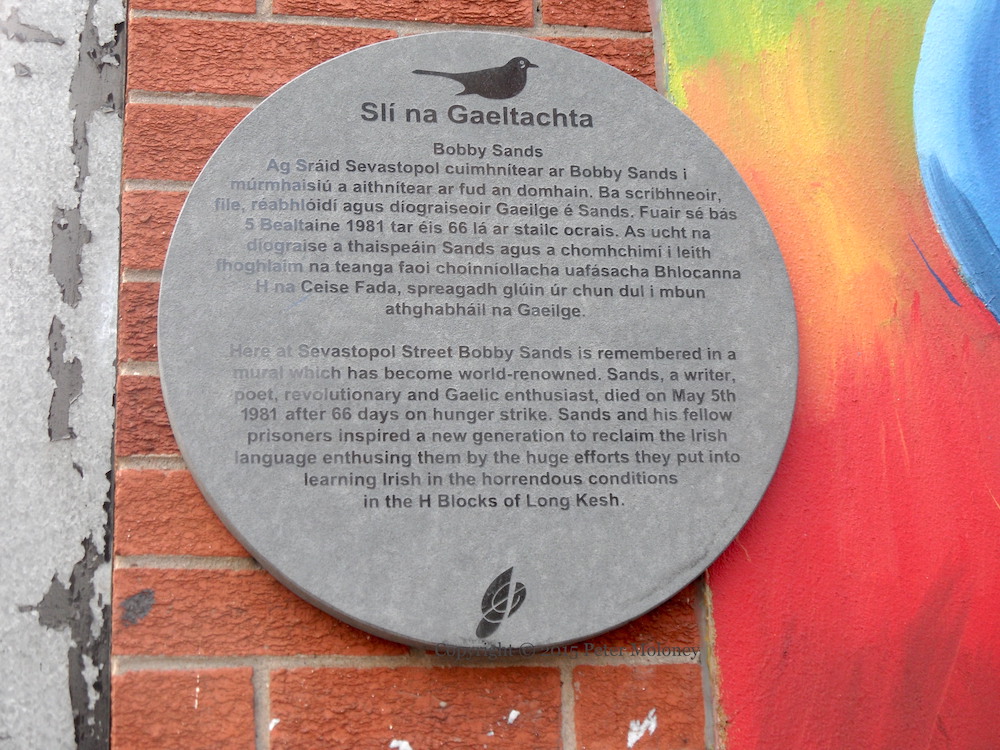
The ‘Slí Na Gaeltachta’ plaque off to the left reads:
Ag sráıd Sevastopol cuımhnıtear ar Bobby Sands ı múrmhaısıú a aithnıtear ar fud an domhaın. Ba scrıbhneoır, file, réabhlóıdí agus díograıseoır Gaeılge é Sands. Fuaır sé bas 5 Bealtaıne 1981 tar éıs 66 lá ar stailc ocraıs. As ucht na dıograıse a thaıspeáın Sands agus a chomhchımí ı leıth fhoglaım na teanga faoı choınníollacha uafásacha Bhlocanna H na Ceıse Fada, spreagadh glúın úr chun dul ı mbun athghabháıl na Gaeılge.
Here at Sevastopol Street Bobby Sands is remembered in a mural which has become world-renowned. Sands, a writer, poet, revolutionary and Gaelic enthusiast, died on May 5th 1981 after 66 days on hunger strike. Sands and his fellow prisoners inspired a new generation to reclaim the Irish language enthusing them by the huge efforts they put into learning Irish in the horrendous conditions on the H Blocks of Long Kesh.
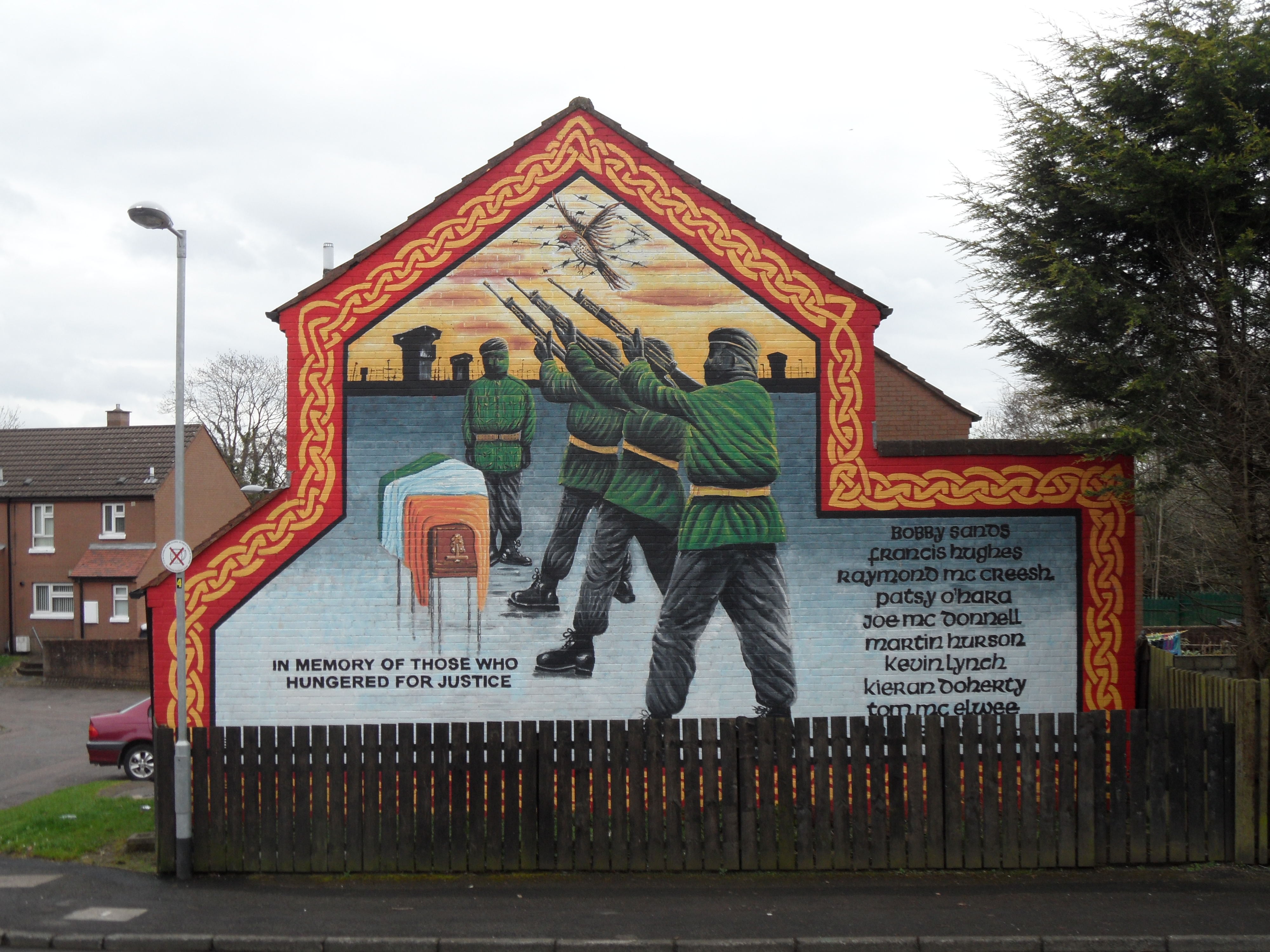
This is a 2015 repainting of a 2001 mural in Glenwood. The ten deceased hunger-strikers of 1981 are listed in the bottom right: Bobby Sands, Francis Hughes, Raymond McCreesh, Patsy O’Hara, Joe McDonnell, Martin Hurson, Kevin Lynch, Kieran Doherty, Tom McElwee, Mickey Devine. In the main panel, a lark in barbed wire flies over the H-blocks of Long Kesh and a funeral volley being fired over a Tricolour-draped coffin.
A plan for a “peace and conflict resolution” centre at HMP Maze was approved in April 2013 (Guardian) but the plans were scuppered before the end of the year (BBC) thanks in part to unionist objections that it would focus on prisoners rather than victims (BBC).
The other placard also refers to another controversy from 2013, the flying of the Union Flag at Belfast City Hall, which began with the December 2012 decision to fly the flag on 18 days a year, but which petered out the following spring.
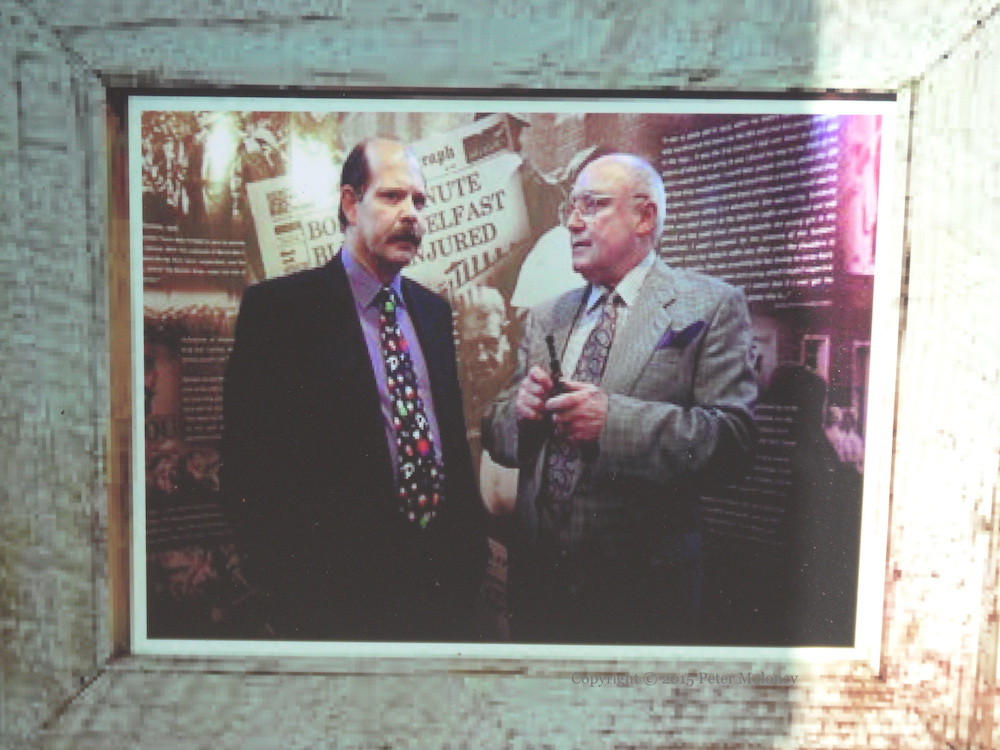
“He had the courage to climb out of the traditional trenches, meet the enemy in no man’s land and play ball with him.” David Ervine was a UVF member, arrested in 1974 and served six years in the Maze before turning to politics: he first ran for office in 1985 and represented East Belfast in the NI Assembly from 1998 until his death in 2007. The board shows Ervine’s silhouette in a wreath of poppies along with pictures of and information about his life, including a photograph of Ervine with Gusty Spence, who is shown holding a pipe.
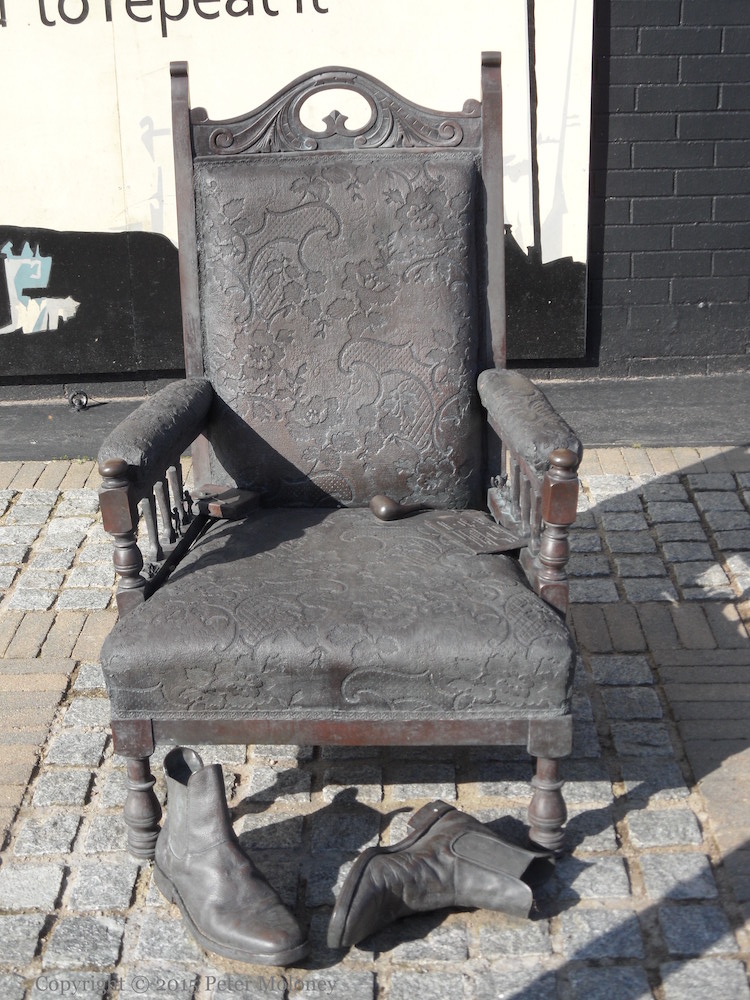
Ervine’s own pipe is included among the items on the “Memory Chair” sculpture by Ross Wilson, along with a ticket for the Titanic and a little (prayer?) book with a poppy on the cover. The prayer book would be for Protestantism, the poppy for loyalism and service in WWI, and the ticket for the shipyard. The boots like the pipe are personal effects of Ervine’s.
“David Ervine 21st July 1953 – 8th January 2007 David Ervine was born in nearby Chamberlain Street, the youngest of five children. A lifelong supporter of Glentoran Football Club he was a true son of East Belfast. David attended Avoniel Primary School and Orangefield Boys High School. Leaving school before his fifteenth birthday he began his working life in an atmosphere of tension and violent confrontation. At nineteen he joined the UF. He was arrested in 1974 and served five years in Long Kesh, a wasteland that he and other prisoners transformed into a place of personal and political growth and development. A founding member of the Progressive Unionist Party and its most articulate spokesperson, he was elected to the Northern Ireland Forum, Belfast City Council and the Northern Ireland Assembly. David Ervine was a truly inspirational leader. With vision and courage he led his community from violence to peace, winning the respect of friend and foe alike. He gave voice to the common man and woman acting always in the interest of peace and his beloved Ulster.”
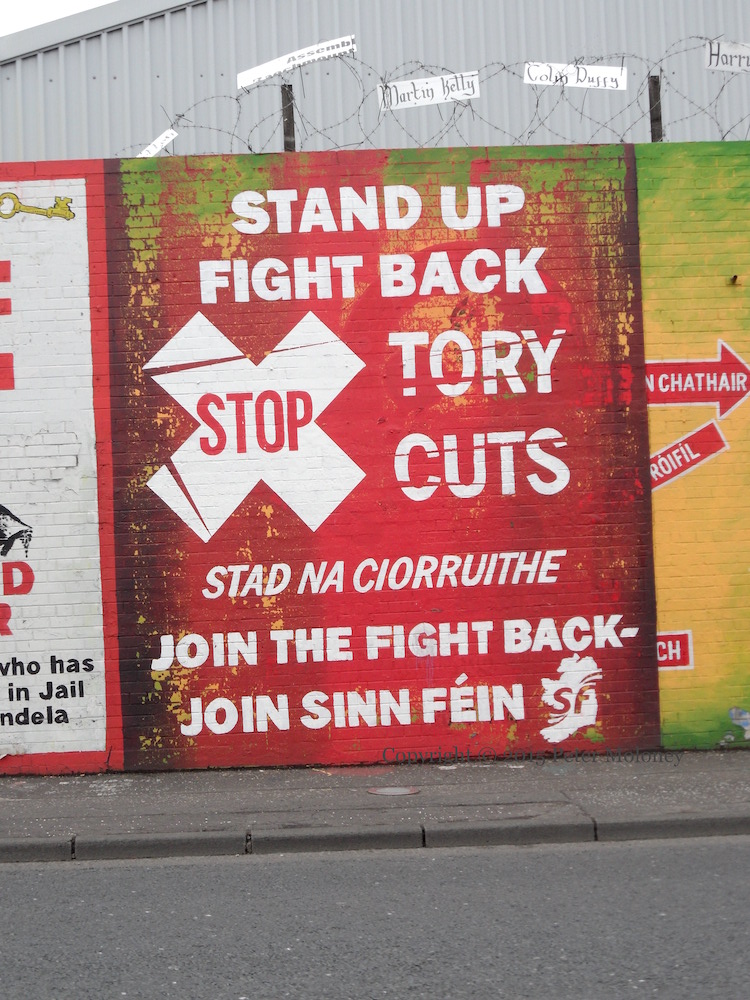
“Stad na cıorruıthe. Stand up, fight back.” The (UK) Conservative Party has proposed a series of cuts, including a freeze of child benefit, income support, tax credits, dole, and housing benefit. These are opposed by various parties and advocacy groups in both Great Britain and Northern Ireland. Protest rallies were held in both Belfast and Dublin in October last year (2014-10-11).
The mural above is on the Divis Street international wall (Visual History).
“‘The Irish republic must be made a word of conjure with – a rallying point for the disaffected, a haven for the oppressed.’ – James Connolly 5th June 1868 – 12th May 1916.”
James Connolly was concerned not just with the political independence of Ireland but its economic independence: both political and economic liberty were required in order for the human being to live freely. The quote in the image above comes from Connolly’s 1897 essay “Socialism & Nationalism”. The economic context is clear when we read a little more broadly:
“To the tenant farmer, ground between landlordism on the one hand and American competition on the other, as between the upper and the nether millstone; to the wage-workers in the towns, suffering from the exactions of the slave-driving capitalist to the agricultural labourer, toiling away his life for a wage barely sufficient to keep body and soul together; in fact to every one of the toiling millions upon whose misery the outwardly-splendid fabric of our modern civilisation is reared, the Irish Republic might be made a word to conjure with – a rallying point for the disaffected, a haven for the oppressed, a point of departure for the Socialist, enthusiastic in the cause of human freedom.” (marxists.org)
“Óglach Joe McDonnell died on hunger strike in the H Blocks of Long Kesh July/ 8th/ 1981. ‘You dare to call me a terrorist while you look down your gun.’ [youtube]”
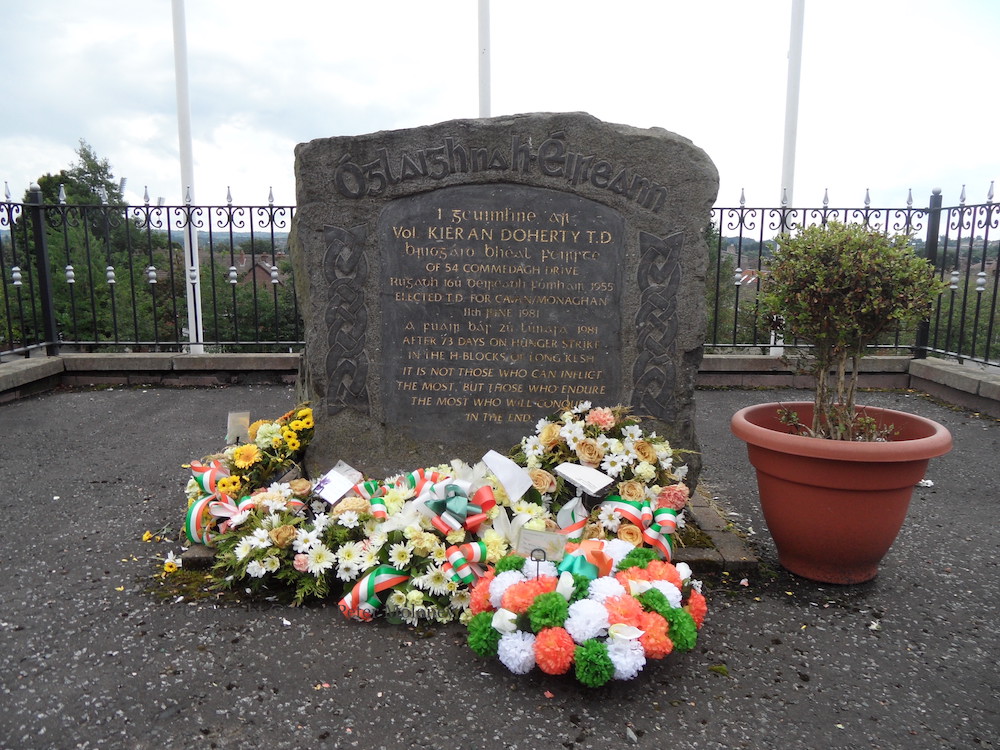
Kieran Doherty died on August 2nd, 1981, after 73 days on hunger-strike. The (repainted – compare to 2001 | 2004 | 2011) mural in his memory depicts scenes from his funeral on 1981-08-04.
The photograph on which the central panel is based is by Derek Spiers; see also this set at hungerstrikes.org. The volley took place outside the Doherty family home in nearby Commedagh Drive (Belfast Media).
The portrait of Doherty in the top left replaces a similar one in the same location; the plaque at the portrait’s top-right corner remains from before. The angled panel shows Doherty’s parents, Alfie and Margaret.
The (actual) memorial stone, which is here reproduced on the perpendicuar joining wall, was also seen in 2007.












 Peter Moloney Collection