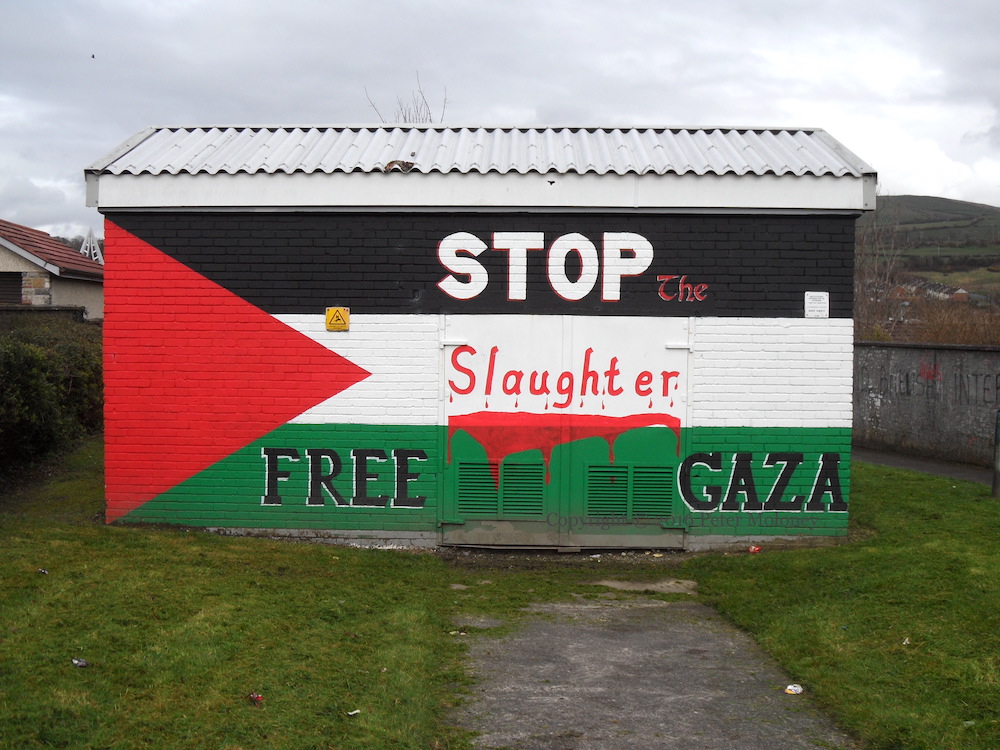
“Free Gaza” in the Ballycolman estate. This piece is from the 2014 war, in which roughly 2,300 Palestinians and 73 Israelis were killed (WP).
Ballycolman Avenue, Strabane
Click image to enlarge
Copyright © 2016 Peter Moloney
M12936
“Free Gaza” in the Ballycolman estate. This piece is from the 2014 war, in which roughly 2,300 Palestinians and 73 Israelis were killed (WP).
Ballycolman Avenue, Strabane
Click image to enlarge
Copyright © 2016 Peter Moloney
M12936
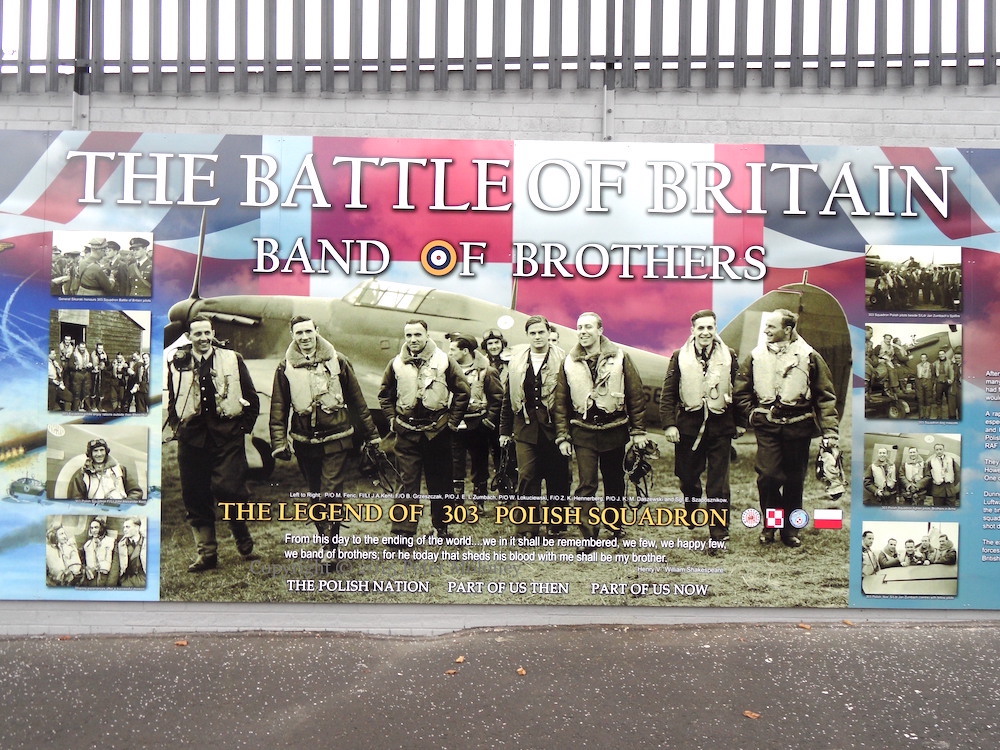


“Love demands sacrifice”. “‘From this day to the ending of the world … we in it shall be remembered, we few, we happy few, we band of brothers’ for he today that sheds his blood with me shall be my brother’ – Henry V, William Shakespeare”
2015 marks the 75th anniversary of the Battle Of Britain, which was waged from July to October in 1940. This large board is part of an anti-racism project, celebrating the contributions to the Battle made by roughly 145 Polish aviators (WP) and especially the 303 squadron, which was stationed in Northern Ireland for a time (BBC-NI). “The Polish nation – part of us then, part of us now”.
The artist is Ross Wilson. Belfast Live has a report on the launch.
Click image to enlarge
Copyright © 2015 Peter Moloney
M12180 M12178 [M12179] M12177
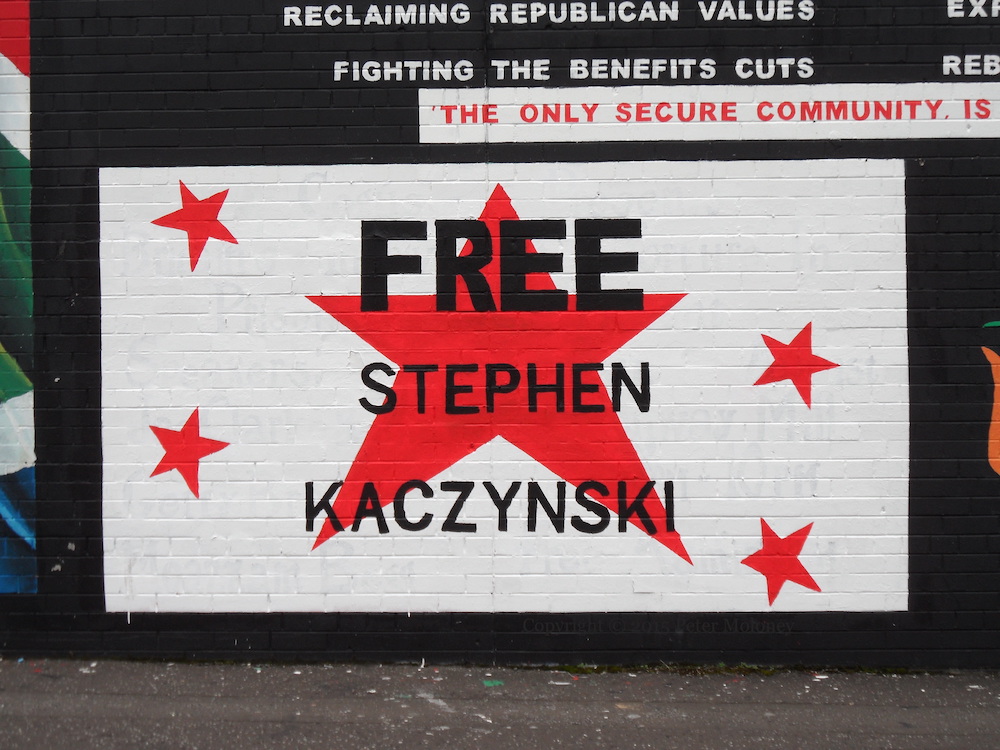
Stephen (or Stephan) “Steve” Kaczynski will go before a Turkish court on September 18th on charges of membership of the Marxist-Leninist ‘Revolutionary People’s Liberation Party-Front’ (DHKP-C). (WP) In April, members of the group took over a courtroom and held a state prosecutor hostage; when special forces stormed the building, the hostage and two of his captors died. (Independent) Kaczynski, a freelance journalist from Scotland, is alleged to be instrumental in financing the group. Alternatively, (according to various newspaper reports) he is an undercover agent of the Germans (Daily Sabah) or the British (Brian Haw). He has been on hunger-strike in protest at the conditions in Maltepe #3 since June 25th.
Replaces the announcement of a talk about torture in prisons. For the wider frame, see The Only Secure Community Is An Organised One.
Click image to enlarge
Copyright © 2015 Peter Moloney
M12710

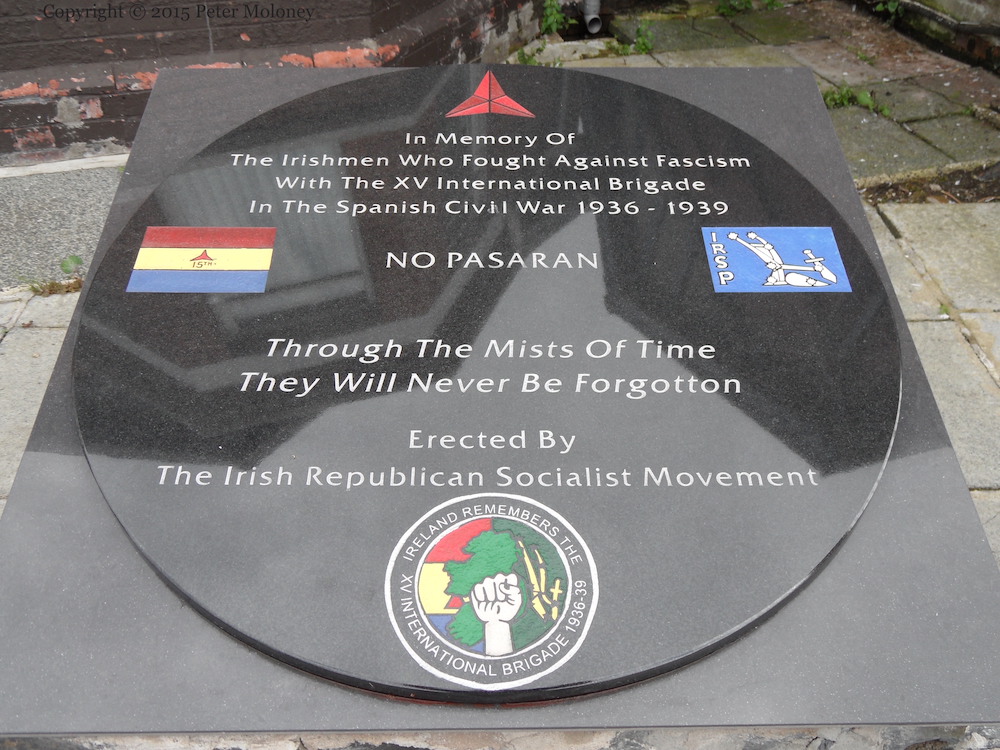
These images are from the front yard of Costello House, the Falls Road home of the IRSP. Top, “Belfast RSYM [Republican Socialist Youth Movement] – join the movement”. Immediately above, “In memory of the Irishmen who fought against fascism with the XV International Brigade in the Spanish Civil War 1936-1939. No pasaran. ‘Through the mists of time they will never be forgotten.’ Erected by the Irish Republish Socialist Movement.”
See also the plaque to Seamus Costello.
Click image to enlarge
Copyright © 2015 Peter Moloney
M12682 [M12683] [M12684] M12685
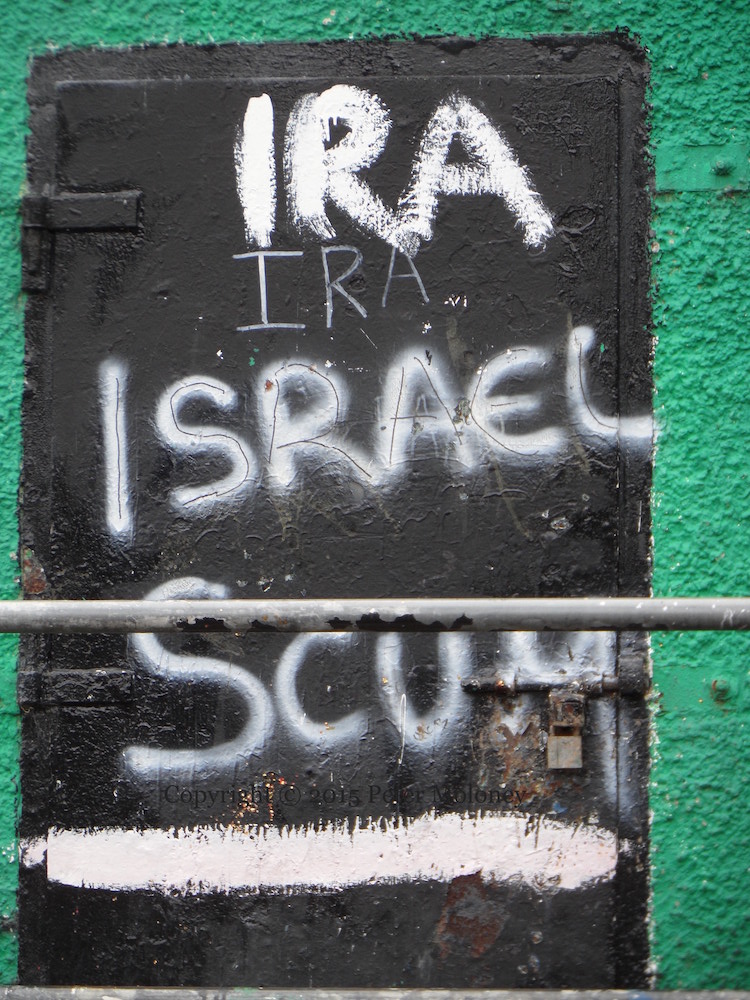

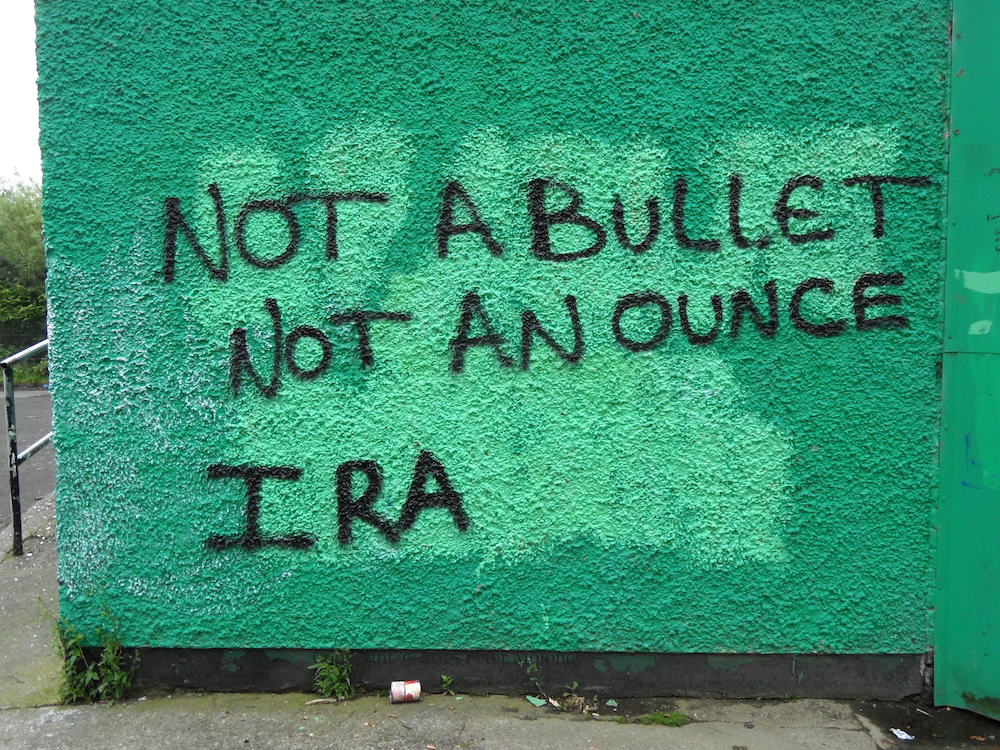

These graffiti are on the building below Kildrum Gardens. “Not a bullet, not an ounce” is a comment on (Provisional) IRA disarmament and continued physical-force resistance; “End British internment” is a comment on the fate of prisoners from anti-Agreement organisation; “Free Gaza!!” and “Israel scum” are comments on the 2014 Gaza War (WP).
Click image to enlarge
Copyright © 2015 Peter Moloney
M12637 M12638 M12639 M12640
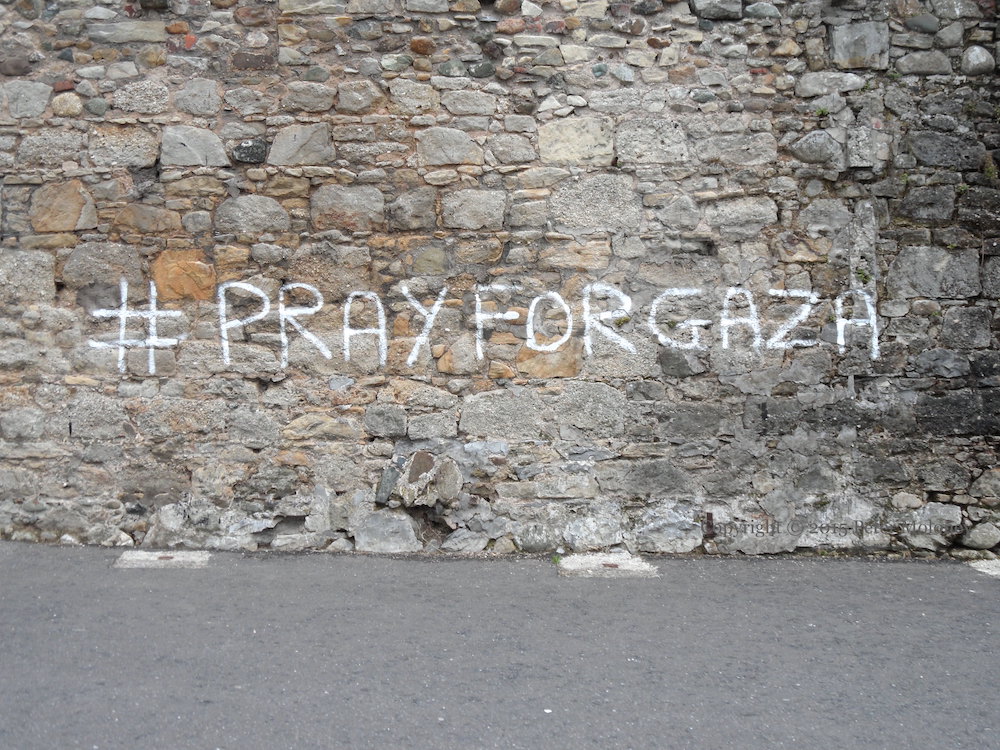
“#PrayForGaza” graffiti in Bishop Street, Derry
Click image to enlarge
Copyright © 2015 Peter Moloney
M12635

A week before he was assassinated and his government overthrown, Burkina Faso president Thomas Sankara asserted: “While revolutionaries as individuals can be murdered, you cannot kill ideas.” Sankara gained power of Burkina Faso (then Upper Volta) in a 1983 coup and launched an ambitious programme of literacy, feminism, public health, and agricultural self-sufficiency, in addition to launching a drive against corruption and of nationalizing natural resources. He attempted this all without the assistance of foreign aid or the IMF or World Bank. However, he wielded power outside the jurisdiction of the courts and controlled the press. He and twelve colleagues were killed in October 1987.
Beechmount Avenue, west Belfast
Click image to enlarge
Copyright © 2015 Peter Moloney
M12618 [M12619] [M12620] [M12621] [M12622]
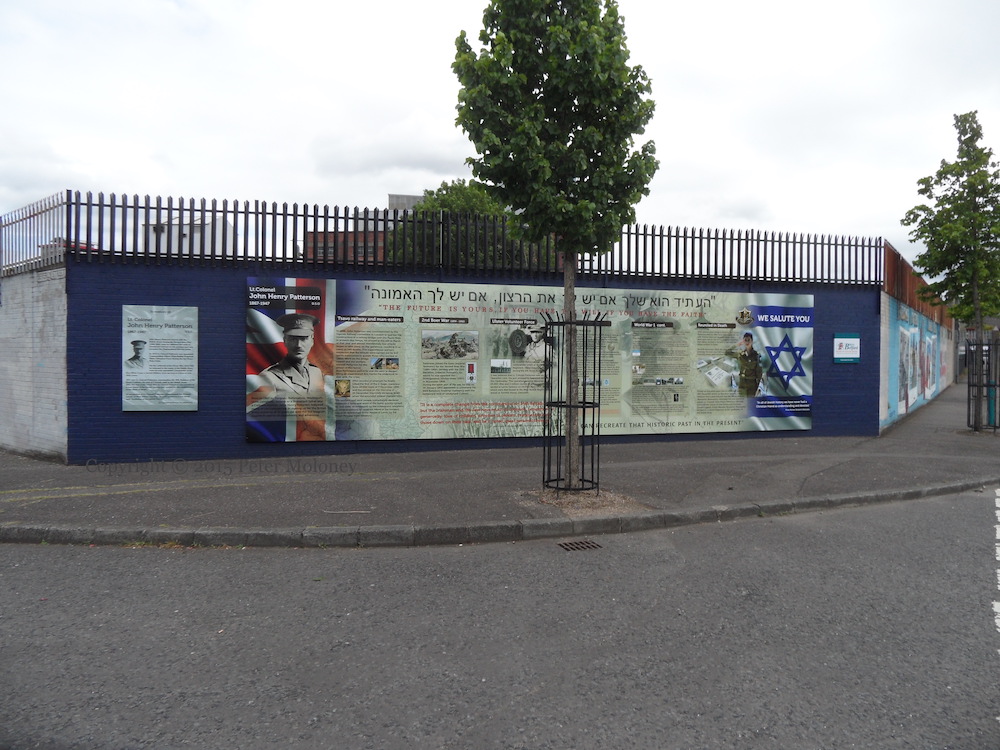


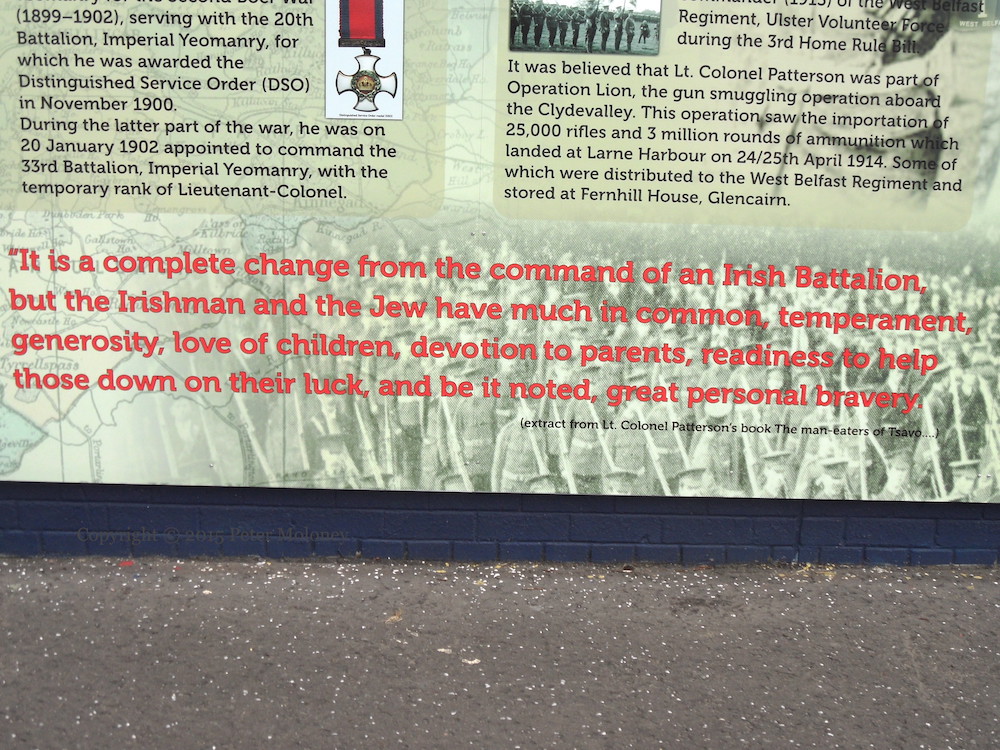


John Henry Patterson went from Ireland to Kenya, where he killed several lions after months of hunting. He wrote an account of the hunt ‘The Man-Eaters of Tsavo’ which has inspired three movies. The lions, named The Ghost and The Darkness, were both over nine feet in length. Back in Ireland he commanded a battalion of the UVF and was involved in the Larne gun-running of 1914: Operation Lion.
The final panel shows the star of David and a quote from Prime Minister Benjamin Netanyahu: “In all of Jewish history we have never had a Christian friend as understanding and devoted.” The interim panels described Patterson’s raising and leading of the Jewish battalions of the Royal Fusiliers in WWI. After dying in obscurity in Los Angeles in 1947, his remains were transported to Israel in December 2014 and reinterred (video). For more, including a recording of Patterson’s voice, see this BBC Magazine article.
“John Henry Patterson DSO 1867-1947. Born in 1867 in Forgney, Ballymahon, Westmeath (now Longford), Ireland to a Protestant father and a Catholic mother, John Henry Patterson followed many of his compatriots in signing up for the British Army enlisting at 17 years old with the 3rd Dragoon Guards in search of opportunity and adventure.”
“In 1898, John Patterson was commissioned by the Uganda Railway committee in London to oversee the construction of a railway bridge of the Tsavo River in present-day Kenya. He arrived at the site in March of that year and almost immediately lion attacks began to take place on the workforce, resulting in as many as 140 deaths. The superstitious workers suspected that the attacks were carried out by evil spirits summoned to punish those who worked at Tsavo. Work on the bridge ceased and the workers blamed Patterson for the arrival of this terror. Now Patterson’s authority and life were in danger, being an experienced lion hunter he undertook to deal with the crisis. After months of attempts he finally killed the first of the 2 huge, maneless lions on the night of 9 December 1898 and the second on the morning of 29 December (narrowly escaping death when the wounded animal charged him). The workers and local people immediately declared Patterson a hero, and word of the event quickly spread far and wide, as evidenced by the subsequent telegrams of congratulations he received. Word of the incident was even mentioned in the House of Lords, by the Prime Minister Lord Salisbury.”
“Patterson joined the Essex Imperial Yeomanry for the Second Boer War (1899-1902), serving with the 20th Battalion, Imperial Yeomanry, for which he was awarded the Distinguished Service Order (DSO) in November 1900. During the latter part of the war, he was on 20 January 1902 appointed to command the 33rd Battalion, Imperial Yeomanry, with the temporary rank of Lieutenant-Colonel. Lt. Colonel Patterson was appointed commander (1913) of the West Belfast Regiment, Ulster Volunteer Force during the 3rd Home Rule Bill. It was believed that Lt. Colonel Patterson was part of Operation Lion, the gun smuggling operation aboard the Clydevalley. This operation saw the importation of 25,000 rifles and 3 million rounds of ammunition which landed at Larne Harbour on 24/25th April 1914. Some of which were distributed to the West Belfast Regiment and stored at Fernhill House, Glencairn.”
“The Zion Mule Corps. Lt. Colonel Patterson rejoined the British Army in 1914, upon the outbreak of World War I, and saw service in Flander[s] before being sent to Egypt. In Alexandria he met Joseph Trumpeldor and Zeev Jabotinsky who were attempting to form a Jewish military force. By the end March 1915, Jewish volunteers from among deportees in Egypt had started training. The British military command opposed to participation of Jewish volunteers on the Palestinian front and suggested the volunteers serve as a detachment for mule transport. In 1915, Lt. Colonel Patterson was made commander of the approximately 750 man Zion Mule Corps, organized in Egypt in March, with a rank of “honorary Lieutenant Colonel.” Swearing in the new volunteers on March 31, 1915. Patterson wrote in his diary “never since the days of Judah Maccabee had such sights and sounds been seen and heard in a military camp – with the drilling of uniformed soldiers in the Hebrew language”. In April of 1915, after the Mule Corps had been in training for just 3 weeks, Lt. Colonel Patterson landed with the corps at V Beach, Gallipoli. About half of the corps were seconded to the Anzacs, who treated them discourteously and had them shipped back to Alexandria, the rest under Lt. Colonel Patterson then landed at Cape Helles on April 27th where they saw action for the very first time, there the corps served with distinction out of the 300 men that landed, 14 were killed.”
“The Mule Corps disbanded in early 1916, Lt. Colonel Patterson returned to Ireland where he commanded the 4th Royal Irish Fusiliers and 5th Royal Dublin Fusiliers. In 1917, after 3 years of lobbying by the British Jewish community, and the likes Jabotinsky the British government finally agreed to the raising of a specifically Jewish unit to fight in the British Army in World War One against the Turks in Palestine/Israel. The force was to be part of the Royal Fusiliers and were given the battalion numbers 38th-42nd. The whole force became known as the Jewish Legion or colloquially as “The First Judeans” The most famous photograph of the men on their march shows Lt. Colonel Patterson clearly and proudly at the head of his men on his horse with one of his offices mounted behind him though the image is blurred has the Lt. Colonel clearly with a broad smile on his face. Indeed every man was smiling as they were lionised by the crowds before embarking on their journey to the Jordan Valley. In June 1918 38th Battalion began engaging the Ottomans some twenty miles north of Jerusalem the Legion also participated in the Battle of Megiddo in mid-September 1918 widely considered to have been one of the final and decisive victories of the Ottoman front. The legion’s mission was to cross the Jordan river. Jabotinsky led the effort. Later he was decorated and Major General Chaytor told the Jewish troops “By forcing the Jordan fords, you helped in no small measure to win the great victory gained at Damascus. During his time in command Lt. Colonel Patterson faced ongoing anti-semitism from superiors, peers and subordinates. His reaction to this engendered much respect from his men, who believed he had sacrificed promotion and position in his quest to ensure fair treatment of them.”
“After several years living in American Lt Colonel Patterson died on 18th June 1947 (aged 79), his wife Frances died just six short weeks later. Both were laid to rest in Los Angeles. Patterson had always wished to be laid to rest with his with fellow soldiers in Israel. On 10th November 2014, the date of his actual birthday, his wish was fulfilled, when his and Frances’s ashes were reunited with Israel. Finally as the ashes were laid to rest once again (4th December 2014); as the choir and the Israeli Defence Force paid tributes and the Prime Minister (Benjamin Netanyahu) extended his own personal salute, Lt. Colonel John Henry Patterson officially achieved the status of time honoured Christian Zionist Legend. Prime Minister Benjamin Netanyahu termed Lt. Colonel Patterson as the ‘godfather of the Israeli army’.
historic past in the present future is yours if you have the will faith david ben-gurion we salute you
Click image to enlarge
Copyright © 2015 Peter Moloney
M11947 M11948 M11949
M11959
M11950 M11951 M11952 M11957
M11953 M11954 [M11958] M11955 M11956
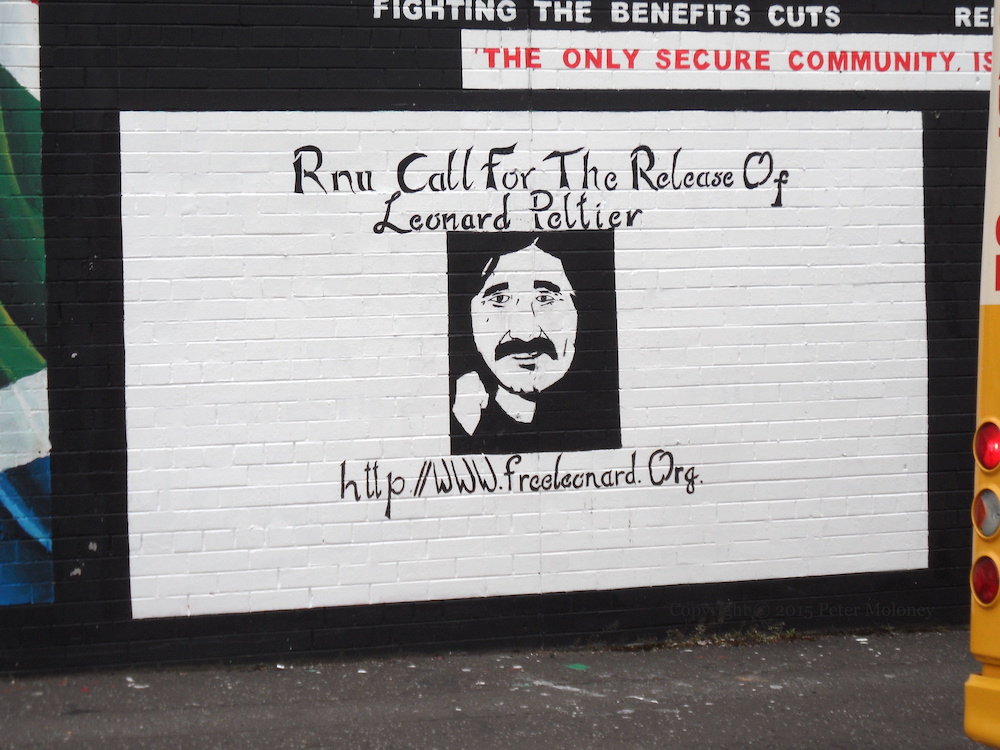
“RNU call for the release of Leonard Peltier – http://www.freeleonard.org“. The lower left-hand panel of the RNU spot on Northumberland Street is serving as a changeable notice-board – it was previously The Popular Front.
Peltier has been in jail since 1977, convicted of killing two FBI agents on the Pine Ridge Reservation in 1975 and sentenced to two life-sentences (WP).
Northumberland Street, west Belfast
Click image to enlarge
Copyright © 2015 Peter Moloney
M12555

“Viva Palestine”. This pro-Palestine mural features sky-jacker Leila Khaled (also seen in in Hugo Street) and the emblem of the Popular Front For The Liberation Of Palestine (WP). The Arabic on the right is an equivalent of “Tıocfaıdh ár lá” on the left.
See also: The same elements used in another mural Oppression Breeds Resistance | The Popular Front in Northumberland Street | “Viva Palestine” in Ardoyne and on Black Mountain/Slıabh Dubh
AMCOMRI Street, off Beechmount Avenue/Ascaıll Ard na bhFeá, west Belfast.
Click image to enlarge
Copyright © 2015 Peter Moloney
M11766 [M11767] [M11768] [M11769]
 Peter Moloney Collection