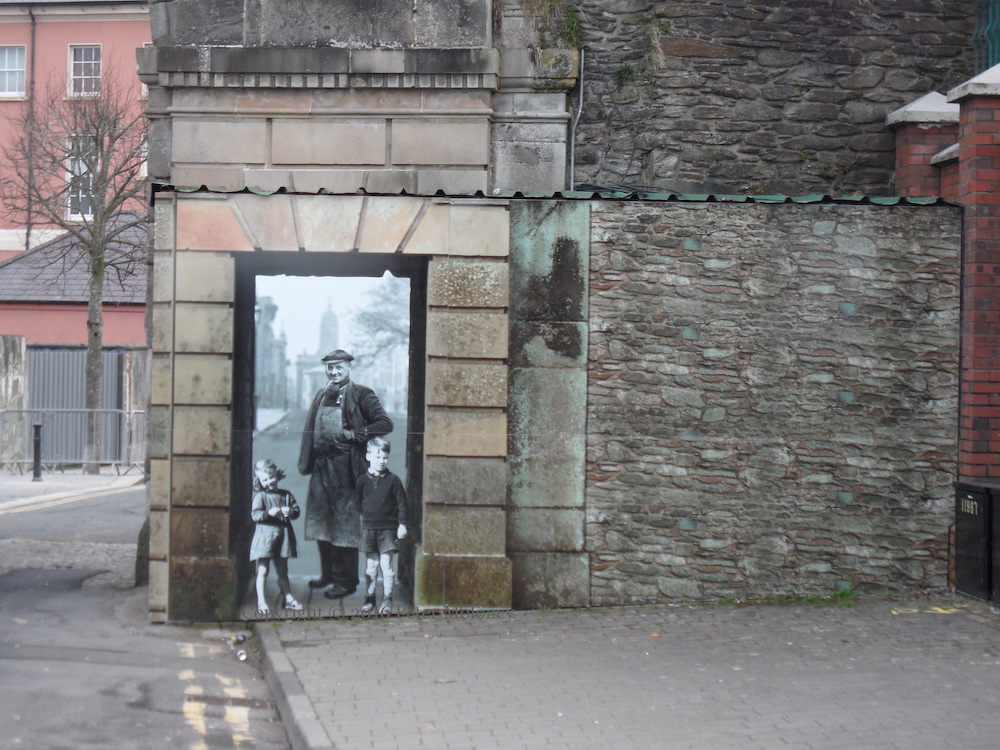
A corrugated metal hut on the outside of Bishop’s Gate has been covered over with fake stone and a fake doorway containing an image of Derry in the old days. The re-model is perhaps part of the “Peacewall Reimaging Project” (Derry Journal) on the railings just out of shot to the right, which was unveiled on December 18th, 2015 (Shared History).
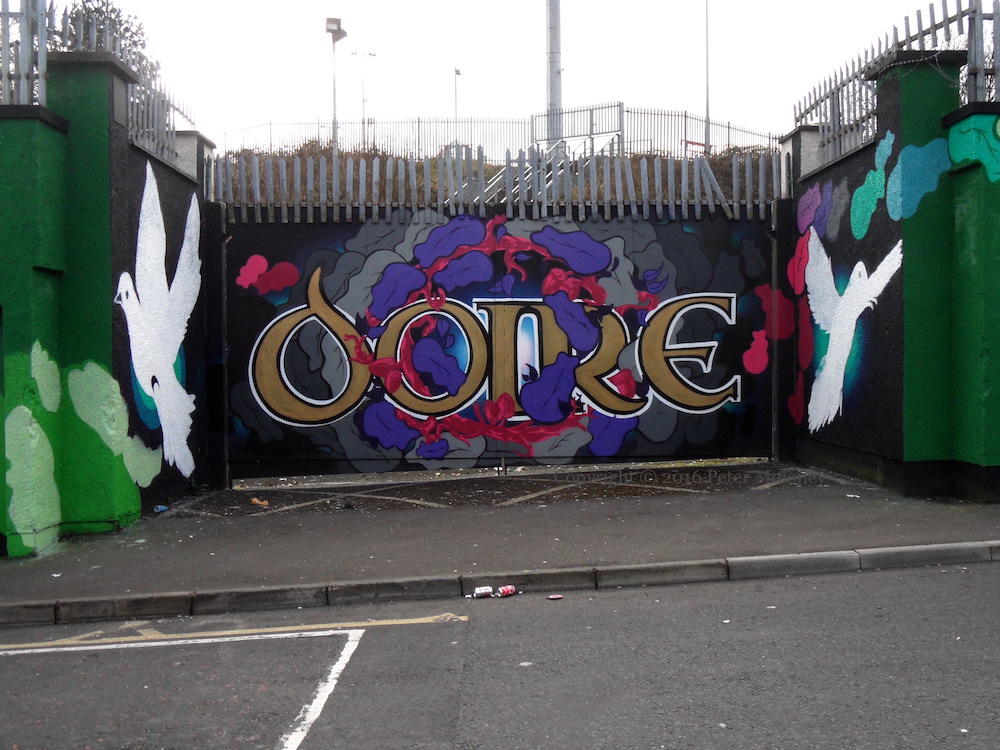
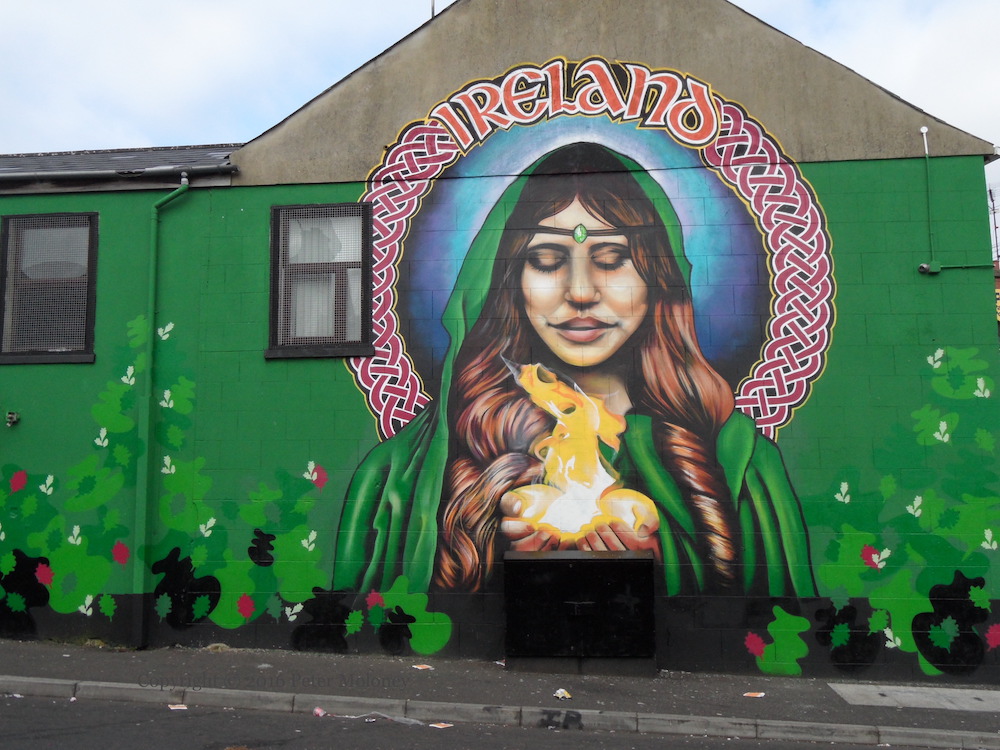
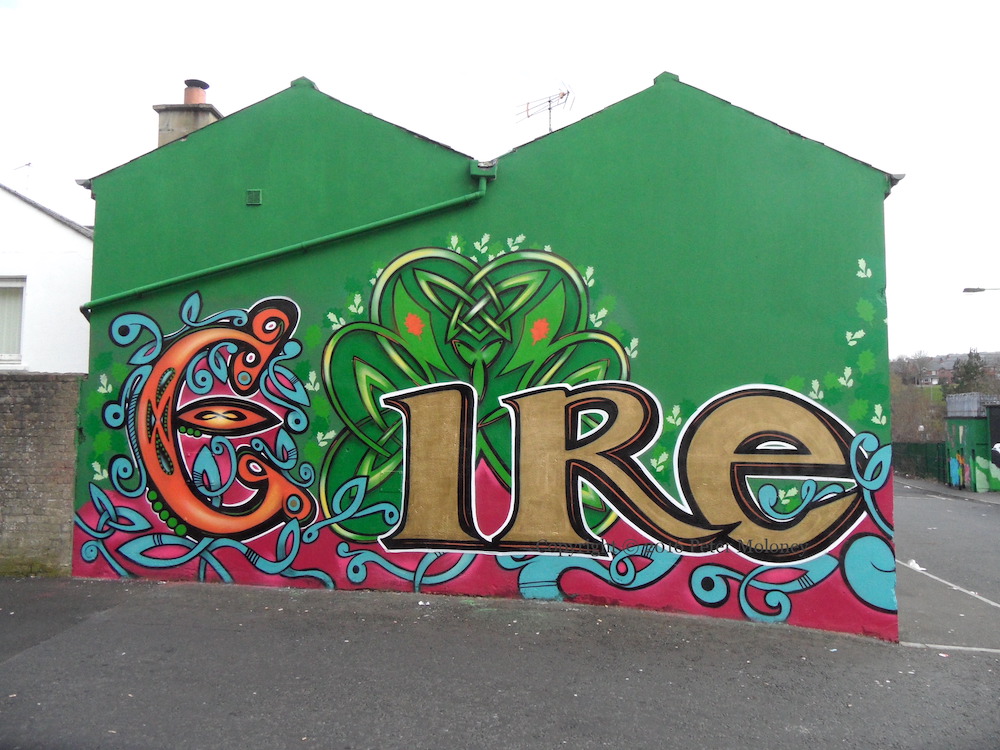
The “Éire” and “Ireland” pieces, and perhaps the Doıre piece, were painted by RAZER (ig). The three are perhaps part of a larger installation at Celtic Park – see Fáılte Go Paırc Na gCeılteach.
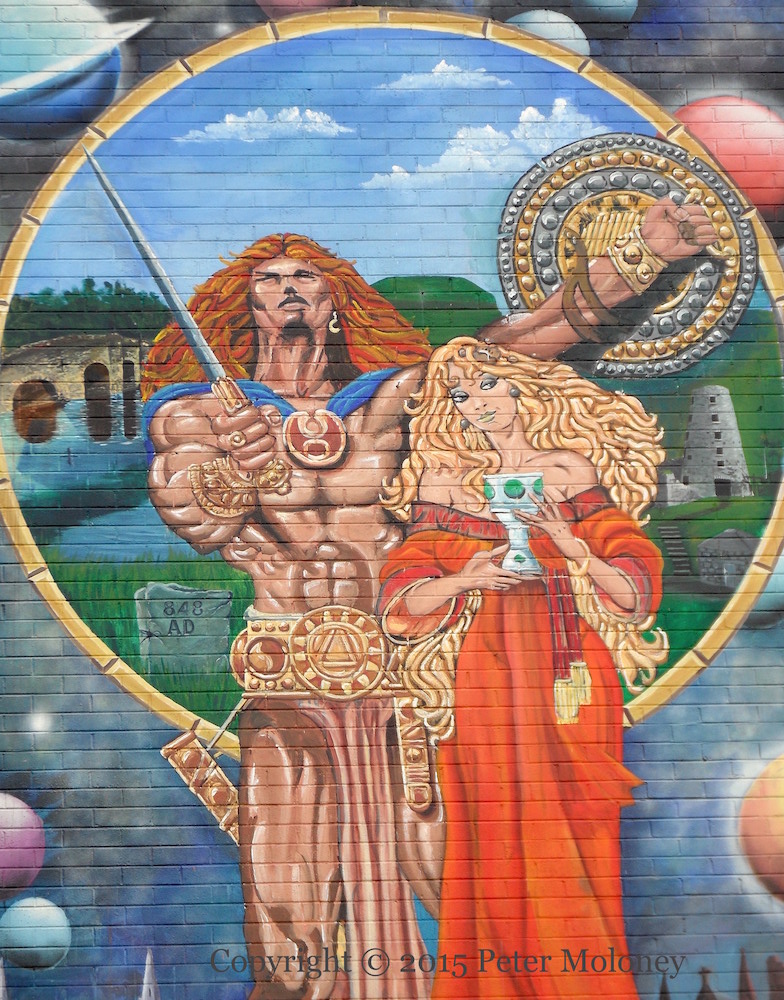
This is a mural of King Niall (Nıall Caılle, Niall of the Callan) and Queen Macha. Niall was high king of Ireland (in competition with Fedelmıd of Munster WP) who held off the Vikings in the late 800s (WP) and died in 846 by drowning in the Callan river. Macha is a much earlier and mythological queen, and gives her name to the town: Ard Mhacha.
The central figures reproduce paintings by Jim Fitzpatrick (Visual History). The Niall figure comes from Nemed The Great but the Macha figure comes from a label Fitzpatrick produced in 1988 for Rosc “mead”, even though Macha (one of them, at least) was the wife of Nemed and there is a female figure in Nemed The Great.
Below the planets and stars, St Patrick’s (Catholic) Cathedral is on the left (WP) and St Patrick’s (CofI) Cathedral is on the right (WP).
In the border, clockwise from left to right, we see: the Tandragee Idol (WP), Naomh Bríd/St Brigid’s, St Patrick preaching the trinity, Irish dancing, Gaelic football, Armagh Harps, “Ard Mhacha”, the Armagh county crest in colour in the apex (Club & County), “Armagh”, Na Pıarsaıgh Óga, hurling/camogie, Cú Chulaınn’s, mummers (perhaps specifically the Armagh Rhymers), Jonathan Swift, a steam locomotive (perhaps representing the Armagh rail disaster of 1889, in which 80 people died WP); a vintage image of Callan Street is depicted along the bottom (History Armagh).
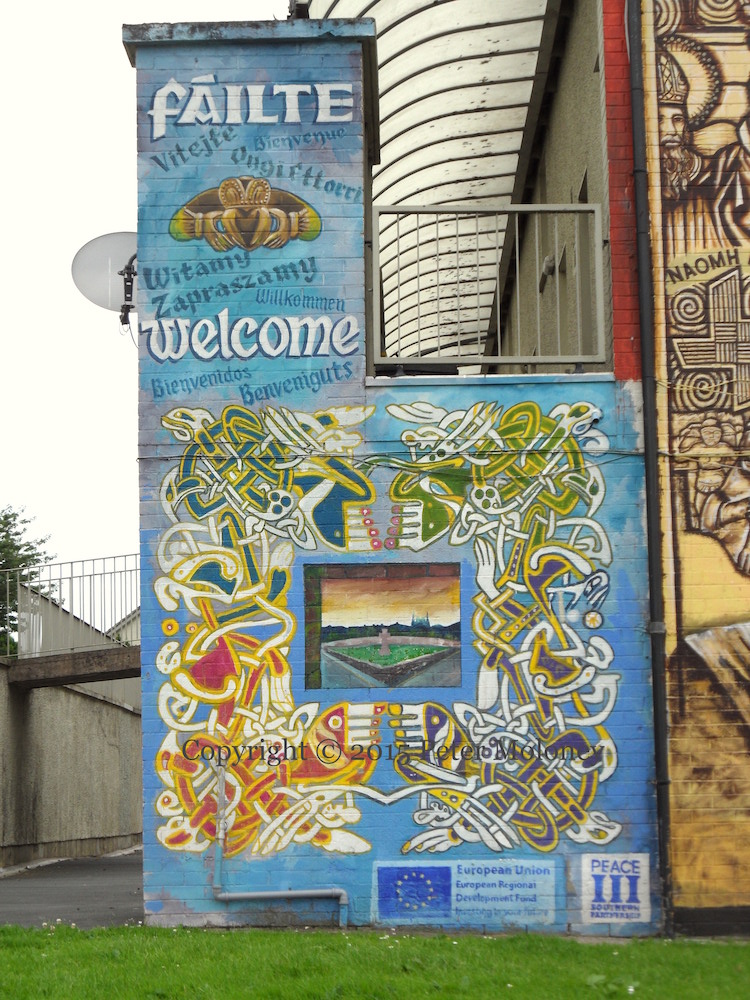
The side-wall features the word “welcome” in many languages, and Celtic knot-work surrounding an image of the Celtic Cross below St Patrick’s, perhaps inspired by this 1903 photograph (Flickr).
Painted by a crew of Belfast artists – Danny D and Mark Ervine, along with Lucas Quigley, Marty Lyons, Micky Doherty – organised by the Callan Street Residents’ Association, with funding from the European Union’s Peace III initiative.
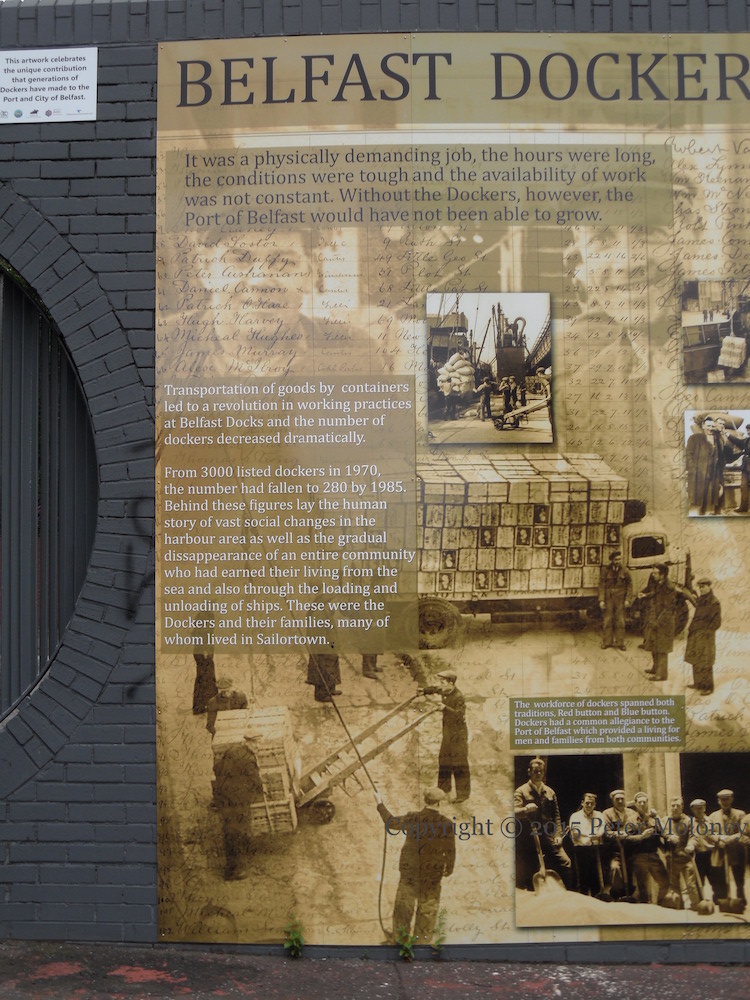
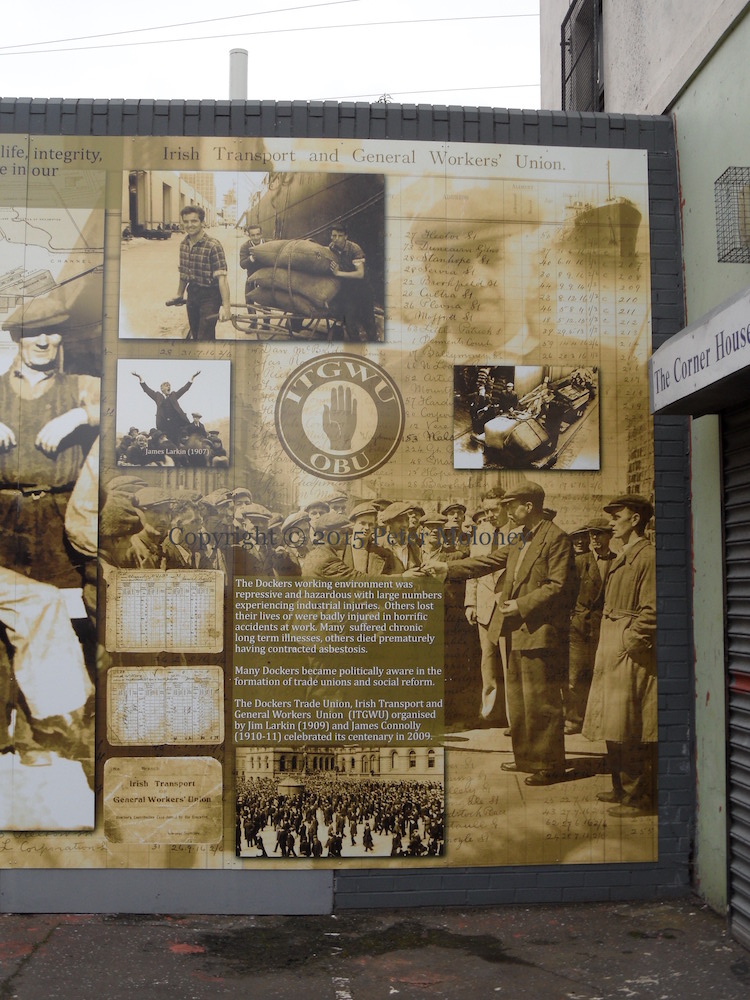
Every day, men would line up in schooling pens on the various docks of the port of Belfast to be hired by foremen. As mentioned on the left-hand side of the board above (recently erected on the New Lodge side of the Duncairn “peace” line) the rise of the shipping container in the 1970s spelled the end of the docker: “from 3000 listed dockers in 1970, the number had fallen to 280 by 1985.” Author and poet John Campbell recalls his first day on the docks in 1952, unloading cement, in this NVTv video.
“This artwork celebrates the unique contribution that generations of dockers have made to the port and City of Belfast.”
“It was a physically demanding job, the hours were long, the conditions were tough and the availability of work was not constant. Without the Dockers, however, the Port of Belfast would not have been able to grow. / Transportation of goods by containers led to a revolution in working practices at Belfast Docks and the number of dockers decreased dramatically. From 3000 listed dockers in 1970, the number had fallen to 280 by 1985. Behind these figures lay the human story of vast social changes in the harbour area as well as the gradual dissappearance [sic] of an entire community who had earned their living from the sea and also through the loading and unloading of ships. These were the Dockers and their families, many of whom lived in Sailortown. / The workforce of dockers spanned both traditions. Red button and Blue button. Dockers had a common allegiance to the Port of Belfast which provided a living for men and families from both communities. / The work was backbreaking, yet the Docks educated us about life, integrity, discipline, about standing up for our rights, about having pride in our identity as working men, as Dockers. / The Dockers[‘] working environment was repressive and hazardous with large numbers experiencing industrial injuries. Others lost their lives or were badly injured in horrific accidents at work. Many suffered chronic long term illnesses, others died prematurely having contracted asbestosis. Many Dockers became politically aware in the formation of trade unions and social reforms. The Dockers Trade Union, Irish Transport and General Workers[‘] Union (ITGWU) organised by Jim Larkin (1909) and James Connolly (1910-11) celebrated its centenary in 2009.”
This new mural pays tribute to two long-time residents of Clonard. On a good day, Noel Fitzpatrick, a cobbler with a little shop on the corner of Odessa and Clonard streets, would take his chair out into the street and play the uıleann pipes. Looking down from above is Alec Reid, the Redemptorist priest who spent 40 years at Clonard monastery and played an important role in the peace process. He died in 2013 at age 82. (WP)
Painted by Marty Lyons & Mickey Doc in Springfield Drive. For the large ‘flower’ mural to the left of this mural (which imitates the stained glass in the cathedral), see C01044.
This pair of boards is outside the Ulster Rangers Supporters Club (Fb) on the Shankill Road.
Above: The painting features a tram going under an Orange arch between the public baths on one side an Spin-A-Disc records on the other, surrounded by notable figures from the Shankill area. (Many thanks to Johnny Dougan of Shankill Area Social History (Fb) for the information below.)
Front, from left to right: Manchester United and Northern Ireland Soccer player Norman Whiteside (WP) and behind him boxer Davy Larmour and community worker Saidie Patterson (see WRDA), boxer Sammy (Cisco) Cosgrove, Senator Charlie McCullough (WP), Tommy Henderson, boxer Jimmy Warnock (original photograph here), Hugh Smyth (see previously Third Class Citizens), artist William Conor (see previously Conor’s Corner, Jack Henning (running), musician Belter Bell, writer Albert Haslett (Northern Visions interview).
Atop the tram: on the left is Jackie Redpath of the Save the Shankill Campaign (note other members of the group with placard on right; Northern Visions has a documentary about the Save The Shankill campaign) and Jack Higgins holding his book The Eagle Has Landed (WP). Up there too is Miss Sands, the music teacher in the Girls Model School, and historian Bobby Foster (Northern Visions interview). On the stairs are May Blood MBE and above her D.I. Nixon.
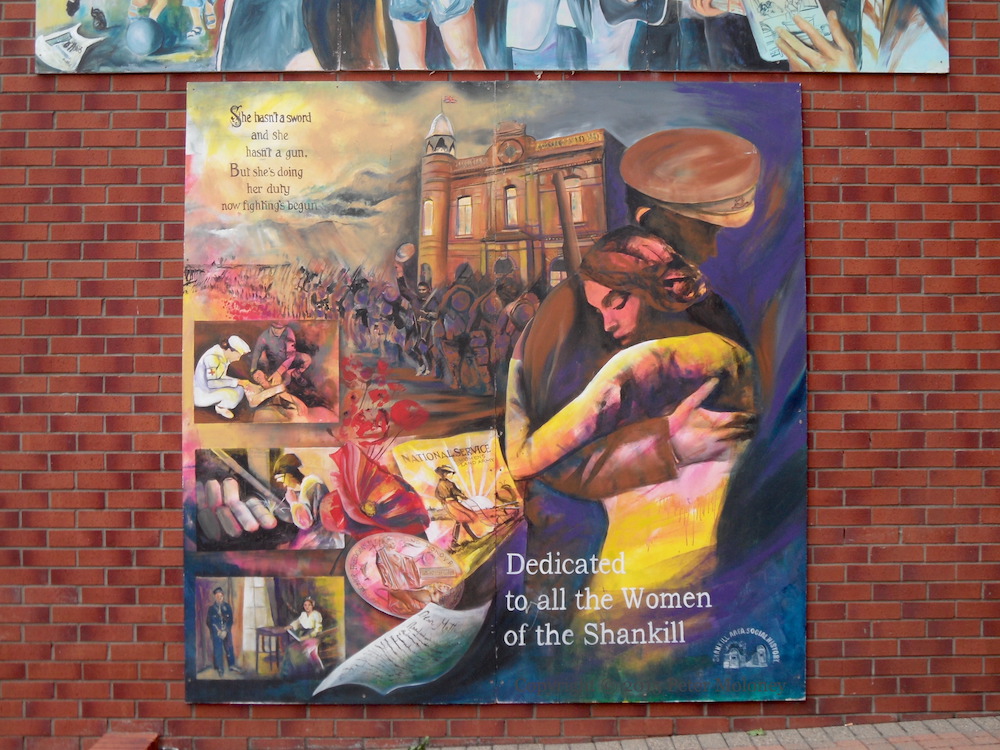
Below is a board highlighting the roles played by women during WWI as nurses and welders and in the Land Army. “She hasn’t a sword and she hasn’t a gun. But she’s doing her duty now fighting’s begun.”
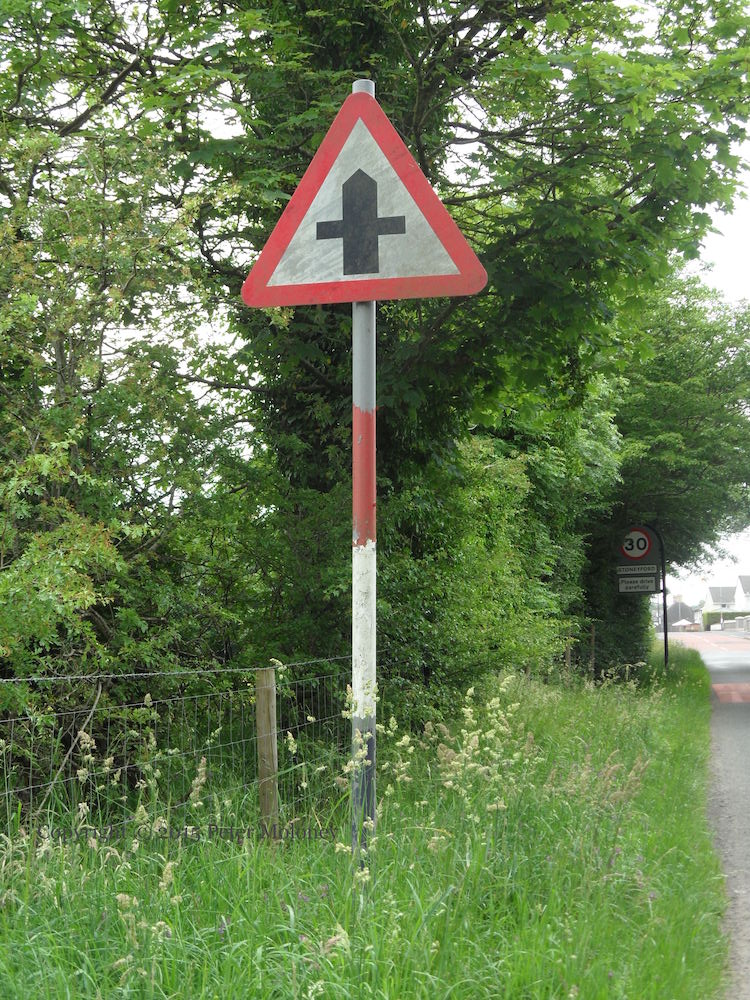
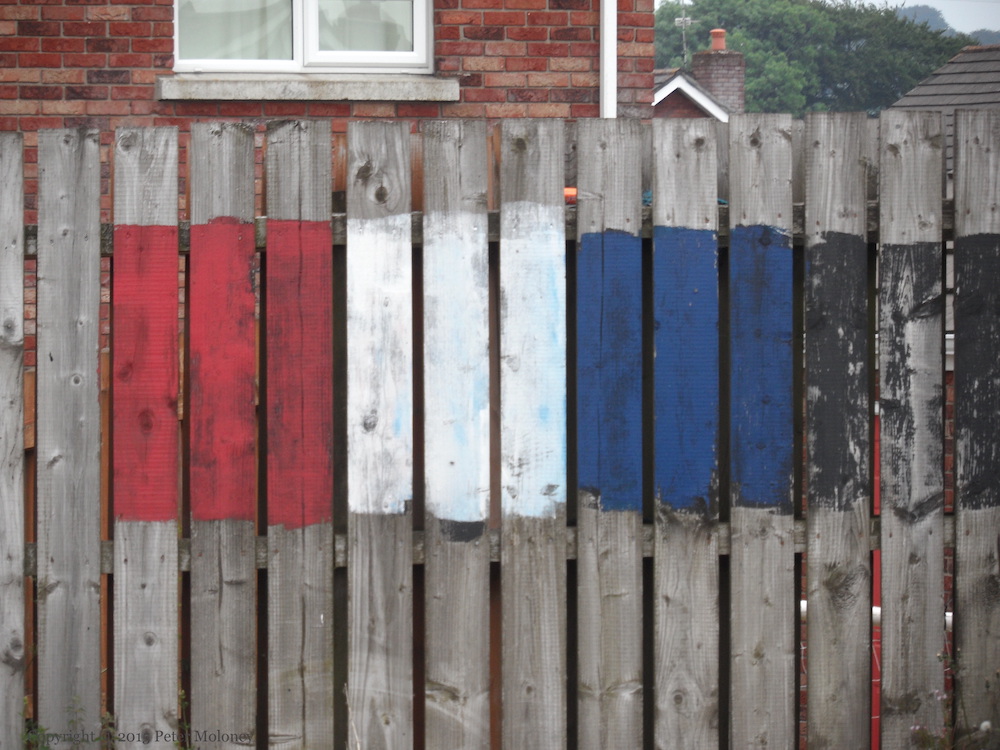
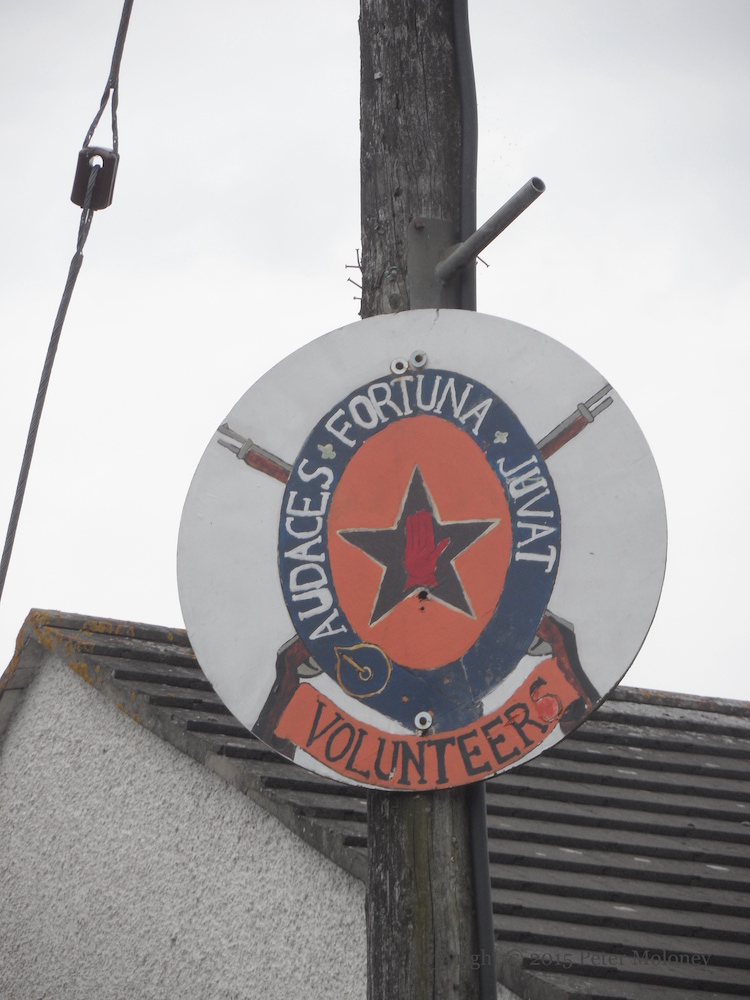
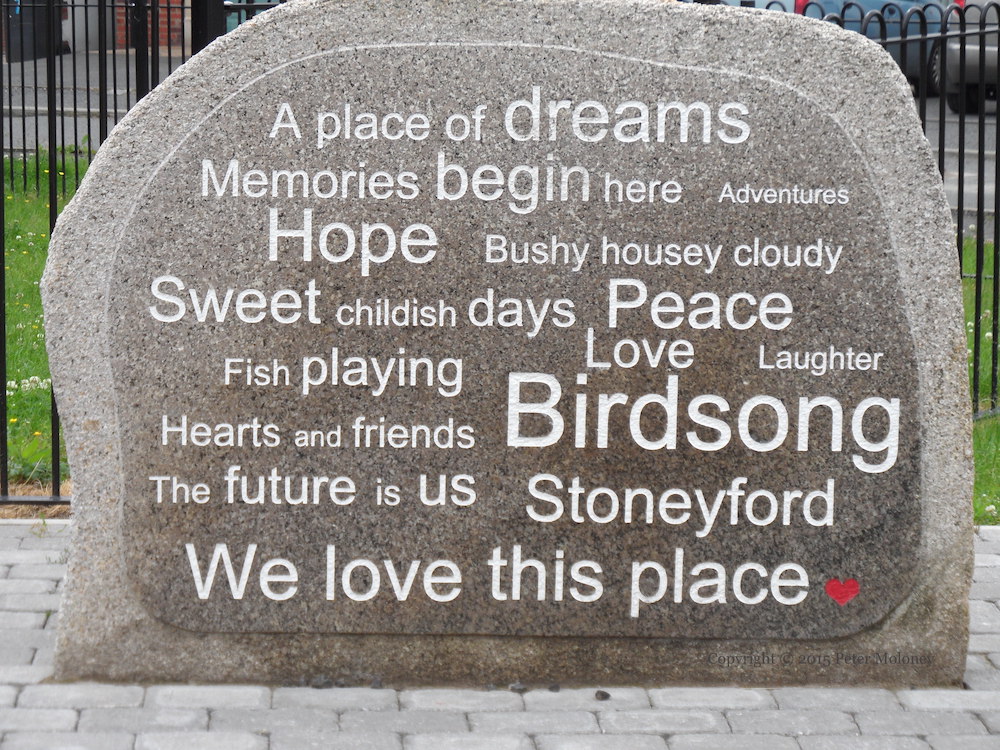
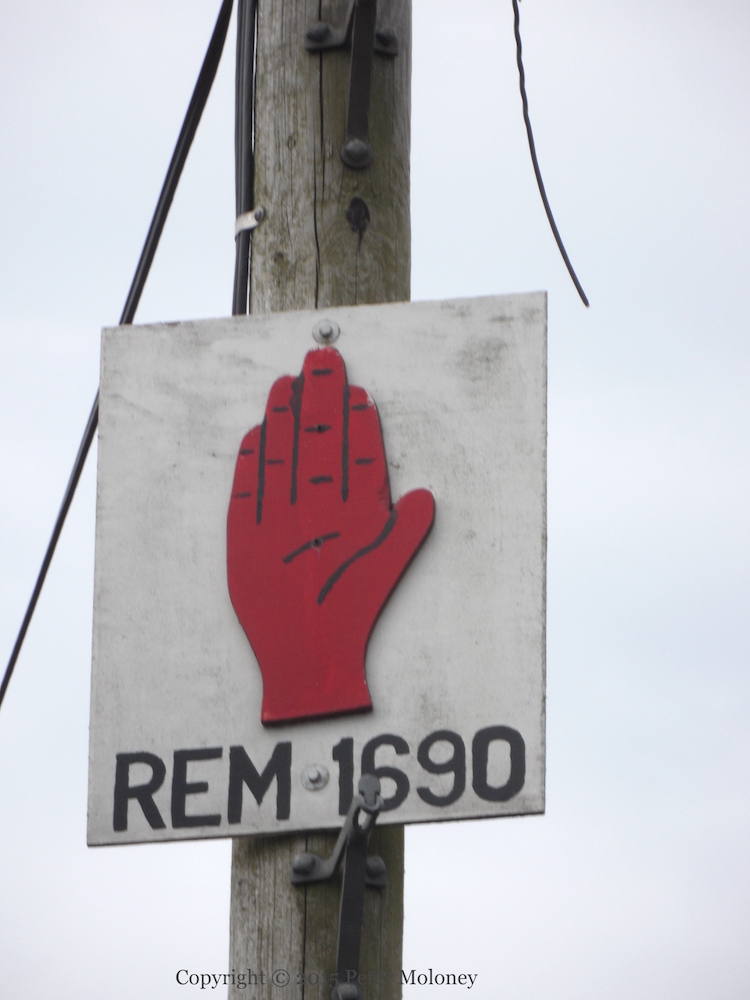
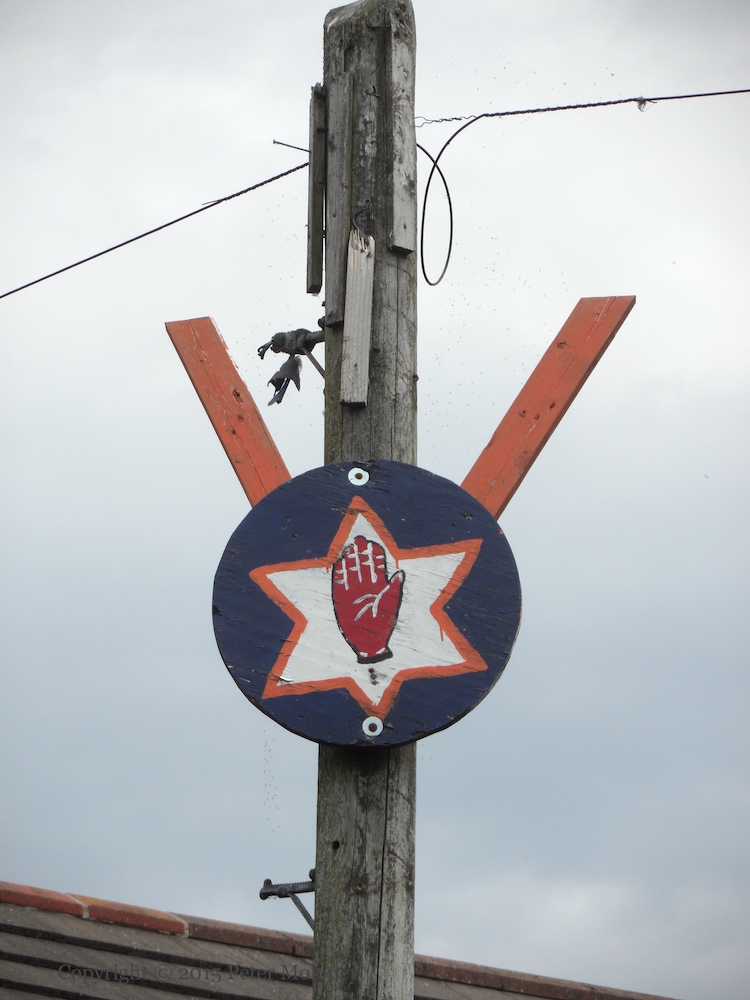
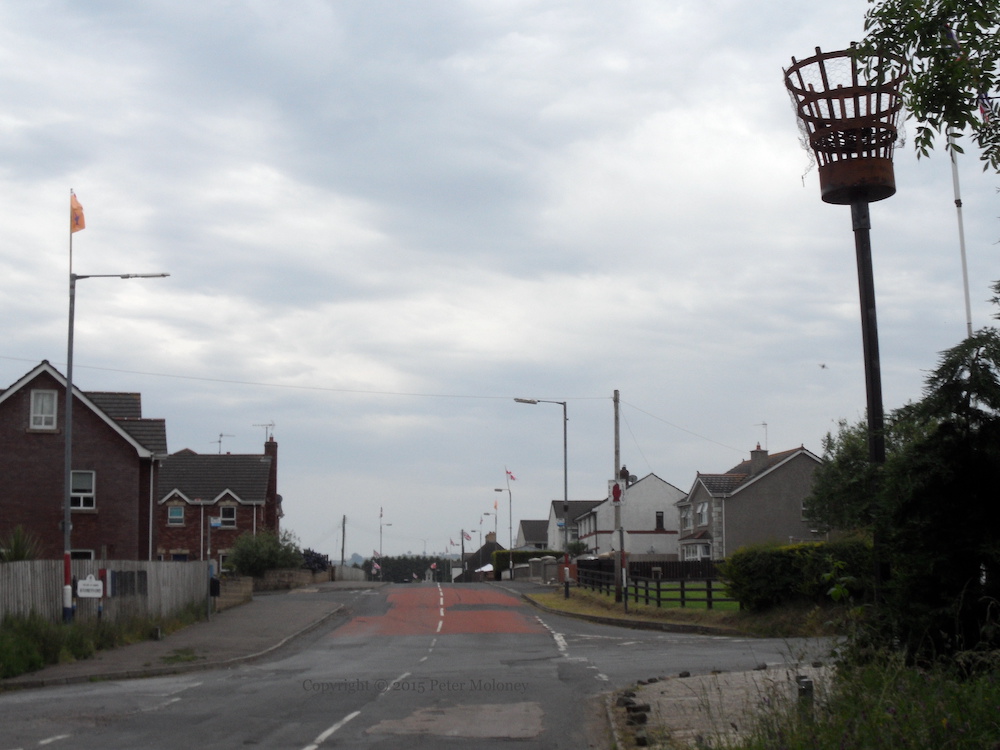
Here is a gallery of images from the village of Stoneyford, ten miles north of Lisburn. The view in the final image is from the cross-roads at north end of the village, with the brazier next to the WWI memorial visible on the right, and the nameplate on the fence on the left. The Orange Hall is in the middle of the village. The village was a centre for the small anti-Agreement organisation the “Orange Volunteers” (WP).
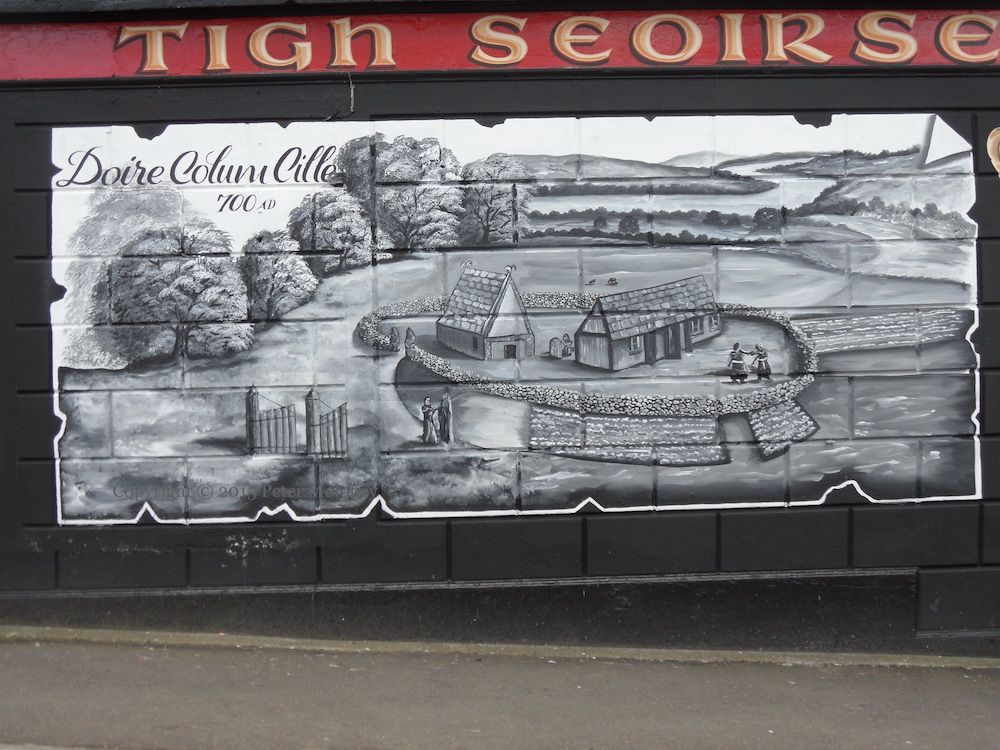
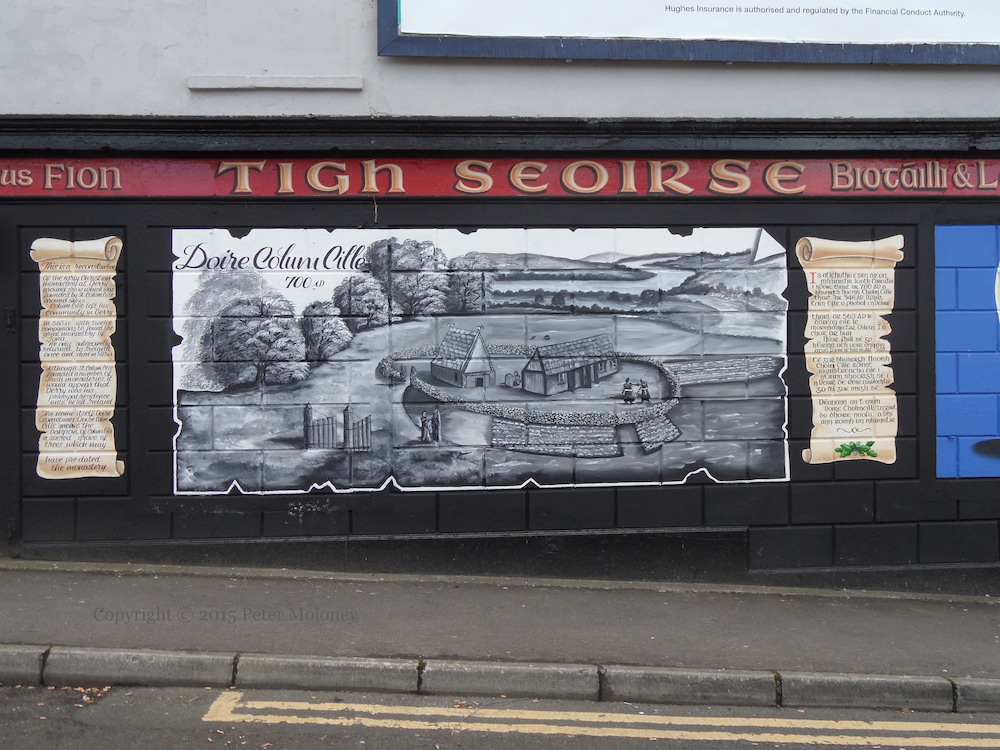
The Christian missionary Colm Cılle (in Latin, Columba), born in Donegal, founded a monastic settlement on the banks of the Foyle (then still part of Donegal) around 540 AD. The “Doıre” part of the name means “oak grove” and perhaps refers (as the information panel suggests) to “a sacred grove of trees, which may have pre-dated the monastery.” The mural above shows a reconstruction of the Derry monastery c. 700 AD. The name “Londonderry” dates to 1662.
Columba moved on to Scotland circa 563 and founded an abbey on the island of Iona. Among his reputed miracles is the banishment of a great water beast from the River Ness in 565.
“This is a reconstruction of the early Christian monastery at Derry around 700 AD which was founded by St Colum Cille around 546 AD. Colum Cille left his community in Derry in 563 AD with twelve companions to found the great monastery of Iona. He only subsequently returned to Ireland once and died in 593 AD. Although St Colum Cille founded a number of Irish monasteries, it would appear that Derry was his principal residence until he left Ireland. The name itself, Doıre, (sometimes Doıre Colum Cılle) means ‘the oakgrove of Colum Cille’ a sacred grove of trees, which may have pre-dated the monastery.”
“Is athchuthú é seo ar an mhainistir luath-Chríostaí i nDoıre thart ar 700 AD a bhunaigh Naomh Cholm Cıille thart ar 546 AD. D’fhág Colm Cille a phobal ı nDoıre thart ar 563 AD le dáréag eıle le mómhaınıstır oıleán Í a chur ar bun. Níor fhill sé go hÉıreann ach uaır amháın agus fuaır sé bás in AD 593. Cé gur bhunaigh Naomh Cholm Cille roınnt maınıstreacha eıle ı nÉırınn, shocrıgh sé ı nDoıre de réır cosúlachta go dtí gut ımıgh sé. Déanann an t-aınm ‘Doıre Cholmcılle’ tagaırt do dhoıre naofa, a bhí ann roımh an mhaınıstir.”
U Bennett Street, Derry, on the side wall of Tıgh Seoırse.
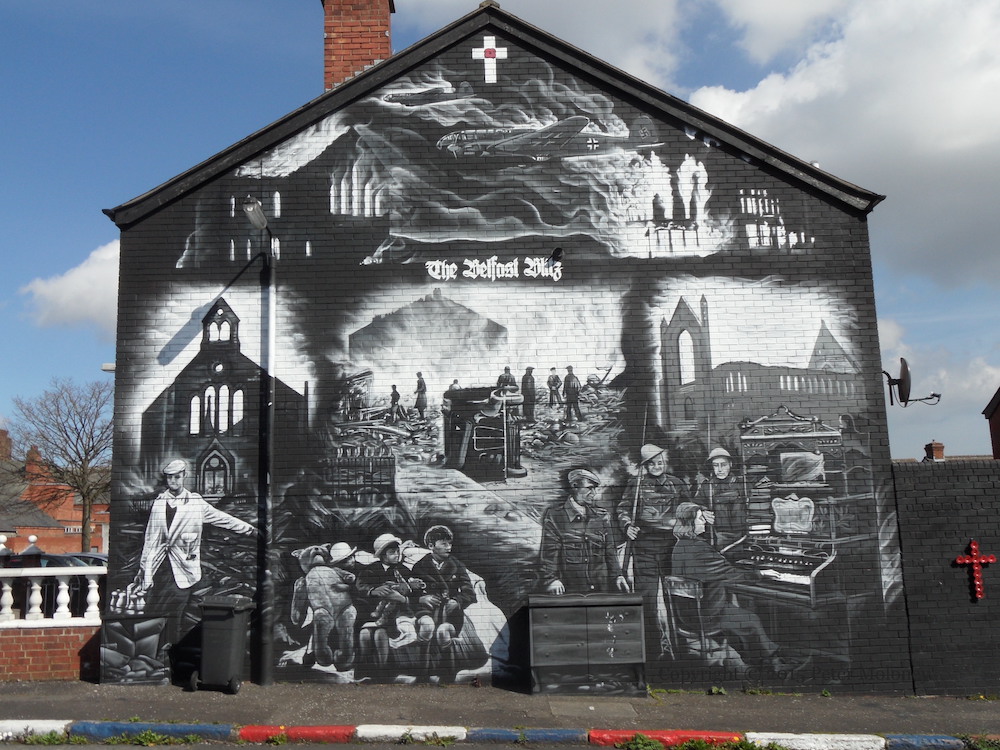
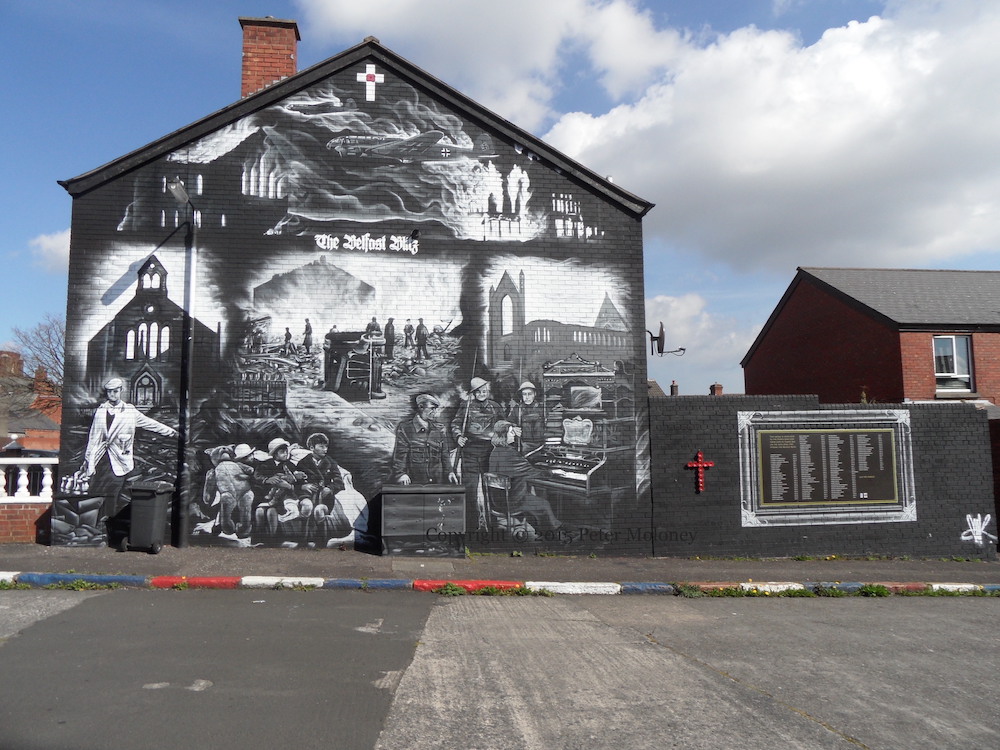
In the “Belfast Blitz” of April and May 1941, during WWII, 900 people died and half the homes in Belfast were destroyed or damaged (WP). In the apex of this mural, a Nazi bomber sets buildings alight; in the main panel, people, including a milkman, walk among the bombed-out buildings, while others (bottom right) test out a piano that has been moved.
On the side-wall to the right is a painted frame surrounding a manufactured plaque with the names of locals who died in the blitz.
By JMK (Jonny McKerr – Fb) in Hogarth Street, Tiger’s Bay, north Belfast. Both the lamp-post and the electrical box have been painted into the mural.
McKerr also did a piece in the area of images from WWI – see The Home Front.
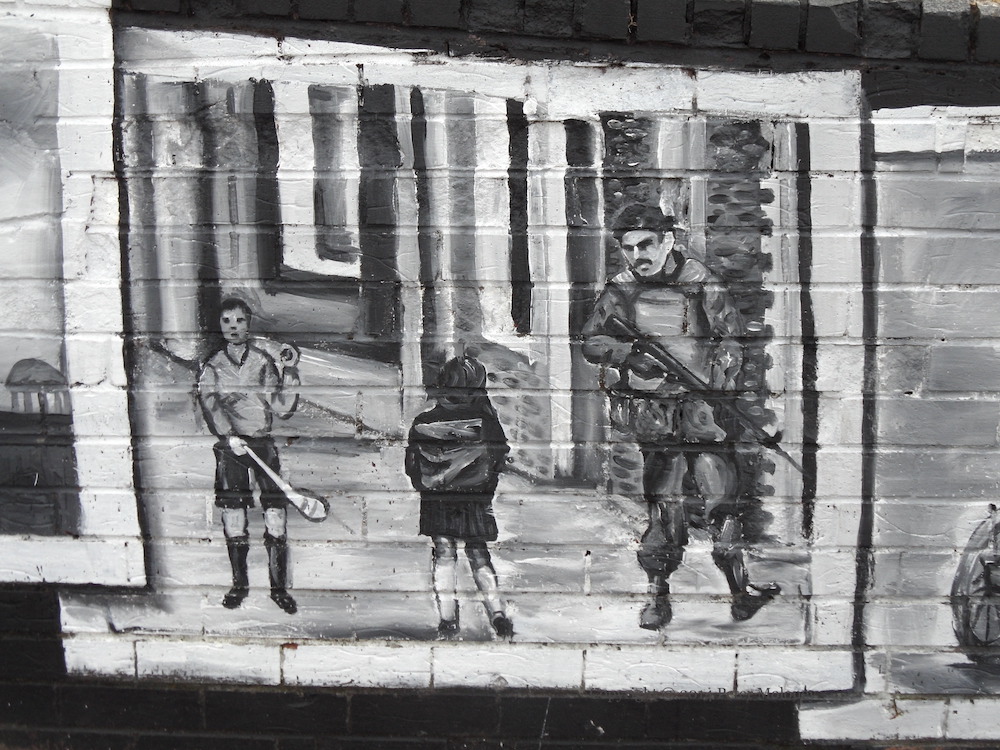
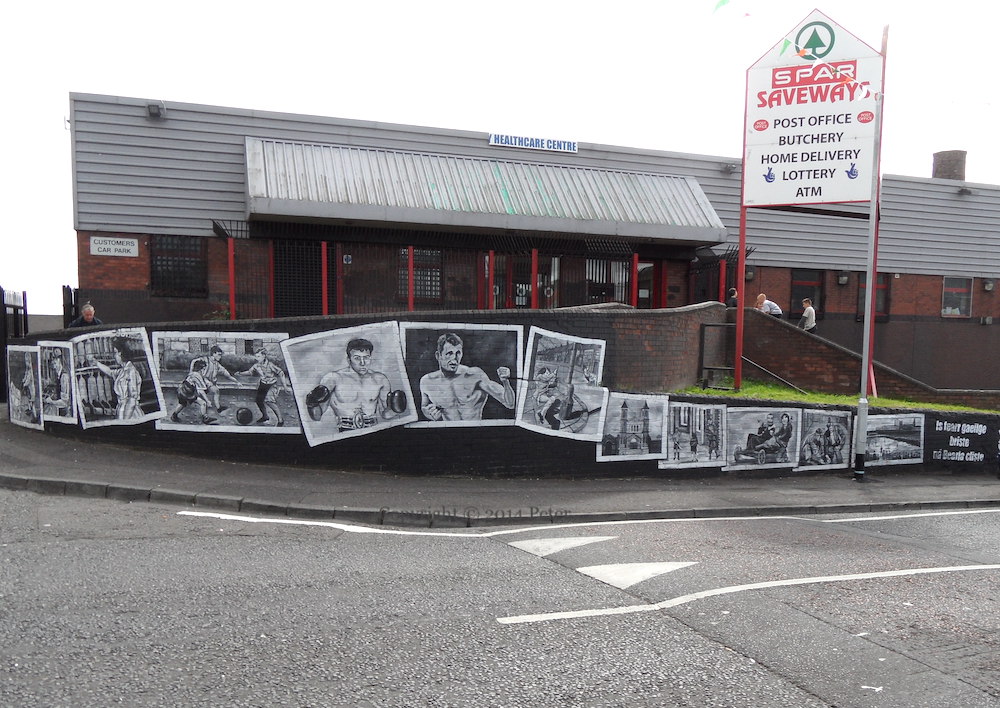
A British soldier patrols the streets while a girl walks home from school and a boy plays hurley. This is one of the panels in the long mural at the shops on Ardoyne Avenue.
The “Welcome” verbiage is just out of shot on the left-hand side; on the right is “Is fearr Gaeılge brıste ná Béarla clıste” [Broken Irish is better than clever English] and (out of shot) some Celtic knotwork. For close-ups of all of the panels, see Growing Up Too Fast.

















 Peter Moloney Collection