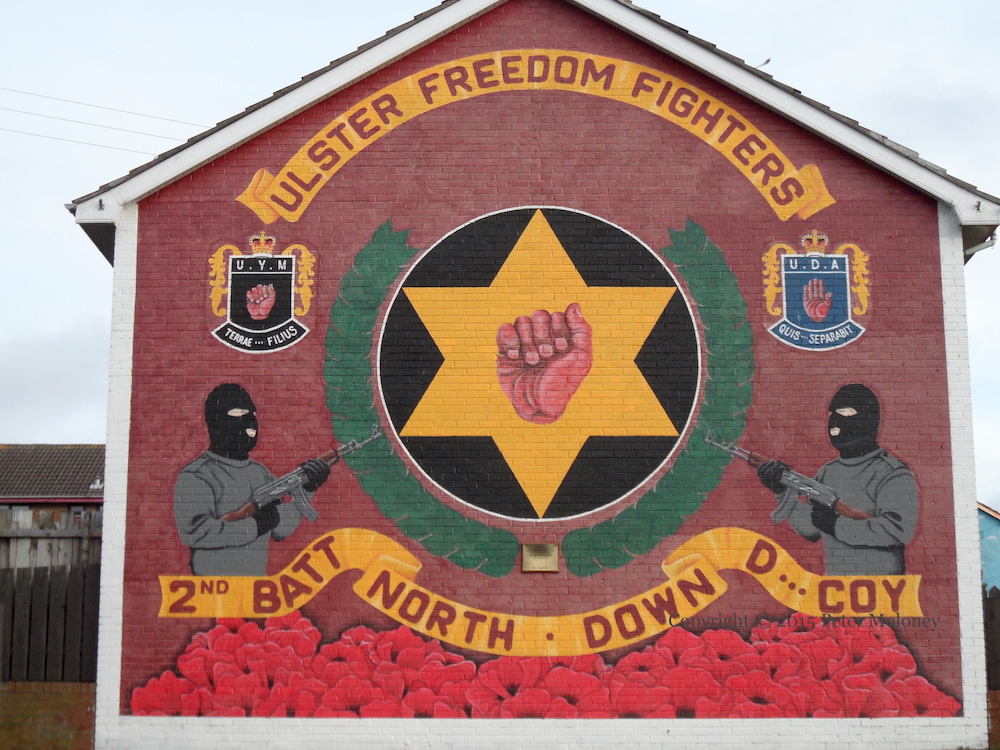
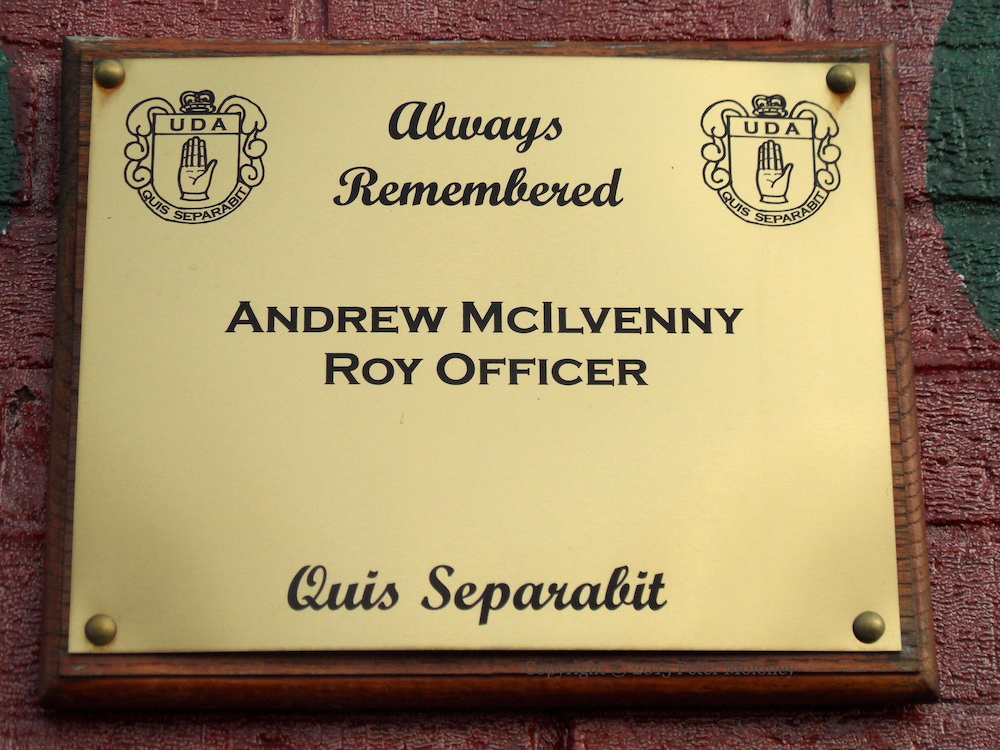
UFF/UDA/UYM (North Down, 2nd battalion, D company) memorial mural in Bloomfield estate, Bangor, to Andrew McIlvenny and Roy Officer, with hooded gunmen on a bed of poppies flanking the UFF clenched fist.
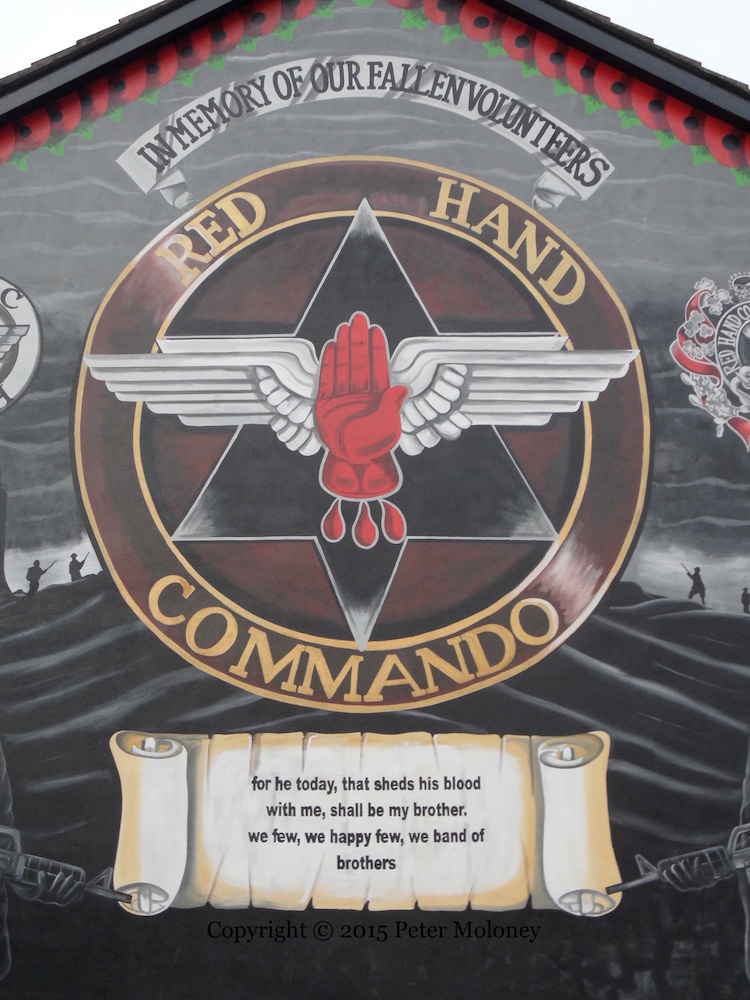
“For he today that sheds his blood with me shall be my brother. We few, we happy few, we band of brothers.” This is a new (July 2014) Red Hand Commando mural in Bangor with RHC Youth and Red Hand Comrades Association insignia against a backdrop of Thiepval Tower and the Somme, with masked gunmen in the foreground and a border of poppies.
The quote is from Shakespeare’s Henry V, act 4, though the lines are reversed (Folger).
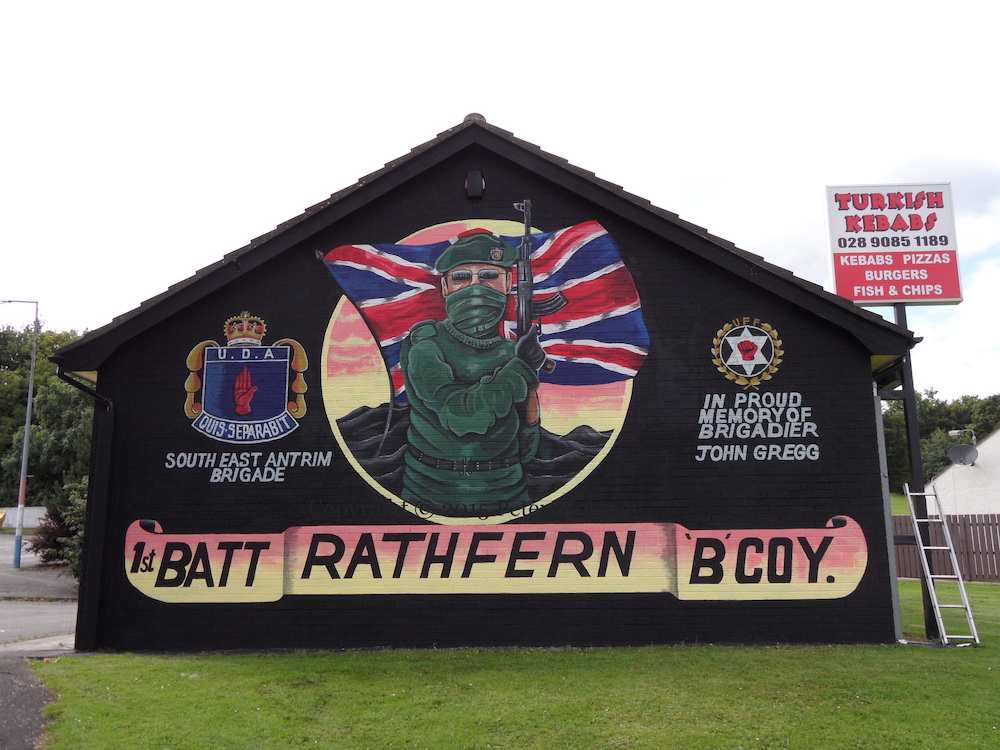
This is a new UDA mural in memory of John Gregg, “The Reaper”, who waged a campaign of terror against Catholics in south-east Antrim and was reputedly associated with British neo-Nazi groups. Gregg was gunned down in 2003, while returning from a Rangers match, as part of the power struggle with Johnny Adair.
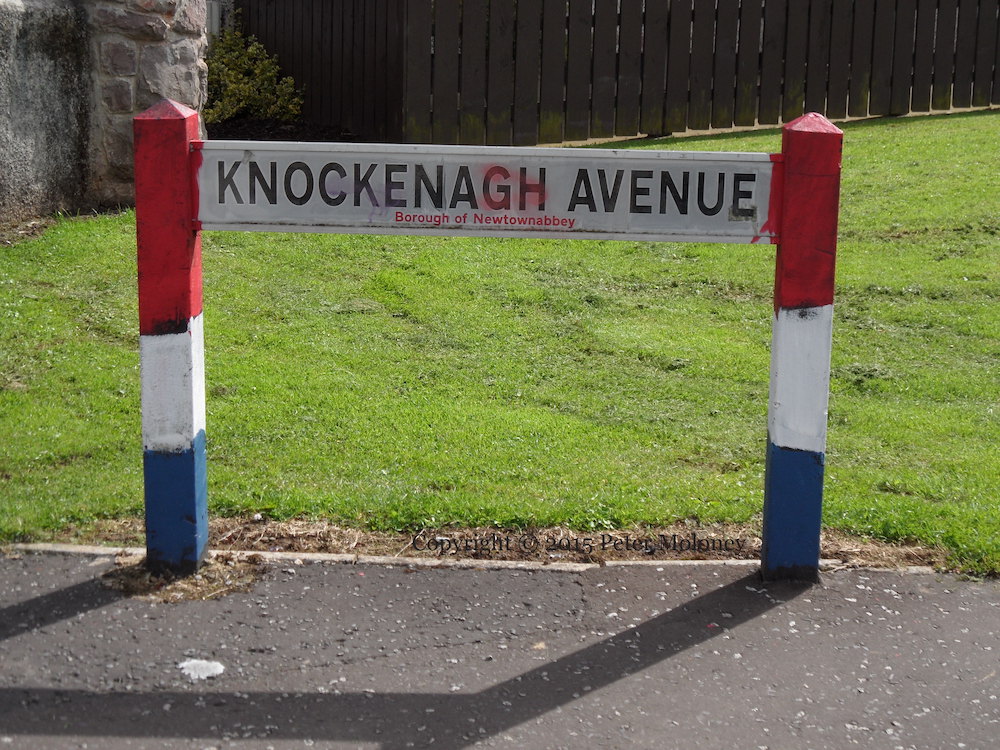
Nearby red-white-and-blue poles on Knockenagh Ave, Newtownabbey, are also shown.
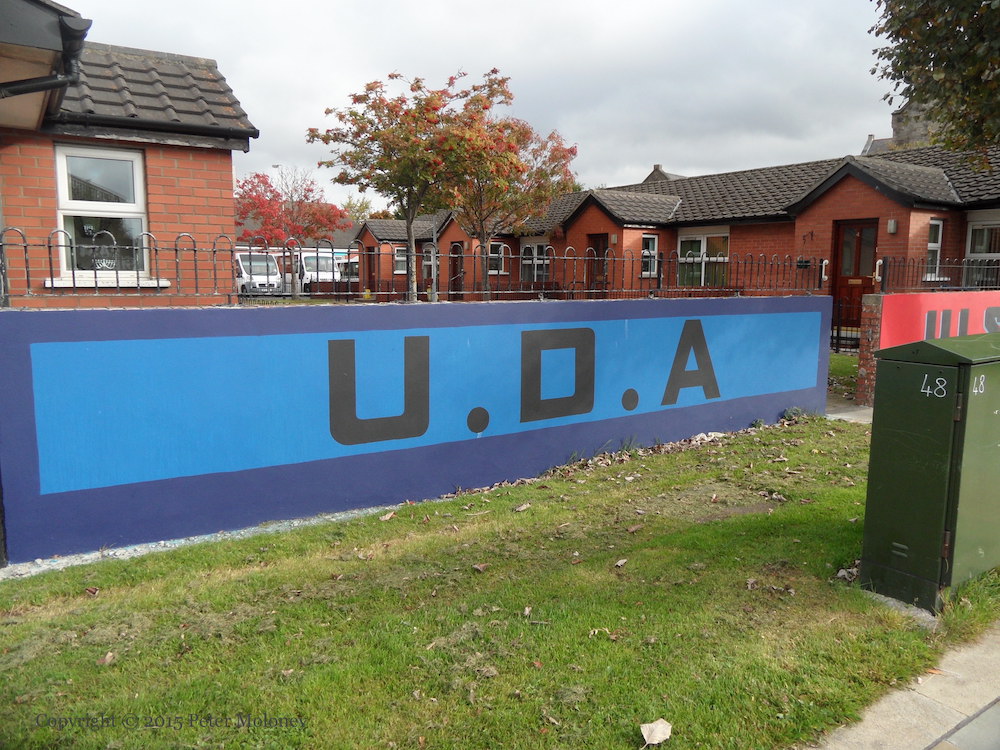
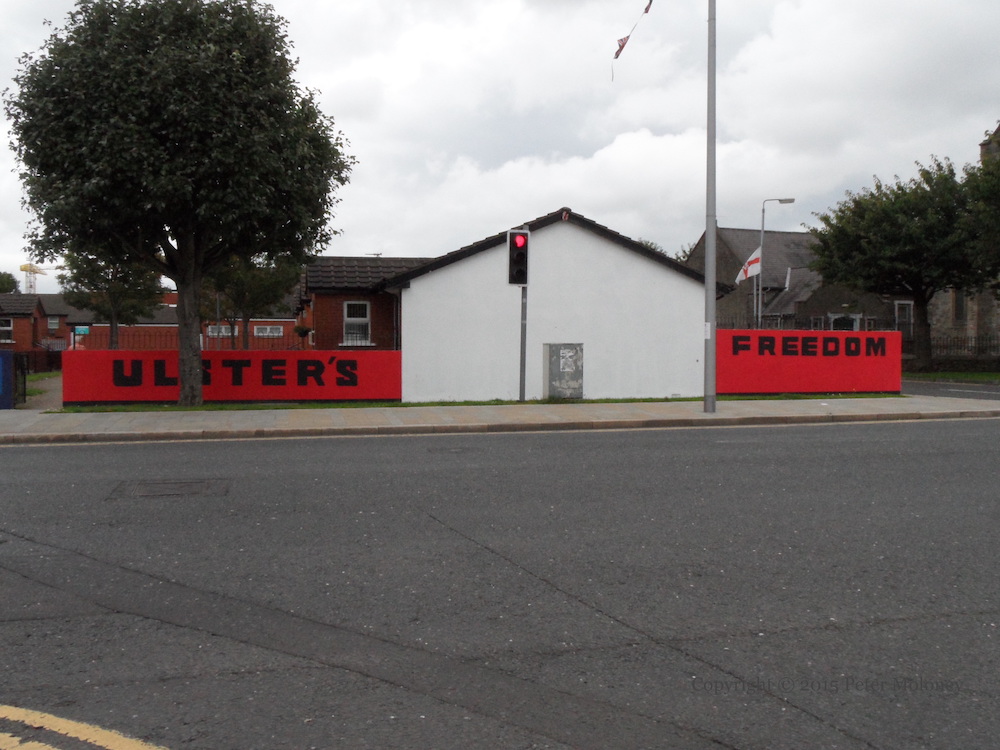
The murals along east Belfast’s “Freedom Corner” (on the Newtownards Road) were repainted over the course of several months in 2015. These images are from a variety of dates in July and August; the ‘red hand’ piece is incomplete – for the finished work, see The Strangest Victory In All History.
The new pieces reproduce the previous ones in terms of theme: UFF/Young Newton at the ends, with the Past (Specials and UDR) and Present Defenders (UDA) in the middle – compare with the 2009 entries Freedom Corner | Ulster’s Present Day Defenders | Young Newton.
This is a vintage cut-out in the Sunnylands estate (visible in 2008 Google Street View). The central board – a RHC emblem – had a plastic or paper layer between the star/wings and the circular back-board with red-white-and-blue colours and the words “Red Hand Commando” in a circle. The hooded gunmen on either side each appear to be a single, painted, carving.
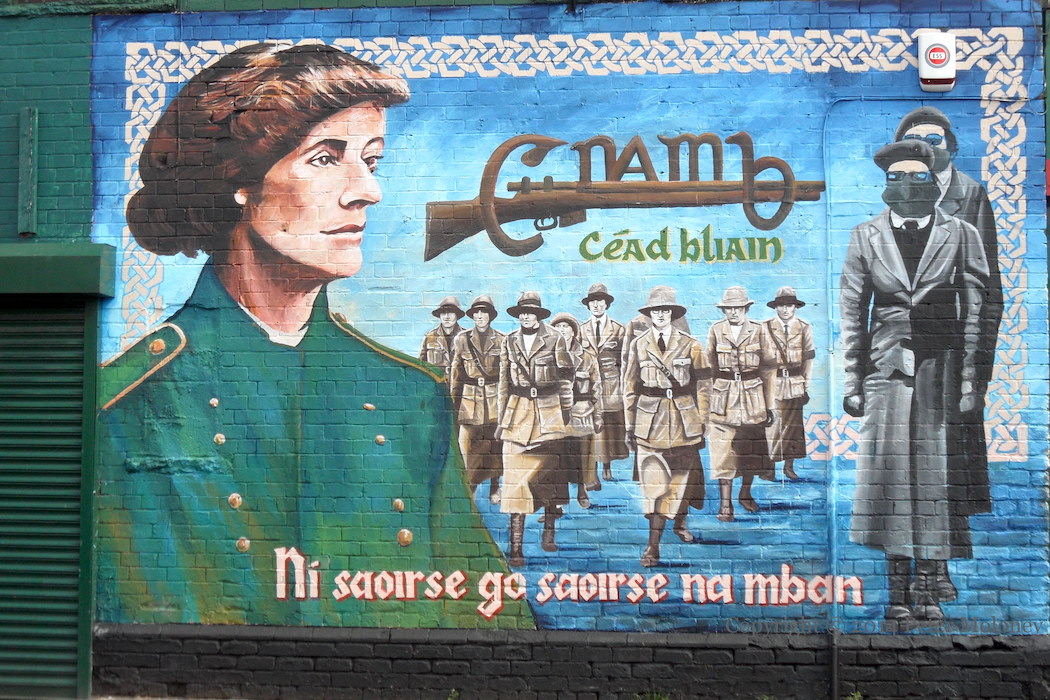
“Cumann Na mBan” in Irish is “the women’s organization/council/society” in English. The organization in question is the republican paramilitary group which was founded on April 2, 1914 and celebrated its 100th anniversary in 2014.
The mural is at the bottom of Teach Na bhFıann/Fianna House (formerly Dill House) in the New Lodge.
“To the memory of Gareth Keys – Mural artist of original artwork Walnut Street, Donegall Pass.” This is a printed version of the YCV mural that was on the side of the Ivy bar in Donegall Pass. The bar closed in 2010 and sat vacant until it was demolished in 2014. The new print has been added below the roll of honour on the side of the Lookout on the next street over (Pine St).
This is the freshly-repainted UFF mural in Ballyduff (former version in purple). As the close-up shows, the figures are quite crudely drawn, with strange lips, elongated fingers, and amorphous limbs.
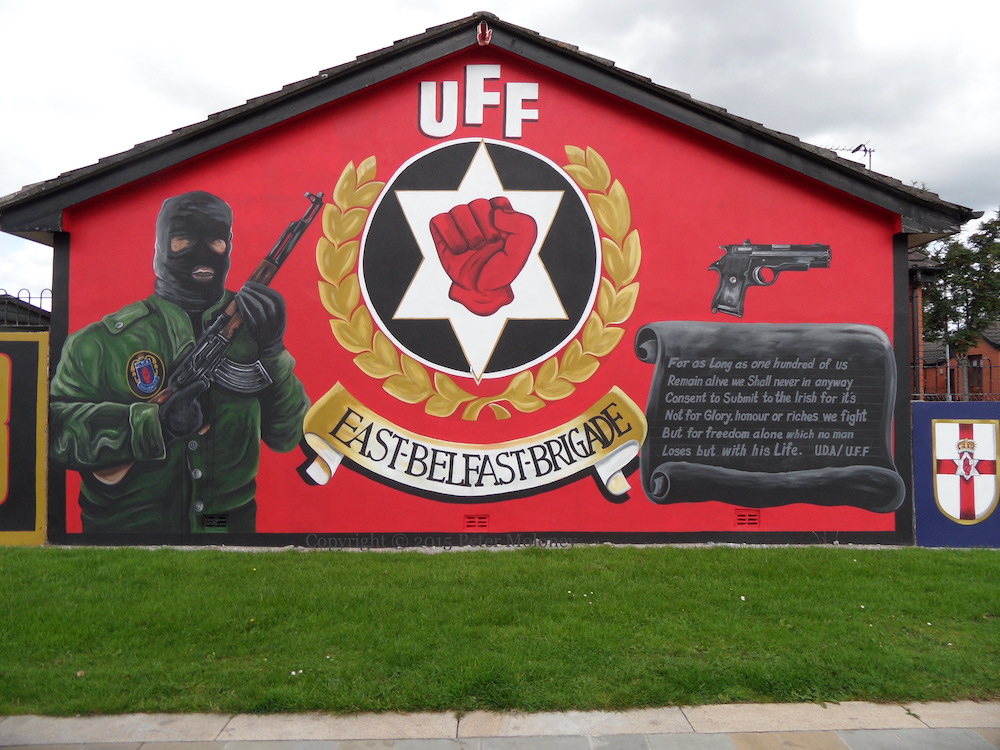
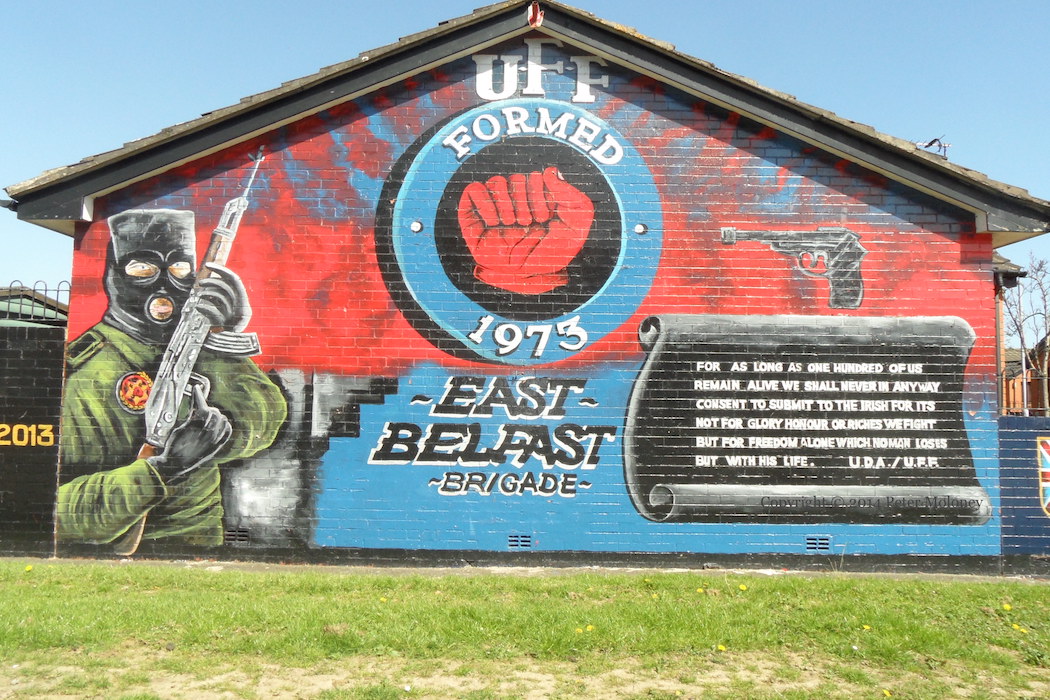
The UFF mural on the first gable of (so-called) Freedom Corner in east Belfast has been repainted many times since the first one took over – in 1991 – from a Gertrude Star mural (D00388). Repaints followed in roughly 2001, 2008, and 2011, now followed by the image shown above. The elements remain as before: a balaclava’d volunteer with assault rifle, the UFF emblem, a pistol, and a modified version of the Declaration of Arbroath: “For as long as one hundred of us remain alive we shall never in anyway consent to submit to the Irish [instead of “English”] for it’s not for glory, honour or riches we fight but for freedom alone which no man loses but with his life – U.D.A./U.F.F”
Cumann Na mBan was founded on April 2nd, 1914, and it is being commemorated in various ways, including a mural on Ascaıll Ard na bhFeá/Beechmount Avenue.
Cumann Na mBan was the women’s division of the Irish Volunteers and is best remembered for its role in the Easter Rising of 1916. Its members were involved in the occupation of many locations. Some, including (non-combatant) Winifred Carney, were in the GPO, while Countess Markievicz, the main figure of the mural, was in St. Stephen’s Green. (Here is an RTÉ gallery of vintage photographs, including one of Markievicz surrendering.)
The letters “Cnamb” on a rifle formed the badge of Cumann Na mBan. The Irish “Ní saoırse go saoırse na mban” means “[There is] No freedom until the freedom of women”.









 Peter Moloney Collection