Young Citizen Volunteers

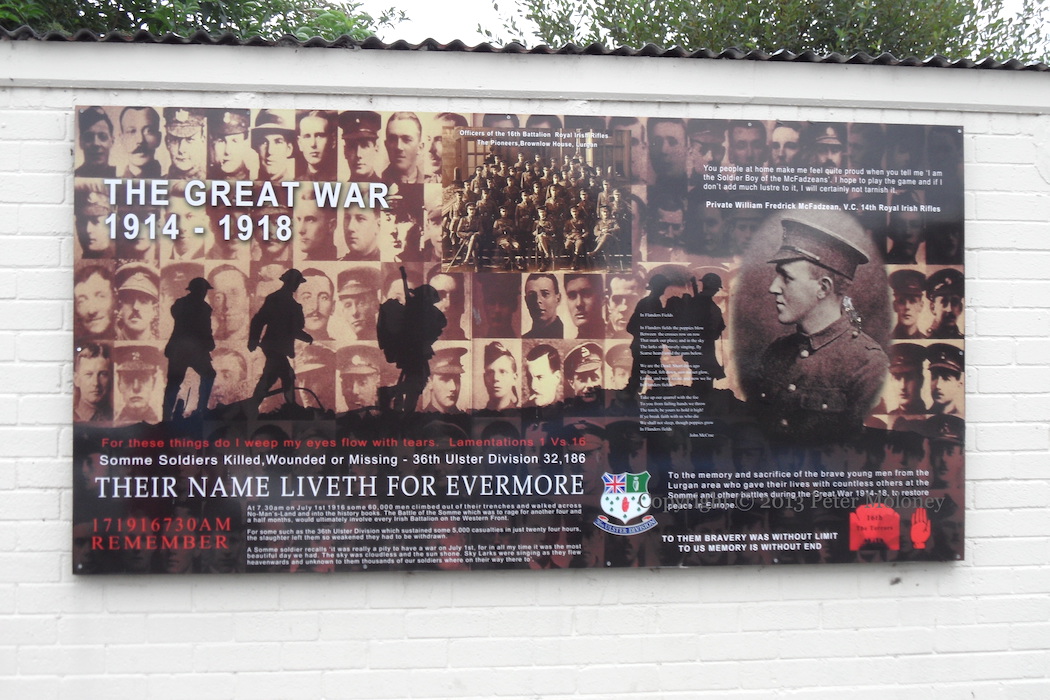
These Kilburn Street boards commemorate the “Young Citizen Volunteers Of Ireland” and the battle of the Somme. The text in the side-wall board (shown below) is from the diary of a Somme soldier: “We surge forward. Bayonets sparkle and glint. Cries and curses rent the air. Chums fall, some without a word … and others … Oh, my God! May I never hear such cries again! There goes the YCV flag tied to the muzzle of a rifle. That man had nerve! Through the road just ahead of us we had crossed the sunken road. We could see khaki figures rushing the German front line. The Inniskillings had got at them.”

The larger board, on the right, describes the transition from rebels in 1912 to British Army soldiers in 1914: “On the 17th May 1914 the Young Citizen Volunteers became a battalion of the Belfast regiment of the Ulster Volunteer Force. This formed part of the Ulster Division authorised on 28th October 1914 which officially became the 14th battalion of the Royal Irish Rifles, part of the 109th brigade. The 14th saw action throughout the First World War.”

It includes a quote from Edward Carson, “You will find in your ranks men with the same ideals, men with the same loyalty and the same determination to uphold the rights of their country”, and a quote from VC winner William Fredrick McFadzean, “You people at home make me feel quite proud when you tell me I am the soldier boy of the McFadzeans. I hope to play the game and if I don’t add much lustre to it I certainly will not tarnish it.”

Click image to enlarge
Copyright © 2014 Peter Moloney
M10804 M10803 M10802
[M10805] [M10806] [M10807] [M10808] [M10809] [M10810] [M10811] [M10812]

East Belfast Volunteers

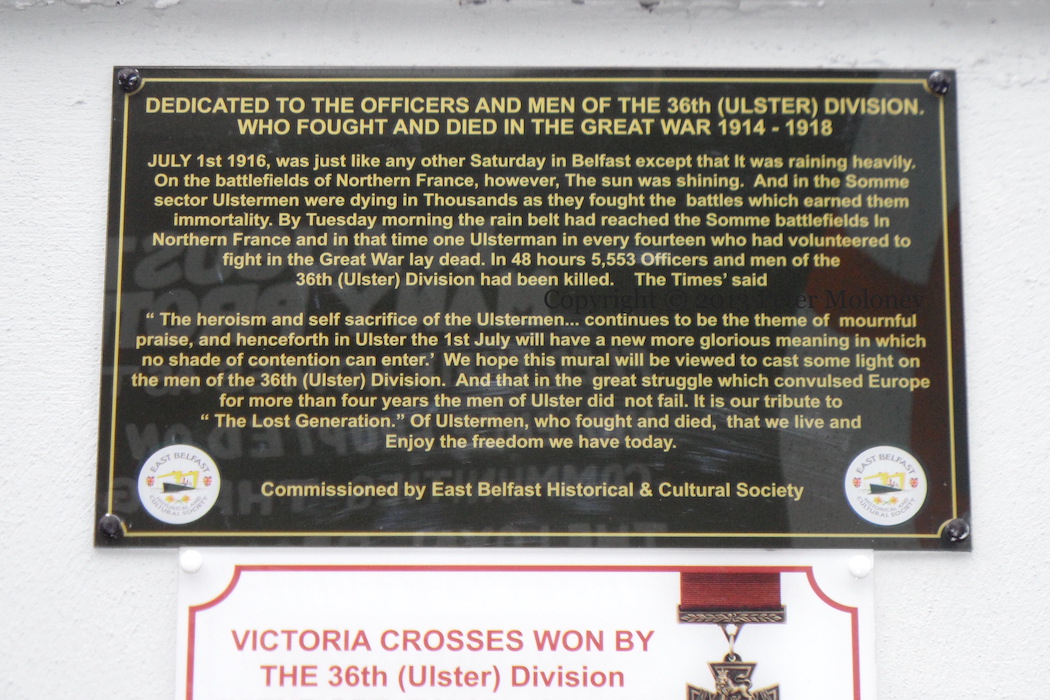
This is a repainted version of the mural of ‘insignia’ of units of the eighth battalion of the Royal Irish Rifles. This new mural includes a background of silhouetted soldiers and additional poppies on the right of the main gable and along the bottom of the side wall; the units included remain the same as before.

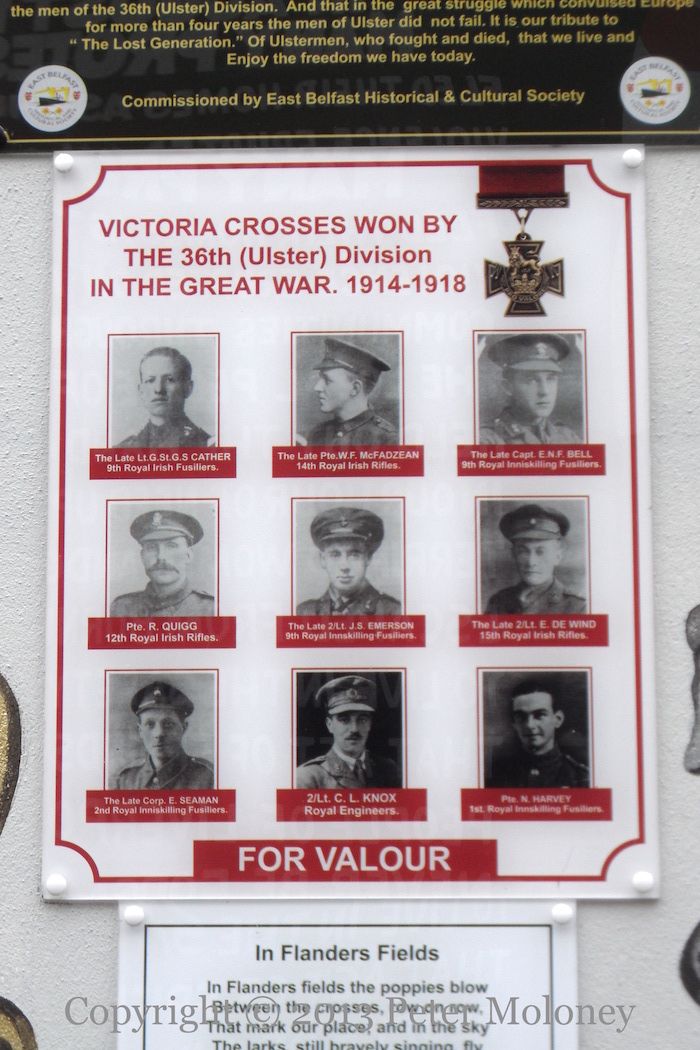
The plaques on the side wall have changed slightly: the information plaque remains from before but the plaque of VC winners now includes photographs, and the words of Moina Michael’s ‘We Shall Keep The Faith’ are now included in addition to McCrae’s ‘In Flanders Fields’.

Canada Street, east Belfast

Click image to enlarge
Copyright © 2013 Peter Moloney
M10633 [M10634] [M10626] M10627 M10628 [M10629] M10630

Dulce Et Decorum Est Pro Patria Mori

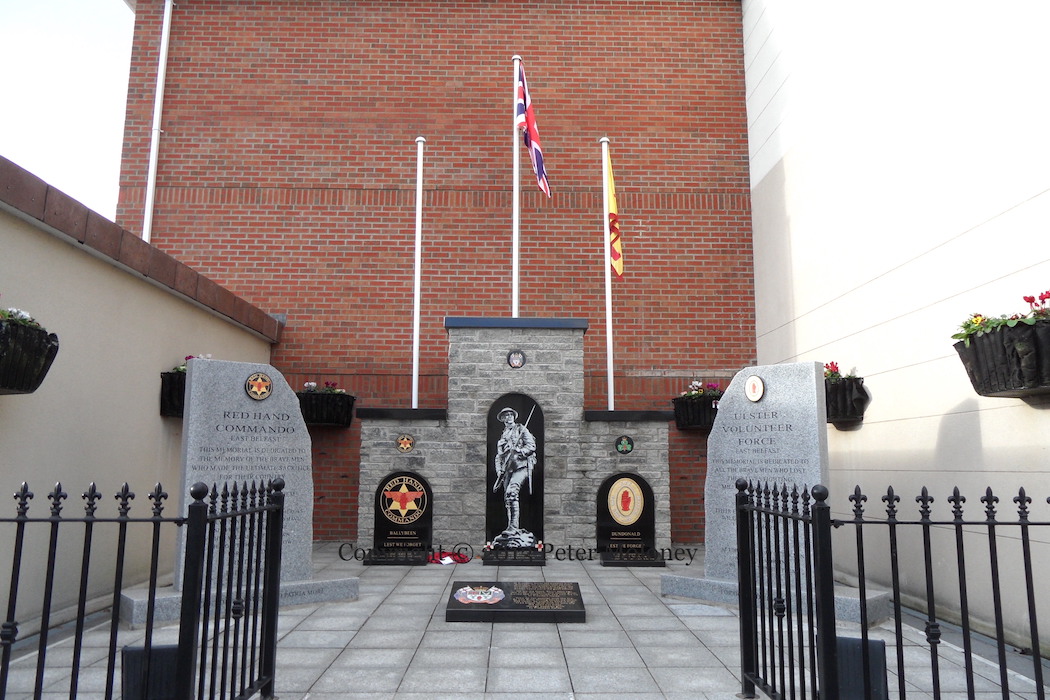
The Ballybeen memorial garden contains stones/plaques to 36th (Ulster) Division (WWI), Ballybeen Red Hand Commando, Dundonald UVF, East Belfast UVF, East Belfast Red Hand Commando.

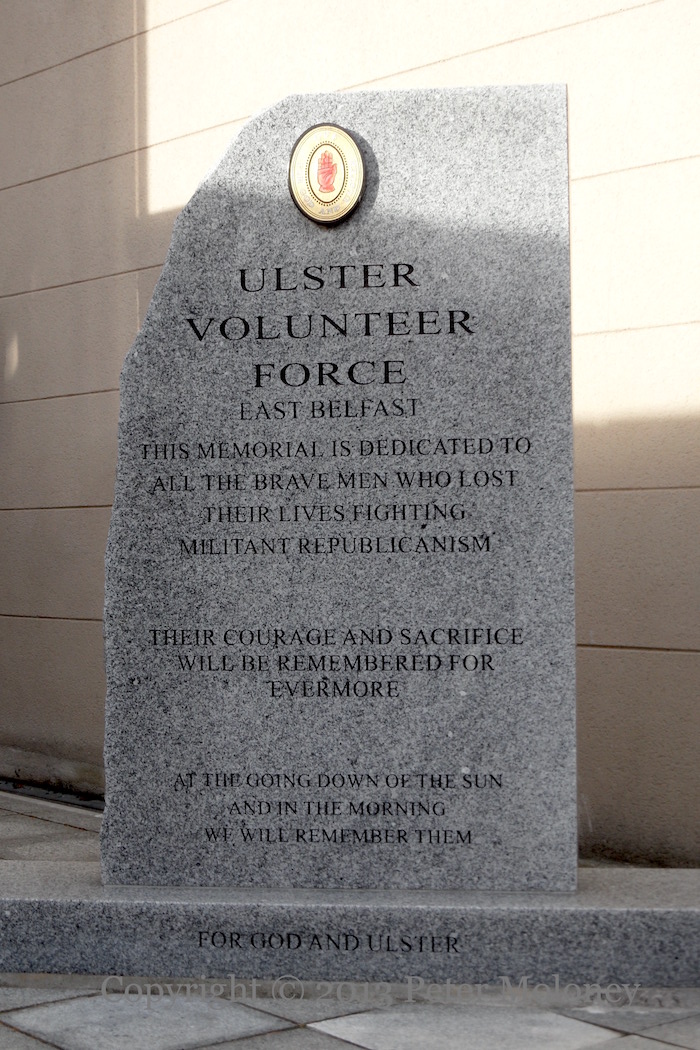
UVF: “This memorial is dedicated to all the brave men who lost their lives fighting militant republicanism. Their courage and sacrifice will be remembered for evermore. ‘At the going down of the sun/And in the morning/We will remember them’ For God and Ulster.”

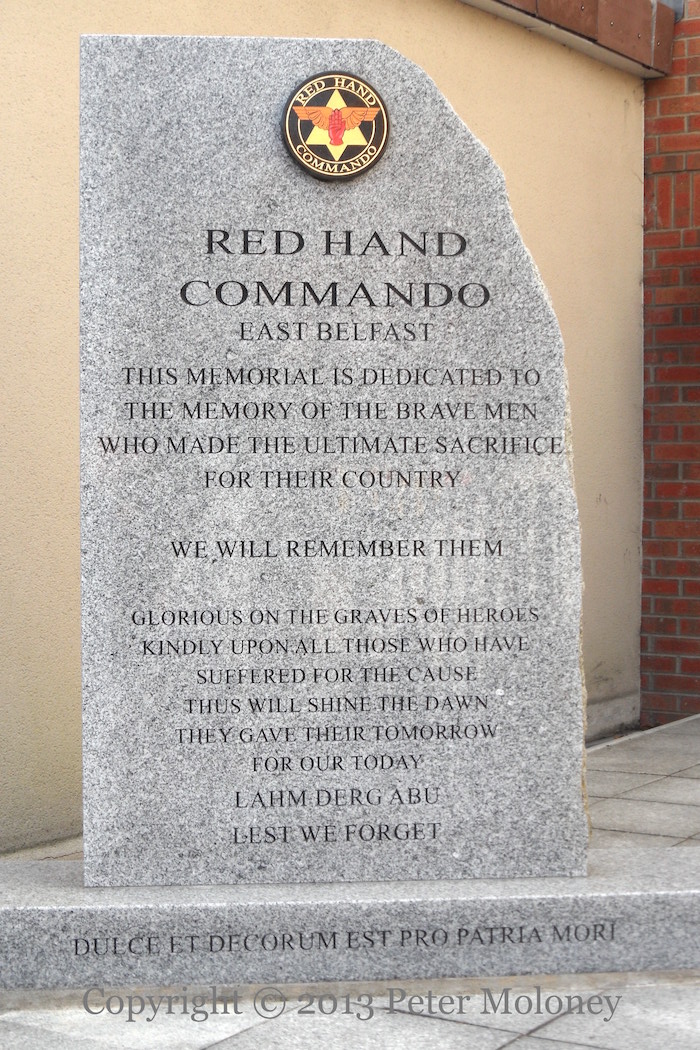
RHC: “This memorial is dedicated to the memory of the brave men who made the ultimate sacrifice for their country. We will remember them. ‘Glorious on the graves of heroes/Kindly upon all those who have suffered for the cause/Thus will shine the dawn.’ [Winston Churchill, radio broadcast on October 21, 1940, entitled Dieu Protège La France.] ‘They gave their tomorrow for our today.’ [John Maxwell Edmonds’s memorial epitaph] Lahm [sic] derg [sic] abu [sic]. Lest we forget. Dulce et decorum est pro patria mori.” (Wilfred Owen)

Davarr Avenue, Ballybeen.

Click image to enlarge
Copyright © 2013 Peter Moloney
M10558 [M10559] [M10560] [M10561] [M10562] [M10563] [M10564] [M10565] [M10566] M10567 [M10568] M10569 [M10570] [M10571]

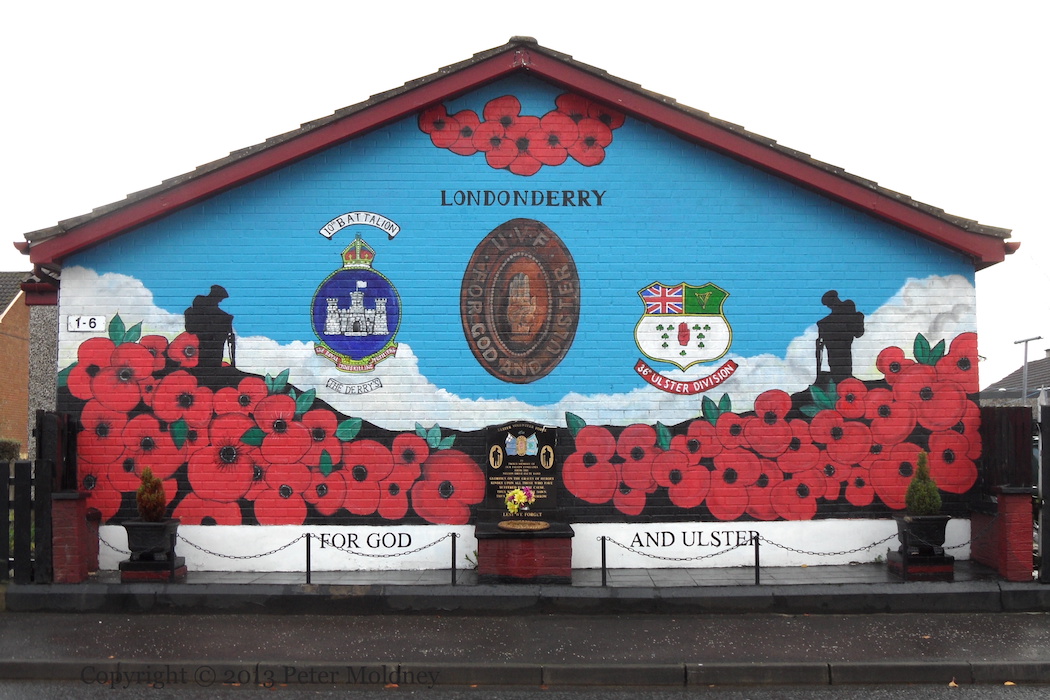
The Derrys

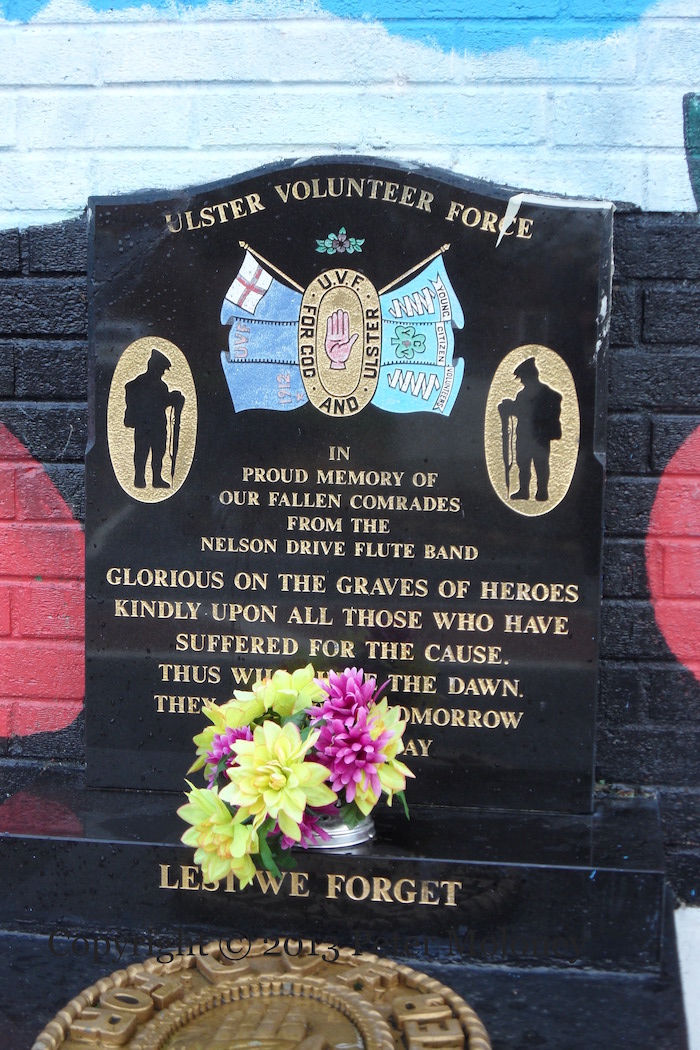
“In proud memory of our fallen comrades from the Nelson Drive flute band. Glorious on the graves of heroes, kindly upon all those who have suffered for the cause. Thus will shine the dawn. They gave their tomorrow for our today.” The words in italics are from a Winston Churchill radio broadcast on October 21, 1940, entitled Dieu Protège La France. The final, more familiar, phrase is John Maxwell Edmonds’s memorial epitaph. The 10th battalion of the Inniskilling Fusiliers, in the 109th brigade of the 36th (Ulster) Division, was called “The Derrys” (web).

Click image to enlarge
Copyright © 2013 Peter Moloney
M10534 [M10535] [M10536] [M10537] M10538 [M10539] [M10540]

For Me There Will Be No More War

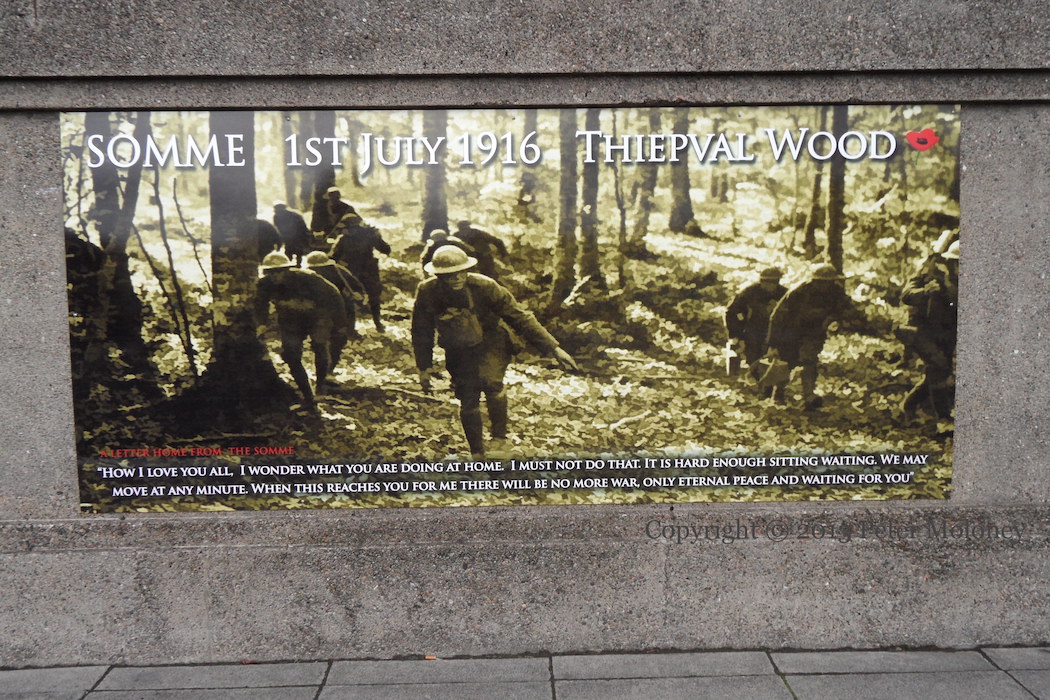
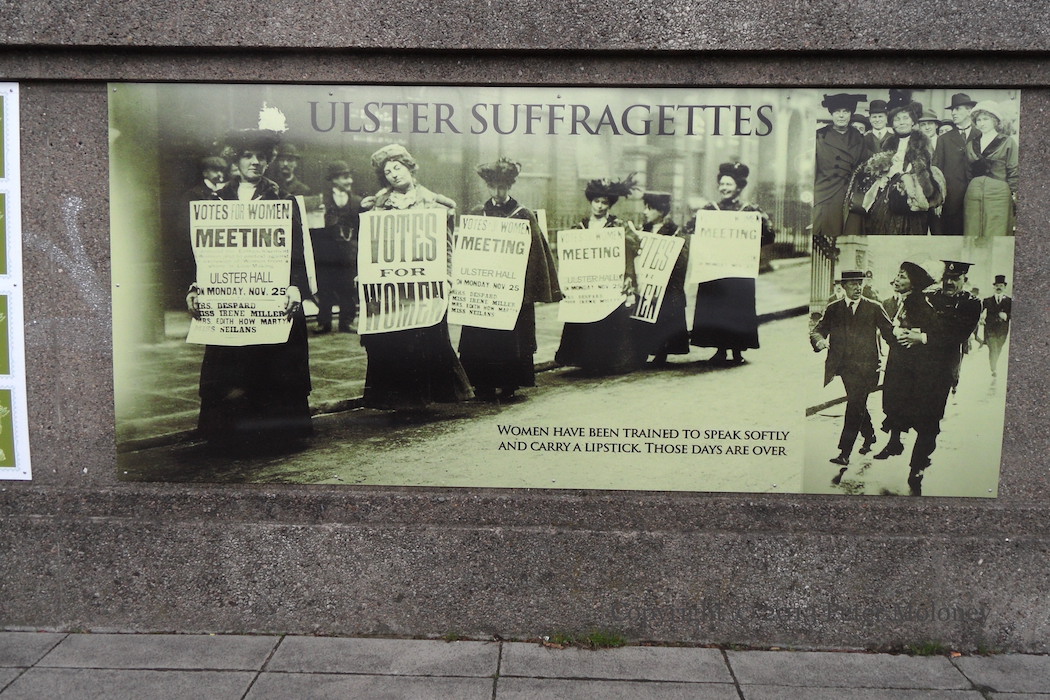
Here are three of twenty new panels on the Donegall Road bridge over the railway.

The post on the mural to James Magennis in Tullycarnet provides background information on him.

A letter home from the Somme: “How I love you all. I wonder what you are doing at home. I must not do that. It is hard enough sitting waiting. We may move at any minute. When this reaches you for me there will be no more war, only eternal peace and waiting for you.” July 1st, 1916 saw the start of the Battle Of The Somme. The 36th (Ulster) division lost over 5,000 men in an initial successful attack near Thiepval Wood, but were driven back that evening.

Ulster suffragettes: “Women have been trained to speak softly and carry a lipstick. Those days are over.” (Bella Abzug). The board shows a picture of women drumming up an audience for a suffragette meeting in the Ulster Hall in November 1912. The image in the bottom right is of Emmeline Pankhurst being arrested in London in 1914; the top image is of Pankhurst on tour in the US in 1913 (LoC; see Pieces Of History for a description of the tour; she gave a speech entitled ‘Freedom Or Death’). Pankhurst spoke in Belfast at the 1912 meeting, though the speakers advertised on the placards are “Mrs Charlotte Despard, Miss Irene Miller, Mrs Edith How-Martyn, Miss Alison Neilans“. The first suffrage group in Ireland was the North Of Ireland Women’s Suffrage Society, founded in Belfast in 1872 by Isabella Tod. See also Belfast’s Infamous Prison for information about suffragettes held in Crumlin Road Gaol.

For a complete set of panels, see north side and south side.

Click image to enlarge
Copyright © 2013 Peter Moloney
M10517 M10516 M10515

The Relief Of Ulster

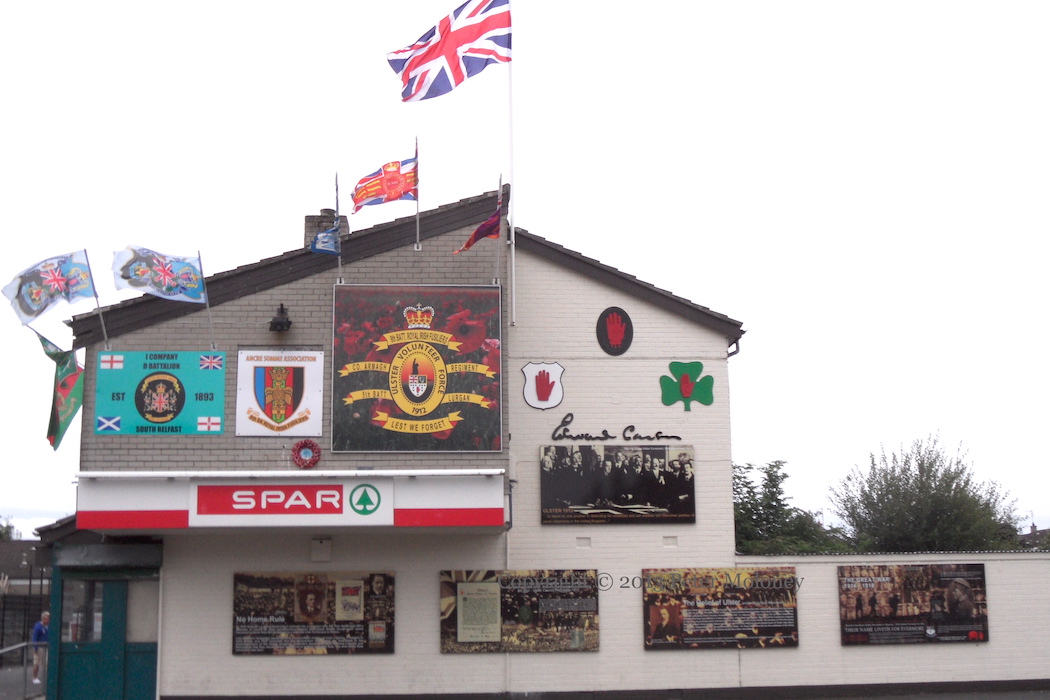
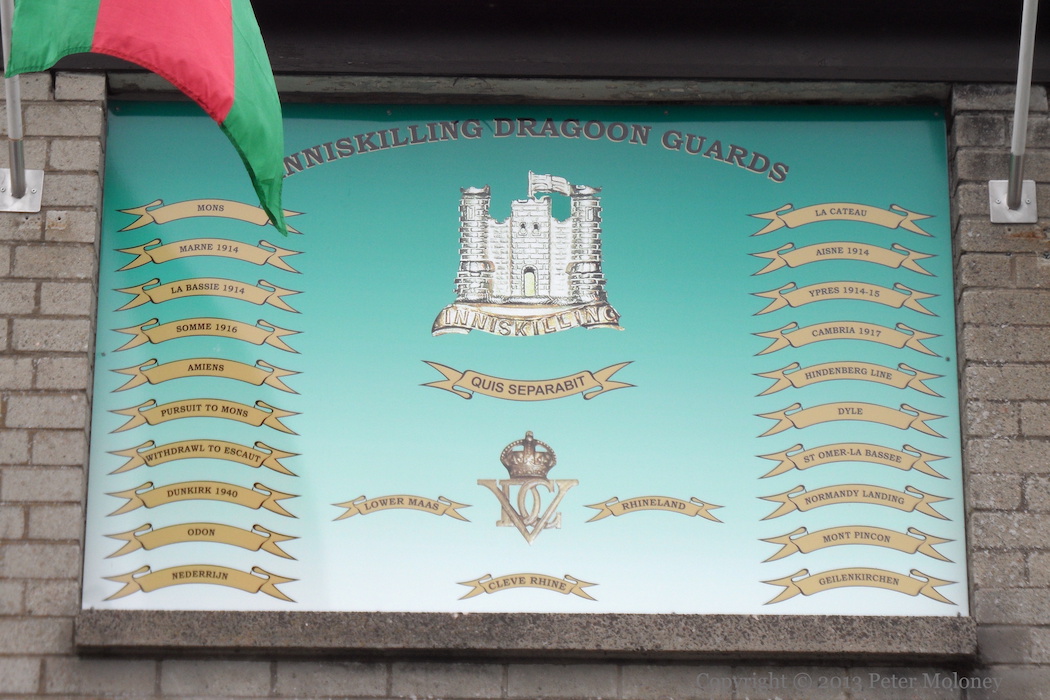
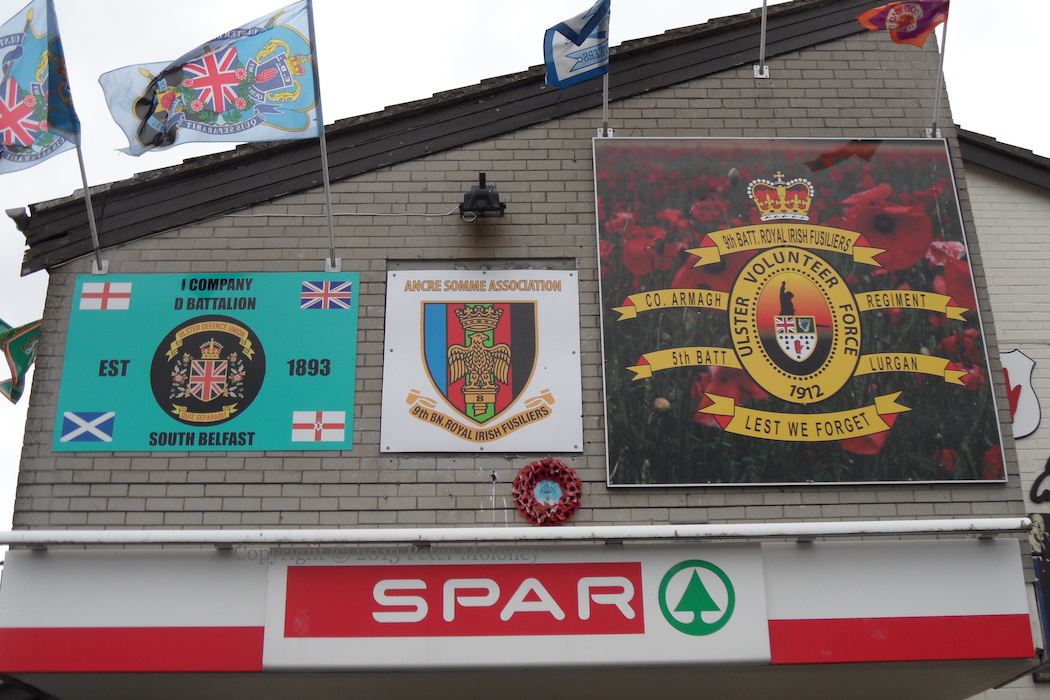
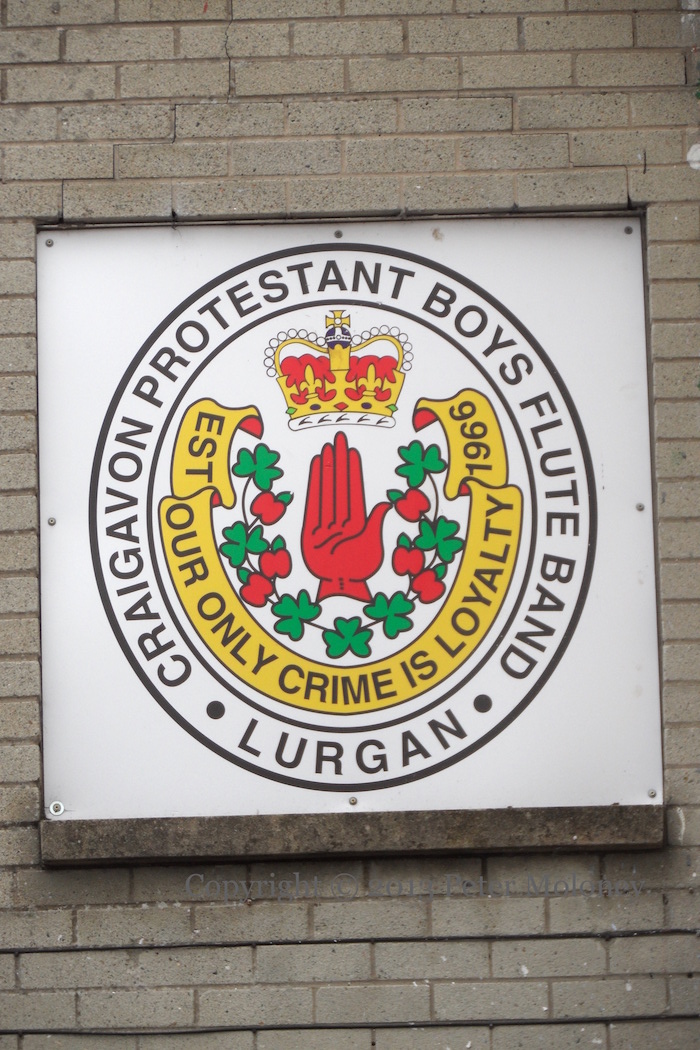
This is the scene at the junction of Pollock Drive and Mourne Road in Mourneview, Lurgan. The images, in order, show the top level of boards (including some on the sides of the building) and then the four along the bottom.

Top: (on side) Inniskilling Dragoon Guards | South Belfast UDA, B battalion, 1 company | Ancre Somme Association | 9th battalion Royal Irish Fusiliers | Craigavon Protestant Boys flute band (Fb) | Carson signing the Covenant in 1912 | (on side, above Mourneview Youth) Upper Bann Fusiliers flute band (Fb) | Upper Bann Fusiliers

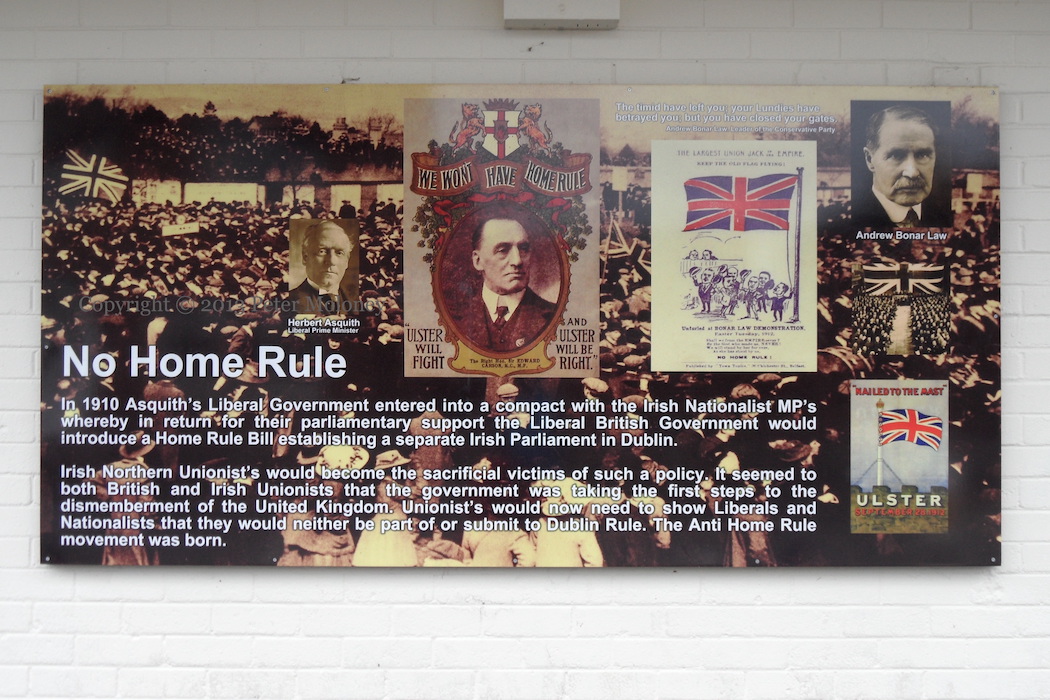
Bottom: No Home Rule including the unfurling of “The Largest Union Jack In The Empire” | The Covenant | The Relief Of Ulster including the Ulster Volunteers and the Larne gun-running | The Great War including the VC won by William MacFadzean – “To them, bravery was without limit; to us, memory is without end”.

Click image to enlarge
Copyright © 2013 Peter Moloney
M10321
M10322
M10316 [M10317] [M10318] [M10319] [M10320]
M10306
M10311 [M10314] [M10315] [M10313] [M10312]
M10305 M10304c
M10310 M10309 M10308 M10307

lamentations the pioneers brownlow house somme bonar law crawford our only crime is loyalty


For King And Country

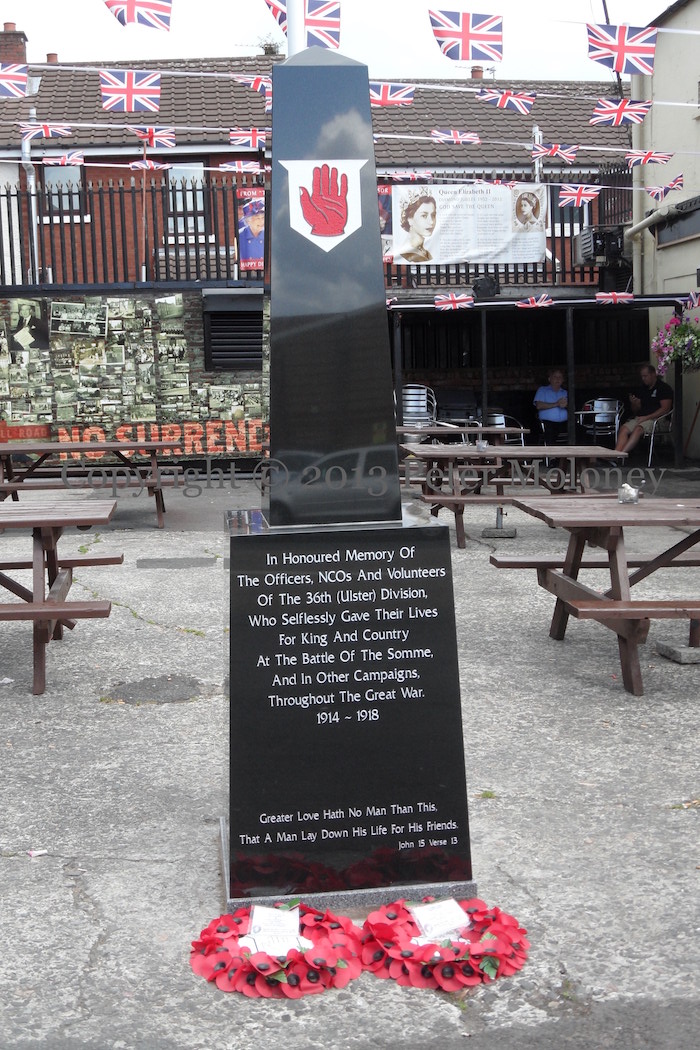
“In honoured memory of the offices, NCOs and volunteers of the 36th (Ulster) Division, who selflessly gave their lives for King and country at the battle of the Somme, and other campaigns, throughout the Great War 1914-1918. ‘Greater love hath no man than this, that a man lay down his life for his friends. John 15 Verse 13′”

The ‘No surrender’ photograph montage shows images of life on the Shankill, from the Home-Rule period onward. It includes various old murals (see Visual History 01) and a photo of Hugh Smyth (see Third-Class Citizens).

Moscow Street/Rex Bar, west Belfast

Click image to enlarge
Copyright © 2013 Peter Moloney
M10134 [M10135] M10136 M10137

Memorial To The Missing

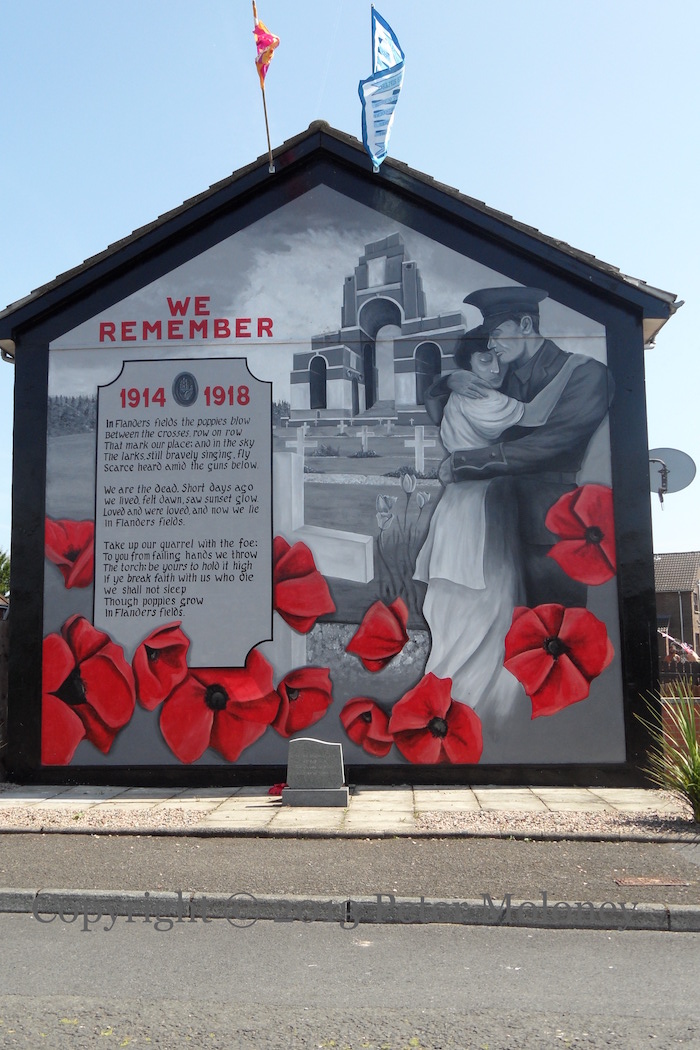
Canadian physician John McCrae’s poem In Flanders Fields and the triple arches of the Thiepval memorial to the missing are featured in this Monkstown mural. It is McCrae’s poem that is thought to have given rise to the use of the poppy as a symbol of military remembrance (WP). The names of over 72,000 dead are inscribed on the memorial (WPtravelfranceonline).

“In Flanders fields the poppies blow/Between the crosses, row on row/That mark our place; and in the sky/The larks, still bravely singing, fly/Scarce heard amid the guns below.//We are the Dead. Short days ago/We lived, felt dawn, saw sunset glow,/Loved and were loved, and now we lie/In Flanders fields//Take up our quarrel with the foe:/To you from failing hands we throw/The torch; be yours to hold it high./If ye break faith with us who die/We shall not sleep/Though poppies grow/In Flanders fields.”

Click image to enlarge
Copyright © 2013 Peter Moloney
M09936 [M09937] [M09938] [M09939] [M09940]

Rifleman Robert King

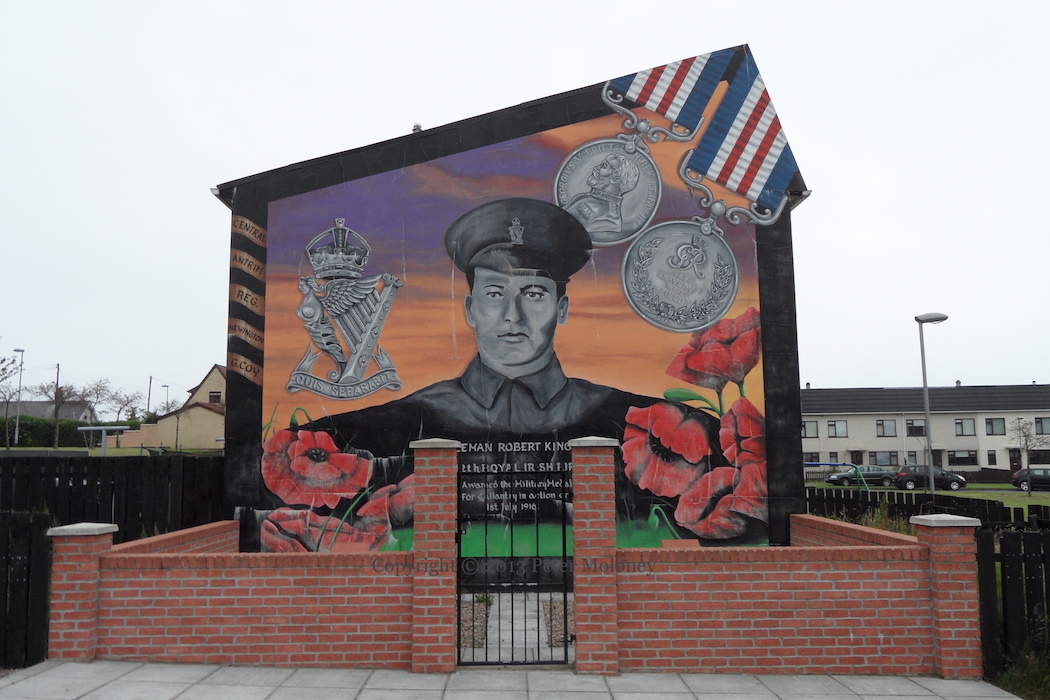
Robert King, of the 12th Royal Irish Rifles, who joined the army from the Ulster Volunteers, was “awarded the Military Medal for gallantry in action on 1st July 1916” at the Somme. The two sides of the medal are shown in the top right, with George V on one side and “for bravery in the field”. The 12th Rifles were drawn from the Central Antrim regiment of the Ulster Volunteers including the Newington area of Larne; King, however, was from Ship Street.

Wellington Green, Larne

Click image to enlarge
Copyright © 2013 Peter Moloney
M09697 [M09894] [M09895] [M09896] [M09897] [M09898]