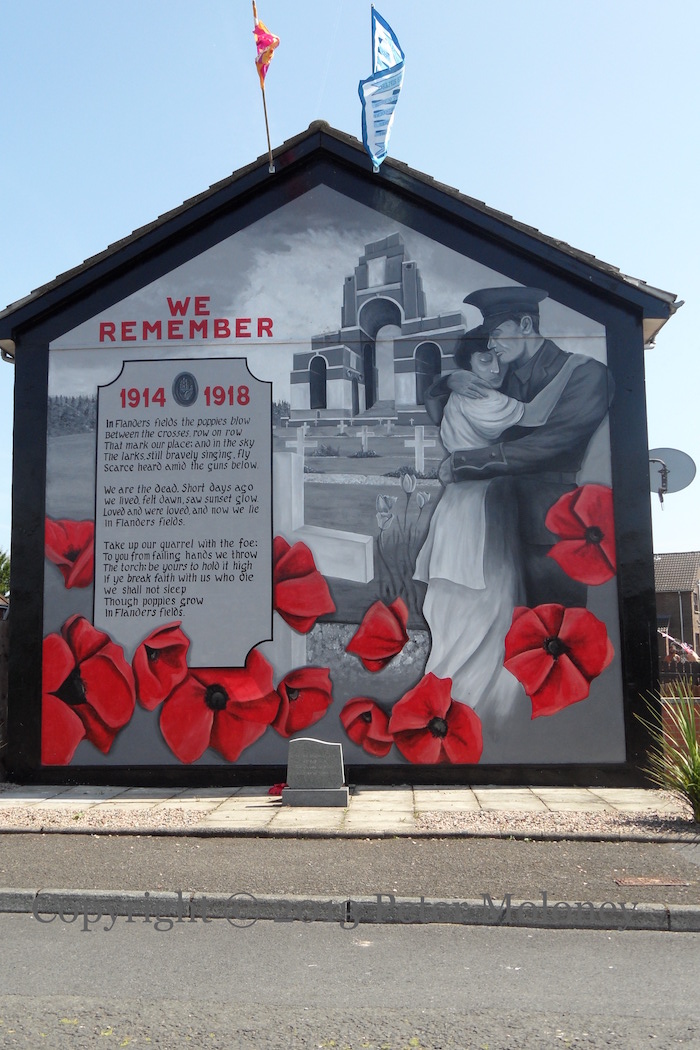
Canadian physician John McCrae’s poem In Flanders Fields and the triple arches of the Thiepval memorial to the missing are featured in this Monkstown mural. It is McCrae’s poem that is thought to have given rise to the use of the poppy as a symbol of military remembrance (WP). The names of over 72,000 dead are inscribed on the memorial (WP| travelfranceonline).
“In Flanders fields the poppies blow/Between the crosses, row on row/That mark our place; and in the sky/The larks, still bravely singing, fly/Scarce heard amid the guns below.//We are the Dead. Short days ago/We lived, felt dawn, saw sunset glow,/Loved and were loved, and now we lie/In Flanders fields//Take up our quarrel with the foe:/To you from failing hands we throw/The torch; be yours to hold it high./If ye break faith with us who die/We shall not sleep/Though poppies grow/In Flanders fields.”
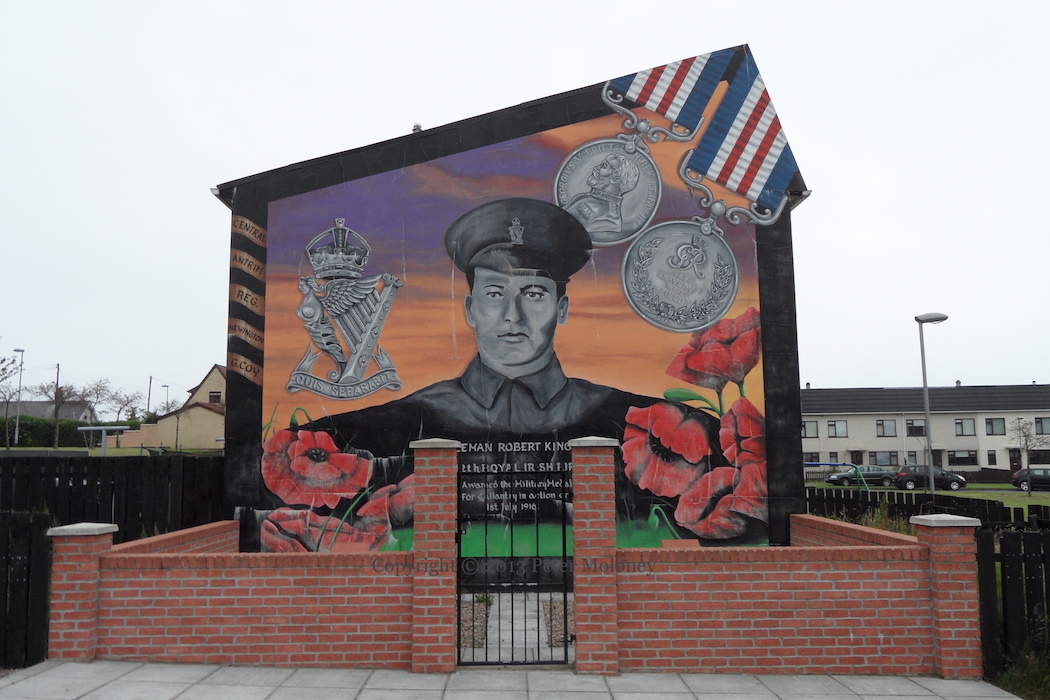
Robert King, of the 12th Royal Irish Rifles, who joined the army from the Ulster Volunteers, was “awarded the Military Medal for gallantry in action on 1st July 1916” at the Somme. The two sides of the medal are shown in the top right, with George V on one side and “for bravery in the field”. The 12th Rifles were drawn from the Central Antrim regiment of the Ulster Volunteers including the Newington area of Larne; King, however, was from Ship Street.
The Ulster Tower at Thiepval, France, is a replica of Helen’s Tower in Clandeboye, around which the 36th (Ulster) Brigade, which formed in August 1914 from the Ulster Volunteers and Young Citizen Volunteers, began their training (see this gallery of images from North Down Museum at BBC-NI). After a year of training in Ireland and England, the Division was deployed to France in September 1915.
In the top corners are two views of the local Scrabo Tower. Produced by muraltec.
“1st July 1916. Somme soldiers killed, wounded, missing, 36th (Ulster) Division, 32,186. To the memory and sacrifice of the brave young men from North Antrim who gave their lives with countless others at the Somme and other battles during the Great War 1914-18, to restore peace in Europe. To them bravery was without limit; to us memory is without end.”
The main panel reads: “Liscolman Protestant Boys remember 1914-1918. 36th (Ulster) Division. Robert Quigg, VC. Sons of Ulster, Somme 1916. When you go home, tell them of us and say,/for their tomorrow, we gave our today.”
On the left: 1914-1918. Private Charles Allen, Rifleman Robert Moore, Rifleman William Moore, Lieuftenant Thomas Patrick Craig, Private Archibald Nicholl, Sergeant Samuel James Holmes, Rifleman James Laverty. Without limit.”
On the right: “Heart and hame” and what is perhaps a mill chimney.
Toberdoney Road, Liscolman. With red-white-and-blue kerb-stones in Carnbore Road, and coping- and kerb-stones in Toberdoney Road.
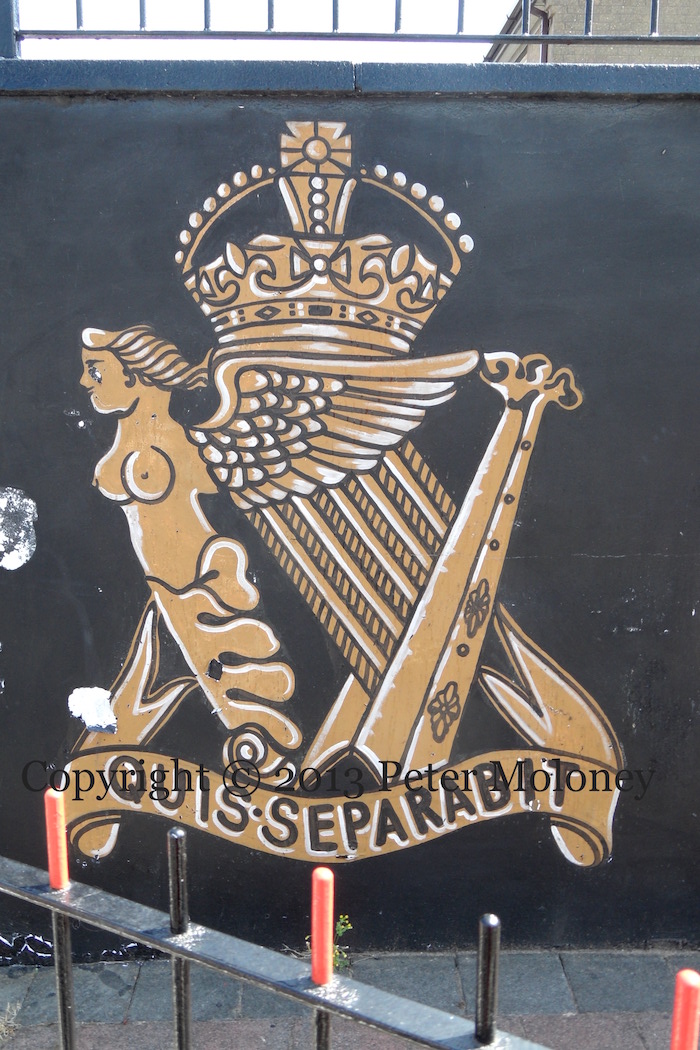
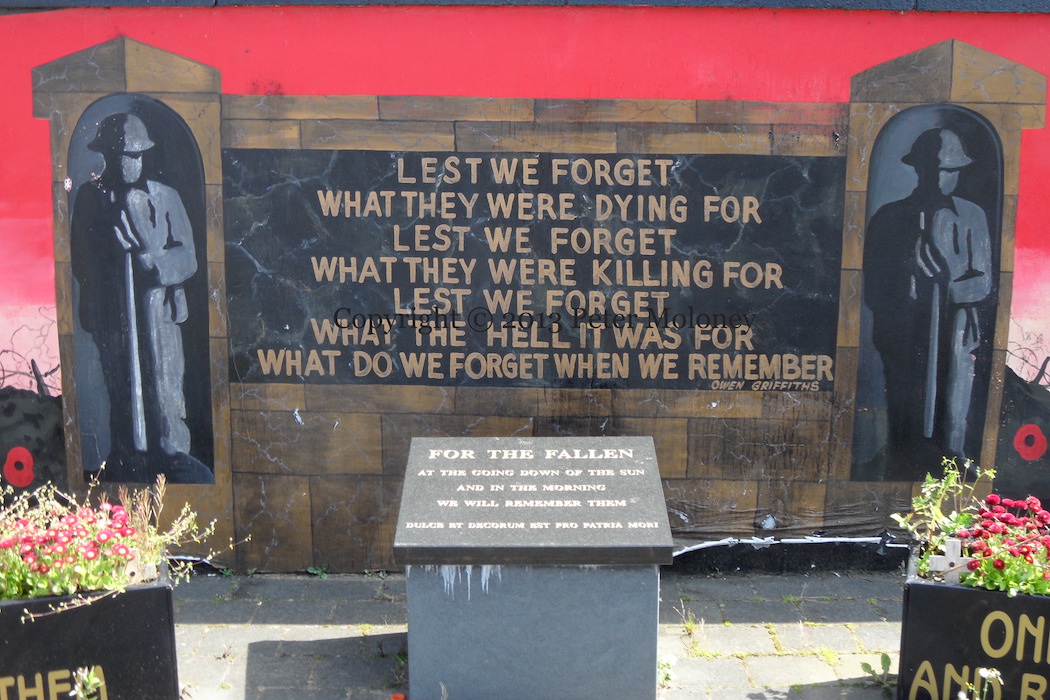
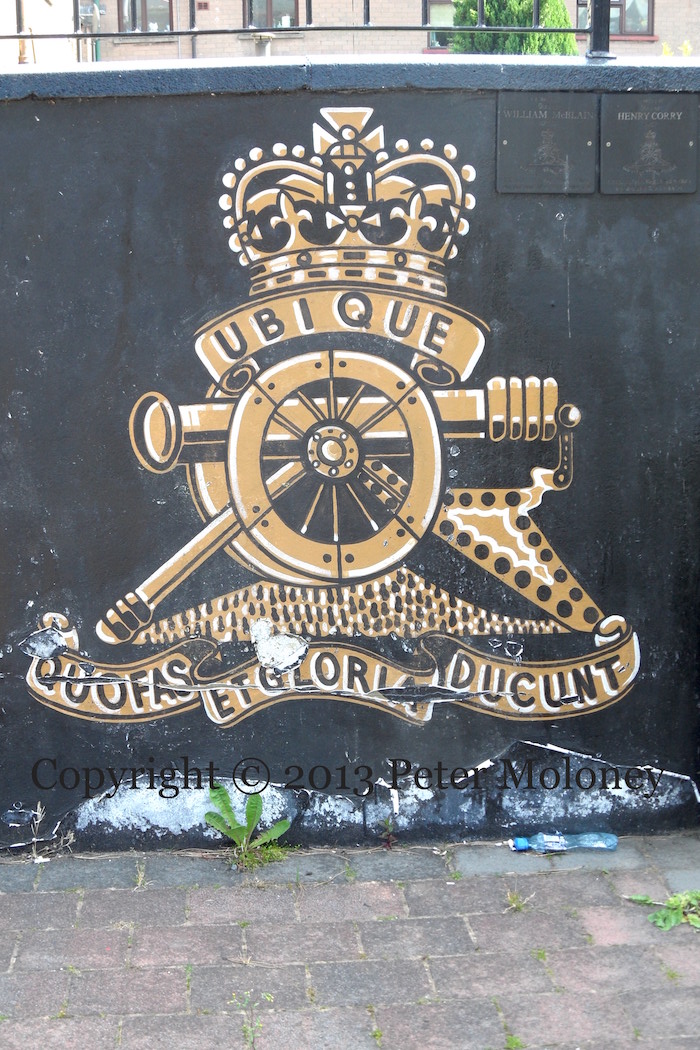
Two poems are featured prominently and another two alluded to in this Newtownards mural and memorial garden to WWI soldiers. The central panel features part of an anti-war work by by Owen Griffiths, Lest We Forget. Robert Laurence Binyon’s For The Fallen is featured on the stone, above a line of Latin from Horace’s Odes (III.2) – On Virtue(which most famously re-appears in Owen’s Dulce Et Decorum Est). On the left and right there appear the mottos of the Royal Irish Rifles – ‘Quis separabit’, which comes from Romans 8:35 – and the Royal Artillery – ‘Ubique – Quo Fas Et Gloria Ducunt’, which comes from Kipling’s Ubique.
For the (WWI) 13th battalion RIR, see Regimental List and similarly for the 16th (rather than the 17th) “Pioneers”. For the (WWII) 5th Anti-Aircraft battery, see Newtownards History.
“I am not an Ulsterman [but] yesterday, the 1st of July 1916, as I followed their amazing attack, I felt I would rather be an Ulsterman than anything else in the world.” The words of Captain Wilfrid (here given as “Wilfred”) Spender replace a Steeple Defenders board that has presumably fallen into disrepair alongside a board showing a soldier from the 36th Division running through no-man’s land (both seen previously in 2003 and 2009).
For a fuller quote, see X04435 from south Belfast.
“In memory of Vol. Denver Smith, murdered by cowards 1st January 2000. Here lies a soldier. He gave his life whilst serving his community. Lest we forget.” Smith was killed by a gang of six men with machetes and pikes; the incident was perhaps drugs-related (Guardian | BBC-NI. For the wider picture An Phoblacht | Irish Times).
The mural originally appeared with seven plaques, then with three plaques, and now with graveside mourners on either side of a single stone, and a bench and three flag-poles to the right.
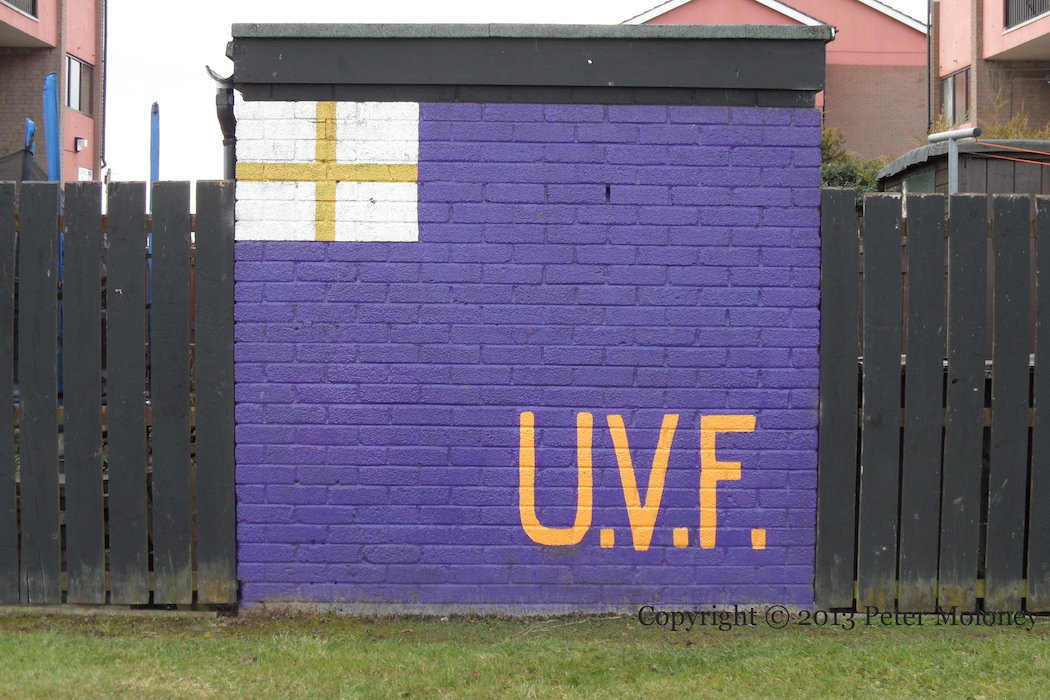
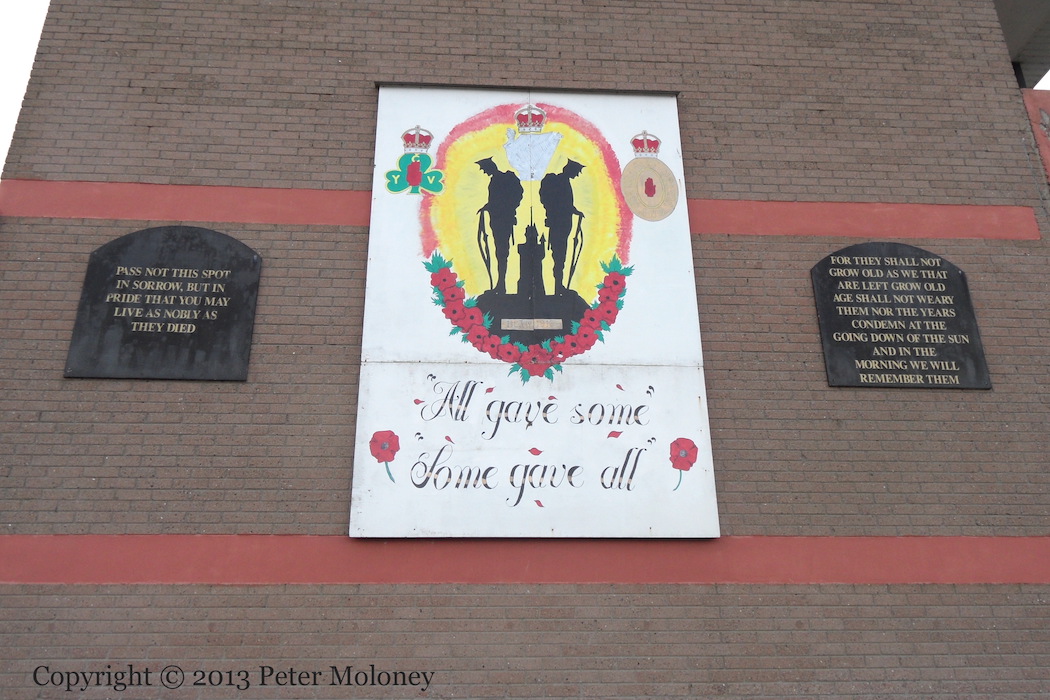
The UVF flag is between the the Denver Smith and All Gave Some gables.
On the right: “They shall not grow old as we that are left grow old./Age shall not weary them nor the years condemn./At the going down of the sun and in the morning, we will remember them.” from Binyon’s For The Fallen.
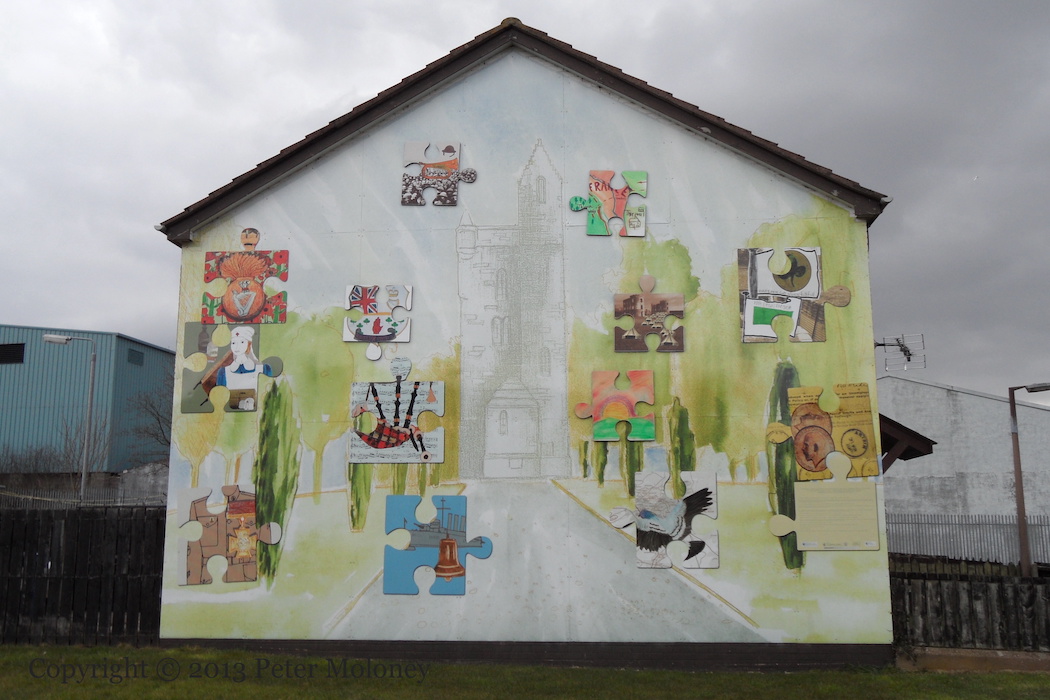
Ulster Tower in Thiepval, France, provides a background for 13 jigsaw pieces with partial images relating to the Great War, including a uniform with a Victoria Cross and badge of the 36th (Ulster) Division, the 10th (Irish) Division, the 16th (Irish) Division, and the Royal Irish Fusiliers (and a fourteenth piece for information).
Kilgreel Road, Antrim. The mural is more than a decade old and is bleached from the sun (the pinks were formerly brown); on the former site of The People’s Army (a UVF board).
“This artwork, commemorating the sacrifices made during the Great War and subsequent conflicts, was produced by the young people of Parkhall Youth & Community Club and was completed in 2010. It is part of a larger Re-imaging project undertaken by Parkhall Cultural Awareness Association & Parkhall Community Association. 14 jigsaw pieces are representated as that was the age of the youngest soldier to die on the Somme. The Royal Irish Fusiliers, who recruited in the Antrim area, served with the 10th Irish Division and 36th Ulster Division during World War I. The cap badge is surrounded with poppies. The poppy is an international symbol commemorating the sacrifices of members of the armed forces and of civilians specifically since the Great War. Birds were used extensively during World War I delivering important logistic message from the front line. HMS Antrim served in the Great War and survived. After the war she became the first ship to be fitted with an experimental sonar system in 1920. Her bell can presently be viewed in Antrim Civic Centre. The grounds of Shane’s Castle in Antrim were used as a training ground and a campsite for the 36th Ulster Division prior to their deployment to France. Of all bell tents and parachutes during the Great War 90% were made from Irish Linen. During the Great War a service man’s basic wage was one shilling a day (5 pence). The sound of the bugle was heard throughout each day in the trenches, starting with Reveille to rouse you from slumber. ‘Flowers of the Forest’, a powerful Scottish lament, is often played by a lone piper at services of Remembrance. “I am not an Ulsterman but yesterday, the 1st July, as I followed their amazing attack, I felt that I would rather be an Ulsterman than anything else in the world.” Extract from the speech by Captain Wilfred [Wilfrid] Spencer 2st July 1916. Men from the 36th Ulster Division received 9 Victoria Crosses. Women played a vital role in field hospitals during the Great War caring for the injured, from the front line. The flags of the 16th and 10th Irish Divisions. 36th Ulster division. The Ulster Tower is a memorial to the men of the 36th Ulster Division. It is situated near the entrance to Thiepval Wood, France.