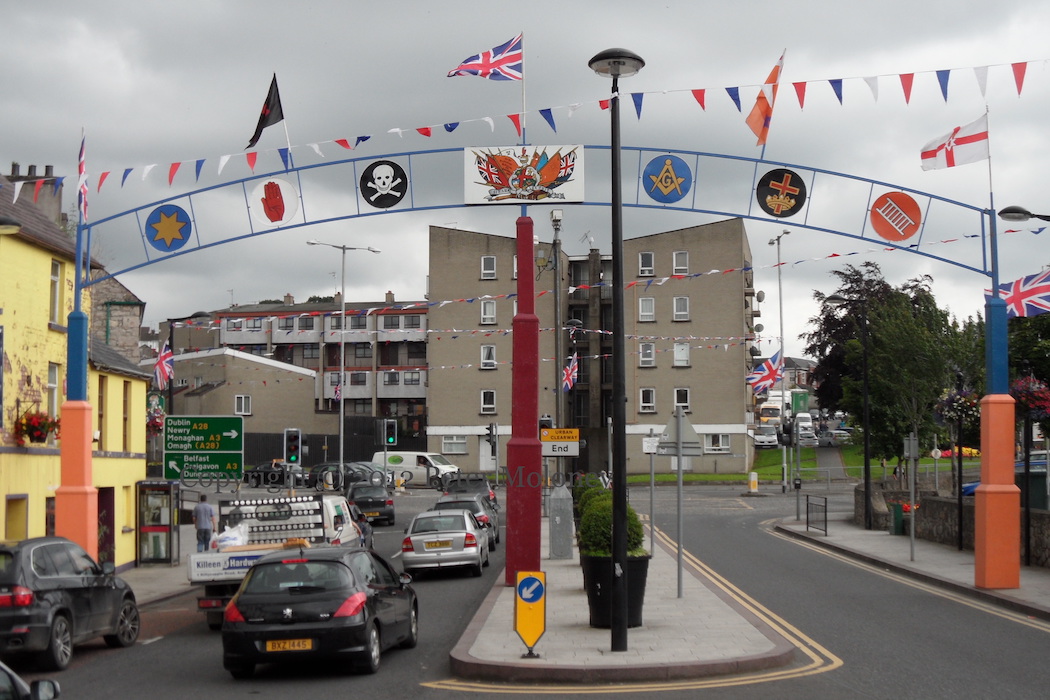
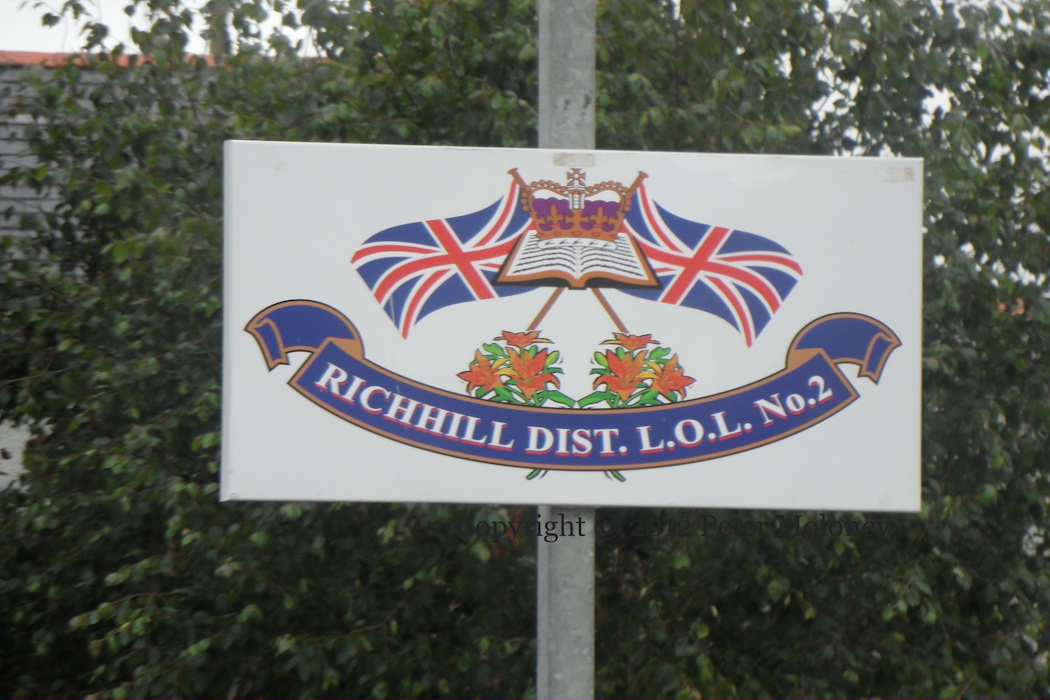
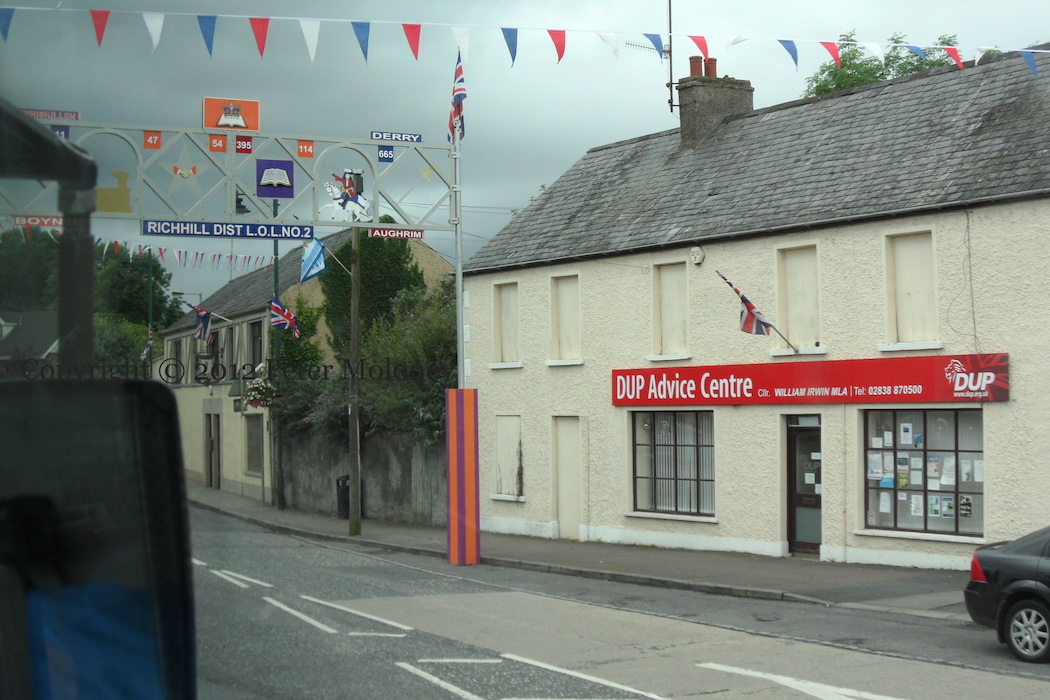
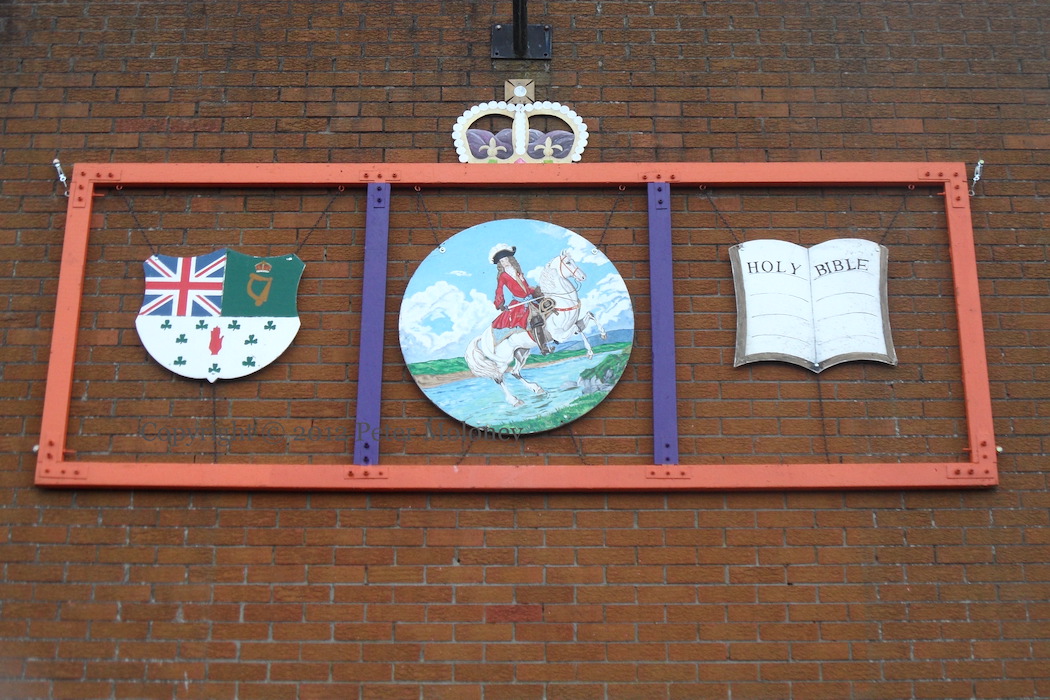
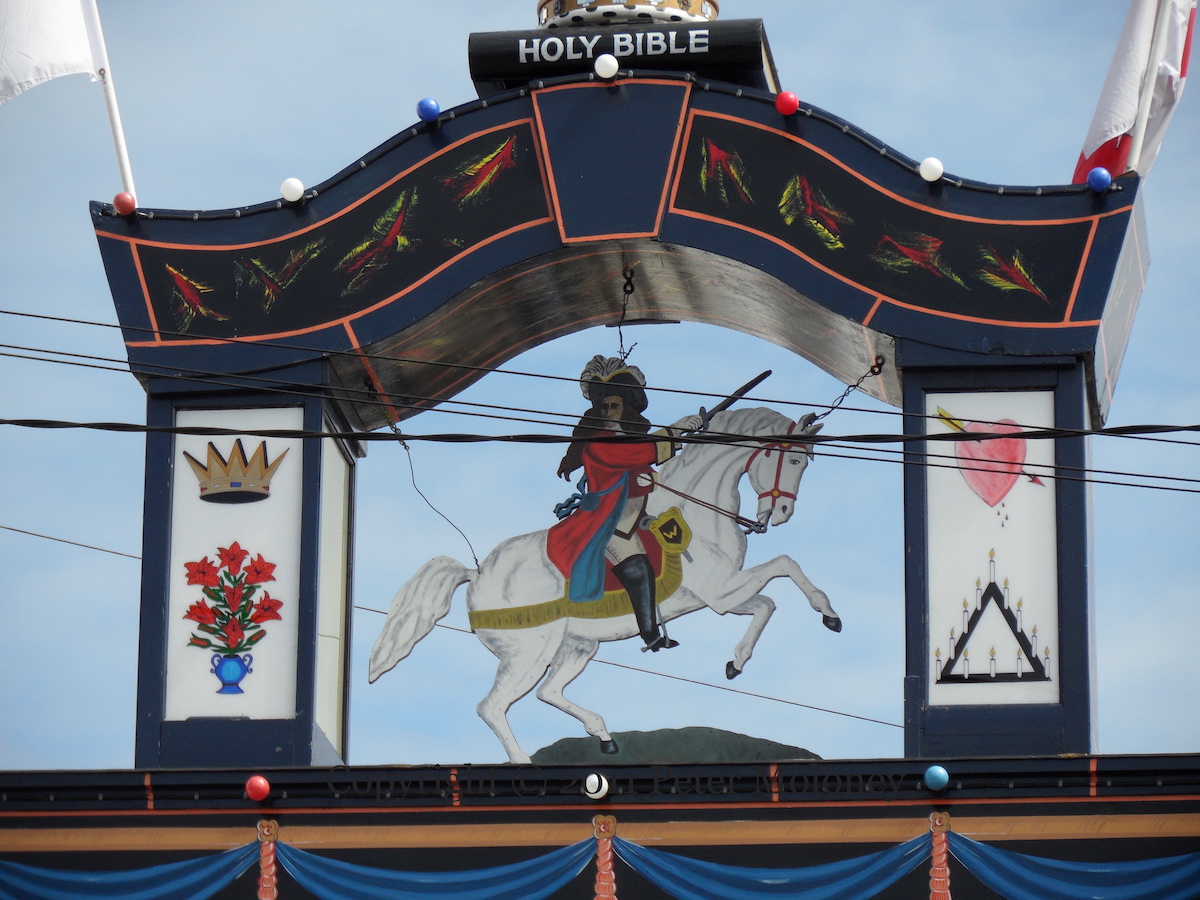
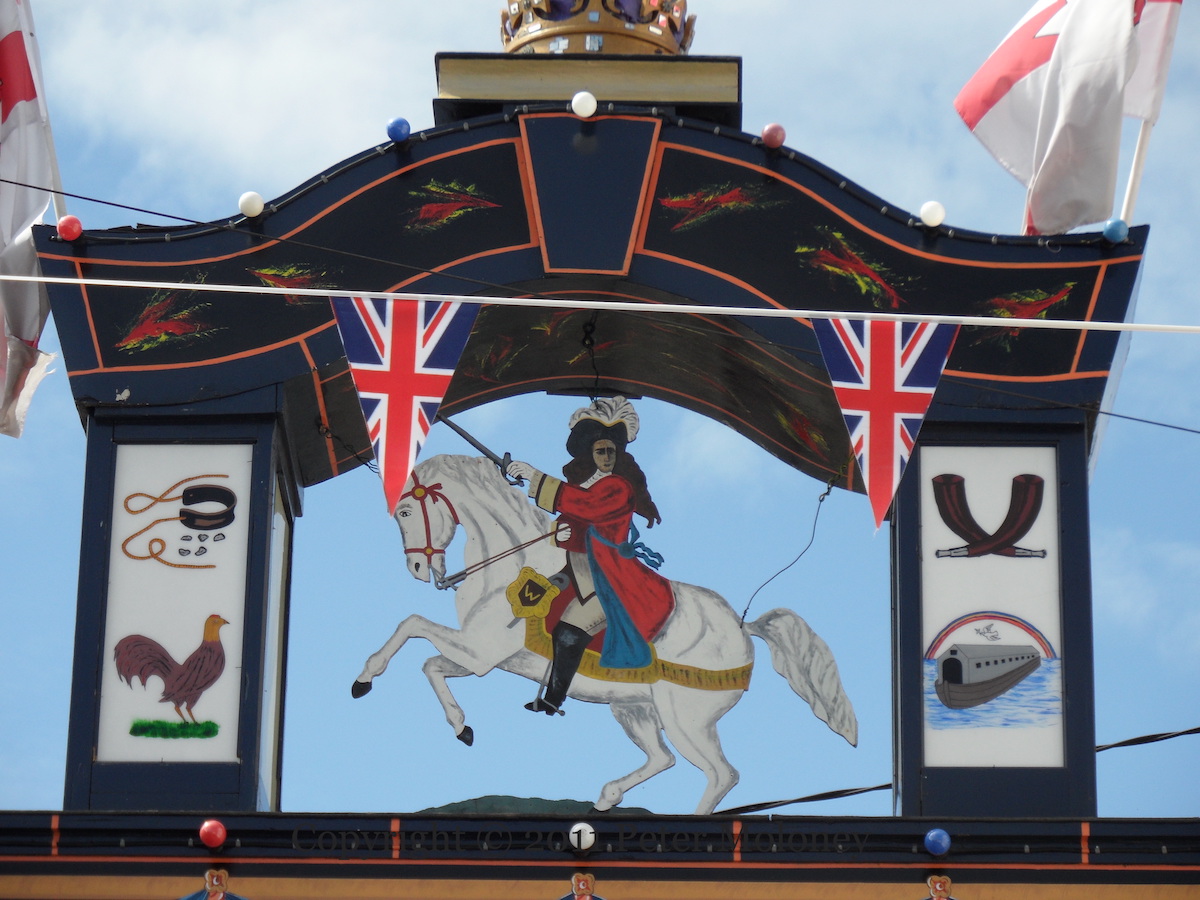
On one side of the main board in this arch is King Billy and on the other flags and a coat of arms associated with the Orange Order. One of the flags reads “For the Protestant religion – Constitution 1688“; on the ribbon banner are the words “Sit lux [et] lux fuit. [Let there be light, and there was light]”
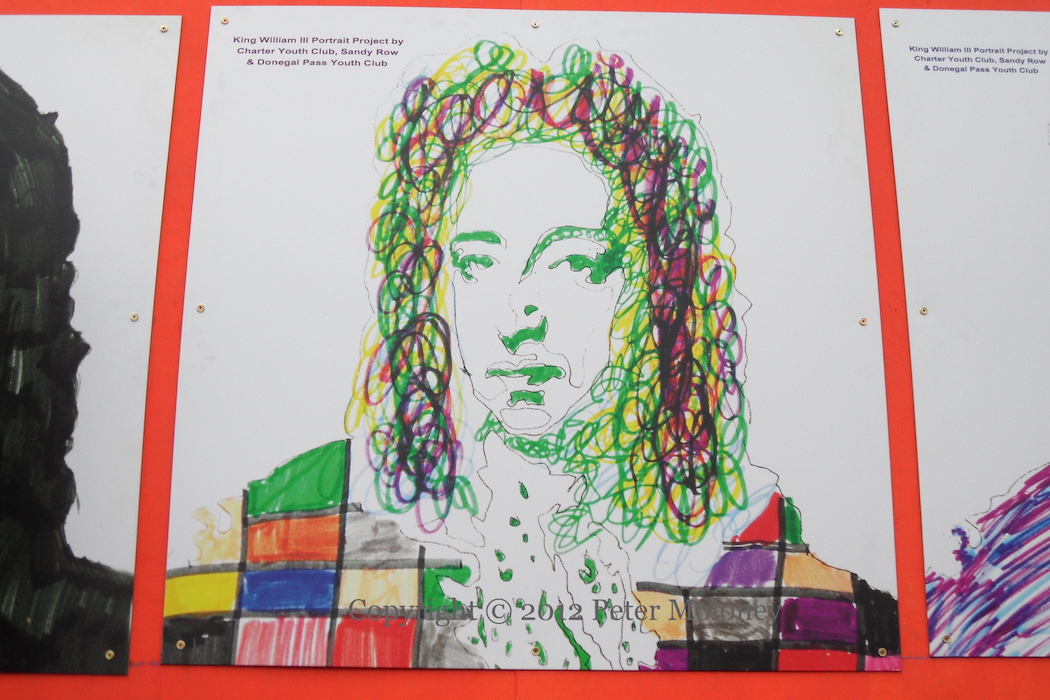
For the Twelfth Of July, 2012, portraits of William Of Orange, as coloured by Charter Youth Club, Sandy Row and Donegall Place Youth Club, were displayed along the Lisburn Road, Belfast.
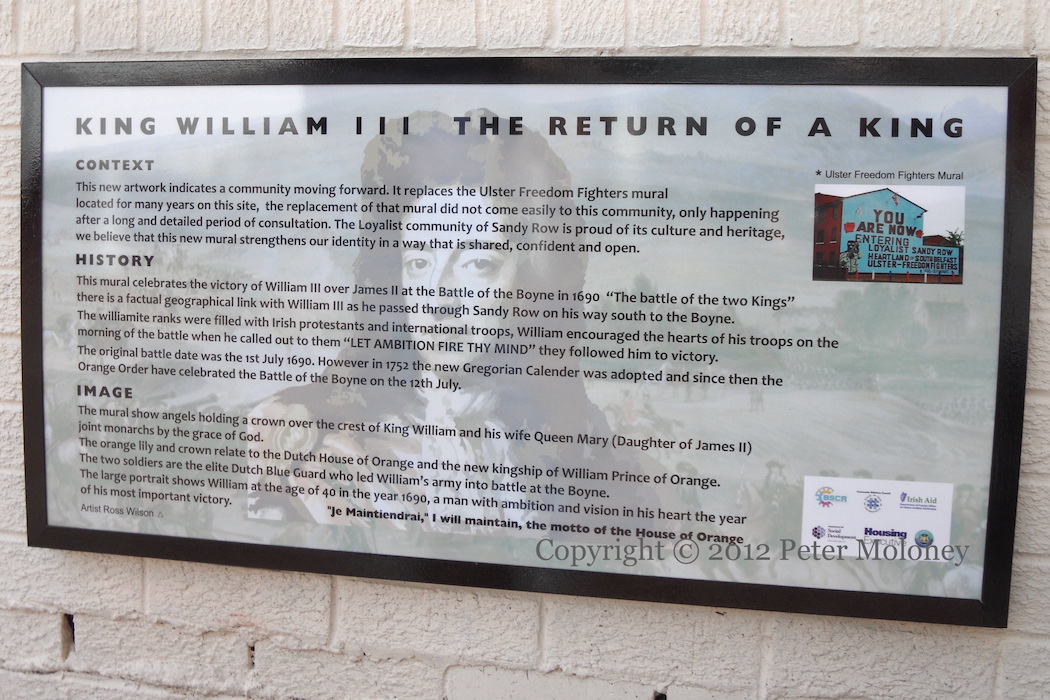
The famous “You are now entering loyalist [UDA] Sandy Row” mural, has been replaced by a new board celebrating the (Dutch) William of Orange (or “King Billy” as he is more commonly referred to) (WP) and his “Danish, English, Dutch, French Huguenots, Prussian, Scots, Irish, Swiss, Polish, Italian, Norwegian” forces. “William III encourages his troops, on the morning of July 12th 1690 [in Dutch]: ‘Let ambition fire thy mind/Laat amitie brand uw verstand'”
The mural was launched July 2nd, 2016, and was painted by artist Ross Wilson (Tele). A time-lapse video of the painting-over of the previous mural and the installation of the various pieces is available on Youtube.
“Context: This new artwork indicates a community moving forward. It replaces the Ulster Freedom Fighters mural located for many years on this site, the replacement of that mural did not come easily to this community, only happening after a long and detailed period of consultation. The Loyalist community of Sandy Row is proud of its culture and heritage, we believe that this new mural strengthens our identity in a way that is shared, confident and open. History: This mural celebrates the victory of William III over James II at the Battle of the Boyne in 1690 “The battle of the two kinds” there is a factual geographical link with William III as he passed through Sandy Row on his way south to the Boyne. The williamite ranks were filled with Irish protestants and international troops, William encouraged the hearts of his troops on the morning of the battle when he called out to them “LET AMBITION FIRE THY MIND” they followed him to victory. The original battle date was the 1st July 1690. However in 1752 the new Gregorian Calendar was adopted and since then the Orange Order have celebrated the Battle of the Boyne on the 12th July. Image: The mural shows angels holding a crown over the crest of King William and his wife Queen Mary (Daughter of James II) joint monarchs by the grace of God. The orange lily and crown relate to the Dutch House of Orange and the new kingship of William Prince of Orange. The two soldiers are the elite Dutch Blue Guard who led William’s army into battle at the Boyne. The large portrait shows William at the age of 40 in the year 1690, a man with ambition and vision in his heart the year of his most important victory. “je Maintiendrai,” I will maintain, the motto of the House of Orange. Artist Ross Wilson”
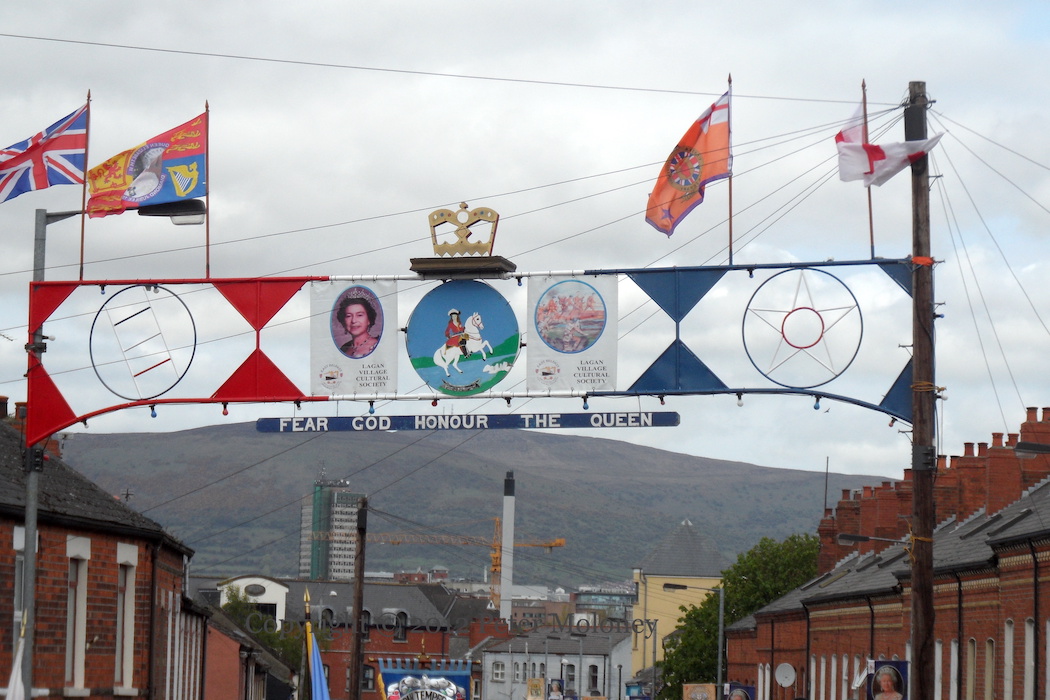
This is the arch in My Lady’s Road, with Orange Order symbols (crown, ladder, star) surrounding a painting of King Billy and two small banners of Queen Elizabeth and the 36th Division going over the top, from the East Belfast Historical And Cultural Society and the Lagan Village Cultural Society.
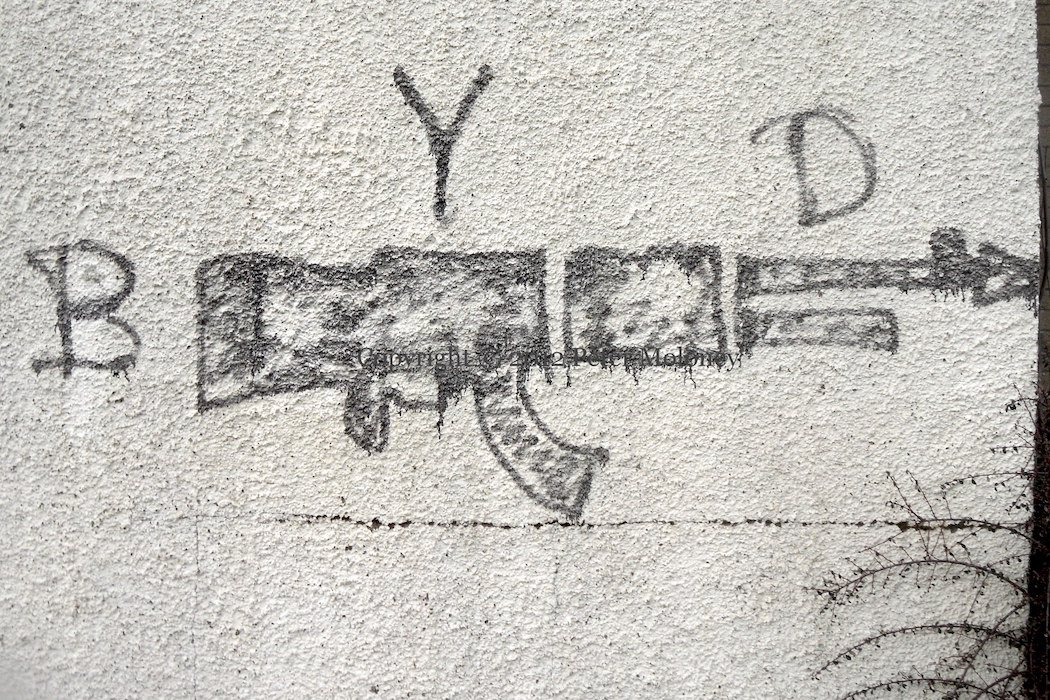
Five-part memorial from Freeman Memorial Flute Band (Fb) “in memory of our fallen friends, [UVF] Lt David Swanson, Vol Aubrey Reid, Vol Mark Dodds, killed on active service 2nd October 1975. Robbie Freeman, died 27th December 1997.” As is common to both republicans and loyalists, “active service” means a premature bomb explosion. Four people listed died in a car explosion at Farrenlester, just outside Coleraine – the three listed and a fourth who is variously named as Geoffrey, Robert, or Andrew Freeman. The date for “Robbie Freeman” is perhaps a relative (father?) of the Freeman who died in 1972.
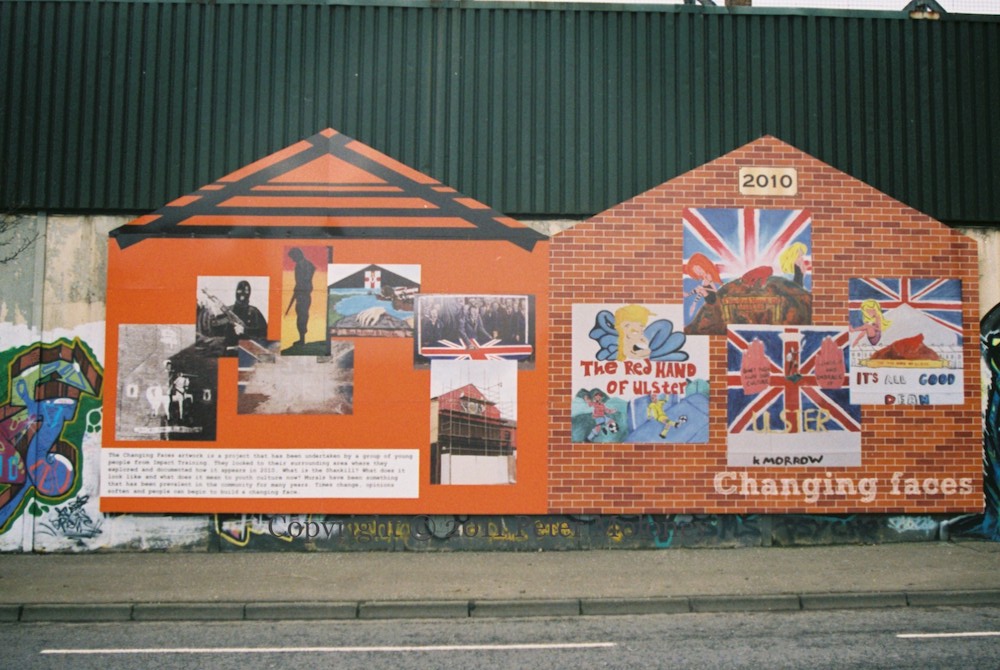
“The Changing Faces artwork is a project that has been undertaken by a group of young people from Impact Training. They looked to their surrounding area where they explored and documented how it appears in 2010. What is the Shankill? What does it look like and what does it mean to youth culture now? Murals have been something that has been prevalent in the community for many years. Times change, opinions soften and people can begin to build a changing face.” On the left is a selection of details from murals with familiar subjects: King Billy, hooded gunmen, the red hand of Ulster, Carson, the Queen Mother; on the right are four panels on the theme of the red hand of Ulster in youth culture (clockwise from left): with wild-style writing from the Cupar Way “peace” line and soccer, with pop music, with It’s All Good by Dublin artist Maser, and with a (two-handed) warrior. “Don’t push away our culture … learn it and embrace it.”
For more on the attempt to put community art on the Cupar Way “peace” line, see Visual History 10.