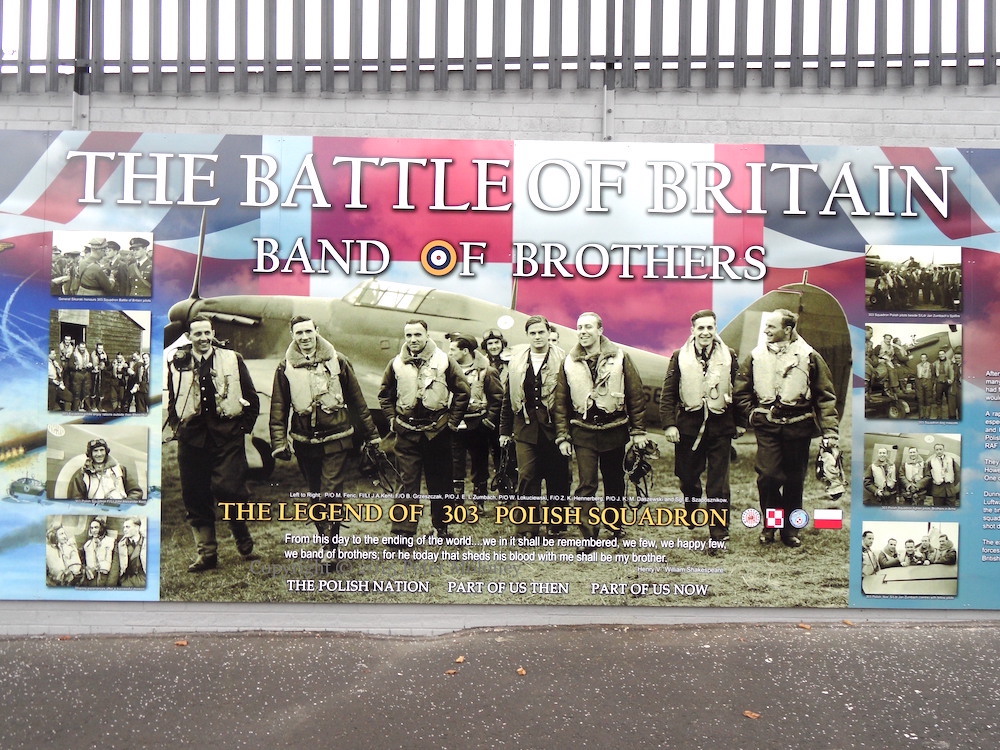
“Love demands sacrifice”. “‘From this day to the ending of the world … we in it shall be remembered, we few, we happy few, we band of brothers’ for he today that sheds his blood with me shall be my brother’ – Henry V, William Shakespeare”
2015 marks the 75th anniversary of the Battle Of Britain, which was waged from July to October in 1940. This large board is part of an anti-racism project, celebrating the contributions to the Battle made by roughly 145 Polish aviators (WP) and especially the 303 squadron, which was stationed in Northern Ireland for a time (BBC-NI). “The Polish nation – part of us then, part of us now”.
The artist is Ross Wilson. Belfast Live has a report on the launch.
Sınn Féın leader Gerry Adams said of the (Provisional) IRA in 1995 “They haven’t gone away, you know” (youtube). The dove of peace is shot down (presumably by IRA weapons) at the junction of Northumberland and Beverly Streets in PUL west Belfast.
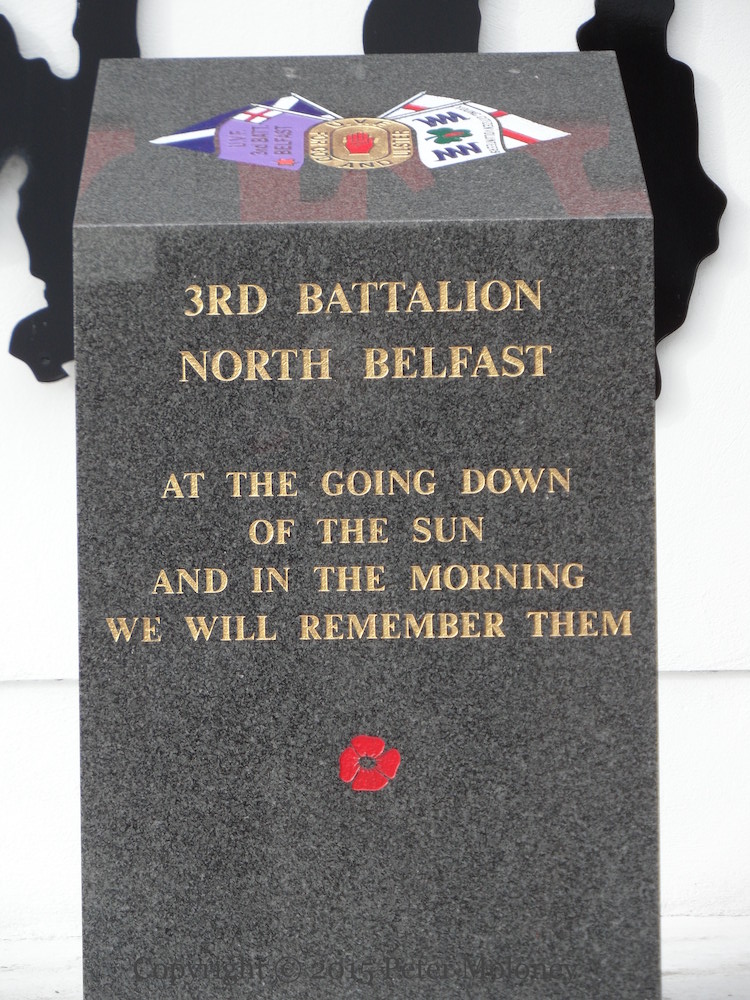
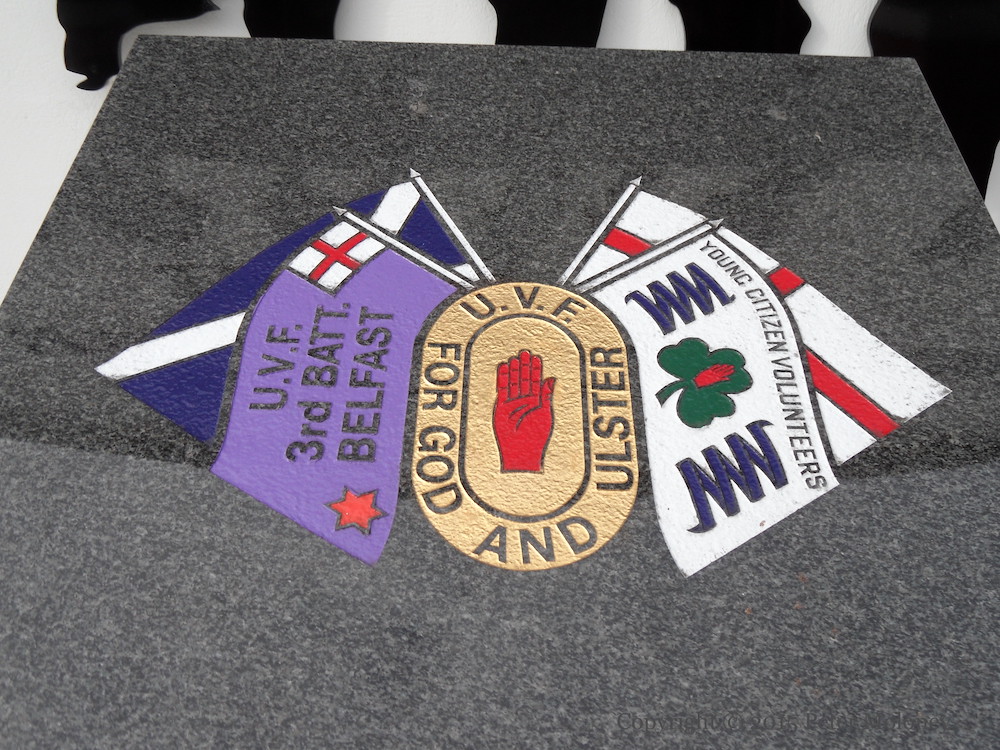
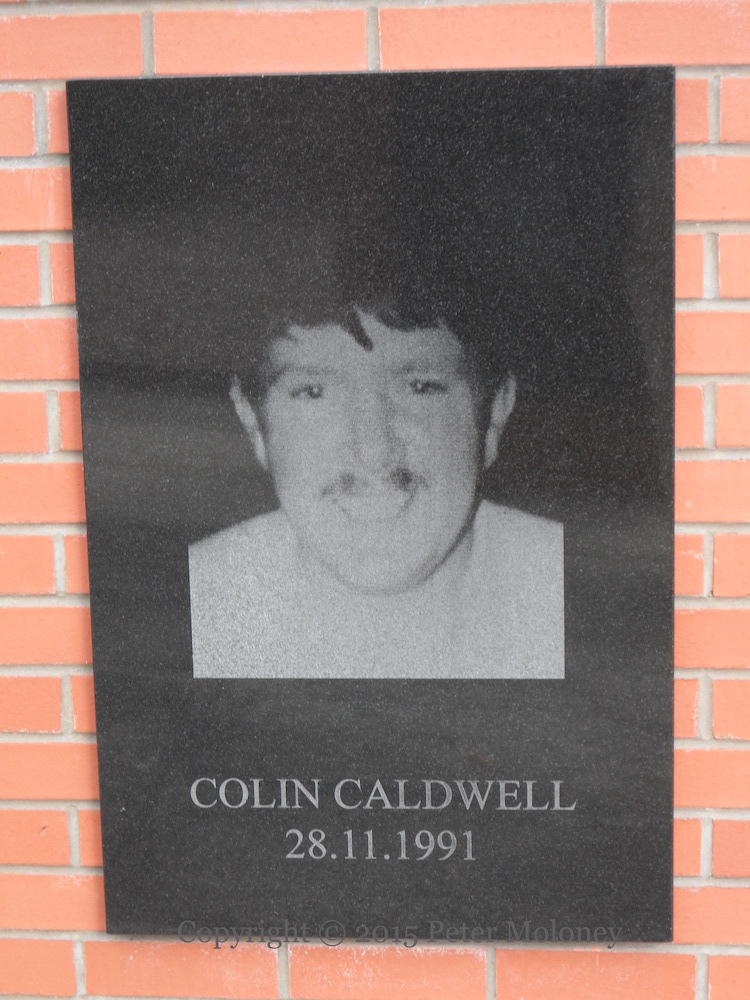
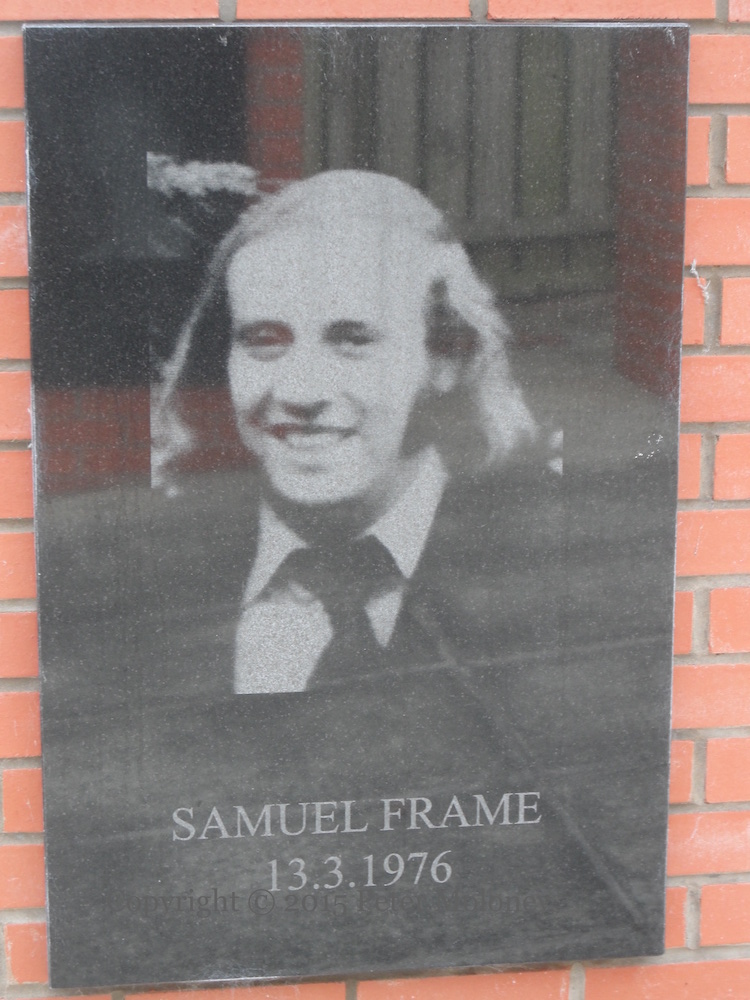
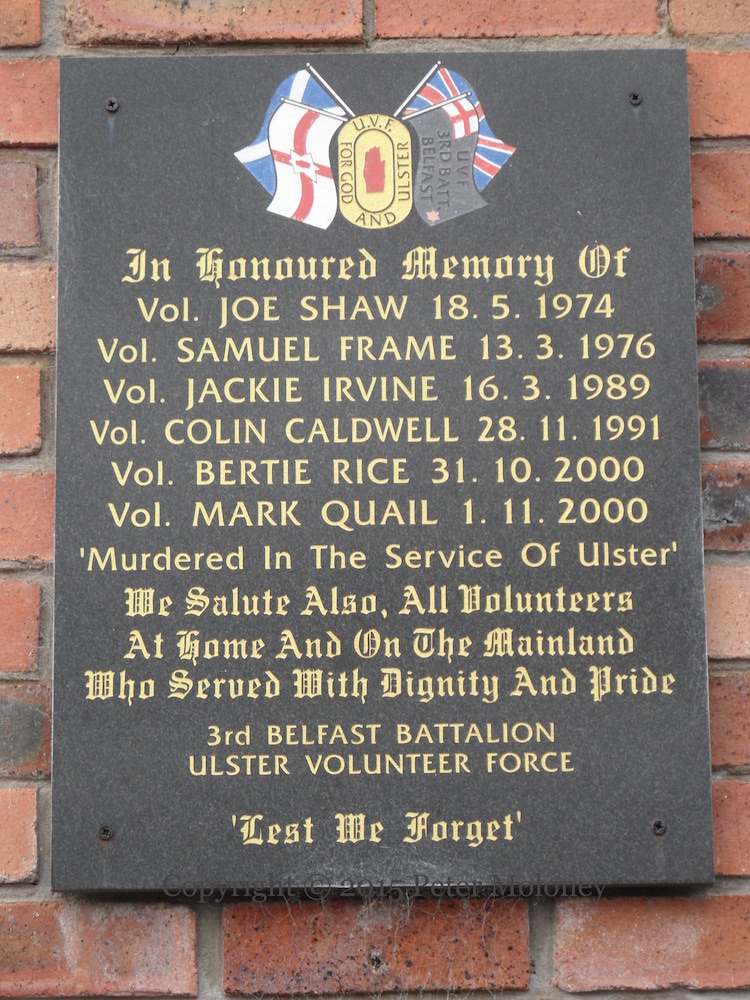
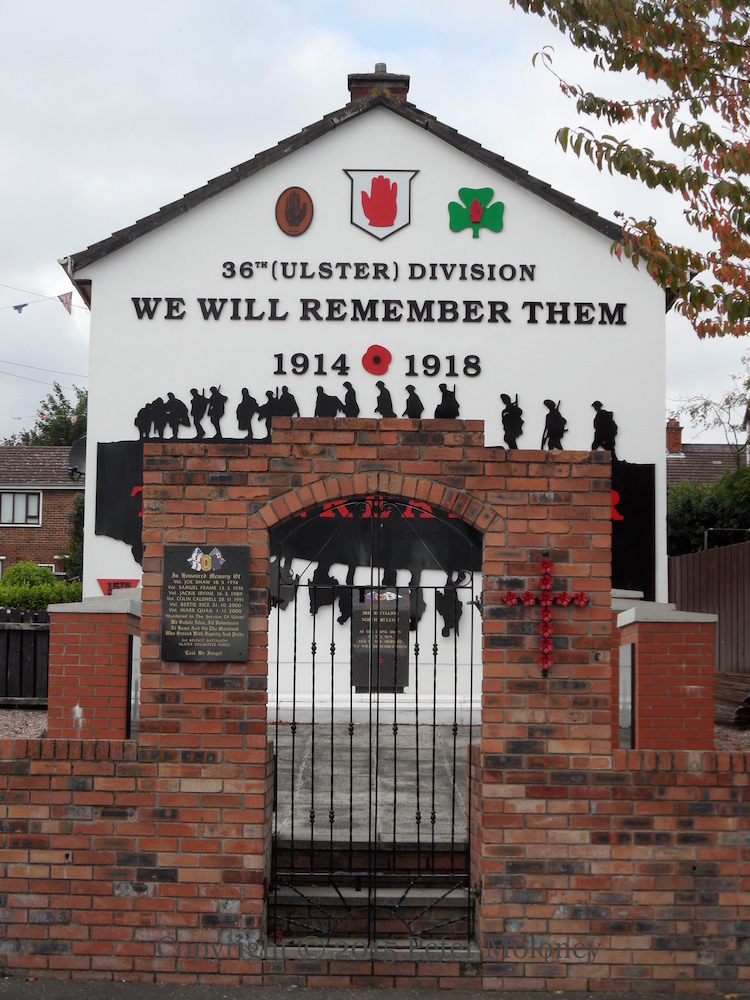
The memorial garden in Mount Vernon, which previously had and Ulster Volunteers mural and UVF stone, has undergone a major redevelopment this year (2015) with a new “cut-out” mural to the 36th (Ulster) Division and stand-alone memorial plaques to six UVF (3rd Belfast Battalion) members who were listed the plaque on the outside wall of the garden. “Murdered in the service of Ulster: Joe Shaw 18-5-1974, Samuel Frame 13-3-1976, Jackie Irvine 16-3-1989. Colin Caldwell 28-11-1991, Bertie Rice 31-10-2000, Mark Quail 1-11-2000.”
“We salute also all volunteers at home and on the mainland who served with dignity and pride.”
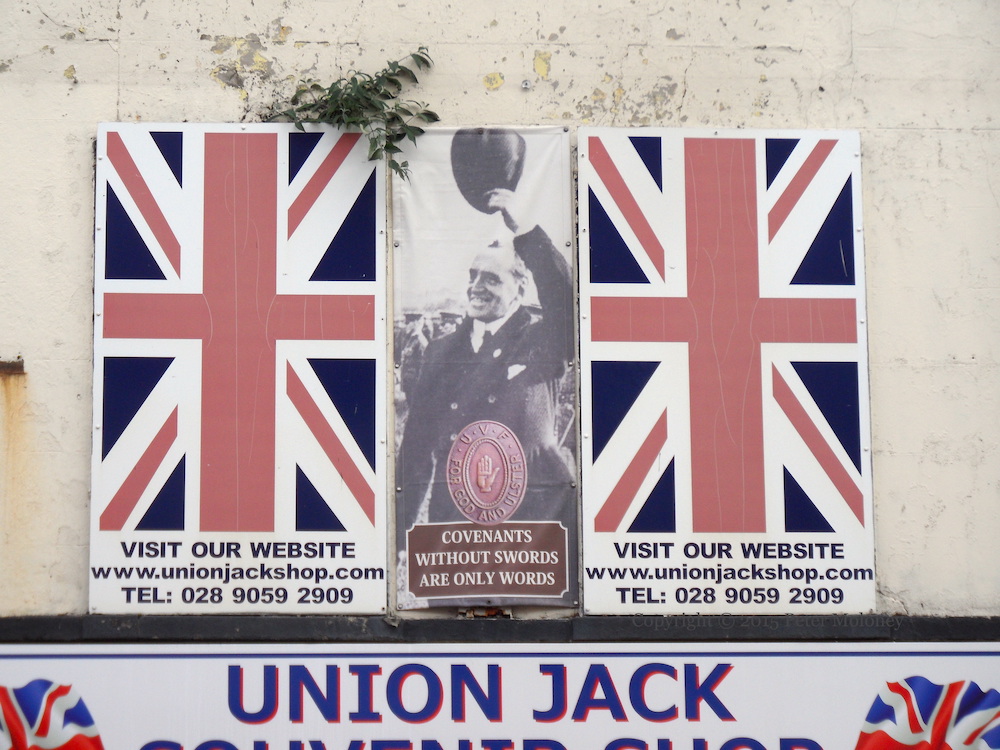
“Covenants without swords are only words” is a slight emendation of a line from Chapter 17 of Thomas Hobbes’s The Leviathan: “And covenants, without the sword, are but words and of no strength to secure a man at all.”
It is applied here to the 1912 Ulster Covenant being backed up by the 1914 gun-running. Edward Carson is shown acknowledging the cheers of the Ulster Volunteers, who have been drilling at Glencairn (as seen in this Shankill mural).
Above the Unionist souvenir shop on the Newtownards Road, east Belfast. Seen previously in 2012: Where Ulstermen Shop.
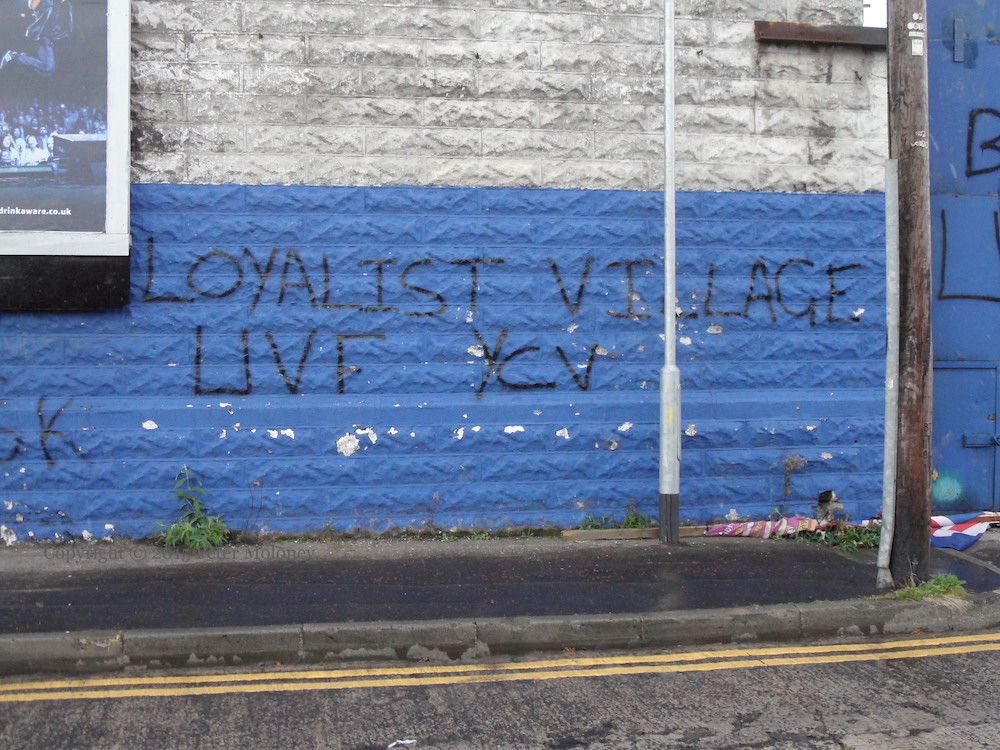
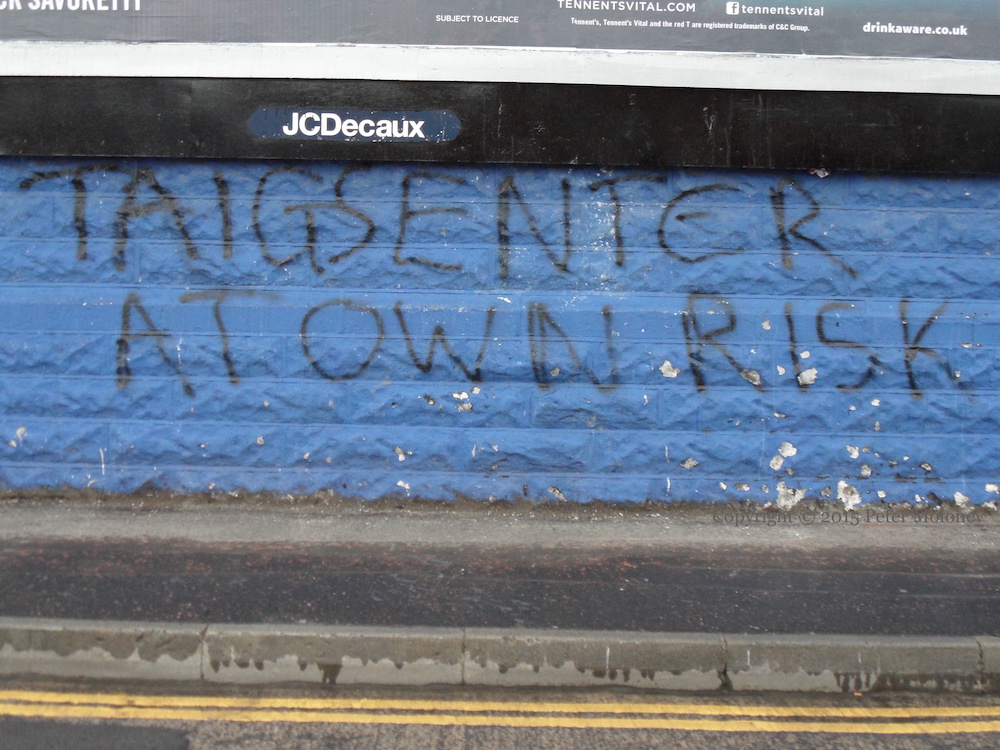
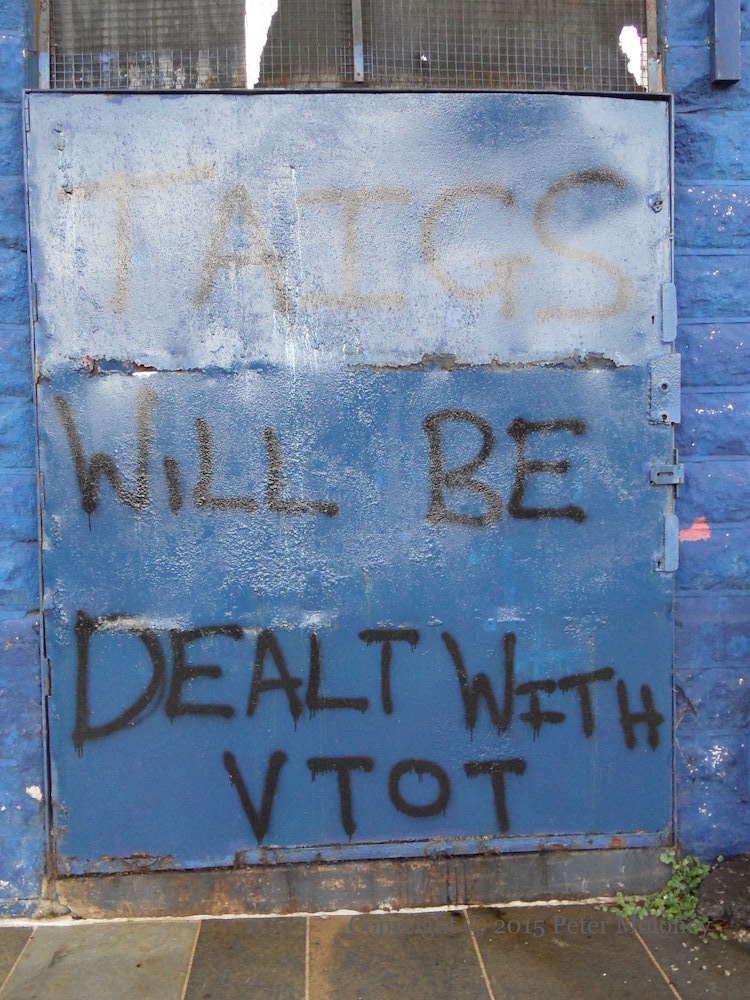
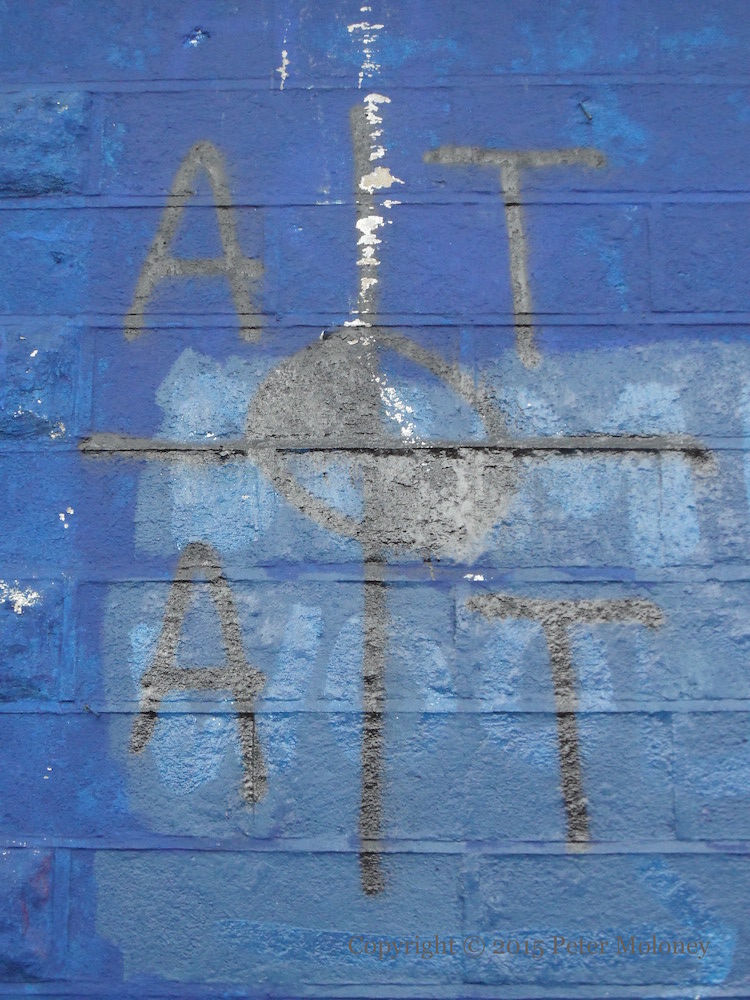
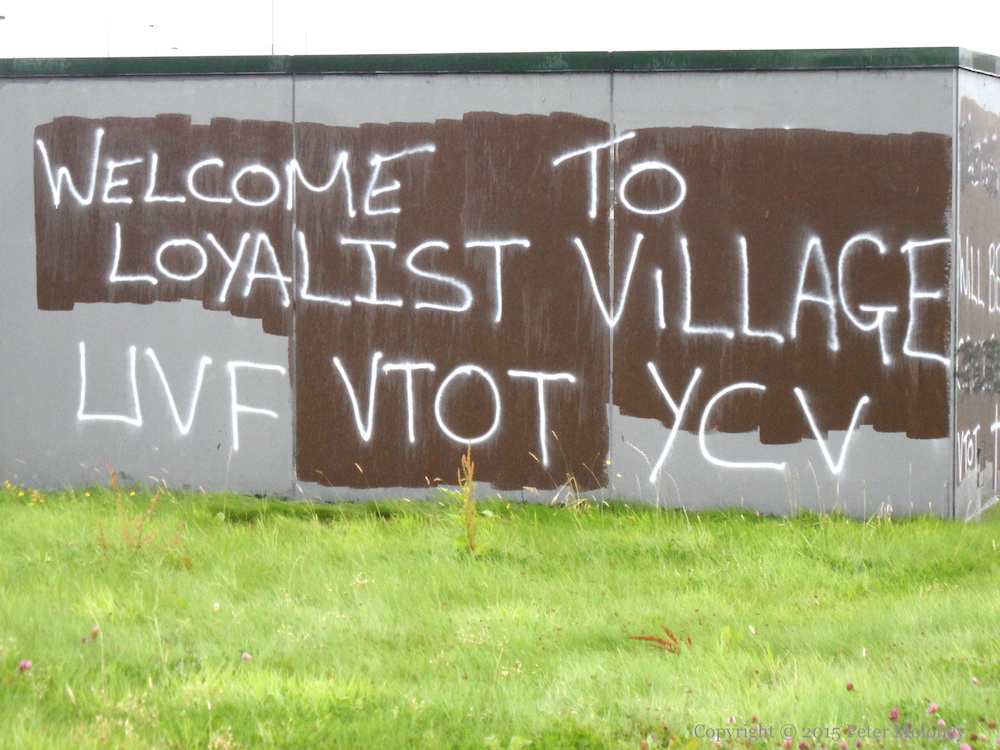
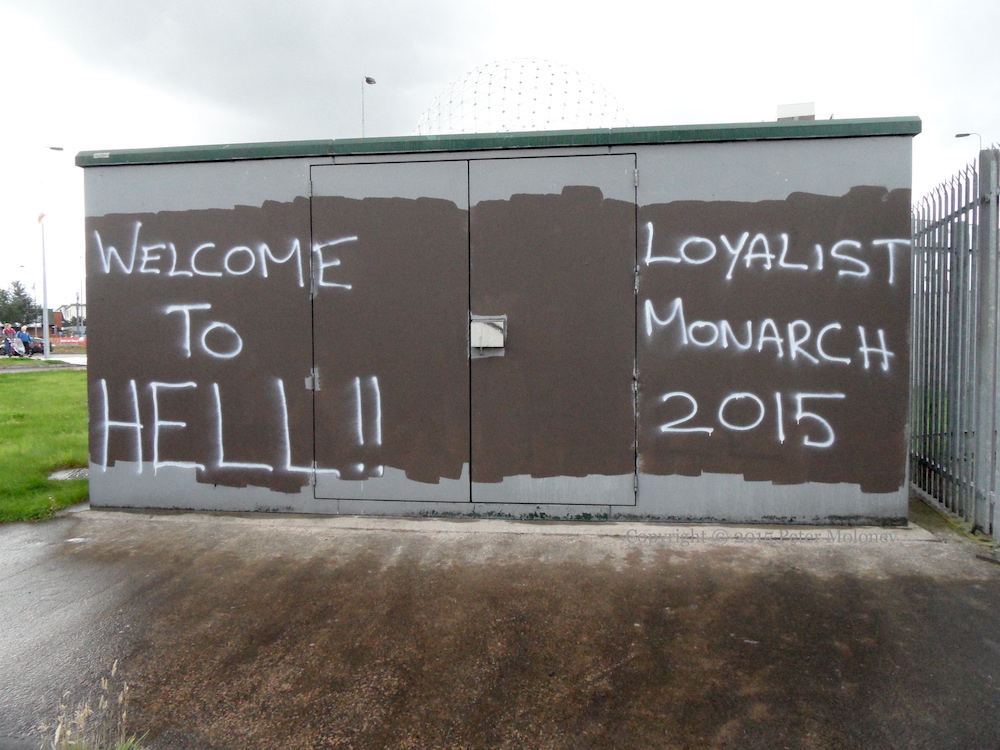
These graffiti are at the western edge of the Village, south Belfast, at the waste-ground over the Blackstaff and next to the Balls On The Falls, a.k.a Rise (on the Broadway roundabout).
“B Coy UFV Village”, Monarch UVF VTOT [Village team on tour]”, “Taigs enter at own risk”, “ATAT [All Taigs are target]”, “Welcome to loyalist Village”, “Taigs will be crucified”, “Welcome to hell!!”
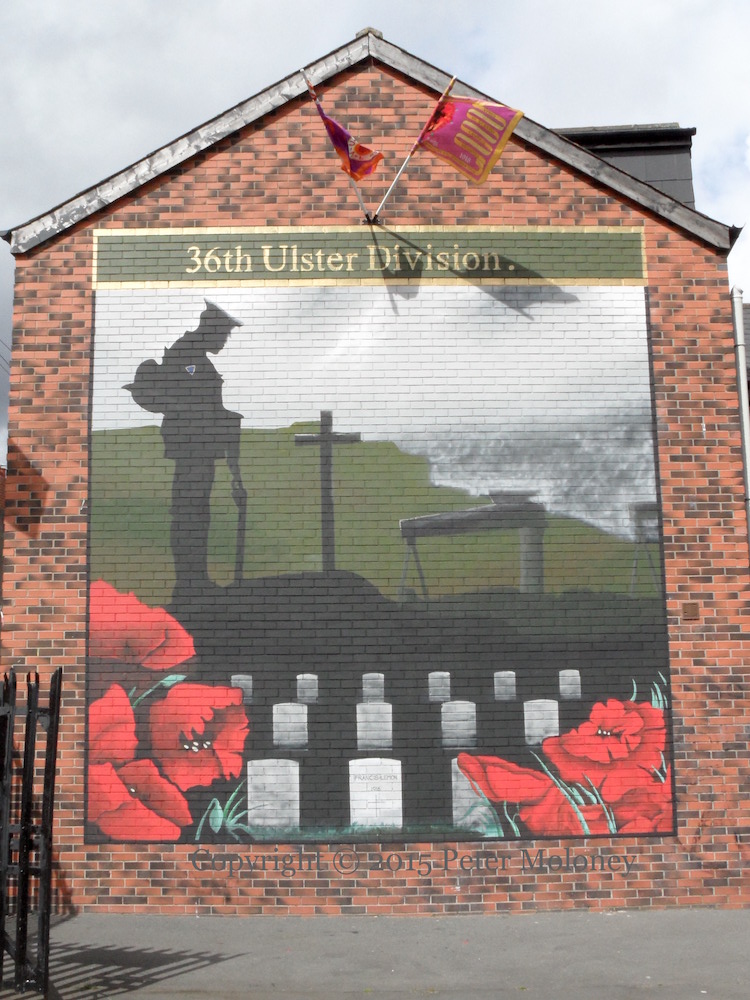
Samson and Goliath, the cranes of the Harland & Wolff shipyard in east Belfast, stand alongside crosses on the burial grounds of the 36th (Ulster) Division in Flanders (though Cave Hill might be in the background) in this Flora Street mural in east Belfast. UVF flags fly overhead.
On the headstone in the front-middle is written “Francis Lemon 1916”, perhaps this Francis Lemon, from Ballymacarrett, who died on July 2nd: FindAGrave | IWM.
This is a new (2015-05) mural in Flora Street, east Belfast.
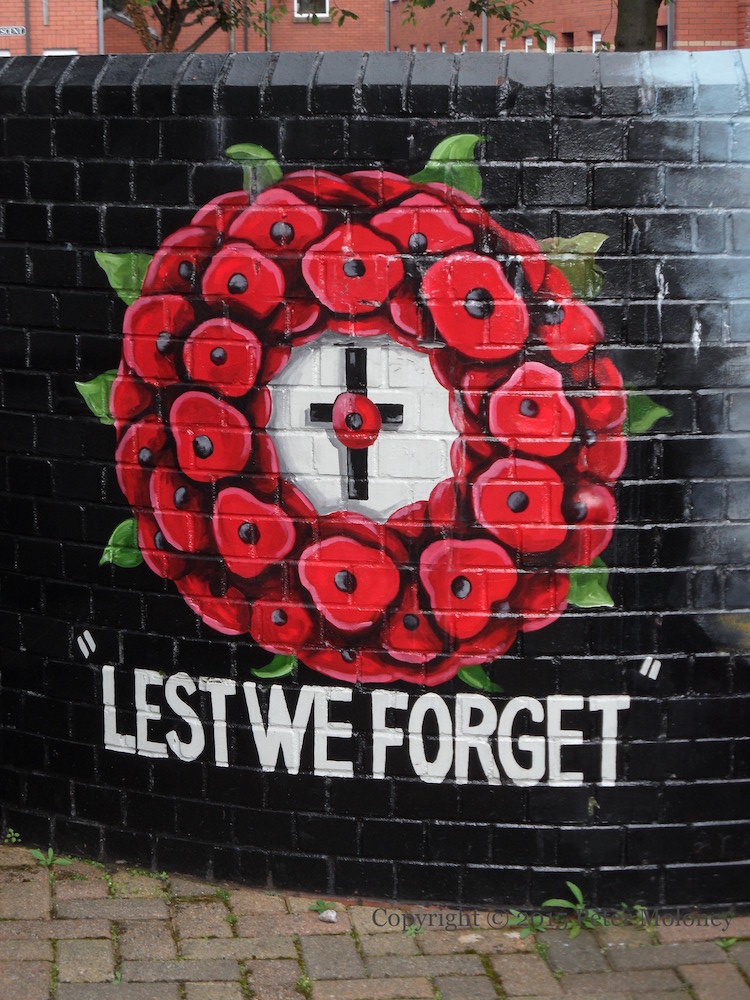
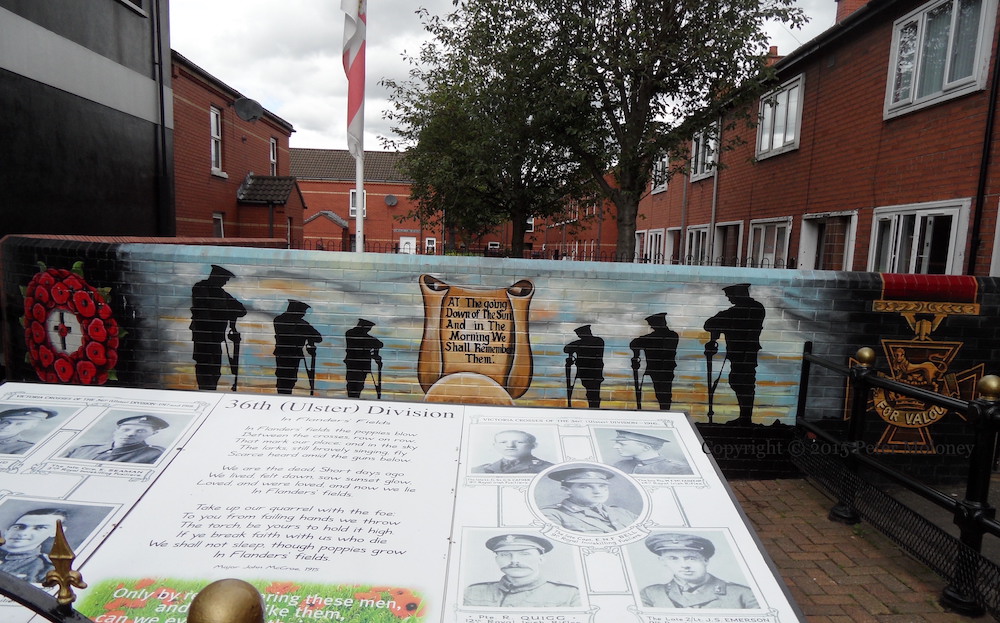
“At the going down of the sun and in the morning, we shall remember them.” The fence at the back of the Belvoir Somme Association’s Victoria Cross memorial garden on along the Newtownards (at the old Newcastle Street) has been replaced with a wall and the poppy wreath on the left (above) has been joined by a mural in memory of the Somme dead and the Victoria Crosses awarded to the 36th Division “For Valour”.
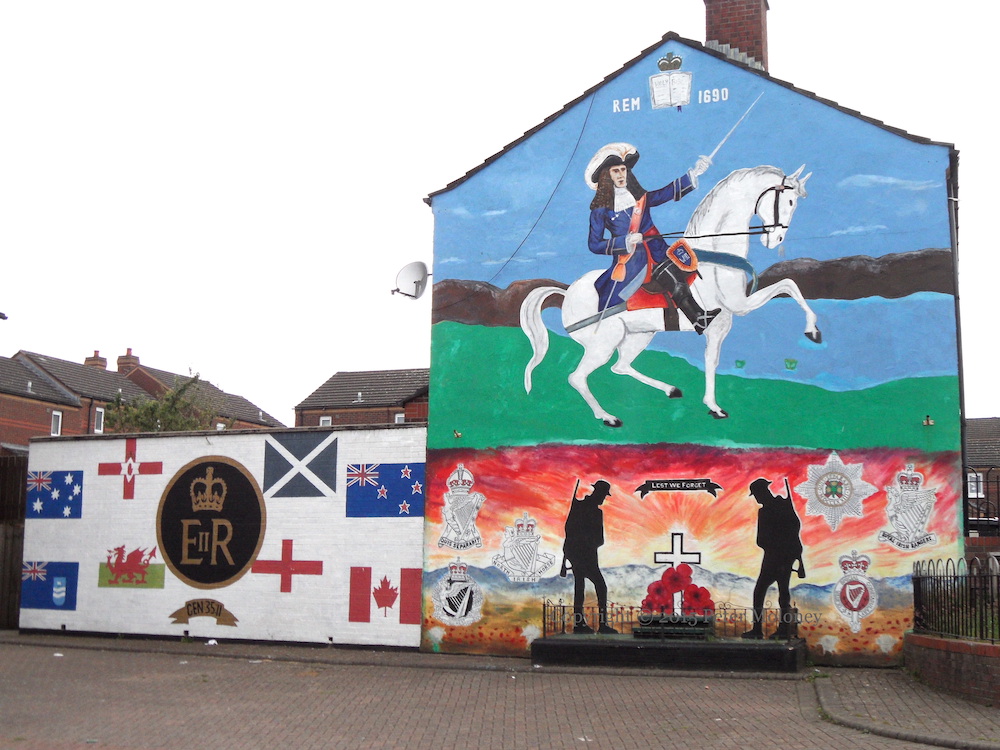
Genesis 35:11 reads (NIV) “And God said to him, “I am God Almighty; be fruitful and increase in number. A nation and a community of nations will come from you, and kings will be among your descendants.” The flags of Northern Ireland, Scotland, Wales, and England are joined in the mural above by those of Australia and (a simplified version of) the Falkland Islands (on the left) and New Zealand and Canada (on the right). The flag flying in the centre is the Royal Standard, flown on the building or vehicle where the monarch is.
The adjacent mural of army badges around a burial scene from the first world war features some lesser-seen items. On the left, alongside the Royal Irish Rifles (top left) and the (modern-day) Royal Irish Regiment (at the time of WWI the harp was plain and there was no garland), we see the emblem of the North Irish Horse, a cavalry unit in the Territorial Army. On the right, the emblem of the Royal Irish Rangers (which was folded into the Royal Irish Regiment in 1992) is joined by the star of the Irish Guards (above) and the emblem of the Ulster Special Constabulary or B-Specials (below). Only the Royal Irish Regiment and the Irish Guards remain as regiments of the British Army; “The Horse” now forms squadrons of other units. Of the six, four served in WWI; the B-Specials were formed in 1920 and the Rangers in 1968.
Above is King William III at the Battle of the Boyne in 1690.
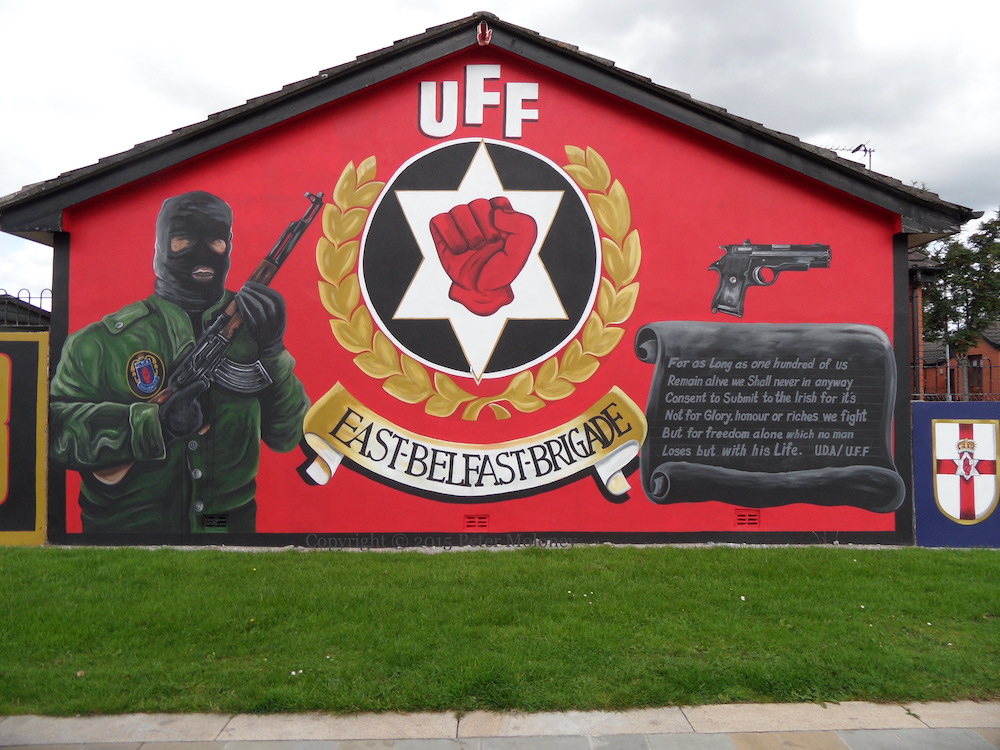
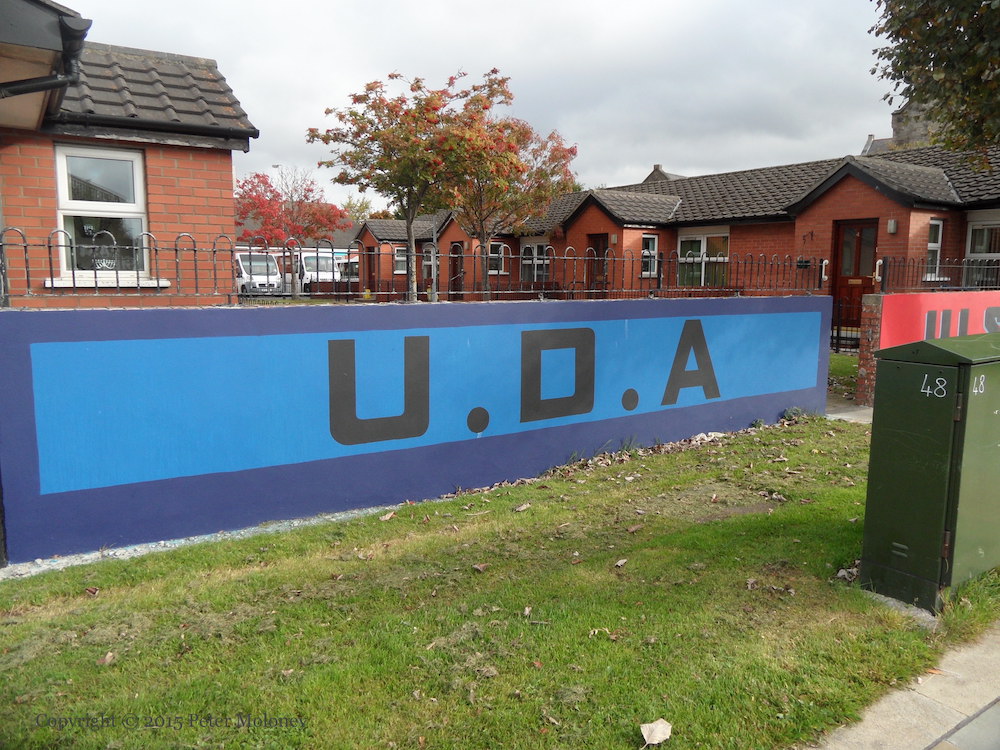
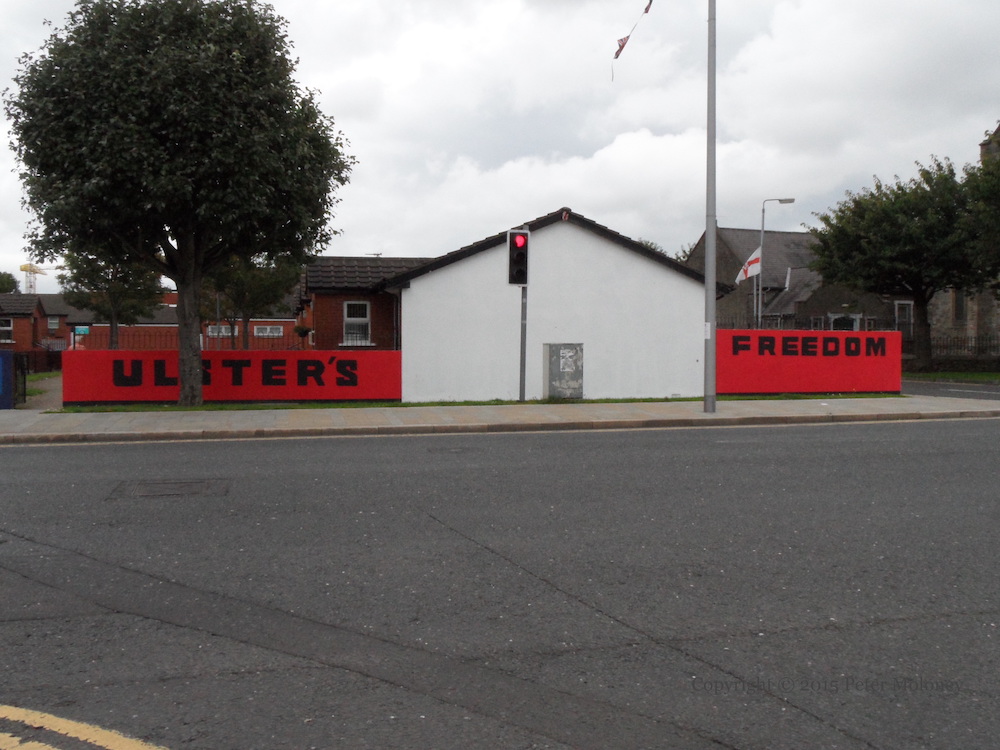
The murals along east Belfast’s “Freedom Corner” (on the Newtownards Road) were repainted over the course of several months in 2015. These images are from a variety of dates in July and August; the ‘red hand’ piece is incomplete – for the finished work, see The Strangest Victory In All History.
The new pieces reproduce the previous ones in terms of theme: UFF/Young Newton at the ends, with the Past (Specials and UDR) and Present Defenders (UDA) in the middle – compare with the 2009 entries Freedom Corner | Ulster’s Present Day Defenders | Young Newton.
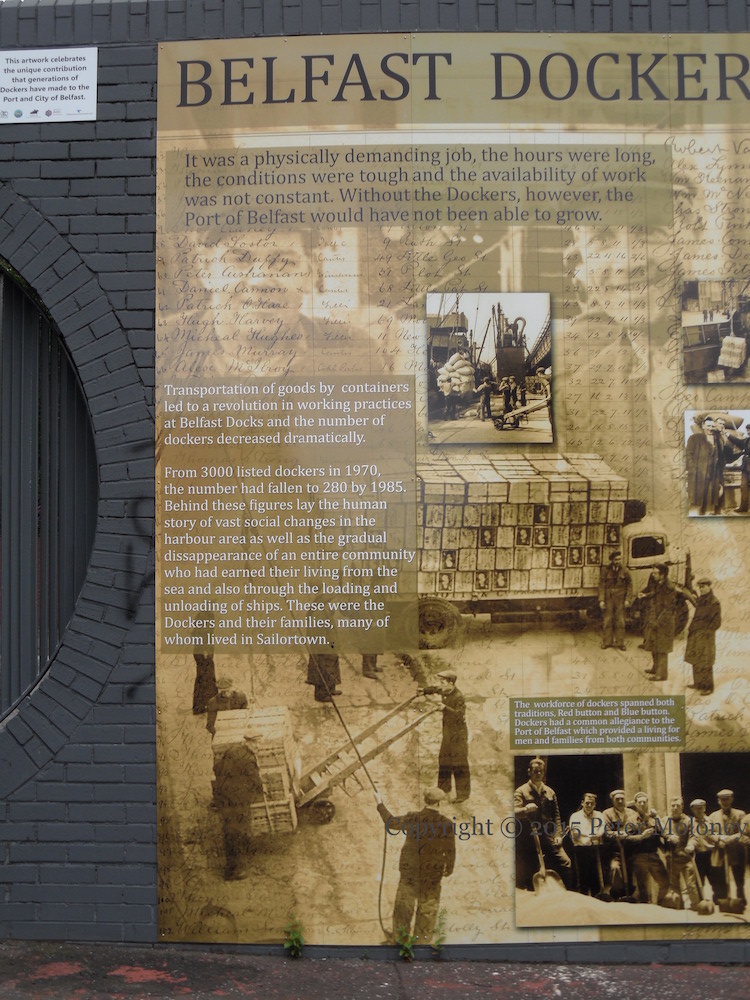
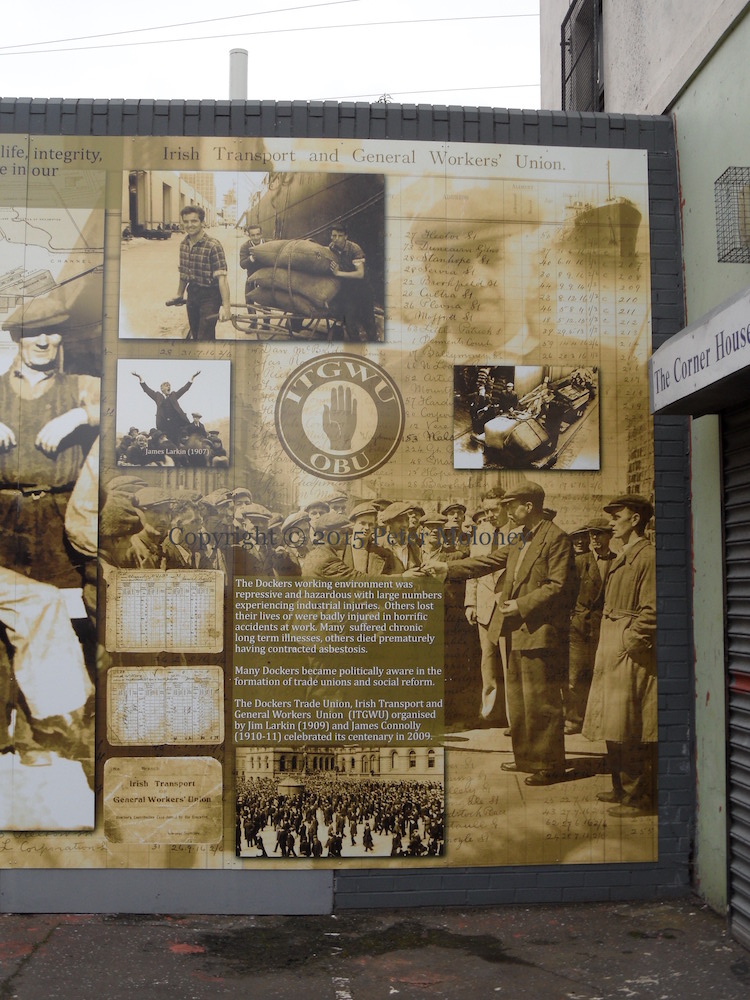
Every day, men would line up in schooling pens on the various docks of the port of Belfast to be hired by foremen. As mentioned on the left-hand side of the board above (recently erected on the New Lodge side of the Duncairn “peace” line) the rise of the shipping container in the 1970s spelled the end of the docker: “from 3000 listed dockers in 1970, the number had fallen to 280 by 1985.” Author and poet John Campbell recalls his first day on the docks in 1952, unloading cement, in this NVTv video.
“This artwork celebrates the unique contribution that generations of dockers have made to the port and City of Belfast.”
“It was a physically demanding job, the hours were long, the conditions were tough and the availability of work was not constant. Without the Dockers, however, the Port of Belfast would not have been able to grow. / Transportation of goods by containers led to a revolution in working practices at Belfast Docks and the number of dockers decreased dramatically. From 3000 listed dockers in 1970, the number had fallen to 280 by 1985. Behind these figures lay the human story of vast social changes in the harbour area as well as the gradual dissappearance [sic] of an entire community who had earned their living from the sea and also through the loading and unloading of ships. These were the Dockers and their families, many of whom lived in Sailortown. / The workforce of dockers spanned both traditions. Red button and Blue button. Dockers had a common allegiance to the Port of Belfast which provided a living for men and families from both communities. / The work was backbreaking, yet the Docks educated us about life, integrity, discipline, about standing up for our rights, about having pride in our identity as working men, as Dockers. / The Dockers[‘] working environment was repressive and hazardous with large numbers experiencing industrial injuries. Others lost their lives or were badly injured in horrific accidents at work. Many suffered chronic long term illnesses, others died prematurely having contracted asbestosis. Many Dockers became politically aware in the formation of trade unions and social reforms. The Dockers Trade Union, Irish Transport and General Workers[‘] Union (ITGWU) organised by Jim Larkin (1909) and James Connolly (1910-11) celebrated its centenary in 2009.”




















 Peter Moloney Collection