“To the memory of Gareth Keys – Mural artist of original artwork Walnut Street, Donegall Pass.” This is a printed version of the YCV mural that was on the side of the Ivy bar in Donegall Pass. The bar closed in 2010 and sat vacant until it was demolished in 2014. The new print has been added below the roll of honour on the side of the Lookout on the next street over (Pine St).
“South Belfast Ulster Volunteer Force 2nd battalion, A company, Donegall Pass.” The flag of England (St. George’s Cross) is in one corner and in the other is an orange star with “1912” written below, the year the Ulster Volunteers were founded. The colour-scheme is the reverse of the Orange Order’s: its flag has the purple star of the Williamites on an orange field.
There is a new ‘Young Conquerors flute band’ mural in Pine Street, south Belfast, connecting the band to local soldiers who died in WWI. (Previous mural.)
The photograph on the left of the main panel is of the original Donegall Pass Defenders flute band, which lasted a short time in the 1970s before the formation of the Conquerors in 1977 (Fb). On the right is the patch of the band.
The small board reads “DPYM” – perhaps “Donegall Pass Young Militia”
“Immediate expulsion of all Israeli diplomats from Éıre”. Gazans flee ahead of smiling soldiers from homes set ablaze by a tank flying the Israeli flag. This new mural on the international wall associates the current Israeli invasion of Gaza (which the Israelis call “Operation Protective Edge“) with the US/South Vietnamese attack on the village of Trang Bang during the Vietnam war by modelling itself on Nick Út’s 1972 Pulitzer prize-winning photograph for the Associated Press of villagers fleeing a napalm bombing (the photo can be seen at Wikipedia).
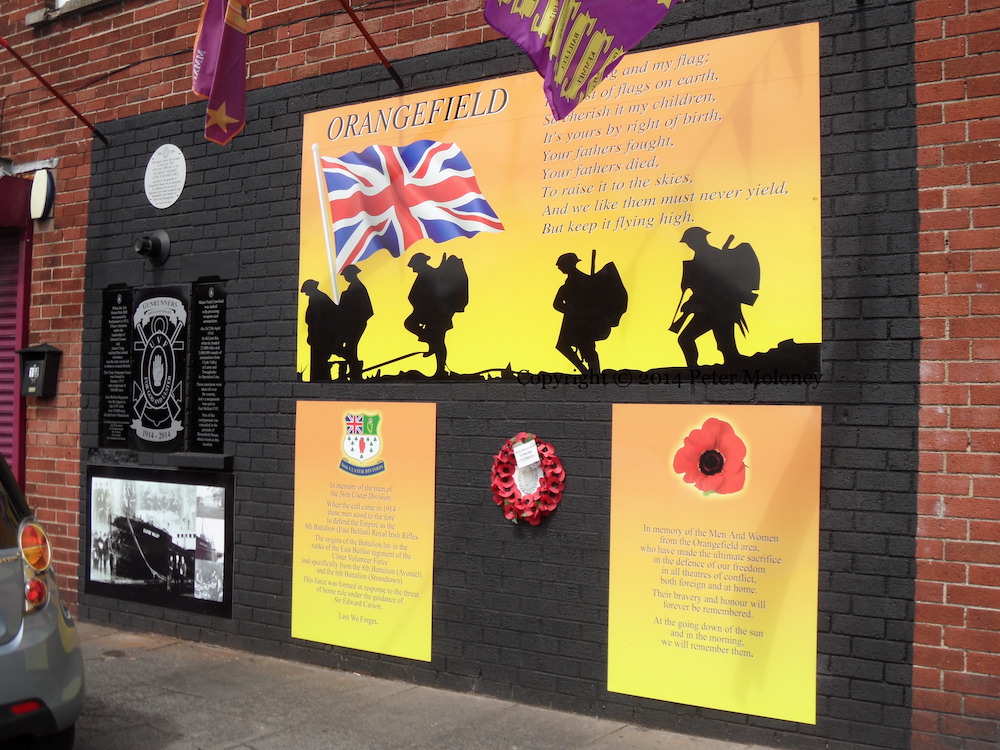
The boards on the left celebrate the 100th anniversary of the 1914 Clyde Valley gun-running; material from the operation was held for the East Belfast battalion of the Ulster Volunteers at Bloomfield House (web), site of these boards. See also: John Henry Patterson’s involvement in Operation Lion.
“When the 3rd Home Rule Bill was passed by Parliament in 1912, Ulster Unionists under the leadership of Edward Carson and James Craig realised that armed resistance was the only resort left to them to remain British. The Ulster Volunteer Force was formed in January 1913 and comprised of 100,000 men. East Belfast Regiment was the largest in the UVF with over 10,000 men divided into 6 Battalions: 1st. Ballynafeigh & Newtownbreda, 2nd. Willowfield, 3rd. Mountpottinger, 4th. Victoria, 5th. Avoniel, 6th. Strandtown & Knock. Major Fred Crawford was tasked with procuring weapons and ammunition. On 24/25th April 1914 he did just this when landed 25,000 rifles and 3,000,000 rounds of ammunition from Clyde Valley at Larne and Donaghadee in Operation Lion. These munitions were taken all over the country, and a consignment was sent to East Belfast UVF. Part of this consignment was concealed in the grounds of Bloomfield House, which stood on this location.”
“This plaque marks the occasion in early May 1914 when over 2,000 men of the East Belfast Regiment, Ulster Volunteer Force paraded to the grounds of Orangefield House for an inspection to celebrate the success of Operation Lion when weapons and ammunition were landed at Larne and Donaghadee. For God and Ulster.”
The boards on the right read: “‘Tis thy flag and my flag;/The best of flags on Earth,/So cherish it my children,/It’s yours by right of birth.//Your fathers fought,/Your fathers died,/To raise it to the skies,/And we like them must never yield,/But keep it flying high.” from The UnionJack, by Edward Shirley, in Little Poems For Little People, and “In memory of the men and women from the Orangefield area, who have made the ultimate sacrifice in the defence of our freedom in all theatres of conflict, both foreign and at home.” These memorial boards are to local men who “stood to the fore to defend the Empire as the 8th Battalion (East Belfast) Royal Irish Rifles” in the 36th division, formed from formed from the “8th Battalion (Avoniel) and the 6th Battalion (Strandtown)” of the Ulster Volunteers.
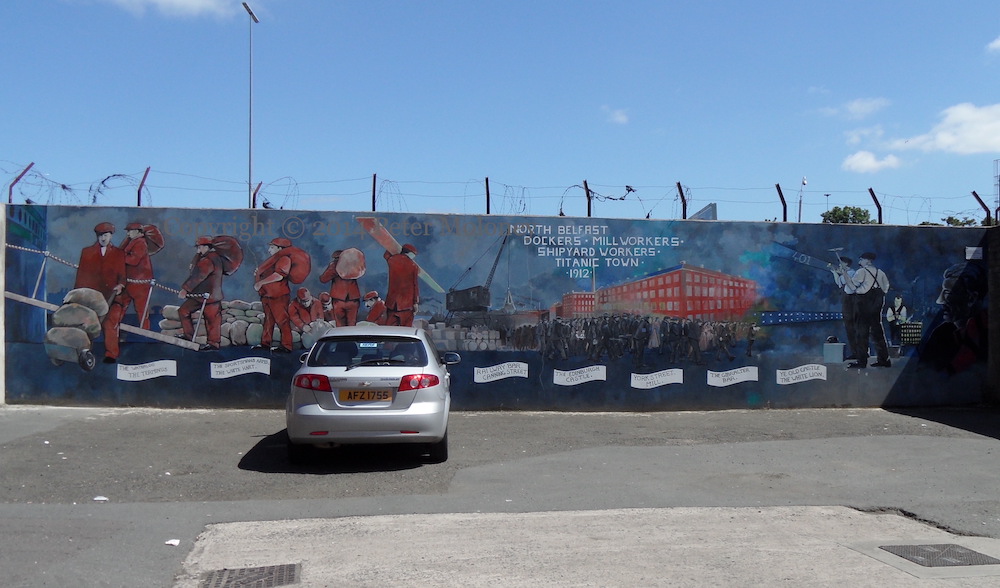
The mural presents a montage of images of “North Belfast dockers, millworkers, shipyard workers” working in “Titanic town 1912”. Along the bottom are the names of various Belfast pubs and other businesses: The Waterloo, The Terminus, The Sportsman’s Arms, The White Hart, The Bowling Green, The City Arms, The Orpheus – York Street, Railway Bar – Canning Street [image from 1970], The Edinburgh Castle [the boat of the Union-Castle line, launched 1910, built at H&W?], York Street Mill, The Gibralter [sic] Bar [whose then-owner was killed in 1972], Ye Old Castle [a bar (and restaurant?) bombed in 1971], The White Lion.
The plaque on the right-hand side reads: “This mural was developed under Belfast City Council’s Titanic community engagement project, with support from Titanic Foundation. Thanks go to Jim Crothers and The Hubb Community Resource Centre.”
St. Vincent Street, north Belfast. For a wide shot without vehicles, see X01139.
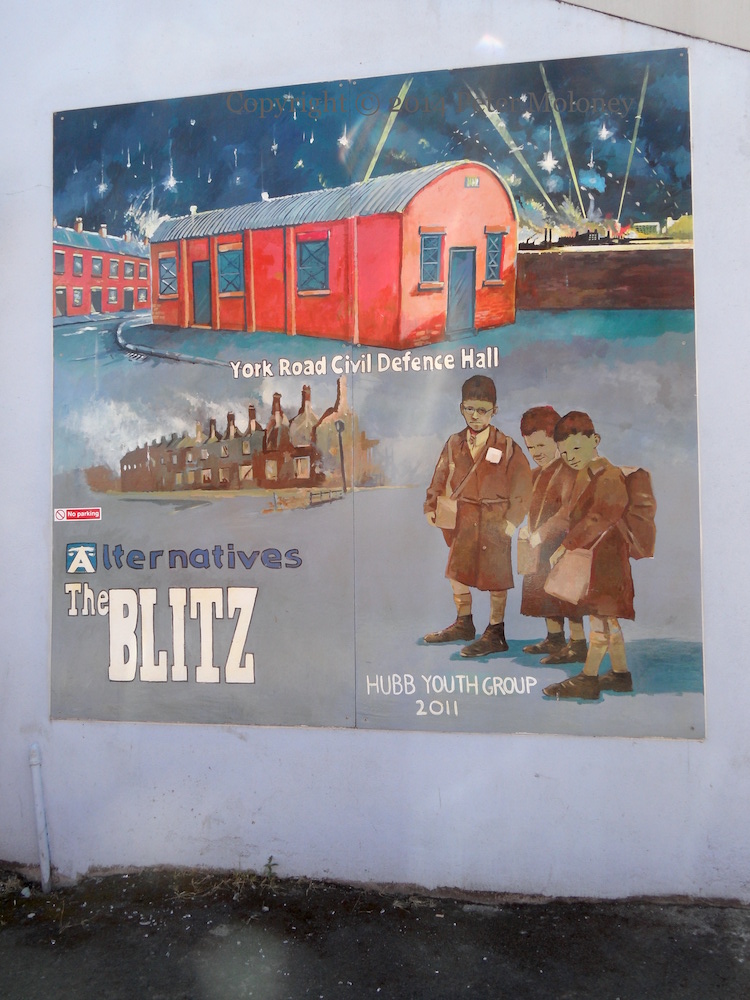
This board is on the end of the Hubb Community Resources Centre and Bowling Club in St. Vincent Street, north Belfast; across the street is Crusaders football ground.
From the Tele: “The building was once the home for local Civil Defence during World War II’s ‘Blitz’. This building is now the one of the last remaining Civil Defence structures in Northern Ireland and has also played home to the local Senior Bowls Club for many years.” The mural also shows bombed-out homes and children going off to the countryside. Short documentary about the 1941 Belfast Blitz (youtube).
HMS Caroline’s connection to Belfast is that she served as the headquarters for the Royal Naval Reserve in Alexandra Dock. Originally built in 1914, she served in the Grand Fleet and took part in the battle of Jutland on May 31st, 1916, as shown in the image above. She was decommissioned in 2011; it is hoped to open her as a museum and visitor attraction by the time of the centenary of the battle (WP). The Daily Mail has a gallery of images of the ship in its current state. Also present at the battle of Jutland, as captain of HMS Nestor, was Commander (later Sir) Edward Bingham.
By Jim Russell in St. Aubyn’s Street, north Belfast
” ‘Peace is more difficult than war. We were not scared as we resisted; we will not be scared when we make peace.’ – Abdulla[h] Öcalan, PKK (Kurdistan Worker[s’] Party), a revolutionary, a prisoner in solitary confinement since Feb 1999. Sign the petition http://www.freeocalan.org “
Öcalan was arrested in Kenya, after being shuttled around by various European countries (Italy, Russia, Greece) who did not want to extradite him but did not want to give him asylum; he was trying to get to the Hague to confront the charges of terrorism with which he was charged. He has changed from advocating violence to advocating a political solution to the Kurdish situation in Turkey. (WP)






 Peter Moloney Collection