This new mural pays tribute to two long-time residents of Clonard. On a good day, Noel Fitzpatrick, a cobbler with a little shop on the corner of Odessa and Clonard streets, would take his chair out into the street and play the uıleann pipes. Looking down from above is Alec Reid, the Redemptorist priest who spent 40 years at Clonard monastery and played an important role in the peace process. He died in 2013 at age 82. (WP)
Painted by Marty Lyons & Mickey Doc in Springfield Drive. For the large ‘flower’ mural to the left of this mural (which imitates the stained glass in the cathedral), see C01044.
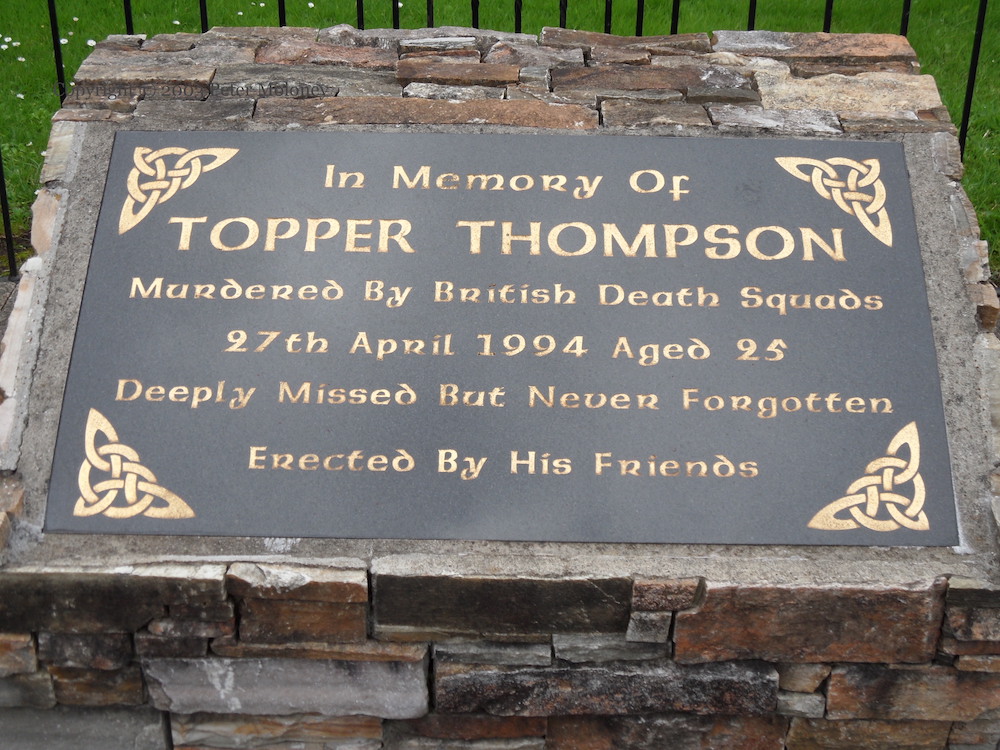
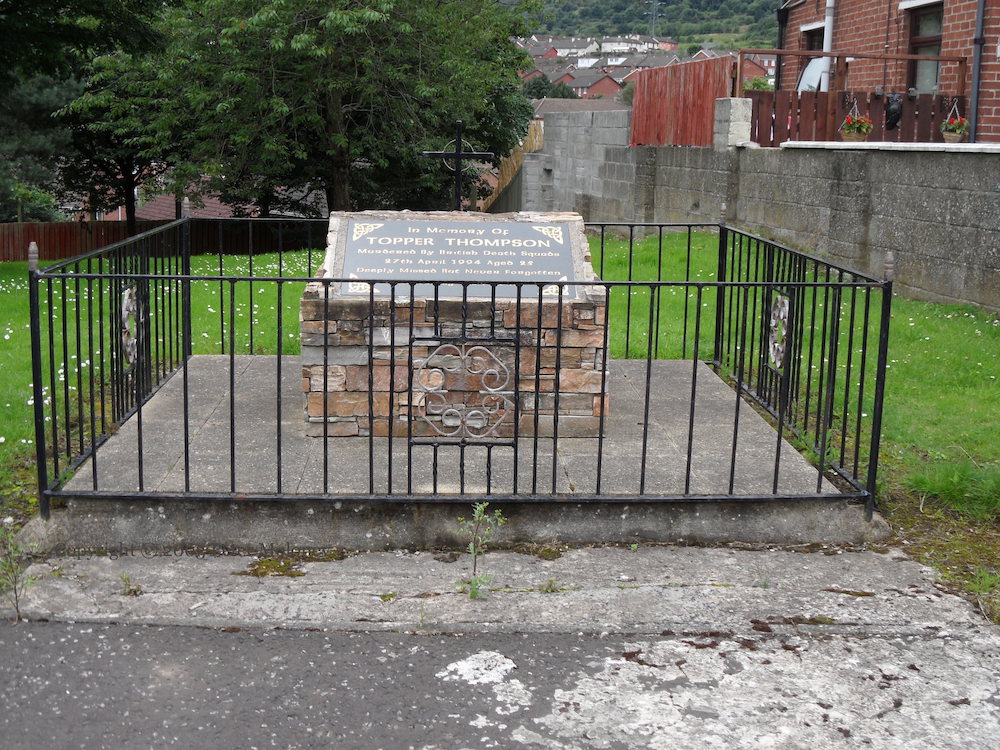
“In memory of Topper Thompson, murdered by British death squads, 27th April 1994 aged 25. Deeply missed by never forgotten. Erected by his friends.” Paul Thompson was shot by a UDA gunman through a hole that had been cut in the security fence and about which the RUC had been notified earlier in the day (Relatives For Justice).
“Join RSF [Republican Sınn Féın] – Éıre Nua”. Éıre Nua was the Provisional Sınn Féın and (after the 1986 split) Republican Sınn Féın (RSF) plan for a federal Ireland, with a semi-independent Ulster parliament (pdf | also a social and economic plan pdf).
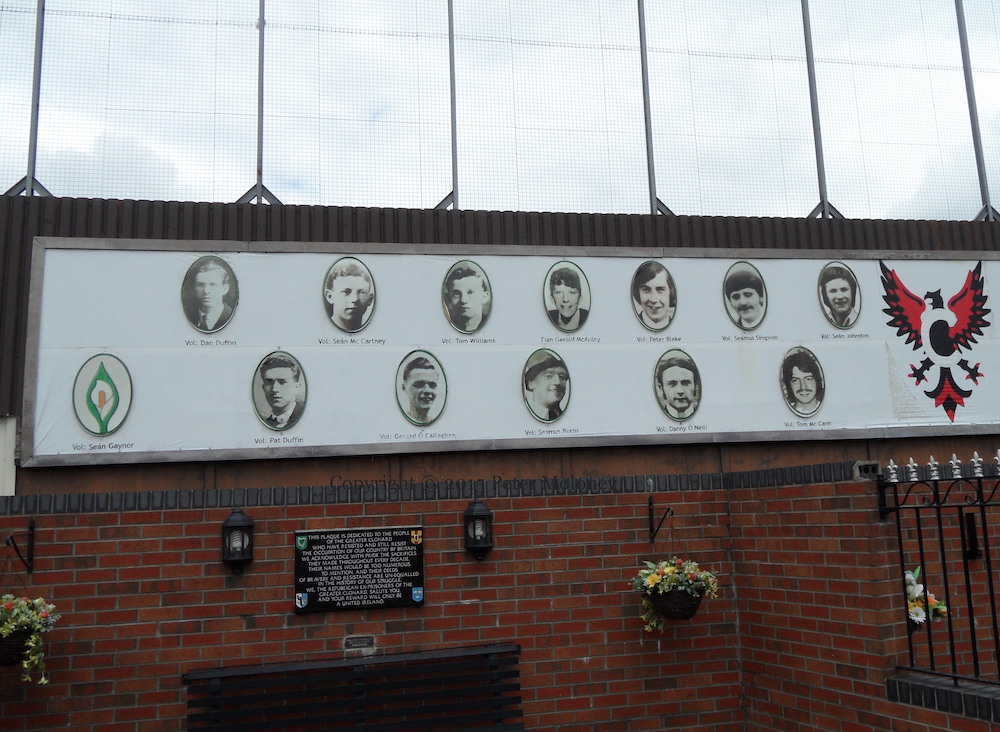
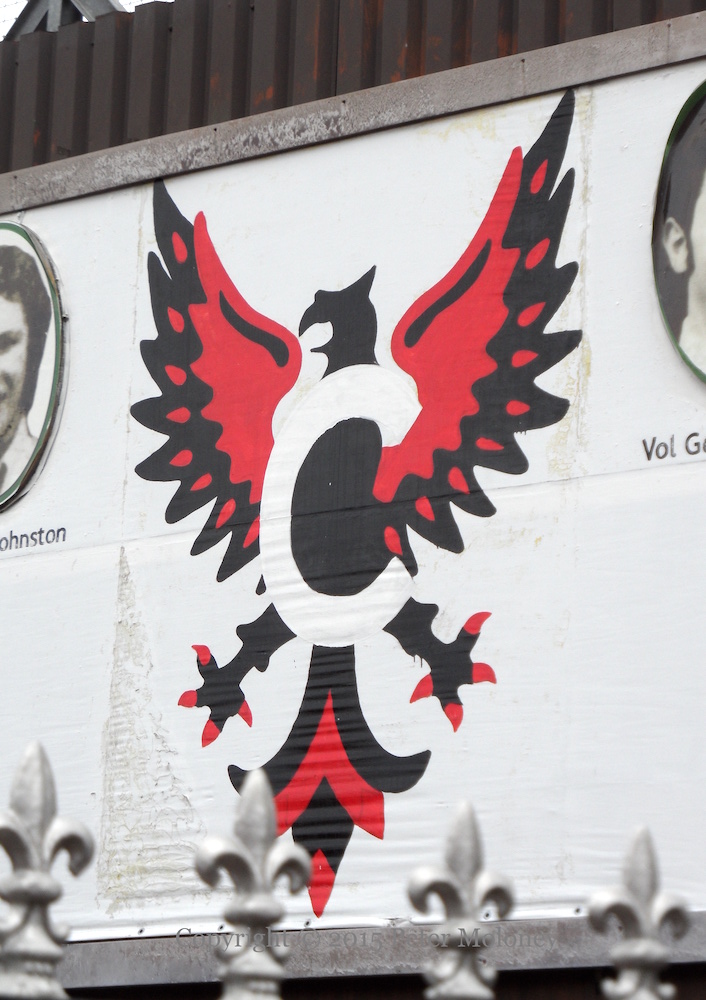
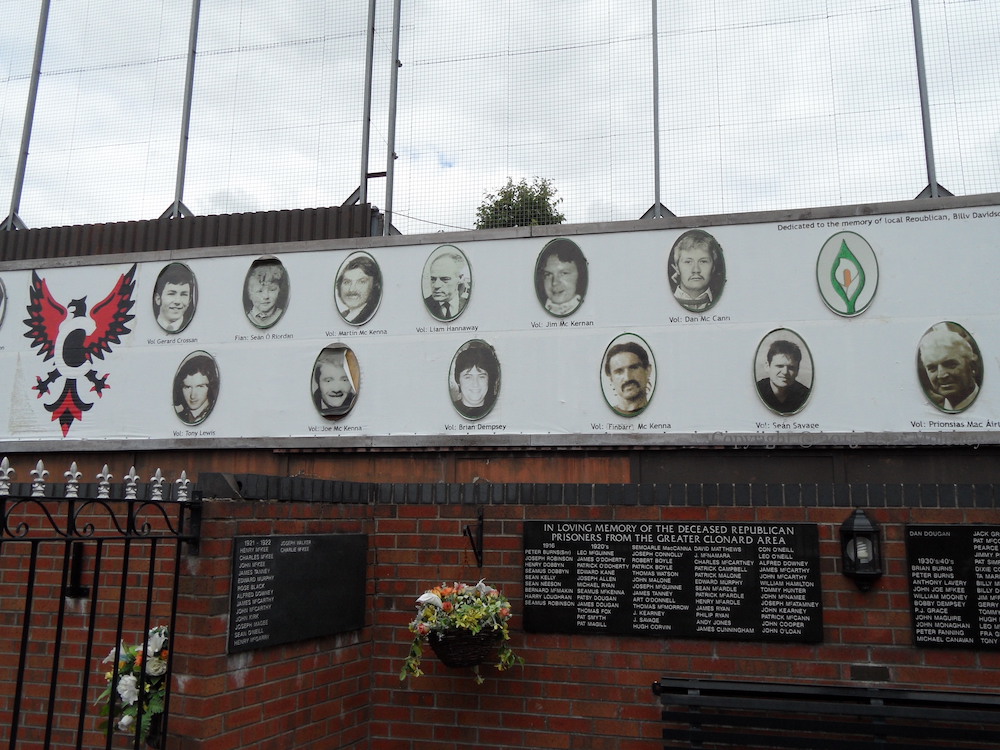
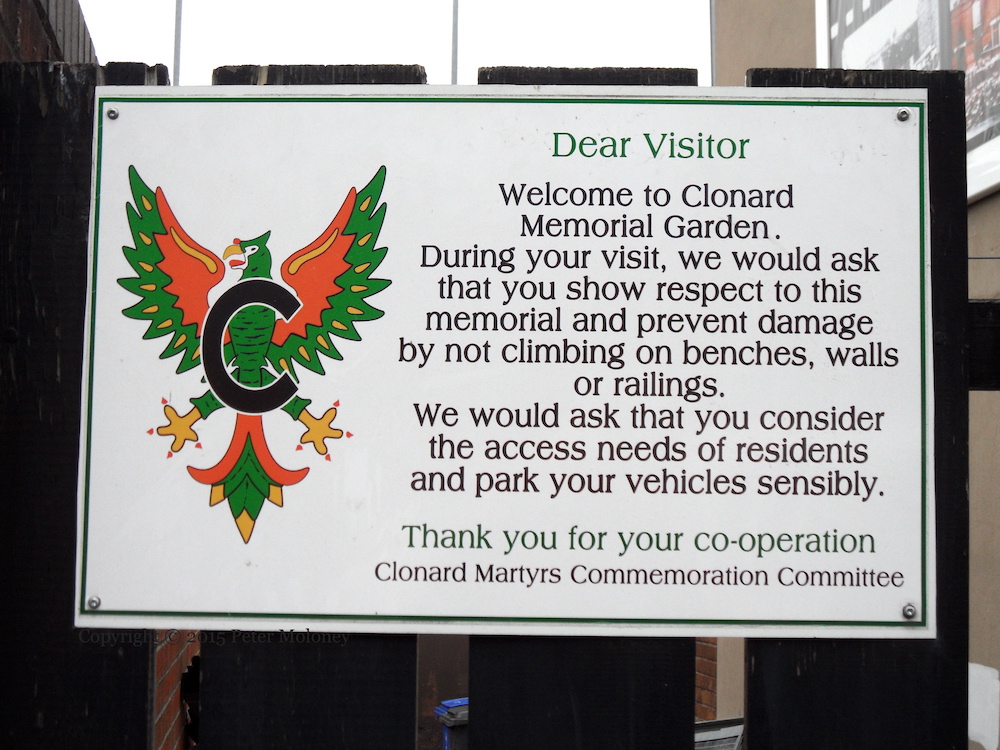
This is a replacement version of the gallery of “Clonard Martyrs” above the memorial garden, seen previously in 2011. The central phoenix is now in red (rather than green) and the background imagery has been removed but the roll of honour remains the same:
Left: Dan Duffin, Seán McCartney, Tom Williams, Gerard McAuley, Peter Blake, Seamus Simpson, Seán Johnston, Seán Gaynor, Pat Duffin, Gerard Ó Callaghan, Seamus Burns, Danny Ó Neill, Tom McCann.
Right: Gerard Crossan, Seán Ó Riordan, Martin McKenna, Liam Hannaway, Jim McKernan, Dan McCann, “dedicated to the memory of local republican, Billy Davidson”, Tony Lewis, Joe McKenna, Brian Dempsey, Finbarr McKenna, Seán Savage, Prıonsaıs Mac Áırt.
“In memory of volunteers Pat and Dan Duffin, murdered by the RIC in their home at 64 Clonard Gardens 23rd April 1921. Erected the by the Greater Clonard Ex-Prisoners Association.”
The IRA shot dead two members of the British Auxiliaries, Ernest Bolan and John Bales, in Donegall Street in Belfast city centre on April 23rd, 1921. Just before midnight, Pat and Dan Duffin were shot to death by men who entered their Clonard home.
Another brother, John, was upstairs and not harmed and when he approached the scene he found not only his dead brothers but the station dog of the Springfield Road RIC barracks (“GB Kenna“, real name Fr John Hassan).
DeValera led the funeral cortège along the Falls. Joe Devlin would include the Duffin murders in a Westminster speech in June, following the killings in a single night of Alexander McBride, Malachy Halfpenny, and William Kerr (Hansard). The RIC in west Belfast under CI Harrison, DI Nixon, and in this case DI Ferris (Aiken et al.), would continue their killings into 1922 – see The RIC Murder Gang.
The 1916 Proclamation Of Irish Republic includes the sentence “The Republic guarantees religious and civil liberty, equal rights and equal opportunities to all its citizens, and declares its resolve to pursue the happiness and prosperity of the whole nation and of all its parts, cherishing all of the children of the nation equally, and oblivious of the differences carefully fostered by an alien Government, which have divided a minority from the majority in the past.”
At the time, it had a political meaning, but it has since been pressed into service by advocates of children’s right and now, in the board above, by supporters of gay rights. James Connolly (leader of the Irish Citizen Army) and the text of the declaration are shown against a backdrop of the gay pride rainbow flag.
Launched 2015-07-31 at the site of the former Andersonstown RUC barracks (Visual History)
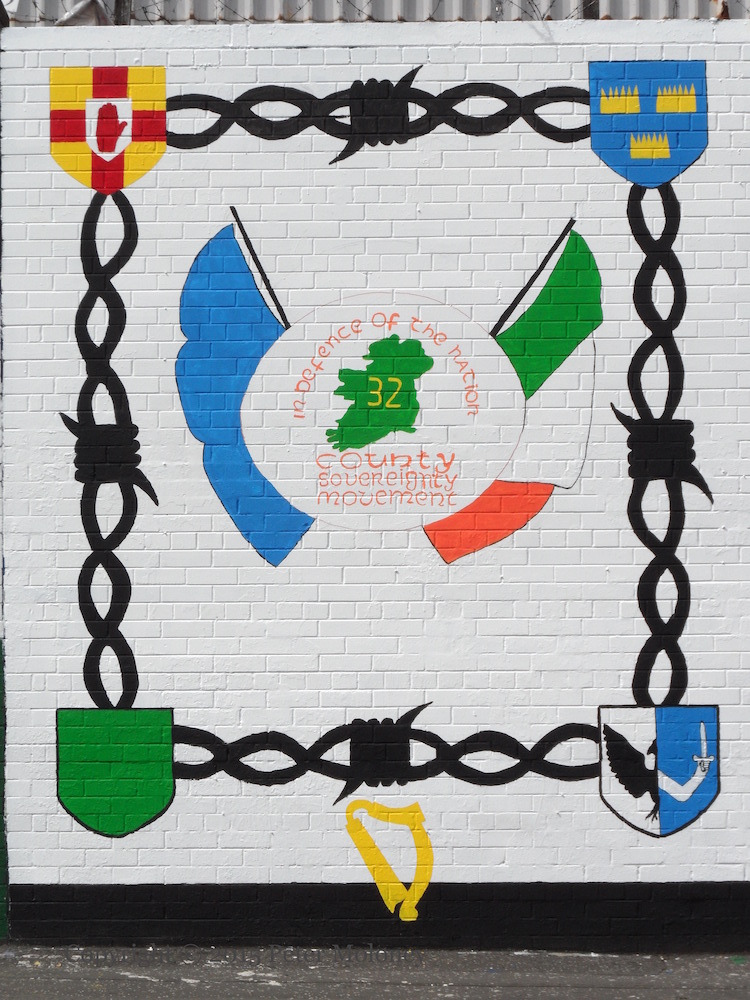
This is a new mural from the 32 County Sovereignty Movement (web) on the international wall, Divis Street, (Visual History) with symbols of nationalism (the crests of the four provinces, the harp, the Tricolour), socialism (the plough in the stars) and support for republican POWs (the barbed wire).
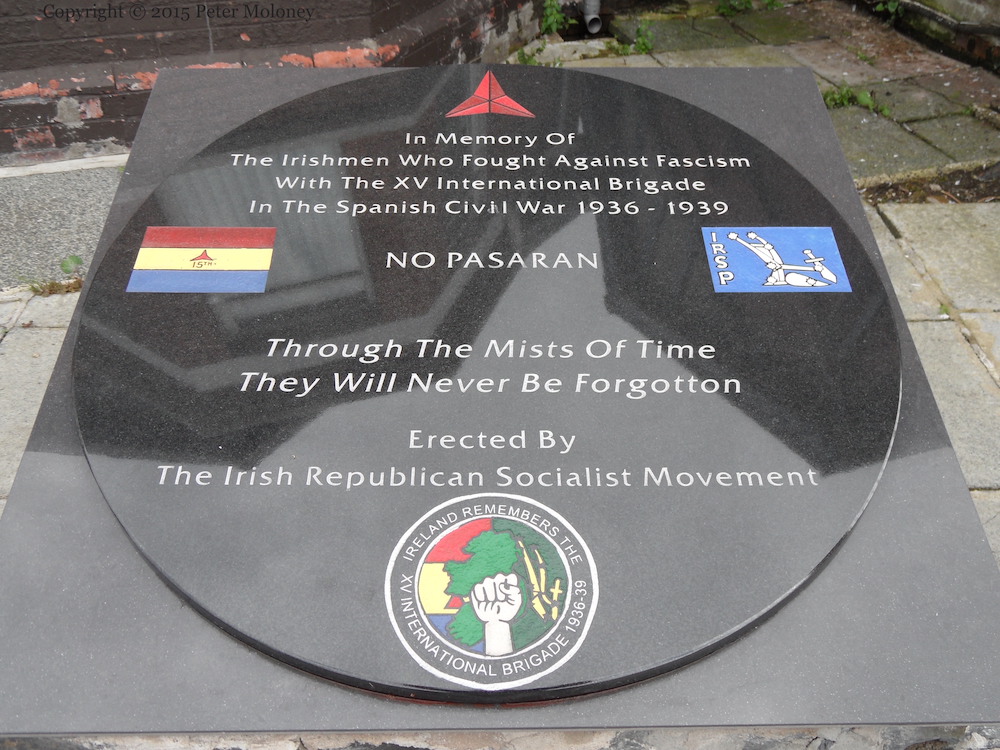
These images are from the front yard of Costello House, the Falls Road home of the IRSP. Top, “Belfast RSYM [Republican Socialist Youth Movement] – join the movement”. Immediately above, “In memory of the Irishmen who fought against fascism with the XV International Brigade in the Spanish Civil War 1936-1939. No pasaran. ‘Through the mists of time they will never be forgotten.’ Erected by the Irish Republish Socialist Movement.”
Here is the new Patrick O’Connell, “Don Patricio”, mural at the bottom of the Whiterock. As a player, the Dublin-born O’Connell started with Belfast Celtic before moving on to various English and Scottish clubs, including a period at Manchester United at the time of WWI. He then went on to manage a string of Spanish clubs. As manager of Barcelona during the Spanish civil war, he accompanied the club on their tour of Mexico and the United States. The money from the tour saved the club from bankruptcy but 12 of the 16 players went into exile in Mexico and France. (WP) Barcelona returns to the US this month (2015-07) for games against the LA Galaxy, Manchester United, and Chelsea. (FCBarcelona)
The newspaper in the mural above crams all of this news onto one page: “Civil war erupts in Spain – Barcelona bombed”, “Football suspended – President [of FC Barcelona] Josep Sunyol assassinated” [by Franco’s troops] (WP); “Irishman O’Connell takes players on tour – FC Barcelona saved from extinction”; “Funds lodged in Switzerland”. In the bottom left-hand corner of the newspaper is Robert Capa’s famous photograph of ‘The Falling Soldier’, purporting to show a Republican soldier at the very moment he is struck by a bullet and dies. The image is now thought to have been staged (WP).
Next to O’Connell is Lionel Messi. The Argentinian forward is shown in front of the Spanish League cup, which Barcelona won this year (2014-2015) with a goal from “La Pulga” (“the flea”) – Messi is 5’7″ but four-time world player of the year.
The stands of three football stadiums are shown in the background of the mural: Belfast Celtic’s Celtic Park (“Paradise”), Manchester United’s Old Trafford, and Barcelona’s Camp Nou. The Old Trafford stands bear the emblems of the teams Patrick O’Connell played for and managed: Liffey Wanderers (whose shirt is also featured, on the left), Sheffield Wednesday, Hull City (The Tigers), Manchester United, Dumbarton, Real Racing Club de Santander, Real Oviedo, and Real Betis Balompié (also shirt on the right).
In this modified ‘School’ safety sign in the Lower Shankill estate, a mother and child with Orange Order collarettes go to school (under the watchful eye of the trio of UFF, UYM, and UDA boards seen in Loyalist Lower Shankill.)
(In 2000, a board reading “Drumcree” was placed over “School”. See J0585)