The 1916 Proclamation Of Irish Republic includes the sentence “The Republic guarantees religious and civil liberty, equal rights and equal opportunities to all its citizens, and declares its resolve to pursue the happiness and prosperity of the whole nation and of all its parts, cherishing all of the children of the nation equally, and oblivious of the differences carefully fostered by an alien Government, which have divided a minority from the majority in the past.”
At the time, it had a political meaning, but it has since been pressed into service by advocates of children’s right and now, in the board above, by supporters of gay rights. James Connolly (leader of the Irish Citizen Army) and the text of the declaration are shown against a backdrop of the gay pride rainbow flag.
Launched 2015-07-31 at the site of the former Andersonstown RUC barracks (Visual History)
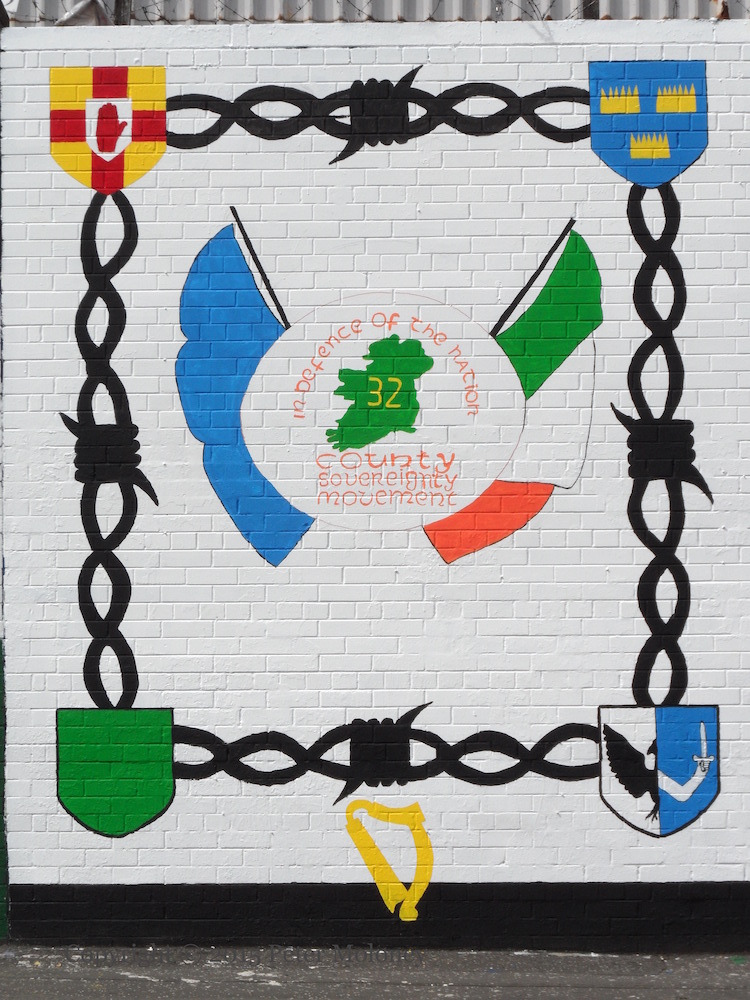
This is a new mural from the 32 County Sovereignty Movement (web) on the international wall, Divis Street, (Visual History) with symbols of nationalism (the crests of the four provinces, the harp, the Tricolour), socialism (the plough in the stars) and support for republican POWs (the barbed wire).
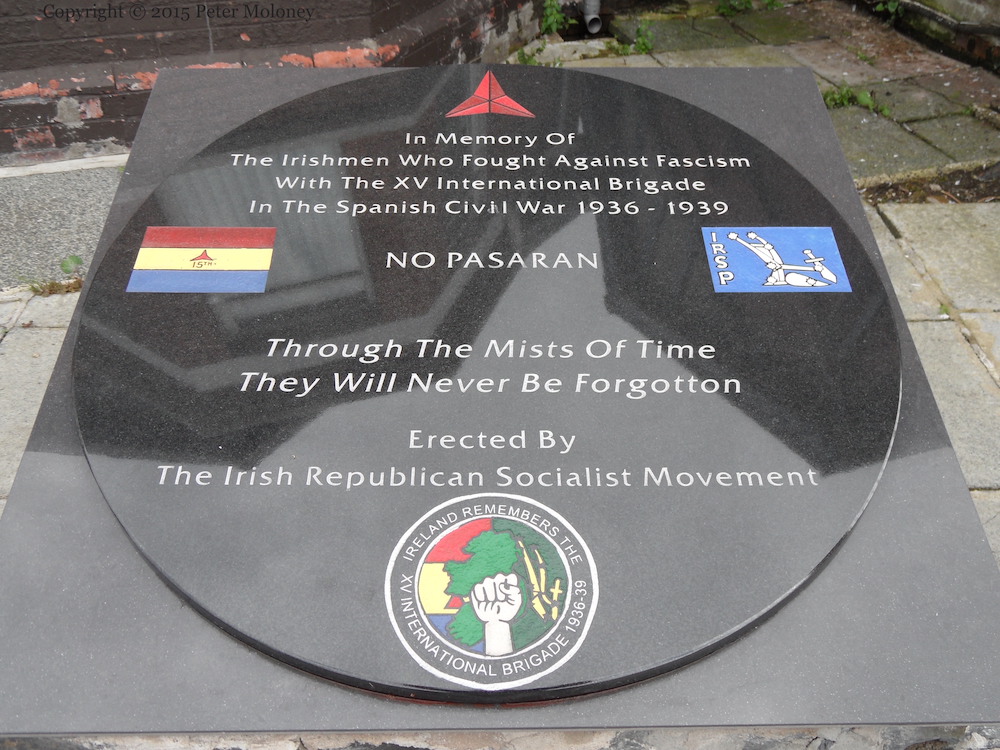
These images are from the front yard of Costello House, the Falls Road home of the IRSP. Top, “Belfast RSYM [Republican Socialist Youth Movement] – join the movement”. Immediately above, “In memory of the Irishmen who fought against fascism with the XV International Brigade in the Spanish Civil War 1936-1939. No pasaran. ‘Through the mists of time they will never be forgotten.’ Erected by the Irish Republish Socialist Movement.”
Here is the new Patrick O’Connell, “Don Patricio”, mural at the bottom of the Whiterock. As a player, the Dublin-born O’Connell started with Belfast Celtic before moving on to various English and Scottish clubs, including a period at Manchester United at the time of WWI. He then went on to manage a string of Spanish clubs. As manager of Barcelona during the Spanish civil war, he accompanied the club on their tour of Mexico and the United States. The money from the tour saved the club from bankruptcy but 12 of the 16 players went into exile in Mexico and France. (WP) Barcelona returns to the US this month (2015-07) for games against the LA Galaxy, Manchester United, and Chelsea. (FCBarcelona)
The newspaper in the mural above crams all of this news onto one page: “Civil war erupts in Spain – Barcelona bombed”, “Football suspended – President [of FC Barcelona] Josep Sunyol assassinated” [by Franco’s troops] (WP); “Irishman O’Connell takes players on tour – FC Barcelona saved from extinction”; “Funds lodged in Switzerland”. In the bottom left-hand corner of the newspaper is Robert Capa’s famous photograph of ‘The Falling Soldier’, purporting to show a Republican soldier at the very moment he is struck by a bullet and dies. The image is now thought to have been staged (WP).
Next to O’Connell is Lionel Messi. The Argentinian forward is shown in front of the Spanish League cup, which Barcelona won this year (2014-2015) with a goal from “La Pulga” (“the flea”) – Messi is 5’7″ but four-time world player of the year.
The stands of three football stadiums are shown in the background of the mural: Belfast Celtic’s Celtic Park (“Paradise”), Manchester United’s Old Trafford, and Barcelona’s Camp Nou. The Old Trafford stands bear the emblems of the teams Patrick O’Connell played for and managed: Liffey Wanderers (whose shirt is also featured, on the left), Sheffield Wednesday, Hull City (The Tigers), Manchester United, Dumbarton, Real Racing Club de Santander, Real Oviedo, and Real Betis Balompié (also shirt on the right).
In this modified ‘School’ safety sign in the Lower Shankill estate, a mother and child with Orange Order collarettes go to school (under the watchful eye of the trio of UFF, UYM, and UDA boards seen in Loyalist Lower Shankill.)
(In 2000, a board reading “Drumcree” was placed over “School”. See J0585)
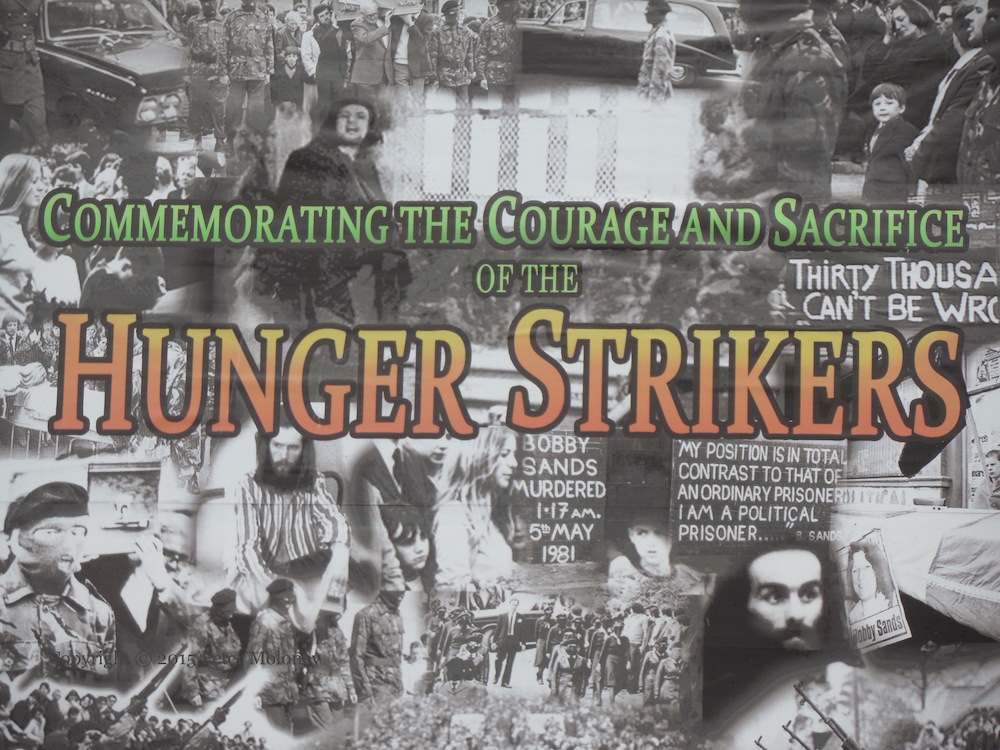
Here is a close-up of the the middle of the Hunger Strike board above the Clowney Street phoenix (which is the Oldest Mural in Belfast) seen previously in 2013.
For an image of the writing – “Bobby Sands murdered 1.17 am. 5th May 1981. ‘My position is in total contrast to that of an ordinary prisoner: I am a political prisoner.”” – see the Homer Sykes collection. The quotation is from Sands’s ‘The Lark And The Freedom Fighter’ (pdf).
For “Thirty thousand can’t be wrong” see this episode of Thames TV’s ‘TV Eye’ (youtube).
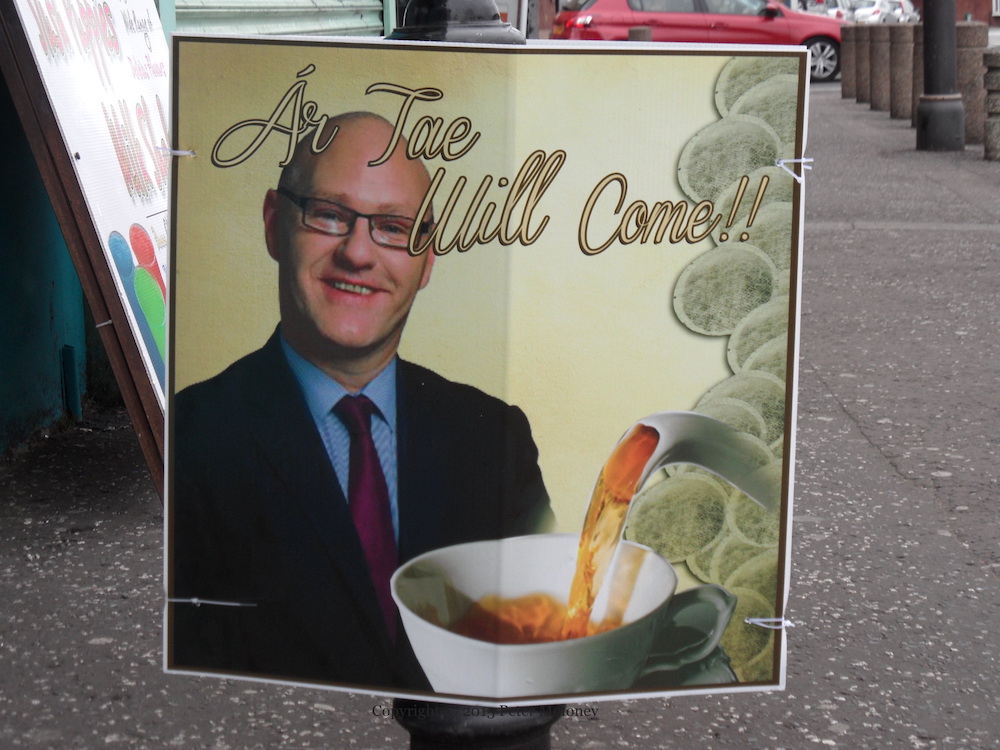
Sınn Féın representatives Paul Maskey (above), Gerry Adams, Alex Maskey, and Martin McGuinness are photoshopped into these coffee-themed, Irish-language puns outside the ‘Falls Rolls’ bakery: Ár tae will come, Tıocfaıgh [sic] ár látte, Al cappuchino, and Mocha-ra.
A week before he was assassinated and his government overthrown, Burkina Faso president Thomas Sankara asserted: “While revolutionaries as individuals can be murdered, you cannot kill ideas.” Sankara gained power of Burkina Faso (then Upper Volta) in a 1983 coup and launched an ambitious programme of literacy, feminism, public health, and agricultural self-sufficiency, in addition to launching a drive against corruption and of nationalizing natural resources. He attempted this all without the assistance of foreign aid or the IMF or World Bank. However, he wielded power outside the jurisdiction of the courts and controlled the press. He and twelve colleagues were killed in October 1987.
INLA hunger-striker Kevin Lynch has been returned (see 2006) to the gable wall he previously adorned after making way for Marian Price, Political Hostage from 2012 to 2014.
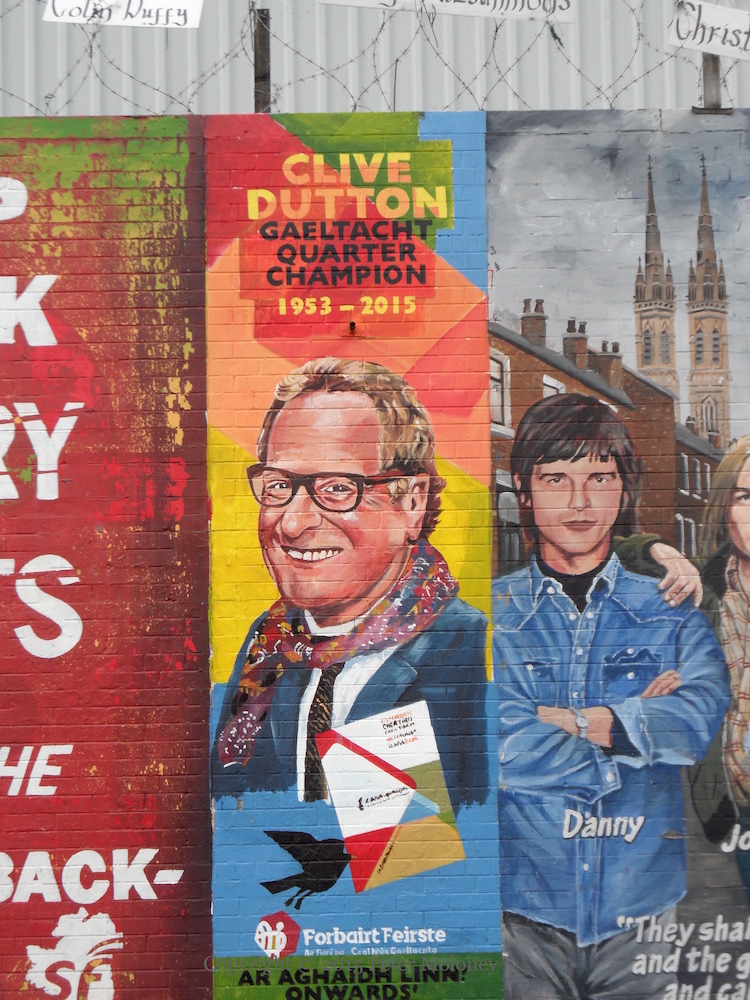
Englishman Clive Dutton was an urban planner who was best known for work in Birmingham, London (Newham), and Belfast. He produced “The Dutton Report” (pdf) in 2004 and “The Big Plan” (pdf) (the cover of which is pictured in the mural) in 2013. In them, he proposed and then updated a plan to tackle economic deprivation in west Belfast by the creation of a ‘Gaeltacht Quarter’ or ‘Ceathrú Gaeltachta’. He died on June 8th at the age of 62 and the mural above has been painted in remembrance.









 Peter Moloney Collection