“”In my country we go to prison first and then become President” – Madiba, Nelson Mandela, freedom lover, friend of Ireland.” The ailing Nelson Mandela’s turns 95 on July 18th, 2013 and to celebrate a new mural has been painted on Northumberland Street, Belfast, by Lucas Quigley (you can see a signature and a telephone number in the lower right). The mural features Mandela, the flags of Ireland and South Africa, and the Sınn Féın logo.
Robert Dougan was commander of the UDA South Belfast Brigade and lived the Oranmore Drive (BelTel). He was killed by the IRA on February 10th, 1998 while sitting in a car outside Balmoral Textiles in Dunmurry, which led to a month-long expulsion of Sinn Féin from the talks (L.A. Times); two months later the Good Friday Agreement was signed. There had been attempts on his life in 1993 and 1994 (Irish Times).
Here are various walls supporting Stephen Murney, an éırígí (web) activist currently in prison since December 2012 on terrorism charges (BBC-NI).
The first is in Hugo Street, to which an éırígí star was later added; the second (from March) is on Divis Street; the third, next to the outstretched arms of Jim Larkin, is under the advertising hoarding in Northumberland Street – in November, Larkin and the banner were replaced with the stencils in the two following images. The final image is from the Andersonstown Road.
“In Memory of the Belfast men who fought against fascism with the international brigade, Spanish civil war 1936 – 1939.” The colours of the international brigade (red, yellow and purple – here a lighter violet colour) serve as a background.
The board shows Belfast socialists walking at Bodenstown, 1934 as part of the annual Wolfe Tone commemoration, held each year in June. Tone, an Anglican and the founder of the United Irishmen, is buried in the Bodenstown graveyard. Sources report, however, that there was an attempt to exclude these marchers, from “Shankill Rd Belfast Branch”, from part of the 1934 commemoration. The reasons given vary: they were carrying a non-standard banner, they had communist leanings, and, they were Protestants. (See Paddy Byrne | WP – though a different banner is mentioned | WP – see “legacy” section | WP – see fn. 1).
The plaque to the right reads: “In memory of all those who fought in Spain against Fascism 1936-1939. This mural was erected by Teach na Fáilte Republican Ex-Prisoners Support Group and Belfast City Council. It was unveiled on April 20th, 2013. Signed “[Fra] Maher 2013”. Northumberland St.
“Rot in hell T[h]atcher scum” and “Rot in hell Maggie Thatcher”. Margaret Thatcher, former UK Prime Minister, died on April 8th. These pieces of graffiti are in west and north Belfast; for Derry, see Thatcher’s Dead.
Beechmount Avenue; McQuillan Street; Leeson Street; N Queen Street.
The Clowney Street phoenix, originally painted in 1981, is repainted – for a history, see The Oldest Murals.
Above, the board at the centre of the mosaics has changed, from an image of blanketmen to a montage of photographs “commemorating the courage and sacrifice of the hunger strikers”.
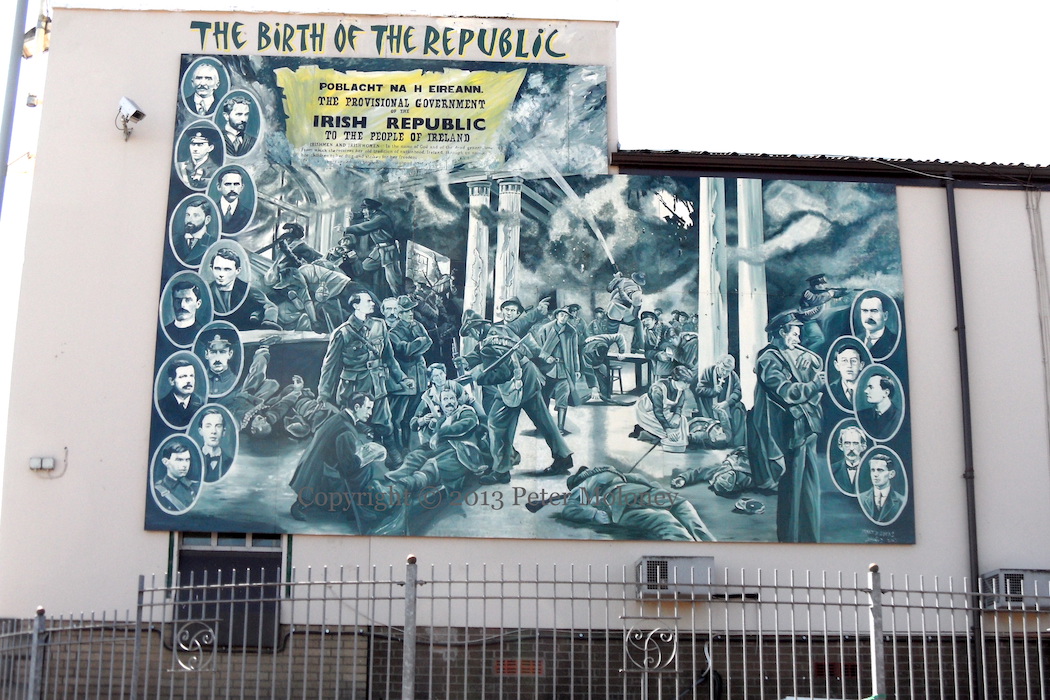
In addition to the seven signatories of the Proclamation of an Irish Republic, nine other leaders of the Easter Rising were executed in the wake of the rebellion. The portraits of all 16 are part of this new mural (on boards) of Walter Paget’s painting The Birth Of The Irish Republic. (For Paget’s painting, see the painting’s Visual History page.) In order of appearance, the 16 (with links to their WP pages) are …
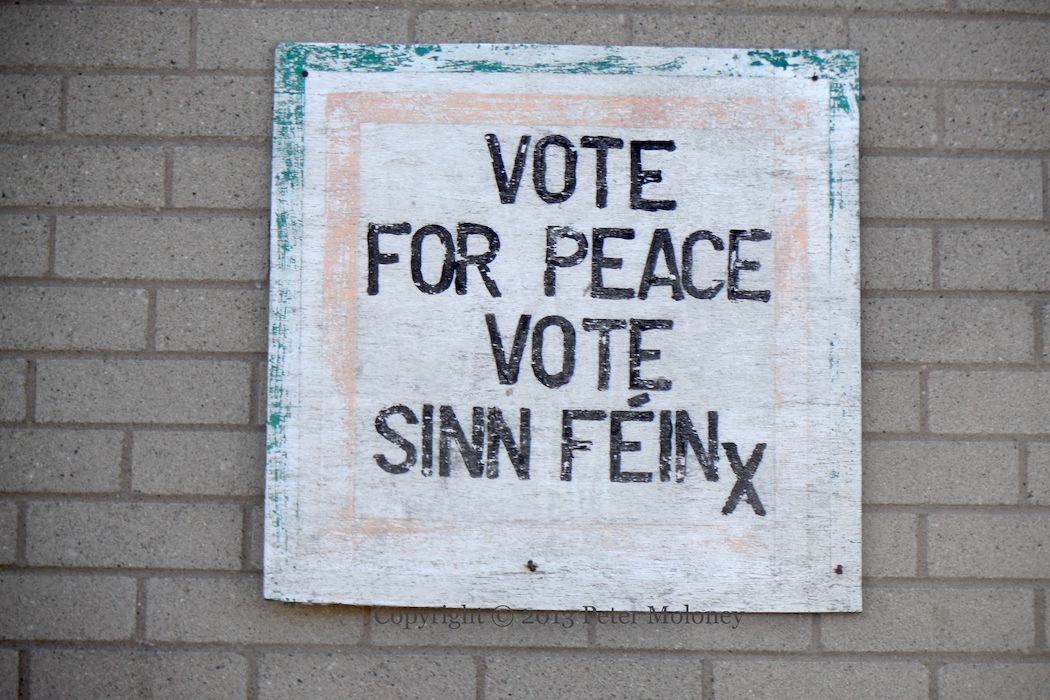
“… vote for Sınn Féın.” This vintage board in Juniper Park, Belfast/Dunmurry, goes back to at least 1998 (compare D00788 around the corner in Juniper Rise).
“Remember the tragic events surrounding the unlawful execution of IRA volunteers [Vols. Sean Savage, Maıréad Farrell, Dan McCann] in Gibraltar by the SAS on the 6th March 1988, the shooting of Vol. Keven McCracken in the defence of the community, the murderous attack on the Gibraltar funeral by a British sponsored assassin and killing of mourners [John Murray, Thomas McErlean, Vol. Caoımhín Mac Brádaıgh]. I ndíl [sic] chuımhne. Always remembered with pride by the people of the Colin area. Béırıgí [sic] bua.”