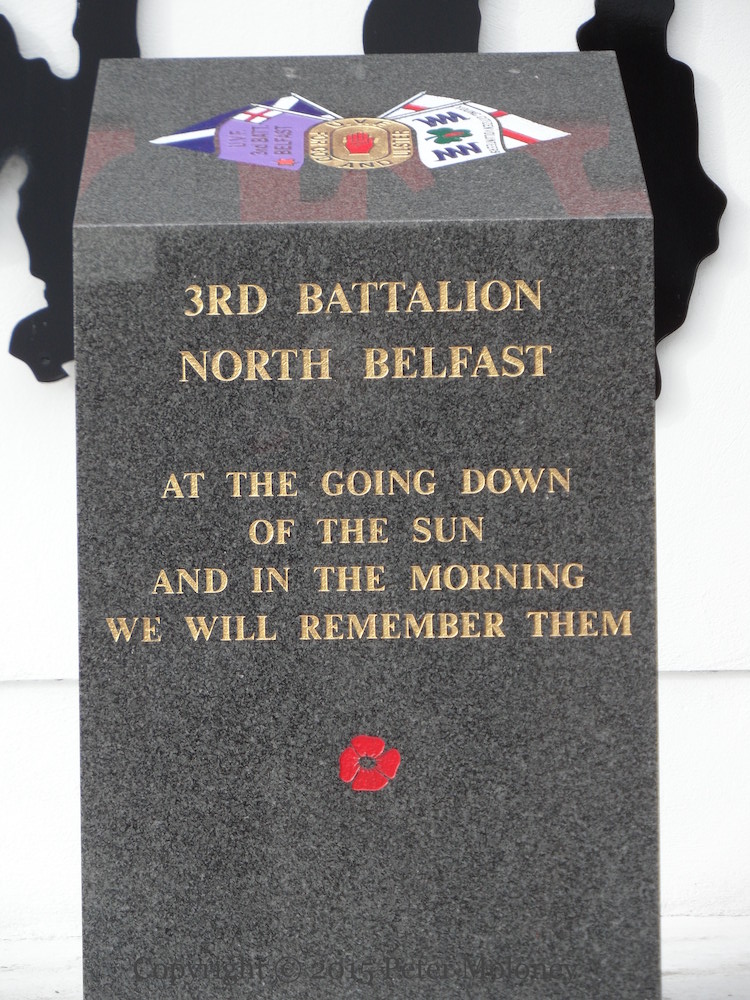
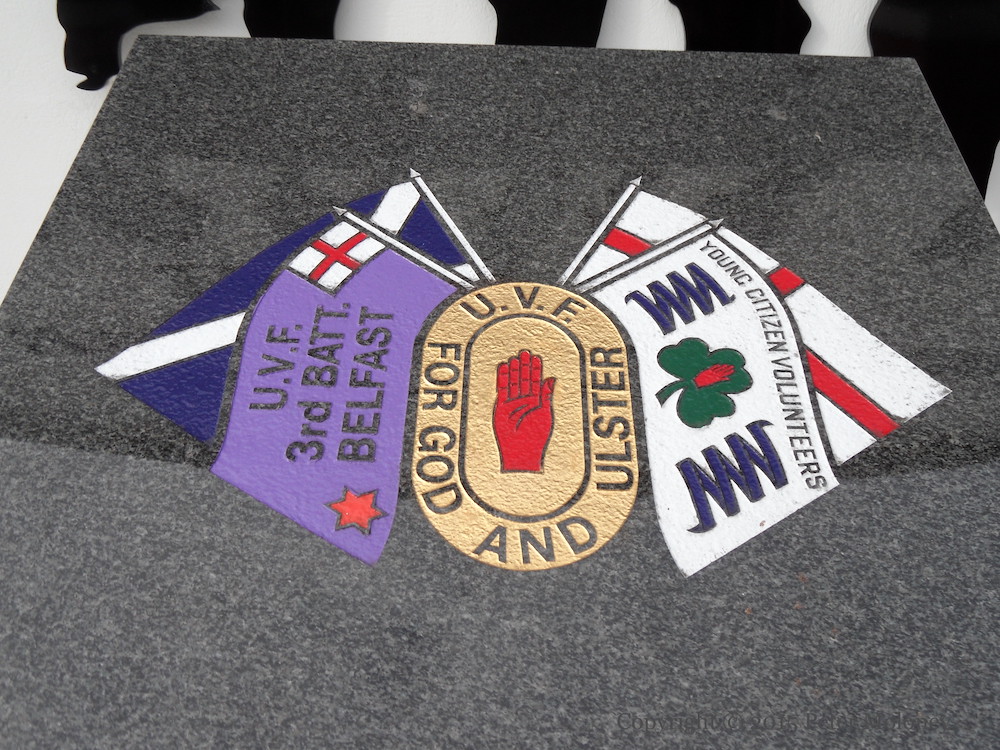
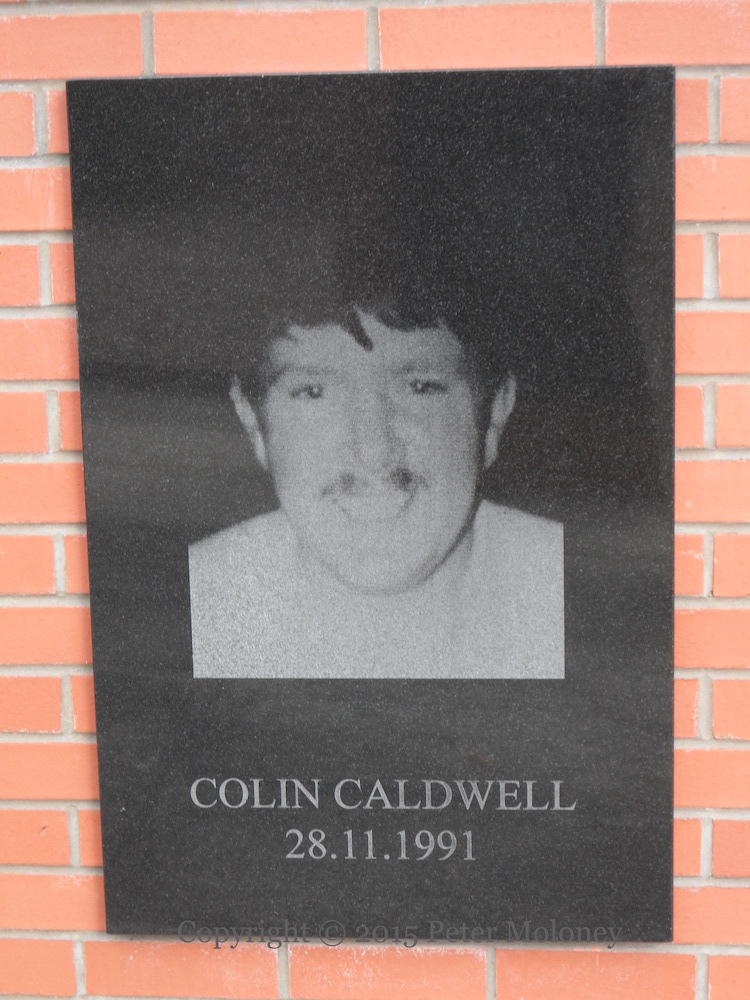
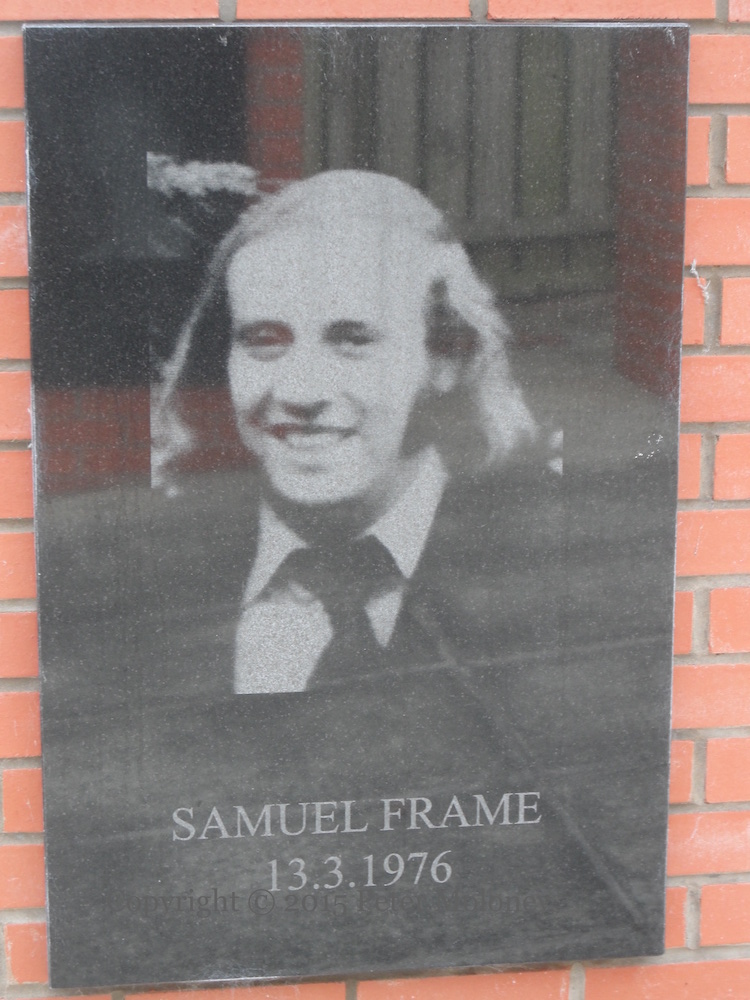
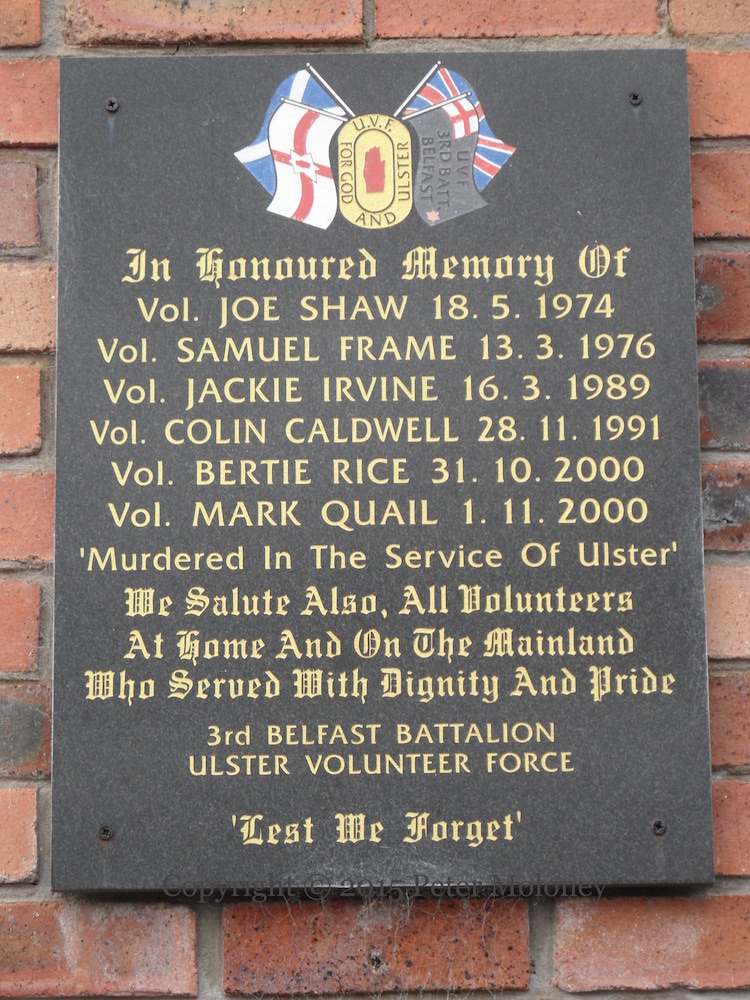
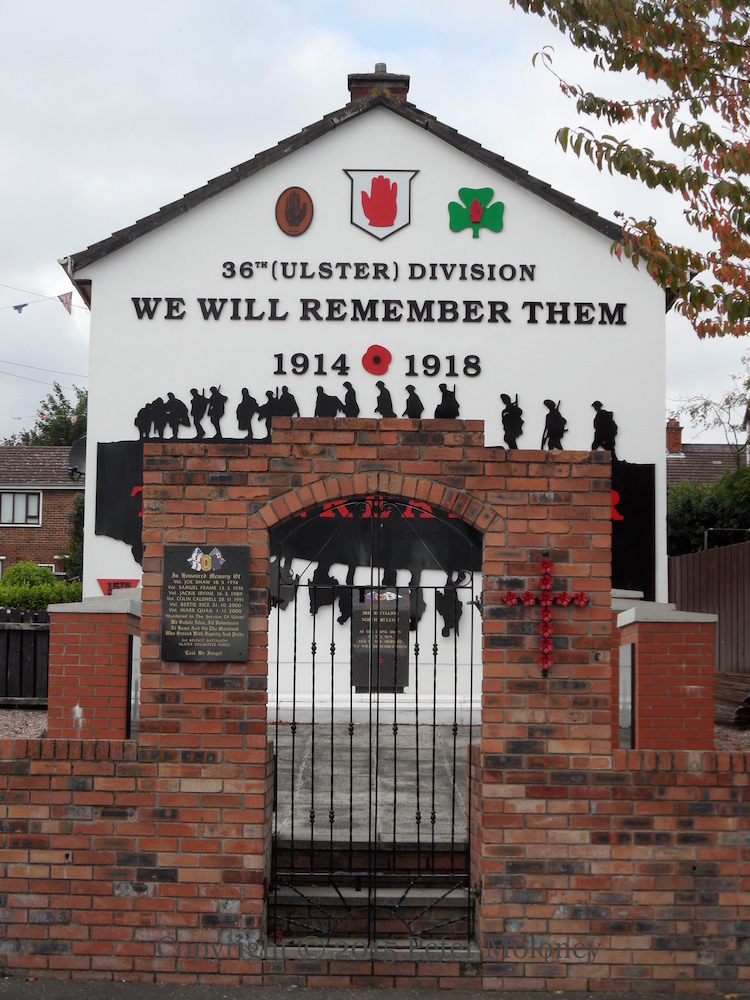
The memorial garden in Mount Vernon, which previously had and Ulster Volunteers mural and UVF stone, has undergone a major redevelopment this year (2015) with a new “cut-out” mural to the 36th (Ulster) Division and stand-alone memorial plaques to six UVF (3rd Belfast Battalion) members who were listed the plaque on the outside wall of the garden. “Murdered in the service of Ulster: Joe Shaw 18-5-1974, Samuel Frame 13-3-1976, Jackie Irvine 16-3-1989. Colin Caldwell 28-11-1991, Bertie Rice 31-10-2000, Mark Quail 1-11-2000.”
“We salute also all volunteers at home and on the mainland who served with dignity and pride.”
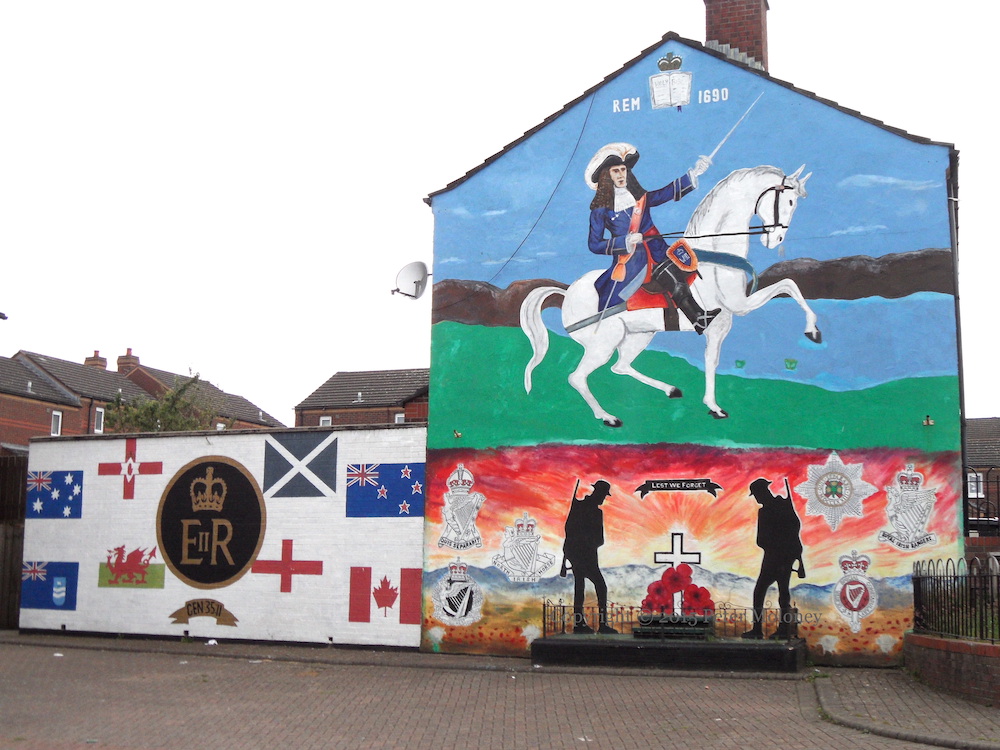
Genesis 35:11 reads (NIV) “And God said to him, “I am God Almighty; be fruitful and increase in number. A nation and a community of nations will come from you, and kings will be among your descendants.” The flags of Northern Ireland, Scotland, Wales, and England are joined in the mural above by those of Australia and (a simplified version of) the Falkland Islands (on the left) and New Zealand and Canada (on the right). The flag flying in the centre is the Royal Standard, flown on the building or vehicle where the monarch is.
The adjacent mural of army badges around a burial scene from the first world war features some lesser-seen items. On the left, alongside the Royal Irish Rifles (top left) and the (modern-day) Royal Irish Regiment (at the time of WWI the harp was plain and there was no garland), we see the emblem of the North Irish Horse, a cavalry unit in the Territorial Army. On the right, the emblem of the Royal Irish Rangers (which was folded into the Royal Irish Regiment in 1992) is joined by the star of the Irish Guards (above) and the emblem of the Ulster Special Constabulary or B-Specials (below). Only the Royal Irish Regiment and the Irish Guards remain as regiments of the British Army; “The Horse” now forms squadrons of other units. Of the six, four served in WWI; the B-Specials were formed in 1920 and the Rangers in 1968.
Above is King William III at the Battle of the Boyne in 1690.
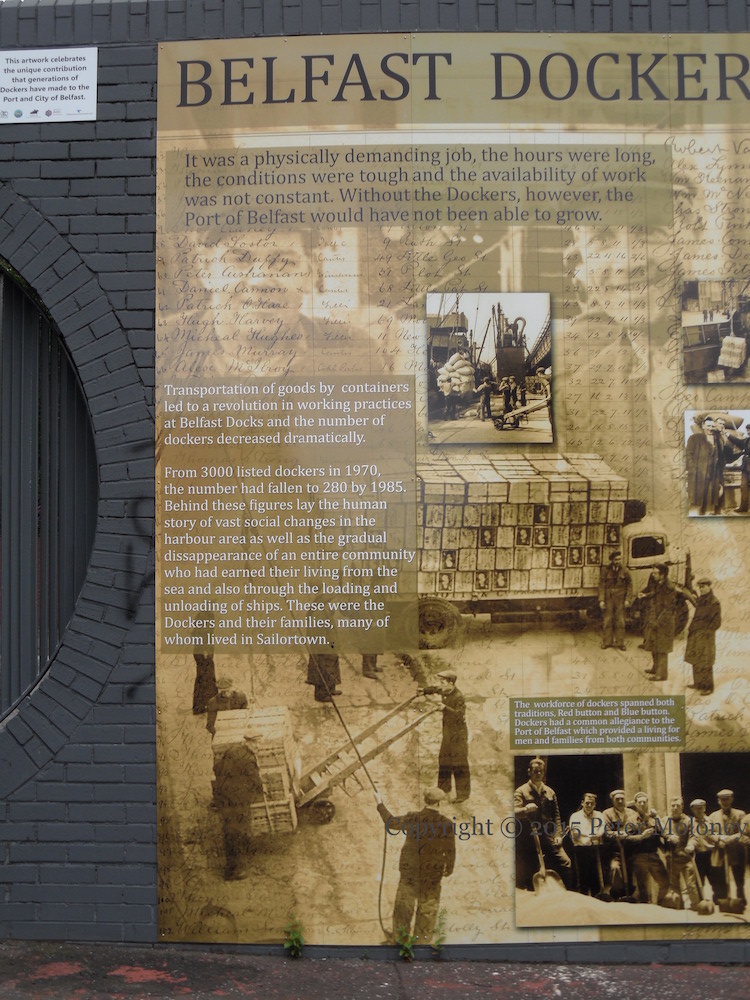
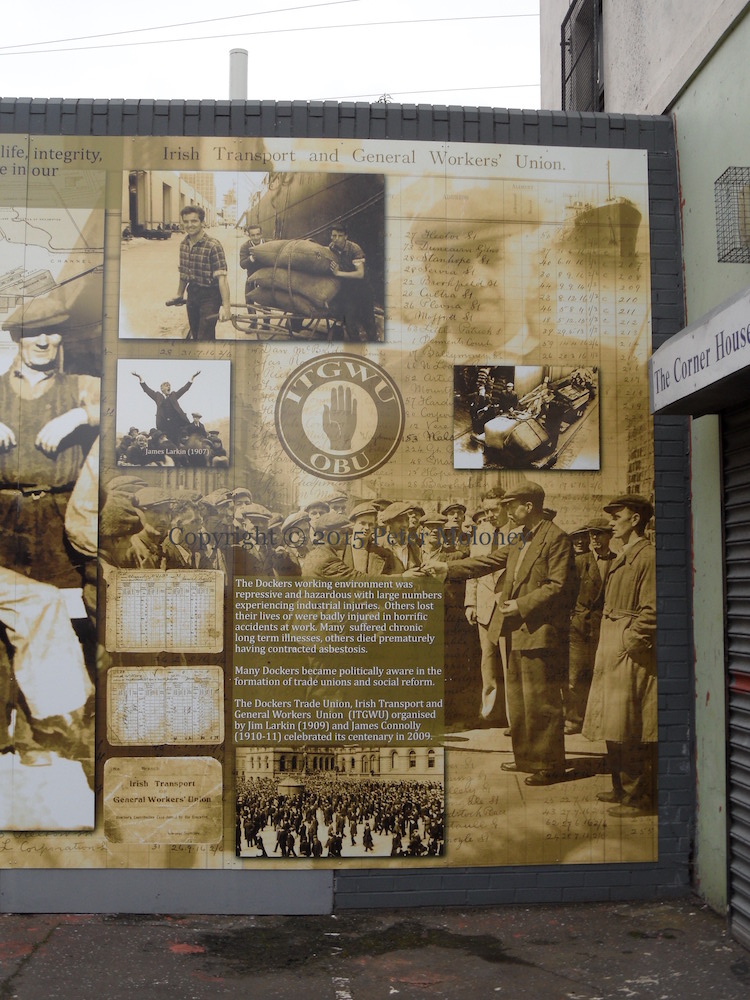
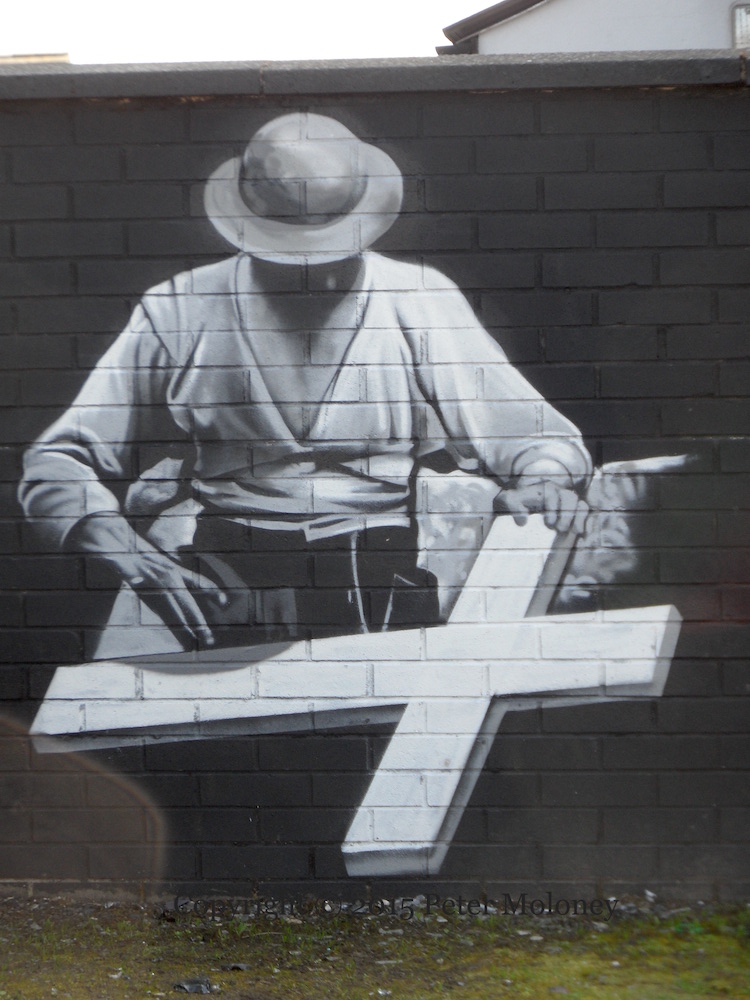
Every day, men would line up in schooling pens on the various docks of the port of Belfast to be hired by foremen. As mentioned on the left-hand side of the board above (recently erected on the New Lodge side of the Duncairn “peace” line) the rise of the shipping container in the 1970s spelled the end of the docker: “from 3000 listed dockers in 1970, the number had fallen to 280 by 1985.” Author and poet John Campbell recalls his first day on the docks in 1952, unloading cement, in this NVTv video.
“This artwork celebrates the unique contribution that generations of dockers have made to the port and City of Belfast.”
“It was a physically demanding job, the hours were long, the conditions were tough and the availability of work was not constant. Without the Dockers, however, the Port of Belfast would not have been able to grow. / Transportation of goods by containers led to a revolution in working practices at Belfast Docks and the number of dockers decreased dramatically. From 3000 listed dockers in 1970, the number had fallen to 280 by 1985. Behind these figures lay the human story of vast social changes in the harbour area as well as the gradual dissappearance [sic] of an entire community who had earned their living from the sea and also through the loading and unloading of ships. These were the Dockers and their families, many of whom lived in Sailortown. / The workforce of dockers spanned both traditions. Red button and Blue button. Dockers had a common allegiance to the Port of Belfast which provided a living for men and families from both communities. / The work was backbreaking, yet the Docks educated us about life, integrity, discipline, about standing up for our rights, about having pride in our identity as working men, as Dockers. / The Dockers[‘] working environment was repressive and hazardous with large numbers experiencing industrial injuries. Others lost their lives or were badly injured in horrific accidents at work. Many suffered chronic long term illnesses, others died prematurely having contracted asbestosis. Many Dockers became politically aware in the formation of trade unions and social reforms. The Dockers Trade Union, Irish Transport and General Workers[‘] Union (ITGWU) organised by Jim Larkin (1909) and James Connolly (1910-11) celebrated its centenary in 2009.”
“Fıann [sic] Robert Allsopp lived at this address. Died on active service March 3rd 1975. Fuaır sé bás ar son na hÉıreann. 1959-1975” Allsopp died at the family home (on the New Lodge Road) from the accidental discharge of a gun. The O’Neill-Allsopp flute band is named in his honour (and in honour of Jim O’Neill) and the band has a mural in Donore Court.
This Ligoniel stencil by Damian Walker of GaelForce has proving controversial: Walker’s previous attempts have been painted over three times, according to an image in this 32 County Sovereignty post, which also alleges that Sınn Féın has been behind the removals. According to the Tele, a housing executive van was burnt out in response to one of the white-washings.
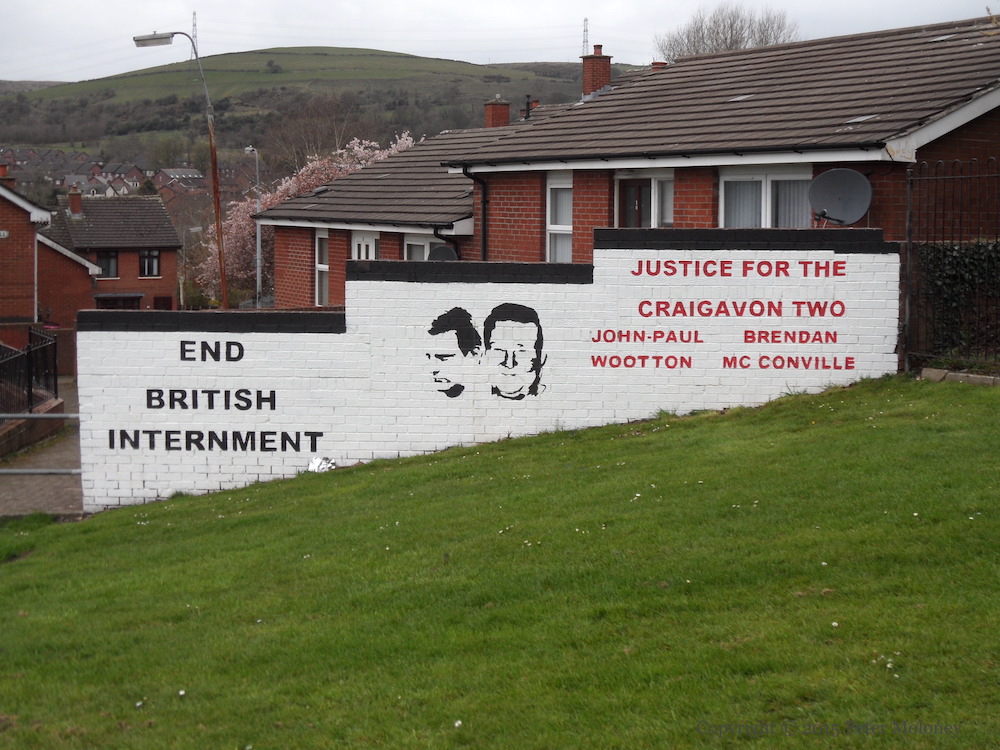
The “Craigavon Two” are John-Paul Wooton and Brendan McConville. For background, see JFTC2.
“On March 10th 1971 at this place three young Scottish Soldiers of the Royal Highland Fusiliers were murdered by republican terrorists. Fusilier John McCaig aged 17, Fusilier Joseph McCaig aged 18, Fusilier Dougald McCaughey aged 22. Always in our hearts. Never forgotten.” The trio were were lured by the IRA from a city-centre pub to their deaths in Ligoniel in 1971 (WP). The stone is frequently vandalised (BelTel | BBC | STV | BBC).
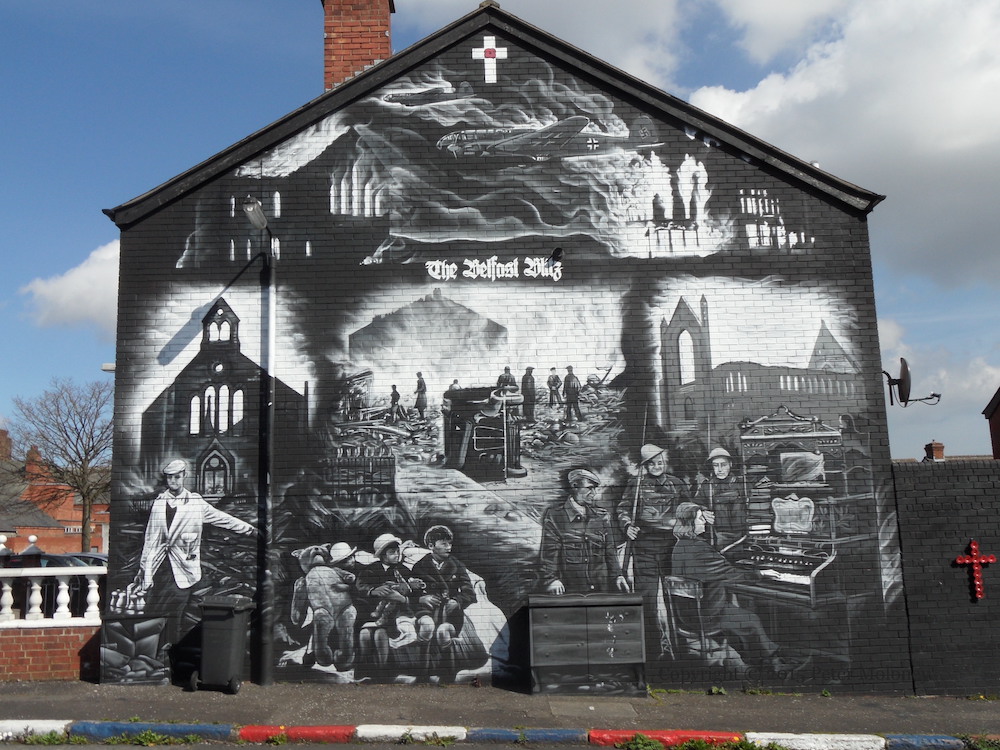
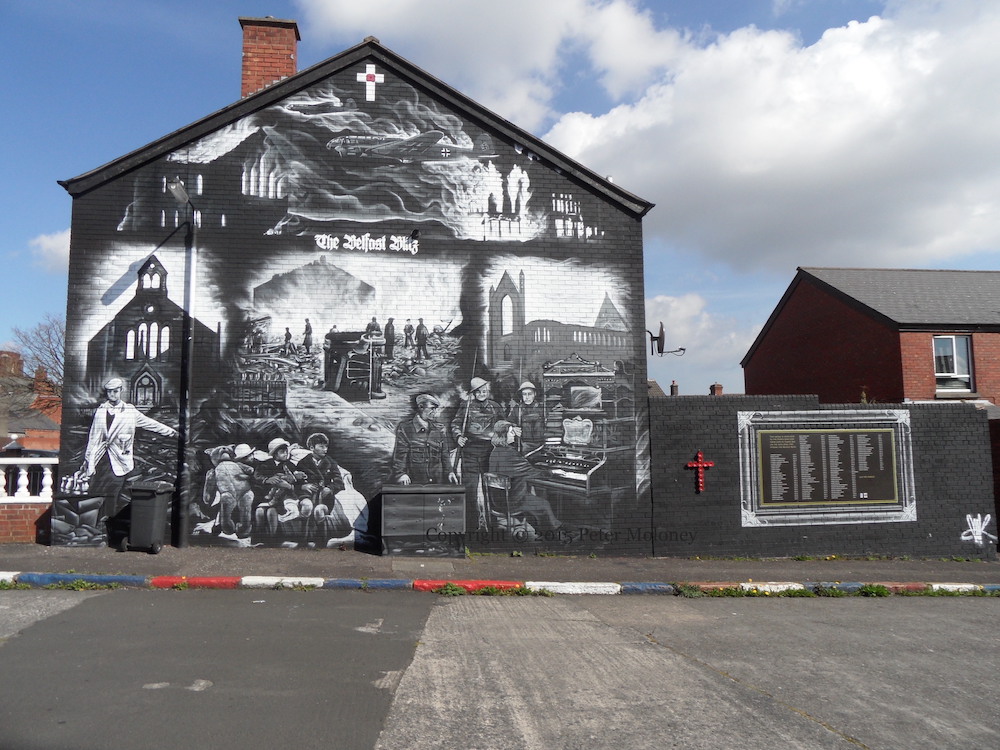
In the “Belfast Blitz” of April and May 1941, during WWII, 900 people died and half the homes in Belfast were destroyed or damaged (WP). In the apex of this mural, a Nazi bomber sets buildings alight; in the main panel, people, including a milkman, walk among the bombed-out buildings, while others (bottom right) test out a piano that has been moved.
On the side-wall to the right is a painted frame surrounding a manufactured plaque with the names of locals who died in the blitz.
By JMK (Jonny McKerr – Fb) in Hogarth Street, Tiger’s Bay, north Belfast. Both the lamp-post and the electrical box have been painted into the mural.
McKerr also did a piece in the area of images from WWI – see The Home Front.
The central image of soldiers at the battle of the Somme is surrounded by images of various occupations: shipyard workers and miners (perhaps), along with images of women welding, carrying coke, and nursing. It’s not clear what the “fair wartime wage” refers to: there was a general strike at the shipyards in 1919 (The Great Unrest | Workers’ Liberty).
“John Bunting MI5 tout”. This Tiger’s Bay placard is an indicator of the continued tensions within the North Belfast UDA that first came to public attention in December 2013. John Bunting was arrested in September (2014) and charged with the attempted murder of John Borland and Andre Shoukri, from the opposing faction.
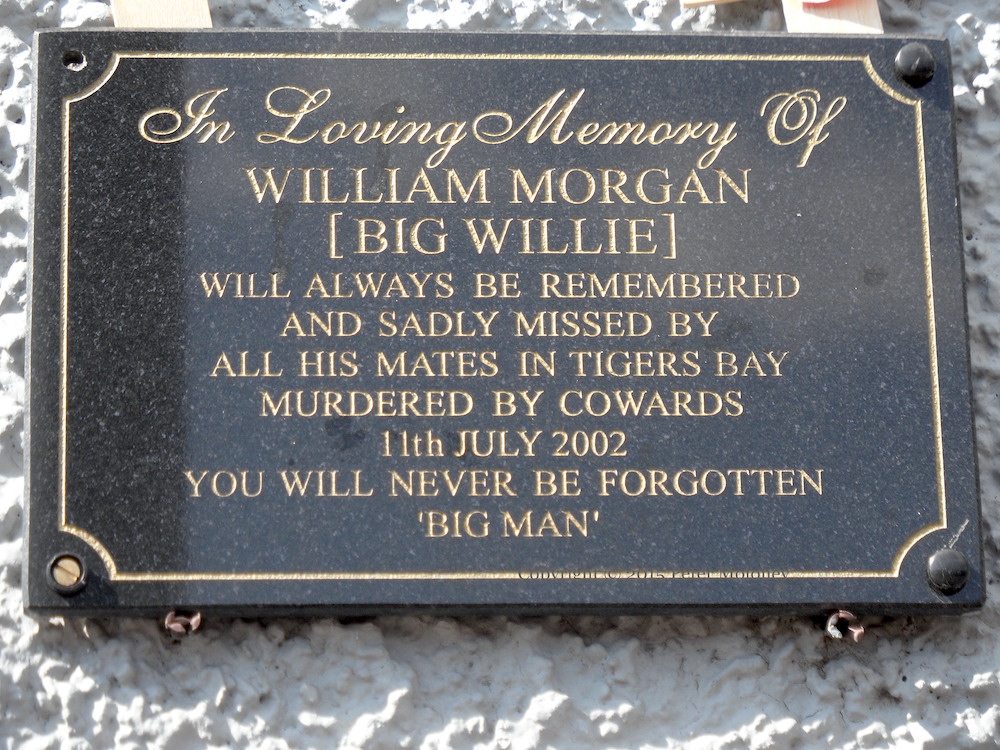
This is the new plaque to “William Morgan (Big Willie). Will always be remembered and sadly missed by all his mates in Tiger’s Bay. Murdered by cowards 11th July 2002. You will never be forgotten ‘big man’.”
Morgan was struck by a hit-and-run car on July 6th, 2002 and died in hospital five days later. The car is reported to have deliberately mounted the kerb where he was walking on North Queen Street and the attack was thought to have been sectarian, as the alleged driver and passenger were republicans and the car was found burned out in the New Lodge (NewsLetter | IndyMedia).















 Peter Moloney Collection