Volunteer Seamus Bradley

“The Story Of The Murder Of Volunteer Seamus Bradley On The 31st Of July 1972, Operation Motorman.

On the 4th of July 1972, the British government met with army intelligence and army personnel, between them they created a blue print which was first called operation carcan to later be changed to operation motorman. In this secret meeting that place on the 4th of July, the army were to take 20,000 troops from the UN forces, and the government gave orders on a shoot to kill policy and confirmed that no soldier would be held accountable for their actions on that day. Over 1,500 of these soldiers and 300 centurion tanks were sent to free Derry to tear down the barricades and cause havoc, but the provisional IRA intercepted their blue print and decided to step down to protect the innocent people of Northern Ireland. It was 4:10am, there were 25 – 30 people at the Creggan shops when there was gunfire heard, Vol. Seamus Bradley unarmed drew attention to himself to save others.

He ran down Bishop field where a soldier was to get out of a saracen, take aim in a kneeling position and fire two shots hitting him in the back, Vol. Seamus Bradley fell. Then the saracen drove down the field to where he lay, they put him in the saracen and took him away to St. Peter’s school, no one knew what happened after that. All they know is that he was interrogated, the pictures tell their own story. He was shot again three more times at close range, he was tortured and beaten and left to bleed to death at the hands of the British army. Afterwards it was confirmed by a doctor that none of Seamus Bradley’s injuries had been life threatening and had he received medical aid he would have lived.

This memorial is to commemorate Vol. Seamus Bradley just yards from where he fell. Vol. Seamus Bradley on the 2nd Battalion of B company Oglaigh Na H-Eireann, even though he was shot five times and beaten they could not make him betray his comrades.

I lived and loved and laboured with a patriot’s heart and will that the dawning years might make you fearless and unfettered still. When a future age shall find thee free men stand by thy side Mother Ireland o” remember me.

They may kill our bodies and take our blood but they will never break our spirits. Vol. Seamus Bradley. The war is not over until Ireland is free.”

Bligh’s Lane/Bishop’s Field, Derry

Click image to enlarge
Copyright © 2013 Peter Moloney
M09342 M09341 [M09343] [M09344]

Óglach Sean McKee

“In proud memory of Óglach Sean McKee killed in action by British Paratroopers 18th May 1973 aged 17 years – “Better to die on your feet than live on your knees””

McKee was shot in Fairfield Street while aiming at a 3 Para observation post in an abandoned building in Butler Street (Lost Lives 847).

Elmfield Street, Ardoyne, Belfast

Click image to enlarge
Copyright © 2013 Peter Moloney
M09524a

I Am Not An Ulsterman

“I am not an Ulsterman [but] yesterday, the 1st of July 1916, as I followed their amazing attack, I felt I would rather be an Ulsterman than anything else in the world.” The words of Captain Wilfrid (here given as “Wilfred”) Spender replace a Steeple Defenders board that has presumably fallen into disrepair alongside a board showing a soldier from the 36th Division running through no-man’s land (both seen previously in 2003 and 2009).

For a fuller quote, see X04435 from south Belfast.

Click image to enlarge
Copyright © 2013 Peter Moloney
M09328 [M09329] [M09330]

Volunteer Denver Smith

“In memory of Vol. Denver Smith, murdered by cowards 1st January 2000. Here lies a soldier. He gave his life whilst serving his community. Lest we forget.” Smith was killed by a gang of six men with machetes and pikes; the incident was perhaps drugs-related (Guardian | BBC-NI. For the wider picture An Phoblacht | Irish Times).

The mural originally appeared with seven plaques, then with three plaques, and now with graveside mourners on either side of a single stone, and a bench and three flag-poles to the right.

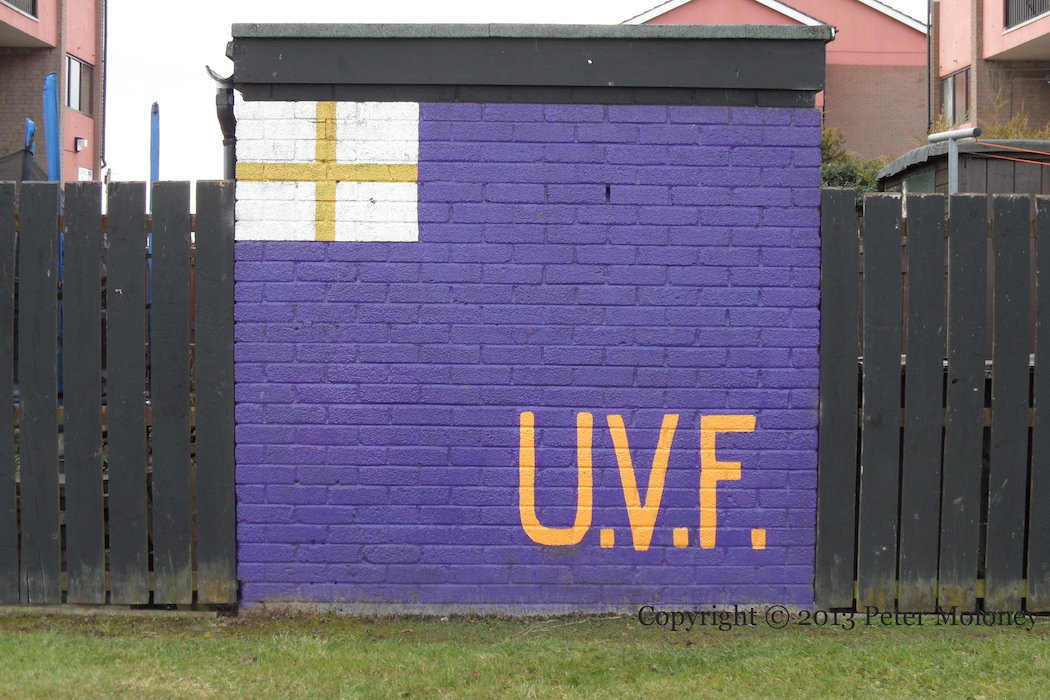
The UVF flag is between the the Denver Smith and All Gave Some gables.

Parkhall Road, Antrim

Click image to enlarge
Copyright © 2013 Peter Moloney
M09316 [M09317] [M09318] [M09319] [M09320] [M09321] [M09322] [M09323] [M09324] [M09325] [M09326] M09327
M08315

All Gave Some, Some Gave All

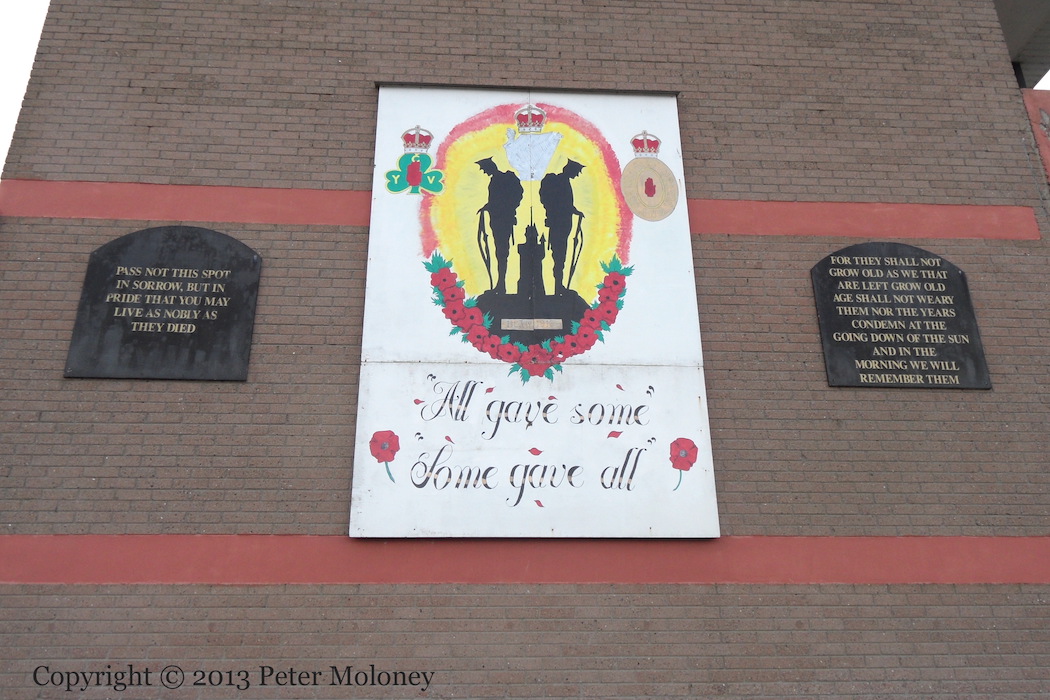
This trio of boards in memory of WWI dead from the Ulster Volunteers replaces the single black board first seen in 2003 in Steeple Defenders.

On the left: “Pass not this spot in sorrow but in pride/That you may live as nobly as they died.” These lines are also used in a WWI memorial mural in Carlingford Street, Belfast.

On the right: “They shall not grow old as we that are left grow old./Age shall not weary them nor the years condemn./At the going down of the sun and in the morning, we will remember them.” from Binyon’s For The Fallen.

Parkhall Road, Antrim

Click image to enlarge
Copyright © 2013 Peter Moloney
M09308 [M09309] [M09310] [M09311] [M09312] [M09313] [M09314]

Fragments Of War

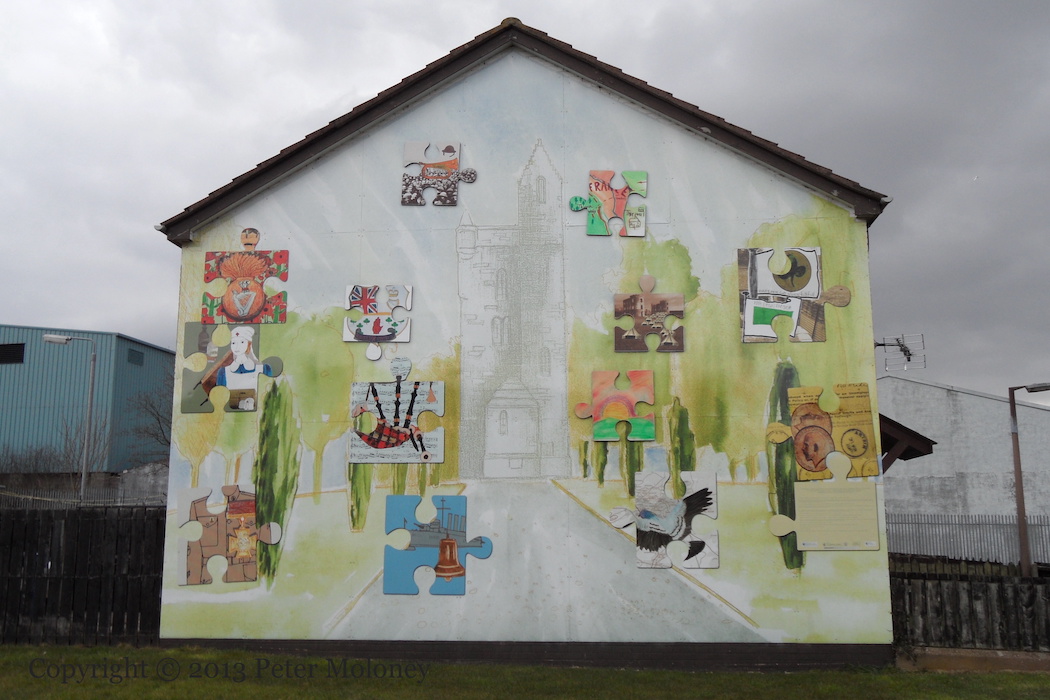
Ulster Tower in Thiepval, France, provides a background for 13 jigsaw pieces with partial images relating to the Great War, including a uniform with a Victoria Cross and badge of the 36th (Ulster) Division, the 10th (Irish) Division, the 16th (Irish) Division, and the Royal Irish Fusiliers (and a fourteenth piece for information).

Kilgreel Road, Antrim. The mural is more than a decade old and is bleached from the sun (the pinks were formerly brown); on the former site of The People’s Army (a UVF board).

“This artwork, commemorating the sacrifices made during the Great War and subsequent conflicts, was produced by the young people of Parkhall Youth & Community Club and was completed in 2010. It is part of a larger Re-imaging project undertaken by Parkhall Cultural Awareness Association & Parkhall Community Association.
14 jigsaw pieces are representated as that was the age of the youngest soldier to die on the Somme.
The Royal Irish Fusiliers, who recruited in the Antrim area, served with the 10th Irish Division and 36th Ulster Division during World War I. The cap badge is surrounded with poppies. The poppy is an international symbol commemorating the sacrifices of members of the armed forces and of civilians specifically since the Great War.
Birds were used extensively during World War I delivering important logistic message from the front line.
HMS Antrim served in the Great War and survived. After the war she became the first ship to be fitted with an experimental sonar system in 1920. Her bell can presently be viewed in Antrim Civic Centre.
The grounds of Shane’s Castle in Antrim were used as a training ground and a campsite for the 36th Ulster Division prior to their deployment to France.
Of all bell tents and parachutes during the Great War 90% were made from Irish Linen.
During the Great War a service man’s basic wage was one shilling a day (5 pence).
The sound of the bugle was heard throughout each day in the trenches, starting with Reveille to rouse you from slumber.
‘Flowers of the Forest’, a powerful Scottish lament, is often played by a lone piper at services of Remembrance.
“I am not an Ulsterman but yesterday, the 1st July, as I followed their amazing attack, I felt that I would rather be an Ulsterman than anything else in the world.” Extract from the speech by Captain Wilfred [Wilfrid] Spencer 2st July 1916.
Men from the 36th Ulster Division received 9 Victoria Crosses.
Women played a vital role in field hospitals during the Great War caring for the injured, from the front line.
The flags of the 16th and 10th Irish Divisions.
36th Ulster division.
The Ulster Tower is a memorial to the men of the 36th Ulster Division. It is situated near the entrance to Thiepval Wood, France.

Click image to enlarge
Copyright © 2013 Peter Moloney
M09289 [M09290] [M09291] [M09292] [M09293] [M09294] [M09295] [M09296] [M09297] [M09298] [M09299] [M09300] [M09301]

Young Guns

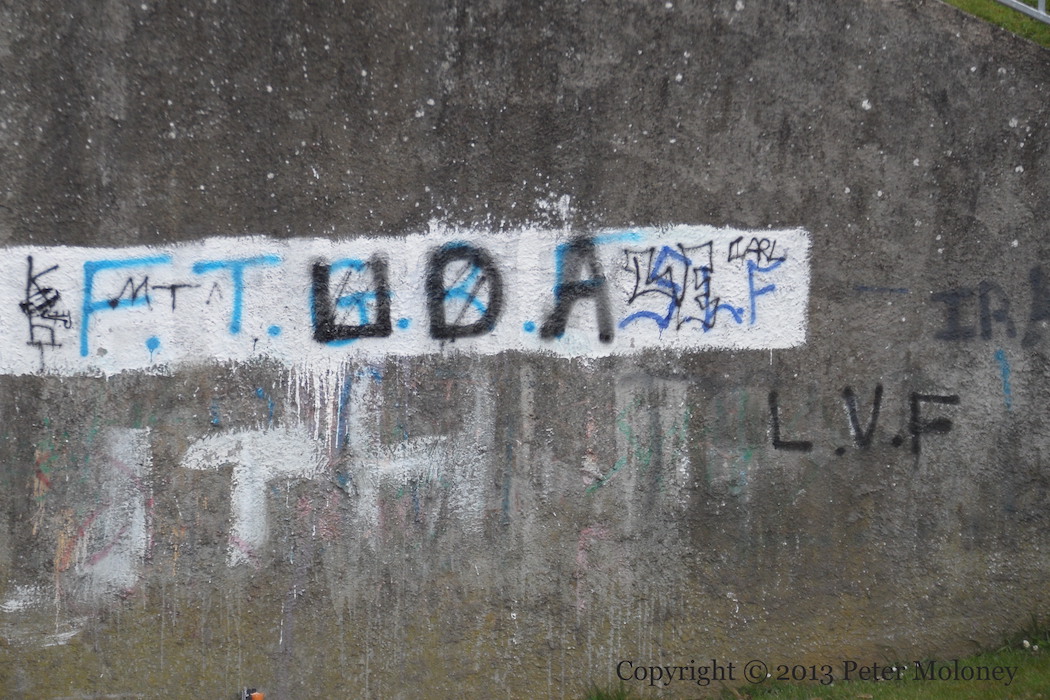
This is a selection of small UDA boards and graffiti from the lower section of Parkhall estate in Antrim. The 90th anniversary board was seen previously in 2009.

Donegore Road, Oriel Park, Fountain Hill, Kilbeg Walk

Click image to enlarge
Copyright © 2013 Peter Moloney
M09288 M09287
M09285 M09286
M09306 M09307

July 1st

While the demolition of the last house in the row is under way, the pair of boards on the gable wall (seen in 2012) has been mounted on some scaffolding, with their order reversed – Covenant Day on the left, Somme trench on the right.

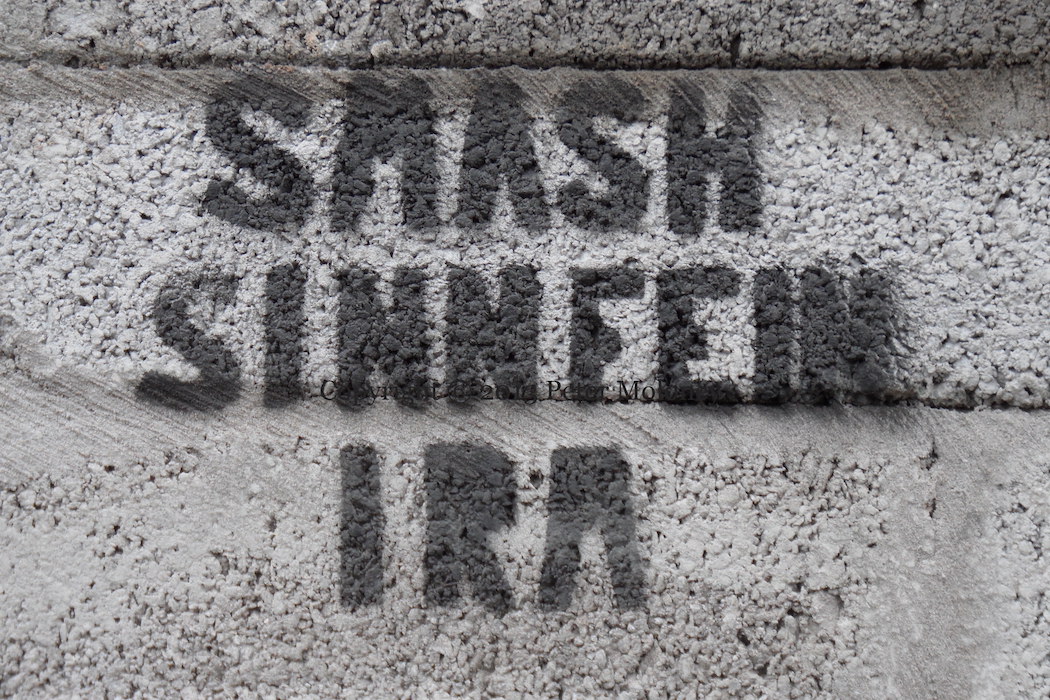
Also included is a “Smash Sinn Fein IRA” stencil in the area.

Barrington Gardens/Donegall Avenue, Belfast

Click image to enlarge
Copyright © 2013 Peter Moloney
M09282 [M09283] [M09284] M09281

All Are Gone

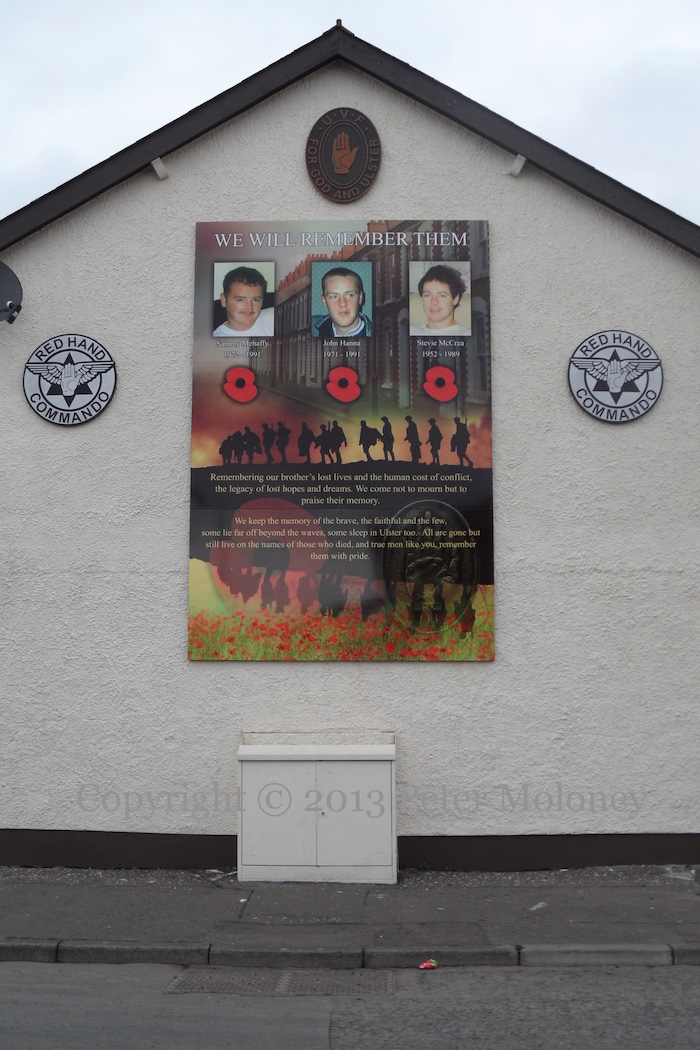
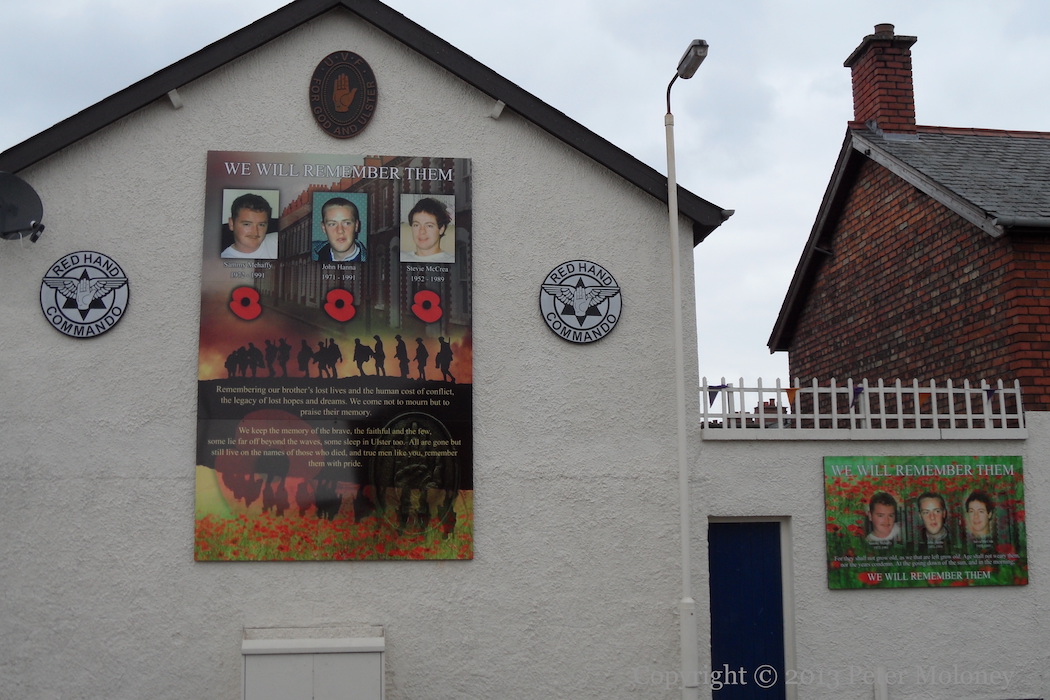
A board to slain UVF/RHC members John Hanna (died 1991-09-10), Stevie McCrea (1989-02-18) and Sammy Mehaffy (1991-11-13), with poppies and image of WWI soldiers.

“Remembering our brother’s lost lives and the human cost of conflict, the legacy of lost hopes and dreams. We come not to mourn but to praise their memory. We keep the memory of the brave, the faithful and the few, some lie far off beyond the waves, some sleep in Ulster too. All are gone but still live on the names of those who died, and true men like you, remember them with pride.”

“36th ulster division, for they shall not grow old, as we that are left grow old, age shall not weary them nor the years condemn, at the going down of the sun and in the morning we will remember them.”

Frenchpark Street in the Village, south Belfast

Click image to enlarge
Copyright © 2013 Peter Moloney
M09270 [M09271] [M09272] [M09273] [M09274] [M09275] [M09276] [M09277] [M09278] M09279
M09269

March, 1988

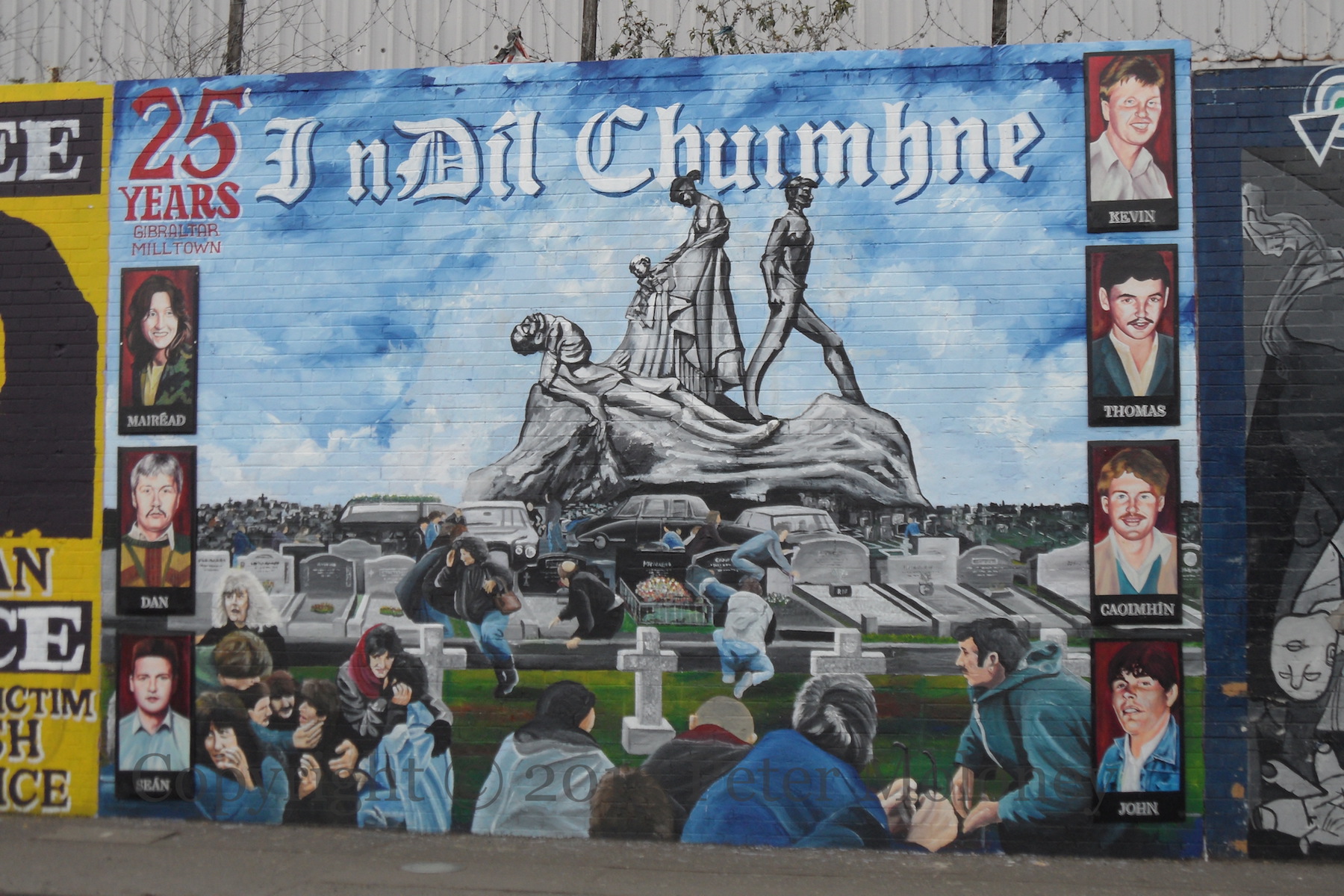
March 2013 is the 25th anniversary of the Michael Stone’s attack on mourners attending the burials of the Gibraltar 3 in Milltown cemetery. Stone killed three people. The mural combines images of mourners taking shelter from Stone’s attack – links to the photographs represented and in-progress images can be found at Extramural – with the civil war memorial in Ballyseedy, Co. Kerry (WP) which was famously connected to the Gibraltar 3 in a mural prepared for the return of the coffins to Belfast – see A Legitimate Right To Take Up Arms. (Here is a copy of Tragedies In Kerry.) The Gibraltar 3 are portrayed on the left; Stone’s victims are on the right. In the top right is an IRA volunteer who had been shot two days earlier, on the night that the coffins of the Gibraltar 3 arrived in Belfast.

1988 puts us firmly in the era of video, and so you can see footage on youtube relating to each of these events. In chronological order:

Death On The Rock, a famous Thames Television production about the SAS killings of IRA members Maıréad Farrell, Danny McCann and Seán Savage on March 6th in Gibraltar.

Michael Stone’s attack on mourners at their funerals in Milltown cemetery, March 16th, which killed Thomas McErlean, John Murray, and IRA member Caoımhín Mac Brádaıgh (Kevin Brady).

The funeral of IRA member Kevin McCracken on March 17th (he had been killed on March 14th) at which British Army corporals Wood and Howes were killed.

For the small Marian Price piece to the left, see Another Victim Of British Injustice. These pieces together replace the Relatives Action Committee mural, later with Marian Price poster

Click image to enlarge
Copyright © 2013 Peter Moloney
M09248 [M09250] [M09251] [M09252] [M09253] [M09254] [M09255] [M09256] [M09257] [M09258]