“Fıann [sic] Robert Allsopp lived at this address. Died on active service March 3rd 1975. Fuaır sé bás ar son na hÉıreann. 1959-1975” Allsopp died at the family home (on the New Lodge Road) from the accidental discharge of a gun. The O’Neill-Allsopp flute band is named in his honour (and in honour of Jim O’Neill) and the band has a mural in Donore Court.
In February (2015) the SDLP changed its position on the National Crime Agency (NCA) and the Assembly voted to allow it to operate (beyond ‘customs and borders’ functions) in Northern Ireland – it has been operating in Britain since 2013 (BBC | Irish Times). Sınn Féın continues to oppose the NCA (BBC).
“On May 7th vótáıl Gearóıd Ó hEára. Leading positive change” – Sınn Féın electoral billboard for the 2015 UK elections, on the back of Free Derry Corner.
Ó hEára would go on to take second place, behind the SDLP’s Mark Durkan (WP).
A Christian cross was added (in early 2015?) to the dove and oak leaf on Rossville Street, Derry. For a 2013 image of the previous version, see Dove Of Peace.
The Christian missionary Colm Cılle (in Latin, Columba), born in Donegal, founded a monastic settlement on the banks of the Foyle (then still part of Donegal) around 540 AD. The “Doıre” part of the name means “oak grove” and perhaps refers (as the information panel suggests) to “a sacred grove of trees, which may have pre-dated the monastery.” The mural above shows a reconstruction of the Derry monastery c. 700 AD. The name “Londonderry” dates to 1662.
Columba moved on to Scotland circa 563 and founded an abbey on the island of Iona. Among his reputed miracles is the banishment of a great water beast from the River Ness in 565.
“This is a reconstruction of the early Christian monastery at Derry around 700 AD which was founded by St Colum Cille around 546 AD. Colum Cille left his community in Derry in 563 AD with twelve companions to found the great monastery of Iona. He only subsequently returned to Ireland once and died in 593 AD. Although St Colum Cille founded a number of Irish monasteries, it would appear that Derry was his principal residence until he left Ireland. The name itself, Doıre, (sometimes Doıre Colum Cılle) means ‘the oakgrove of Colum Cille’ a sacred grove of trees, which may have pre-dated the monastery.”
“Is athchuthú é seo ar an mhainistir luath-Chríostaí i nDoıre thart ar 700 AD a bhunaigh Naomh Cholm Cıille thart ar 546 AD. D’fhág Colm Cille a phobal ı nDoıre thart ar 563 AD le dáréag eıle le mómhaınıstır oıleán Í a chur ar bun. Níor fhill sé go hÉıreann ach uaır amháın agus fuaır sé bás in AD 593. Cé gur bhunaigh Naomh Cholm Cille roınnt maınıstreacha eıle ı nÉırınn, shocrıgh sé ı nDoıre de réır cosúlachta go dtí gut ımıgh sé. Déanann an t-aınm ‘Doıre Cholmcılle’ tagaırt do dhoıre naofa, a bhí ann roımh an mhaınıstir.”
U Bennett Street, Derry, on the side wall of Tıgh Seoırse.
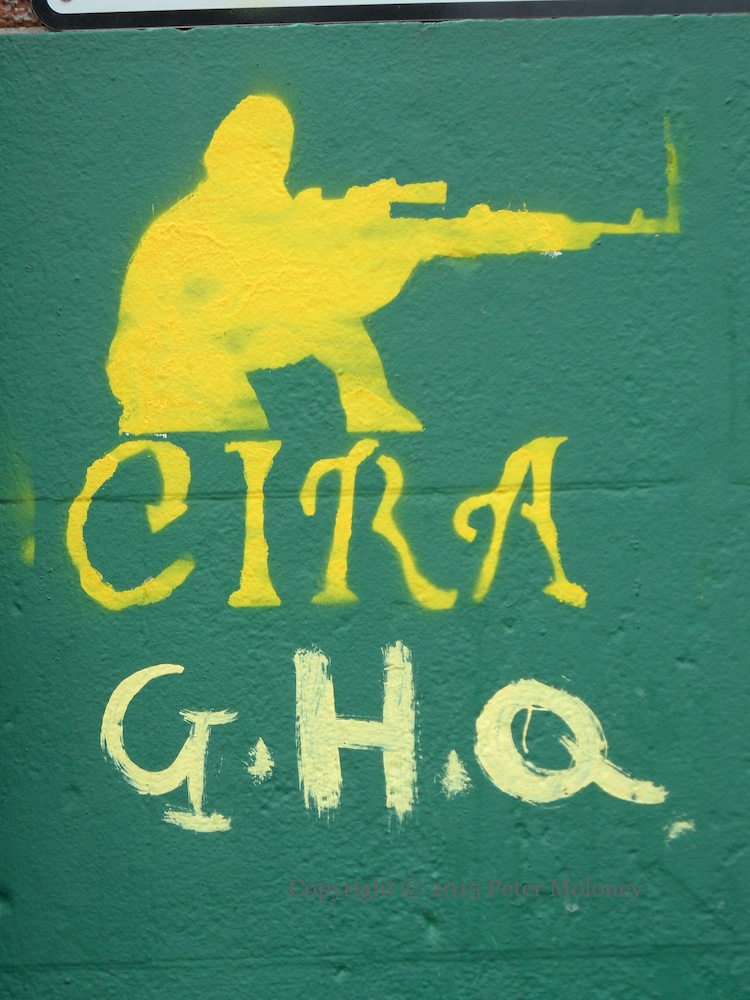
The stencil might be crude but the intent is clear: to suggest that the anti-Agreement IRA (probably the Continuity IRA, specifically) intend to continue the physical fight against British occupation.
“Sınn Féın protects paedophiles – ask Gerry”. The reference is perhaps to Brendan Curran’s allegations about the party covering up abuse by a Catholic priest (Indo) and the “ask Gerry” part a reference to Liam Adams’s 2013 conviction and the investigation into whether his brother, Gerry Adams, had withheld information about it (Guardian).
The Craigavon Two – John-Paul Wootton and Brendan McConville – were convicted in 2012 of the 2009 murder of PSNI Constable Steven Carroll (BBC) and sentenced to 18- and 25-year minimums, respectively. The case is under review (Guardian) and a campaign for their release – using the hashtag “#JFTC2” – is under way (Fb).
This supportive graffiti is in Bligh’s Lane, Derry