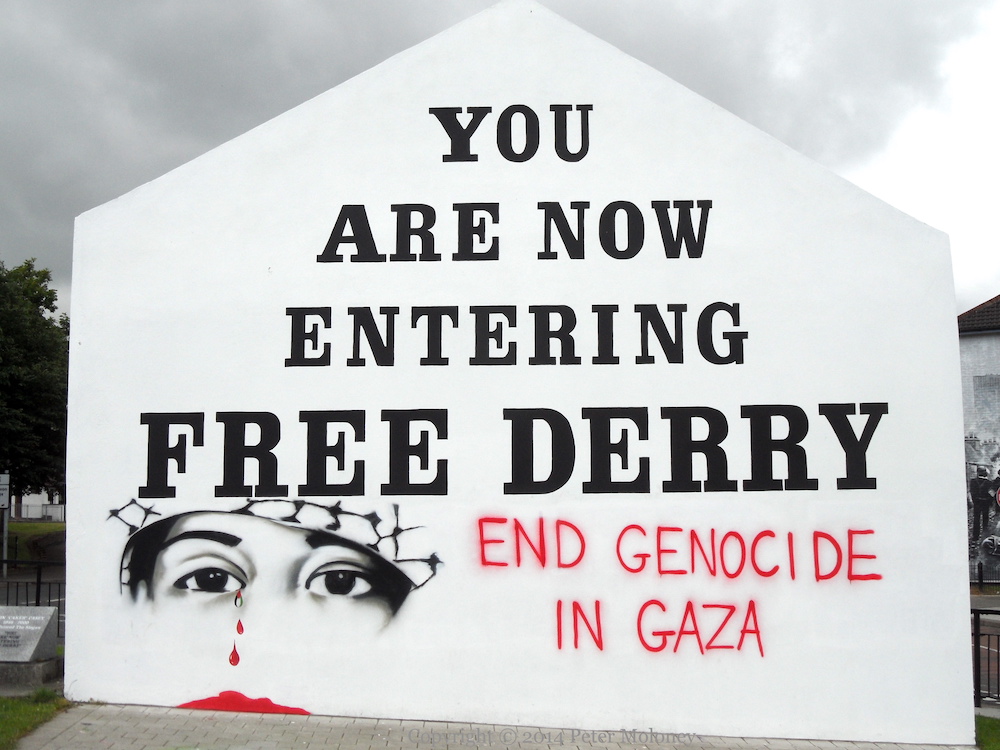
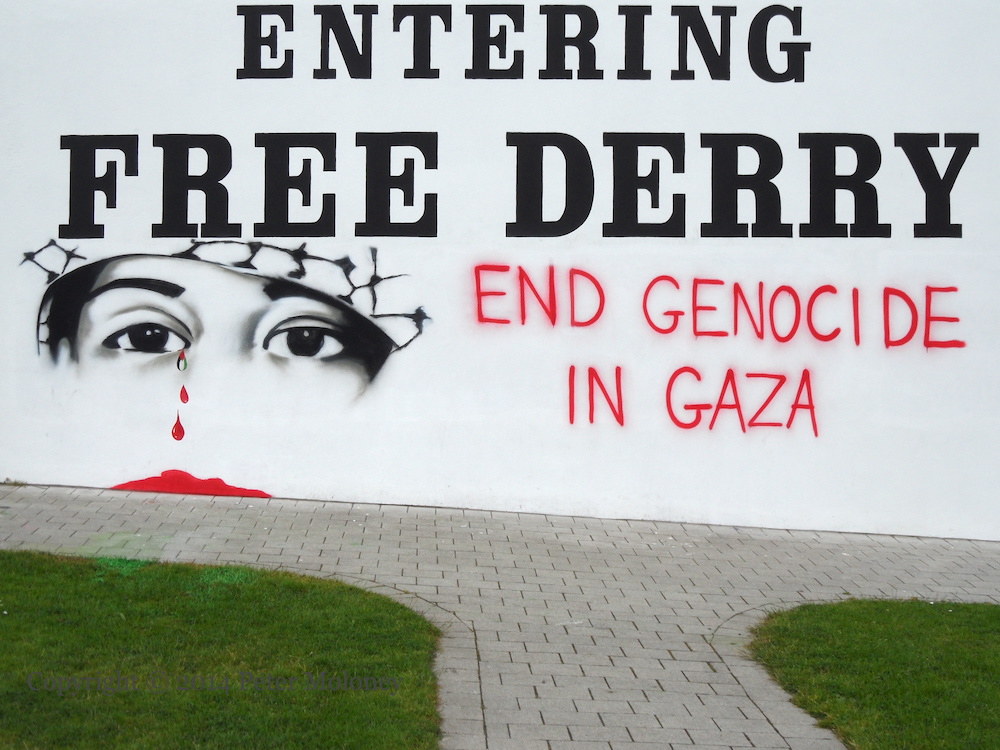
A Palestinian wearing a keffiyeh sheds a tear in the colours of the Palestinian flag, along with additional tears of blood, over the “genocide” in Gaza due to the long-running Israeli blockade of Gaza, forbidding movement by air and sea and controlling what enters and exits via the three (land) border-crossings, and sanctioning the Palestinian Authority (led by Hamas). The mural has perhaps been prompted more specifically by the recent Israeli airstrikes on Gaza and arrests of Palestinians in the West Bank – see the WP page on the 2014 Gaza War.
Cut-out boards in the shapes of the red hand of Ulster (both left and right hands!), the five-pointed orange star (usually purple) of the Williamites, the crown of the British monarch, and King Billy on his steed line the fence along Bute Park in Ballybeen, Dundonald.
Also included are images of the nearby bonfire on Davarr Avenue, festooned with election posters for Martina Anderson, Nuala Toman, and (from Alliance) Anna Lo.
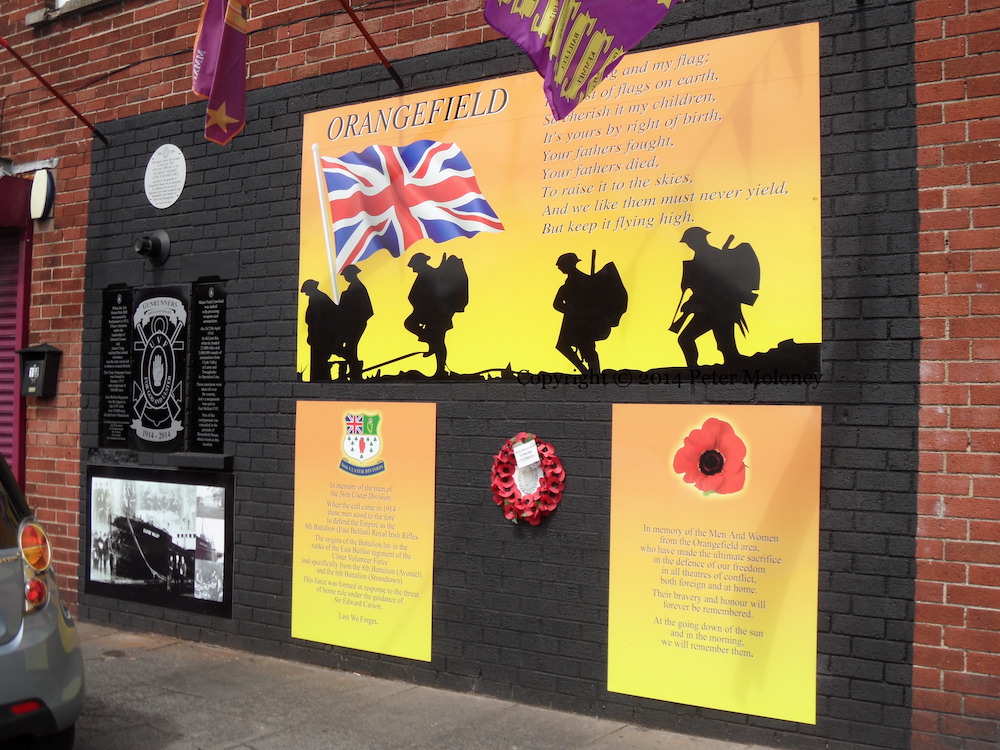
The boards on the left celebrate the 100th anniversary of the 1914 Clyde Valley gun-running; material from the operation was held for the East Belfast battalion of the Ulster Volunteers at Bloomfield House (web), site of these boards. See also: John Henry Patterson’s involvement in Operation Lion.
“When the 3rd Home Rule Bill was passed by Parliament in 1912, Ulster Unionists under the leadership of Edward Carson and James Craig realised that armed resistance was the only resort left to them to remain British. The Ulster Volunteer Force was formed in January 1913 and comprised of 100,000 men. East Belfast Regiment was the largest in the UVF with over 10,000 men divided into 6 Battalions: 1st. Ballynafeigh & Newtownbreda, 2nd. Willowfield, 3rd. Mountpottinger, 4th. Victoria, 5th. Avoniel, 6th. Strandtown & Knock. Major Fred Crawford was tasked with procuring weapons and ammunition. On 24/25th April 1914 he did just this when landed 25,000 rifles and 3,000,000 rounds of ammunition from Clyde Valley at Larne and Donaghadee in Operation Lion. These munitions were taken all over the country, and a consignment was sent to East Belfast UVF. Part of this consignment was concealed in the grounds of Bloomfield House, which stood on this location.”
“This plaque marks the occasion in early May 1914 when over 2,000 men of the East Belfast Regiment, Ulster Volunteer Force paraded to the grounds of Orangefield House for an inspection to celebrate the success of Operation Lion when weapons and ammunition were landed at Larne and Donaghadee. For God and Ulster.”
The boards on the right read: “‘Tis thy flag and my flag;/The best of flags on Earth,/So cherish it my children,/It’s yours by right of birth.//Your fathers fought,/Your fathers died,/To raise it to the skies,/And we like them must never yield,/But keep it flying high.” from The UnionJack, by Edward Shirley, in Little Poems For Little People, and “In memory of the men and women from the Orangefield area, who have made the ultimate sacrifice in the defence of our freedom in all theatres of conflict, both foreign and at home.” These memorial boards are to local men who “stood to the fore to defend the Empire as the 8th Battalion (East Belfast) Royal Irish Rifles” in the 36th division, formed from formed from the “8th Battalion (Avoniel) and the 6th Battalion (Strandtown)” of the Ulster Volunteers.
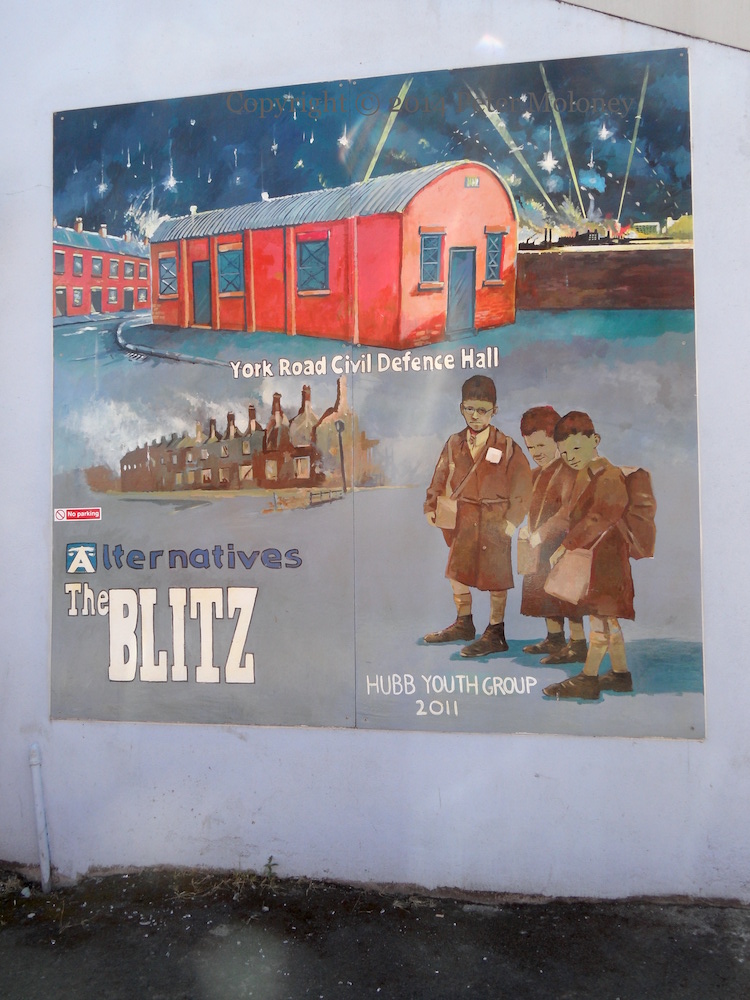
This board is on the end of the Hubb Community Resources Centre and Bowling Club in St. Vincent Street, north Belfast; across the street is Crusaders football ground.
From the Tele: “The building was once the home for local Civil Defence during World War II’s ‘Blitz’. This building is now the one of the last remaining Civil Defence structures in Northern Ireland and has also played home to the local Senior Bowls Club for many years.” The mural also shows bombed-out homes and children going off to the countryside. Short documentary about the 1941 Belfast Blitz (youtube).
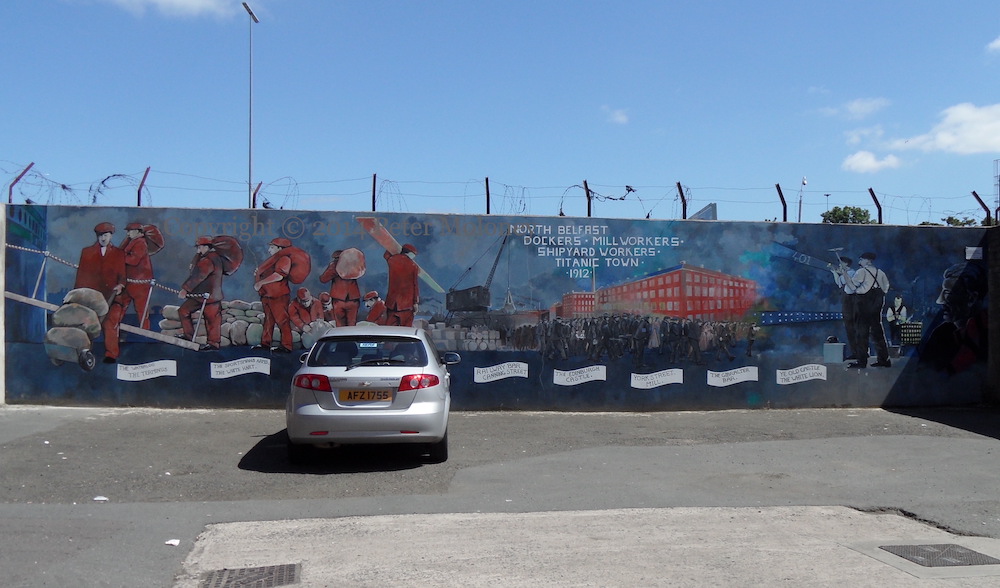
The mural presents a montage of images of “North Belfast dockers, millworkers, shipyard workers” working in “Titanic town 1912”. Along the bottom are the names of various Belfast pubs and other businesses: The Waterloo, The Terminus, The Sportsman’s Arms, The White Hart, The Bowling Green, The City Arms, The Orpheus – York Street, Railway Bar – Canning Street [image from 1970], The Edinburgh Castle [the boat of the Union-Castle line, launched 1910, built at H&W?], York Street Mill, The Gibralter [sic] Bar [whose then-owner was killed in 1972], Ye Old Castle [a bar (and restaurant?) bombed in 1971], The White Lion.
The plaque on the right-hand side reads: “This mural was developed under Belfast City Council’s Titanic community engagement project, with support from Titanic Foundation. Thanks go to Jim Crothers and The Hubb Community Resource Centre.”
St. Vincent Street, north Belfast. For a wide shot without vehicles, see X01139.
HMS Caroline’s connection to Belfast is that she served as the headquarters for the Royal Naval Reserve in Alexandra Dock. Originally built in 1914, she served in the Grand Fleet and took part in the battle of Jutland on May 31st, 1916, as shown in the image above. She was decommissioned in 2011; it is hoped to open her as a museum and visitor attraction by the time of the centenary of the battle (WP). The Daily Mail has a gallery of images of the ship in its current state. Also present at the battle of Jutland, as captain of HMS Nestor, was Commander (later Sir) Edward Bingham.
By Jim Russell in St. Aubyn’s Street, north Belfast
This is the freshly-repainted UFF mural in Ballyduff (former version in purple). As the close-up shows, the figures are quite crudely drawn, with strange lips, elongated fingers, and amorphous limbs.
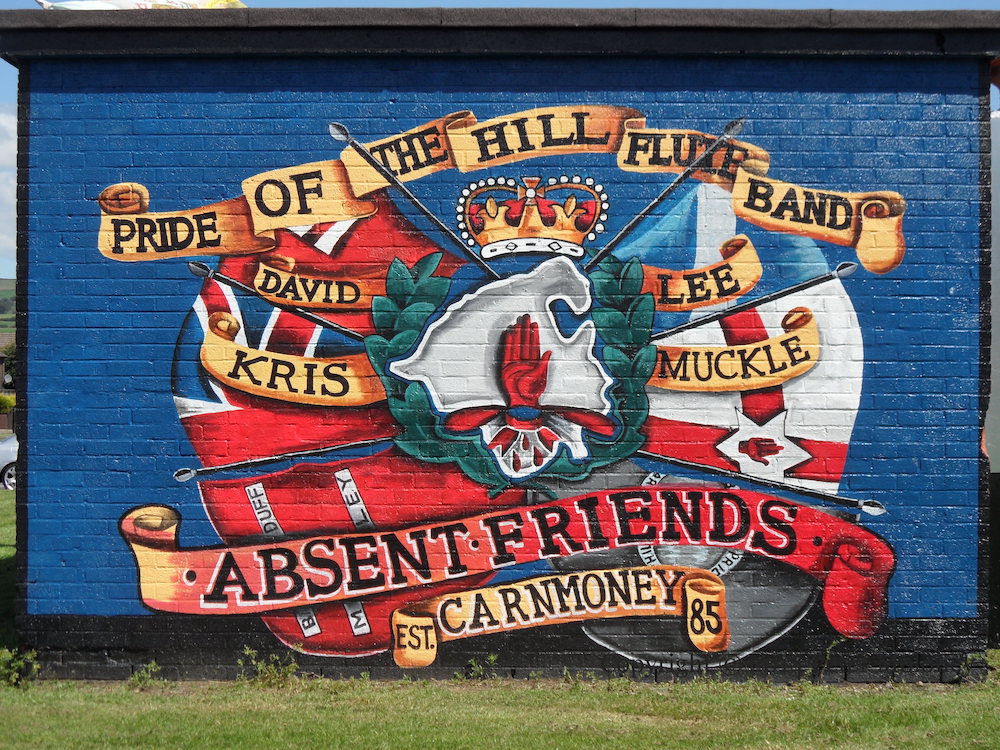
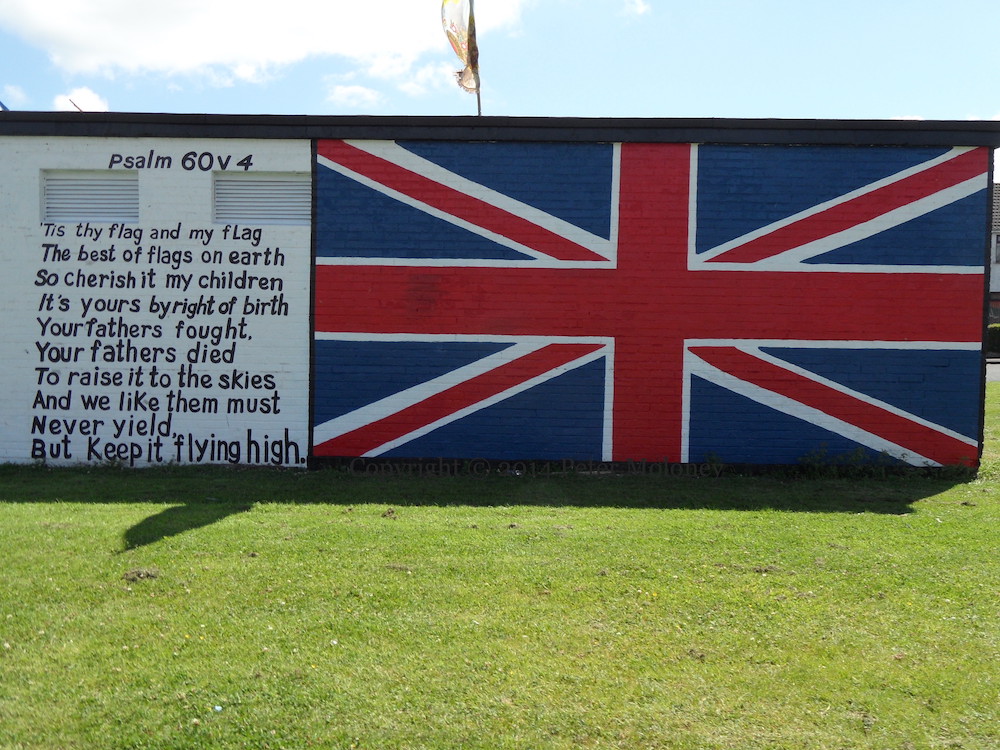
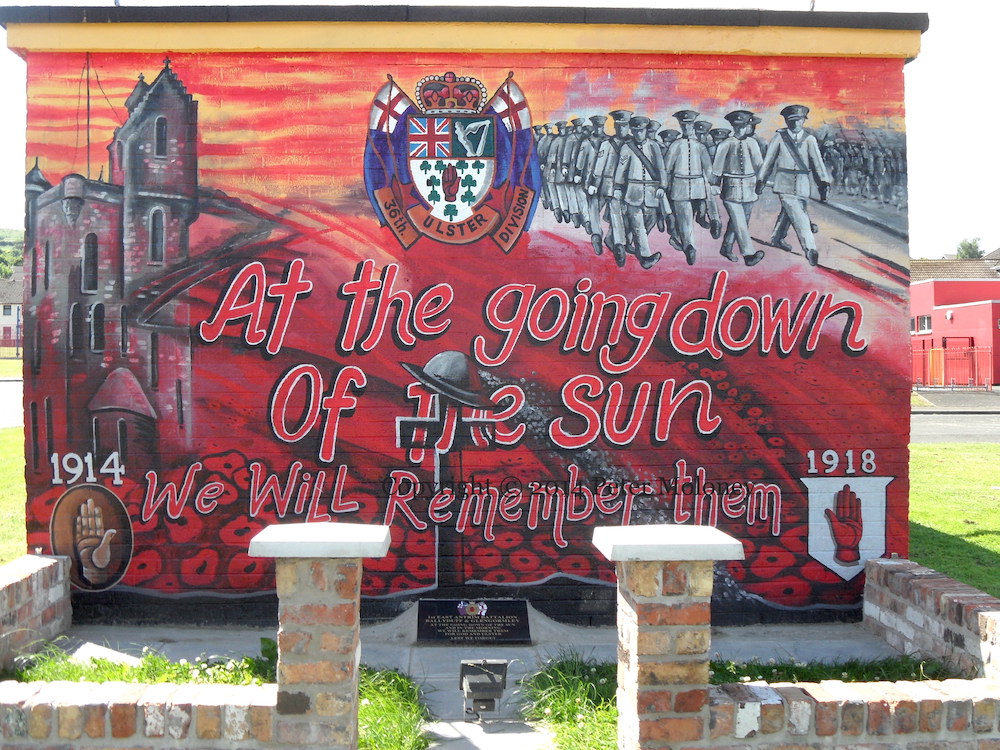
This large electrical sub-station, painted on all four sides, is in Ballyduff, Newtownabbey.
First: David Lee was a founder, in 1985, of Pride Of The Hill Flute Band in Carnmoney/Ballyduff. Kris Muckle – now deceased – was a long-time member. (Fb)
Second: Translations of Psalm 60.4 vary, but it is something like “You (the Lord) have given those who fear you a banner so that they will not flee before your arrows”, which might work quite well alongside a Union jack. But in fact, the lines on the side of the sub-station come do not come from Psalm 60.4; they are rather the first stanza of a 1902 poem (earliest found mention), The UnionJack, by Edward Shirley, in Little Poems For Little People:
‘Tis thy flag and my flag, the best of flags on earth; Oh, cherish it my children, for ’tis yours by right of birth. Your fathers fought, your fathers died, to rear it to the skies; And we like them will never yield, but keep it flying high.
Third and fourth: “They paid the ultimate sacrifice”. WWI soldiers from the 36th (Ulster) Division in relief against an orange sky (perhaps “at the going down of the sun”), picking their way across the battlefields of Flanders. The Ulster Memorial at Thiepval, which commemorates the 5,000 lost lives and more specifically the role of Orange Order members, is shown in the top left corner of the smaller wall. The plaque commemorates members of the modern UVF “1st East Antrim Battalion, Ballyduff & Glengormley”.
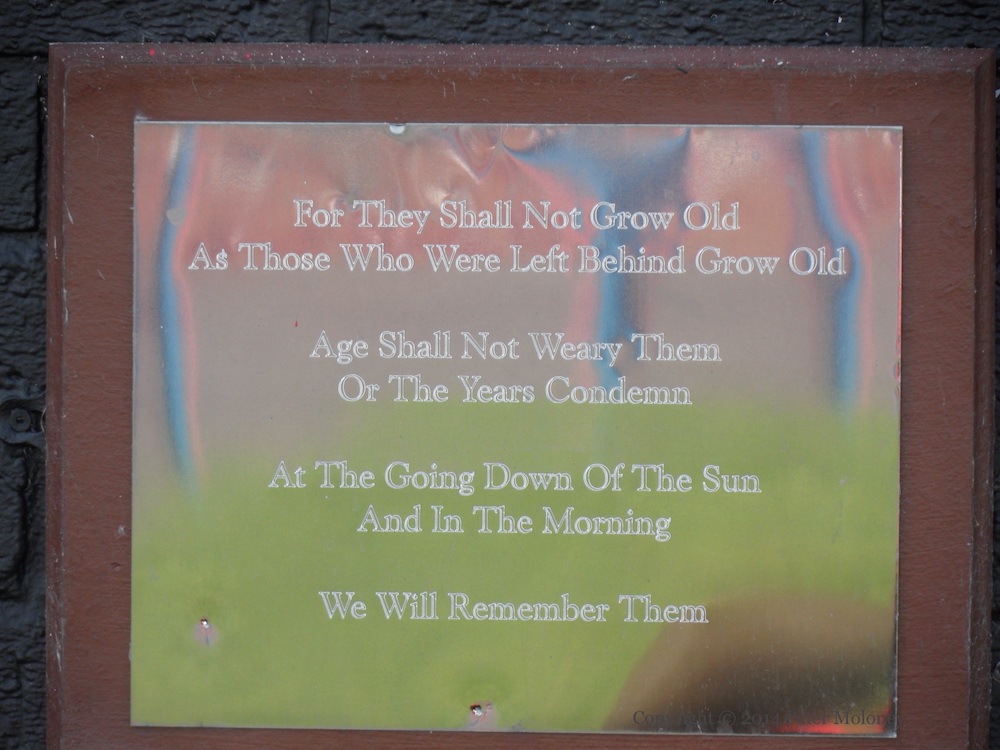
This UVF mural shows the flags and insignia of the UVF and YCV (Young Citizen Volunteers), Ballyduff/Glengormley 1st East Antrim Battalion, alongside the flags of Scotland, Northern Ireland and Great Britain. The plaque shows only a verse from Binyon’s For The Fallen.
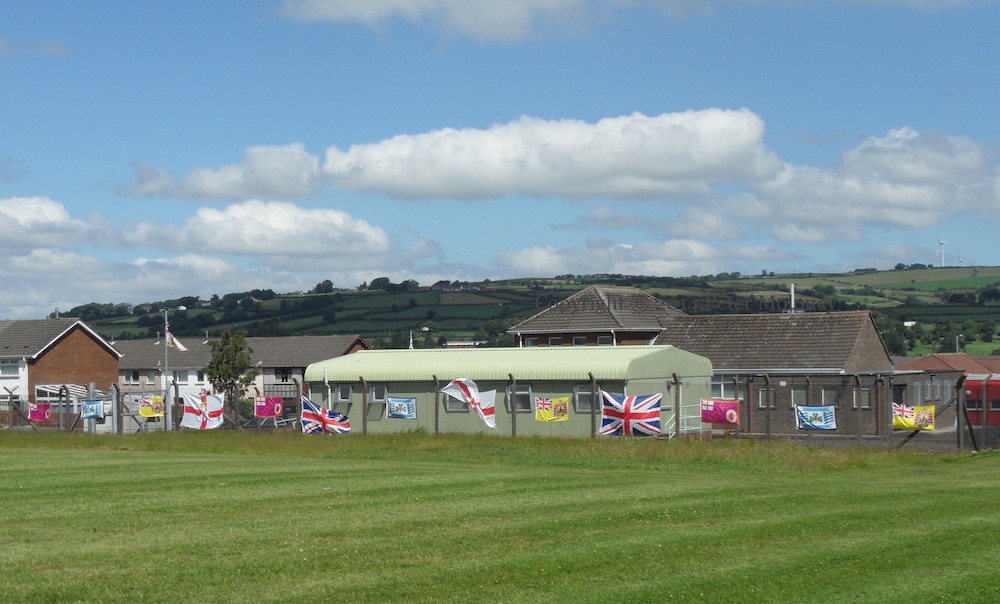
Bonus images of the bonfire and the flags flying around the green.
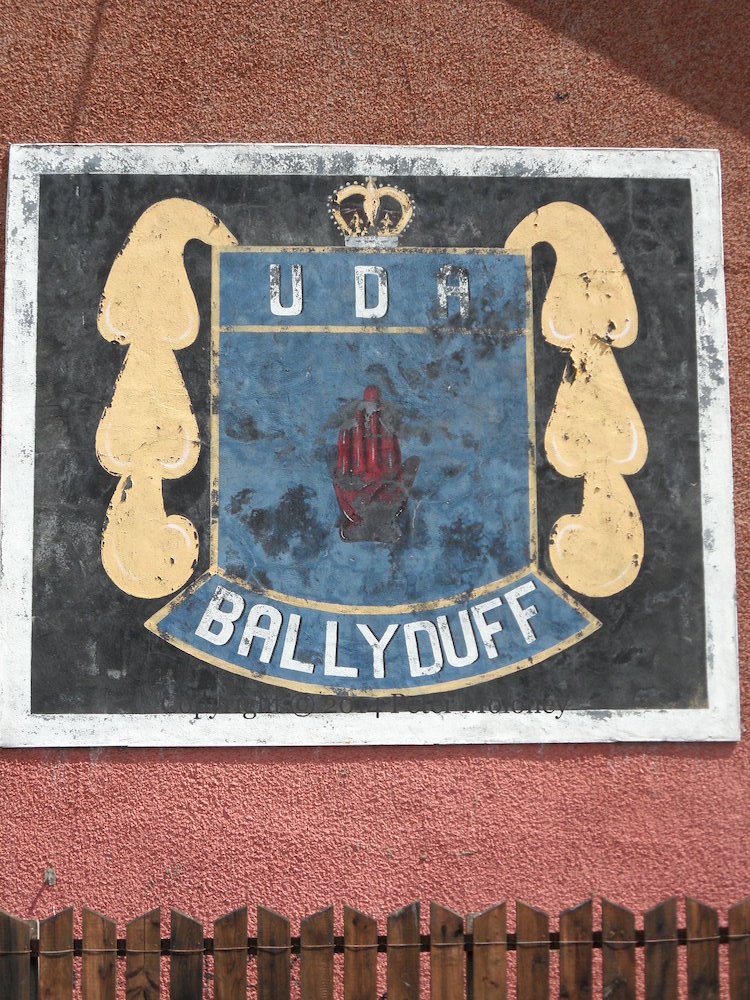
This is an end-of-life shot of the Ballyduff UDA board on Fairview Road – for the same piece in 2009 see M05010. Together with the recently repainted South East Antrim UFF, it sits prominently on the main road through the estate.











 Peter Moloney Collection