
INLA/IRSP mural (somewhere) in Carn Hill, Derry.
Click image to enlarge
Copyright © 2007 Peter Moloney
M03643
INLA/IRSP mural (somewhere) in Carn Hill, Derry.
Click image to enlarge
Copyright © 2007 Peter Moloney
M03643

UFF emblem between Ulster Banner and Union Flag, Strone Park, Dundonald.
Click image to enlarge
Copyright © 2007 Peter Moloney
M03639
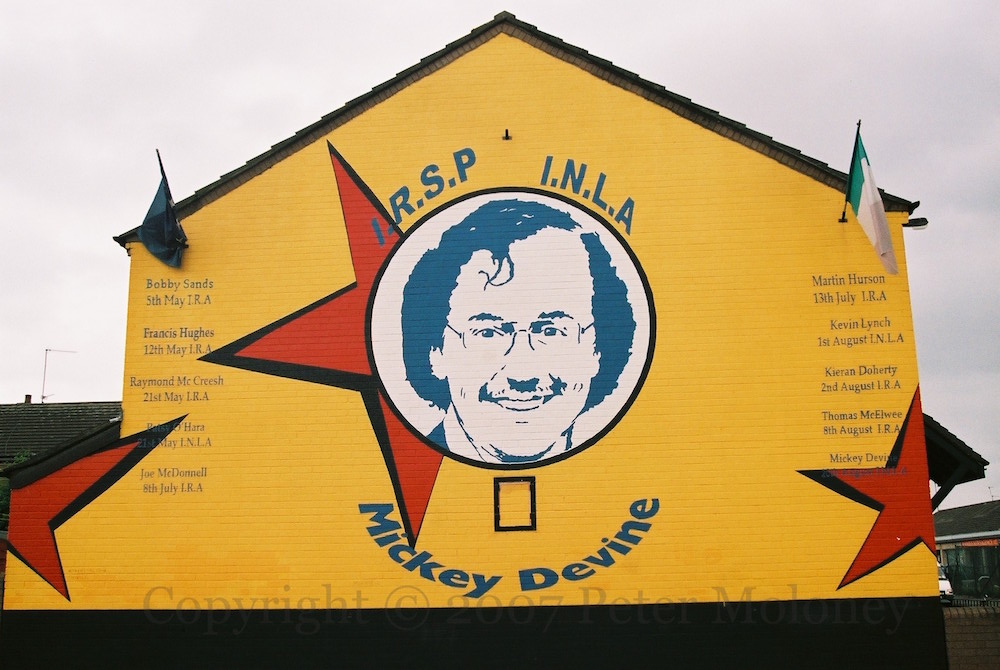
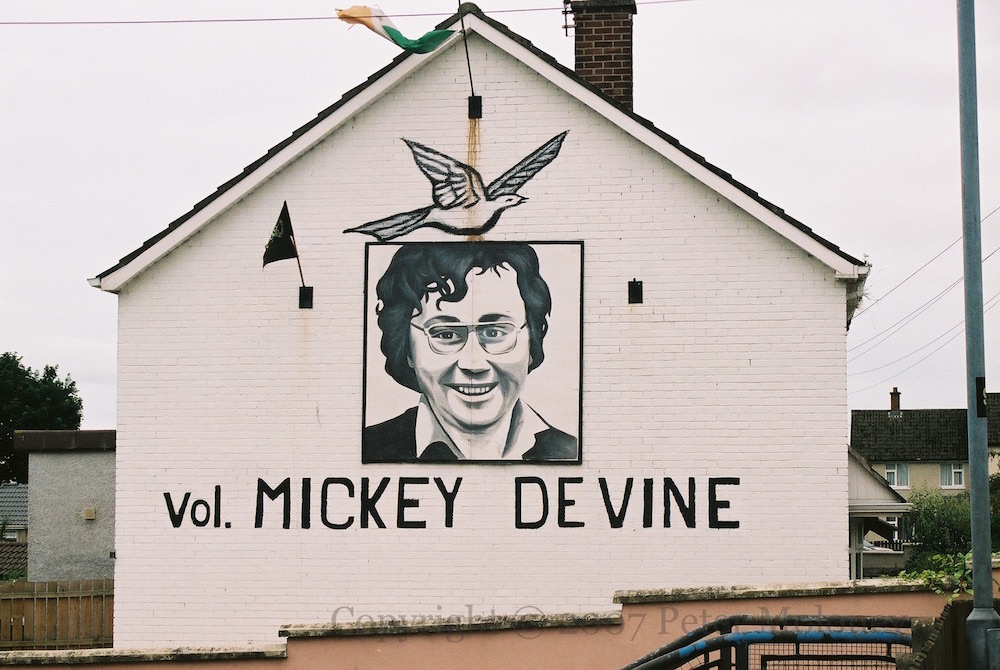
2007 image of the Chemical Street mural to hunger striker Mickey Devine seen previously in 2006 (including the dedication in the frame).
Click image to enlarge
Copyright © 2007 Peter Moloney
M03623
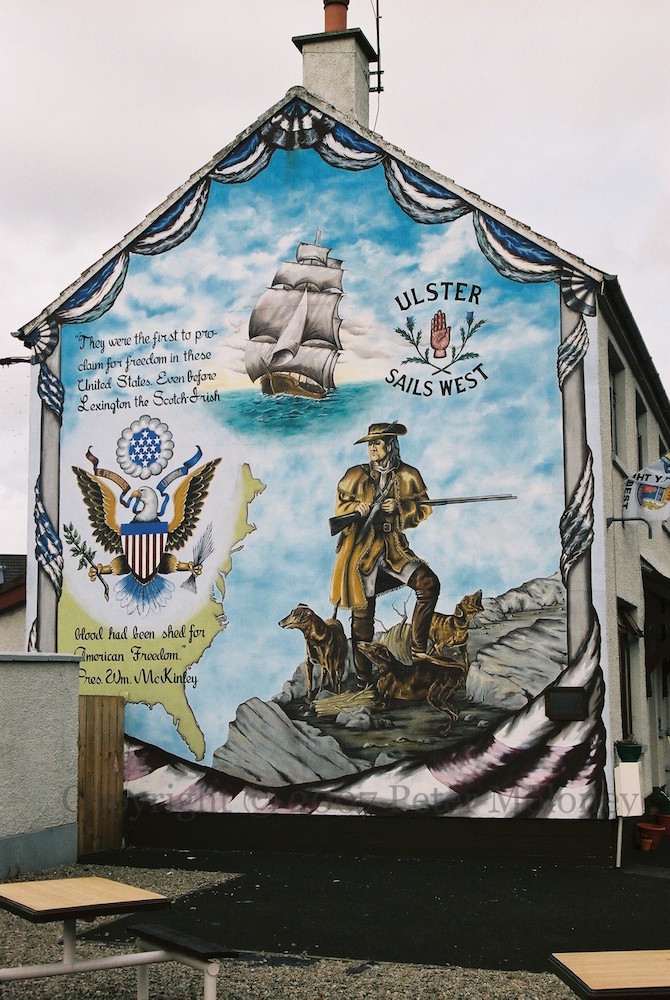
This Ballymoney mural goes all the way back to at least 2004 and to the wave of Ulster-Scots – or as here, “Scotch-Irish” – murals painted in PUL areas after the promotion of Ulstèr-Scotch as a parallel language to Irish by the Good Friday/Belfast Agreement.
As the Visual History page on Ulster-Scots Murals shows, most of these murals made a connection to (what would-become) the United States, to where about a quarter million people emigrated (WP). The mural is intended to tell a story of emigration (signified by the sailing ship), American independence (the McKinley quote), and American expansion (the frontiersman).
The Scotch-Irish were Presbyterians and supporters of breaking the ties to Great Britain. In 1893, Governor Of Ohio (and later US President) (Ulster Nation) William McKinley said, “They were the first to proclaim for freedom in these United States. Even before Lexington [i.e. the outbreak of the Revolutionary War, on April 19, 1775] the Scotch-Irish blood had been shed for American Freedom.” (According to William Marshall’s book Ulster Sails West, the battle McKinley is referring to took place on the Alamace river in North Carolina in 1771 (p. 29).)
The frontiersman on the right is generally taken to be David “Davy” Crockett, from the 1830s (Rolston in Al Jazeera | McCormick J2024); it is in fact a 1991 sketch of a generic frontiersman by David Wright (web), called “The Long Knife”, and the figure is referred to generically as “a trapper” by the artist (BBC).
None of the conquests of European-American colonists provides a good parallel to unionism, due to the complicated nature of political conflicts both there and here. The Americans, of course, threw off British rule in their revolution; Irish unionists want to remain part of the UK. And Crockett died in the Battle Of The Alamo in the Texas Revolution; that is, he died fighting for Texan independence from the Mexican government, which again doesn’t line up well with the desire of Irish unionists to remain part of the United Kingdom. (For another strained analogy involving the Scotch-Irish and US political history, see The War Of Northern Aggression and its discussion in the Ulster-Scots Murals page.)
The reason for its inclusion is the simpler idea that the Scotch-Irish are a rugged and feisty people who are not to be trifled with, whether in North America or Ireland.
Painted by Kenny Blair (Fb) in Hillview Avenue, Ballymoney; sponsored by the North Antrim Cultural And Musical Society and funded by the Heritage Commission. “Ulster Sails West” is the title of a 1943 book by WF Marshall (Isles Abroad).
Hillview Avenue, Ballymoney
Click image to enlarge
Copyright © 2007 Peter Moloney
M03568


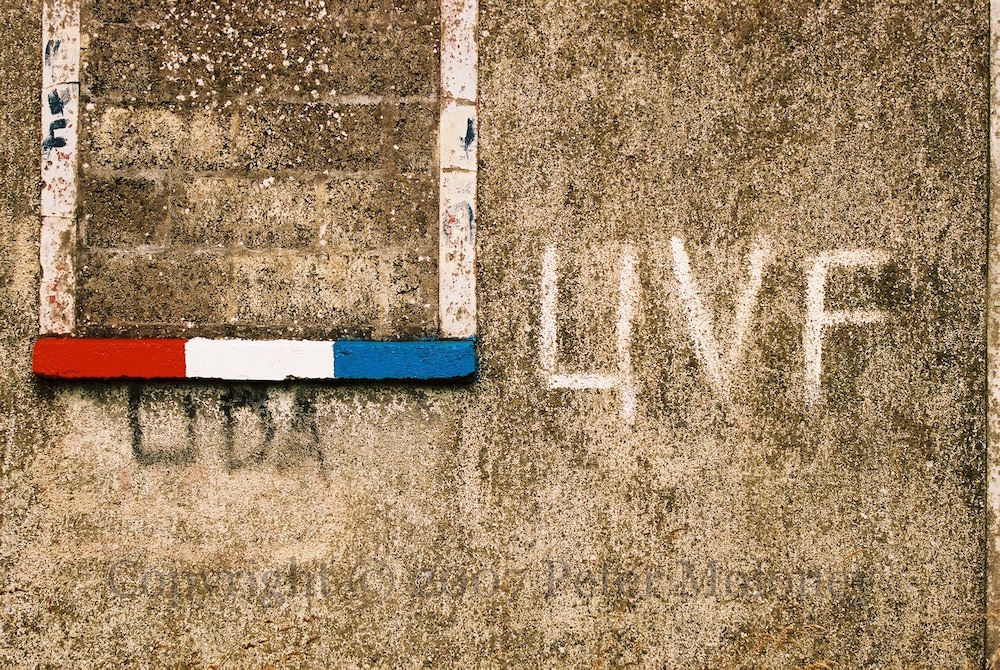
Scenes from the junction of the Tullgrawley, Shellinghill, Ballywatermoy, and Cladytown roads north of Ballymena and Cullybackey.
Click image to enlarge
Copyright © 2007 Peter Moloney
M03558 M03557 M03559


19 year-old Provisional IRA volunteer Eamonn Lafferty was “killed on active service 18th August 1971”, in a gun-battle with British Army forces who were attempting to dismantle barricades in republican “Free Derry”.
Kildrum Gardens, Derry
Click image to enlarge
Copyright © 2007 Peter Moloney
[M03591] [M03592] [M03593] [M03594] M03595 M03596

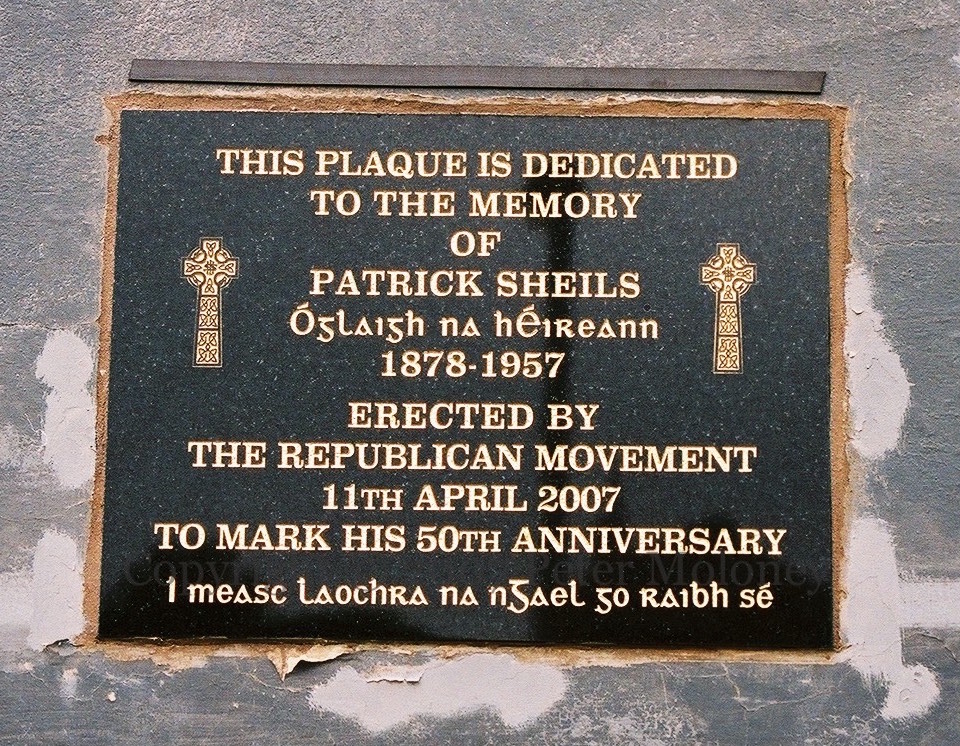
A plaque “dedicated to the memory of Patrick Shiels Óglaıgh Na hÉıreann 1878-1957. Erected by the republican movement 11th April 2007 to mark his 50th anniversary. I measc laochra na nGael go raıbh sé” is added to the Operation Motorman mural in Rossville Street, Derry. Paddy Shiels took part in the Easter Rising and was later Derry OC. See BMH testimony #676 by Liam Brady.
Click image to enlarge
Copyright © 2007 Peter Moloney
M03582 M03583

Mural on the side of the “container” shop in Glenfada Park advertising the “Free Derry” féıle.
Click image to enlarge
Copyright © 2007 Peter Moloney
M03581

This pair of images — “Deserted! Well – I can stand alone” from the anti-Home Rule campaign that continued during WWI and the other a more contemporary scene of “a protestant farmer’s wife guard[ing] her husband against sectarian attack from across the border” — was previously painted in (what remains of) Moscow Street, next to the Rex bar on the Shankill. (See X00066. See also M00558 lower Shankill | M00621 east Belfast | M02302 east Belfast). The plaque on the right was not originally part of the mural (see J2395) and the mural would later be modified by the removal of the Orange Order and St Andrew’s flags (but not the UVF emblem), replaced by a shamrock-strewn banner reading “Fight To A Finish” (M08026).
Drumtara, Ballymena
Click image to enlarge
Copyright © 2007 Peter Moloney
M03578
 Peter Moloney Collection