The UVF flag contains the flag of England (St. George’s Cross) in one corner and in the other an orange star; “1912” – the year the Ulster Volunteers were founded – in this example is in the top right. The colour-scheme is the reverse of the Orange Order’s: its flag has the purple star of the Williamites on an orange field.
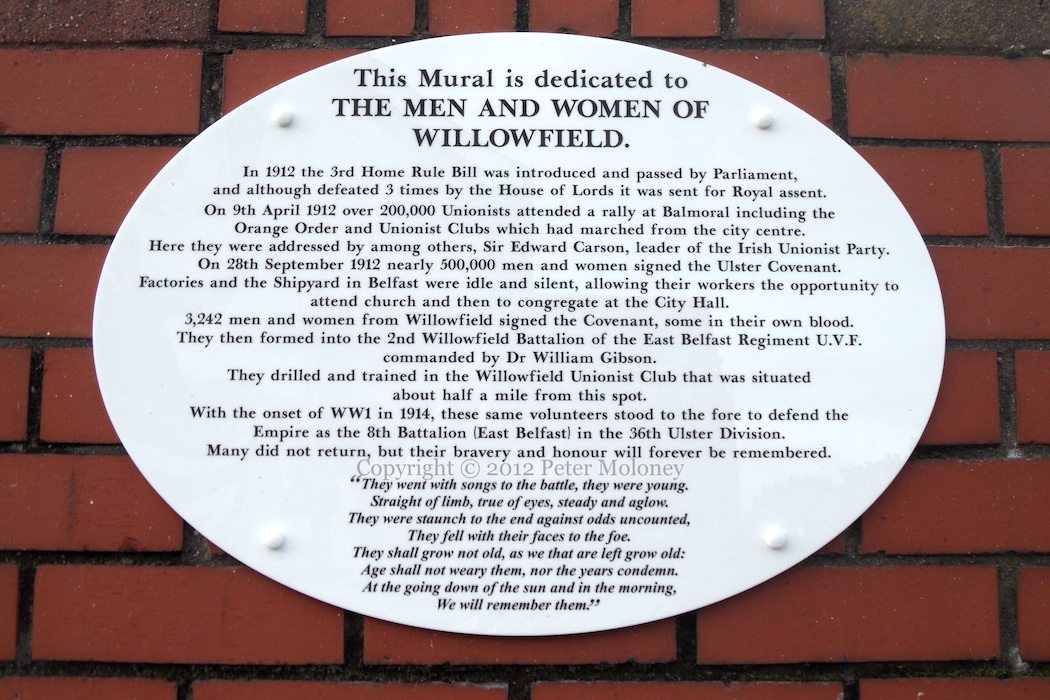
“We will not have Home Rule.” This mural is dedicated to the men and women of Willowfield. In 1912 the 3rd bill was introduced and passed by parliament and although defeated 3 times by the House of Lords it was sent for Royal assent. On 9th April 1912 over 200,000 unionists attended a rally at Balmoral including the Orange Order and Unionist Clubs which had marched from the city center. Here they were addressed by among others, Sir Edward Carson, leader of the Irish Unionist Party. On 28th September 1912 nearly 500,000 men and women signed the Ulster Covenant. Factories and the Shipyard in Belfast were idle and silent, allowing their workers the opportunity to attend church and then to congregate at the City Hall. 3,242 men and women from Willowfield signed the Covenant, some in their own blood. They then formed into the 2nd Willowfield Battalion of the East Belfast Regiment U.V.F. commanded by Dr. William Gibson. They drilled and trained in the Willowfield Unionist Club that was situated about half a mile from this spot. With the onset of WW1 in 1914, these same volunteers stood to the fore to defend the Empire as the 8th Battalion [East Belfast] in the 36th Ulster Division. Many did not return, but their bravery and honour will forever be remembered.
“They went with songs to the battle, they were young/Straight of limb, true of eyes, steady and aglow./ They were staunch to the end against odds uncounted/They fell with their faces to the foe./They shall not grow old, as we that are left grow old;/Age shall not weary them nor the years condemn./At the going down of the sun and in the morning,/We will remember them.”
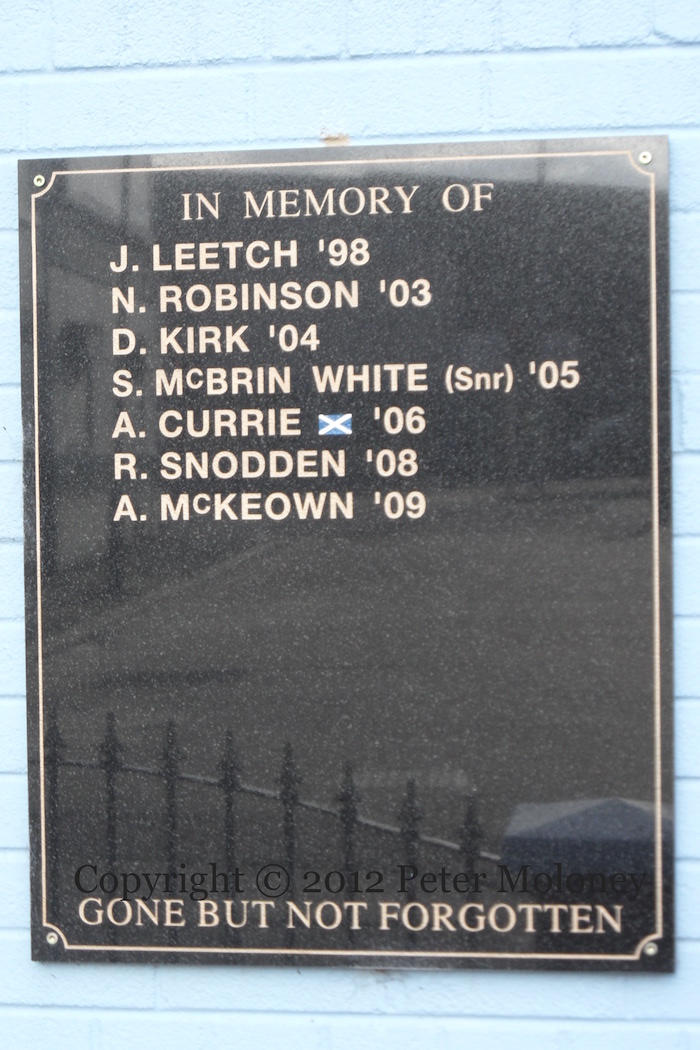
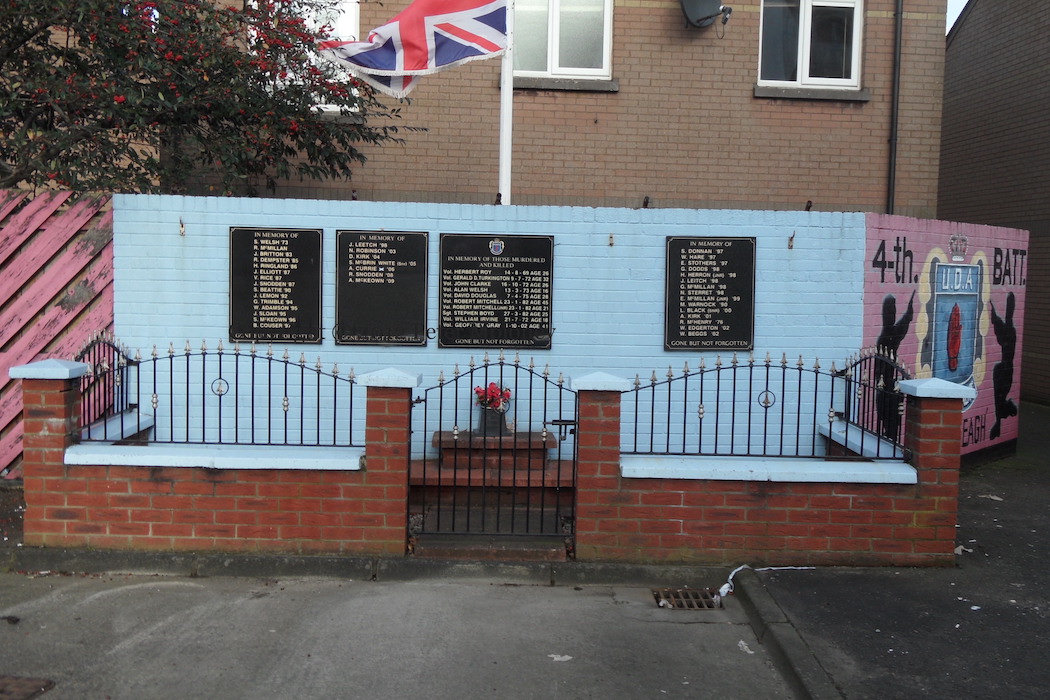
A fourth plaque (shown above) has been added to the UDA memorial in Kenbaan Street, Belfast. The first three, along with the murals to either side, were seen previously, in 2006.
It took Allied forces two months (July – September, 1916) to take High Wood (Bois de Fourcaux – wood of the pitchforks, as made from the chestnut trees (Great War Forum)) as part of the battle of the Somme. The commemorative mural shown here replaces an earlier UFF piece for the Coleraine 2nd battalion of the Londonderry-North Antrim brigade. On the third side is the emblem of the UDA, surrounded with an Ulster Banner and the flag of the independent Northern Ireland – previously there had been two Ulster banners.
“2012 Centenary year” – a history of Michael Davitt’s GAA (Belfast) can be found at its web site. Davitt was a central figure in the IRB, argued for land reform, and was an MP (WP | VP); he was one of the three original patrons of the GAA, along with Archbishop Croke and Charles Stewart Parnell (Cork GAA). The mural is at the club’s premises in Clonard Street; home games are played at St Mary’s Gardens.
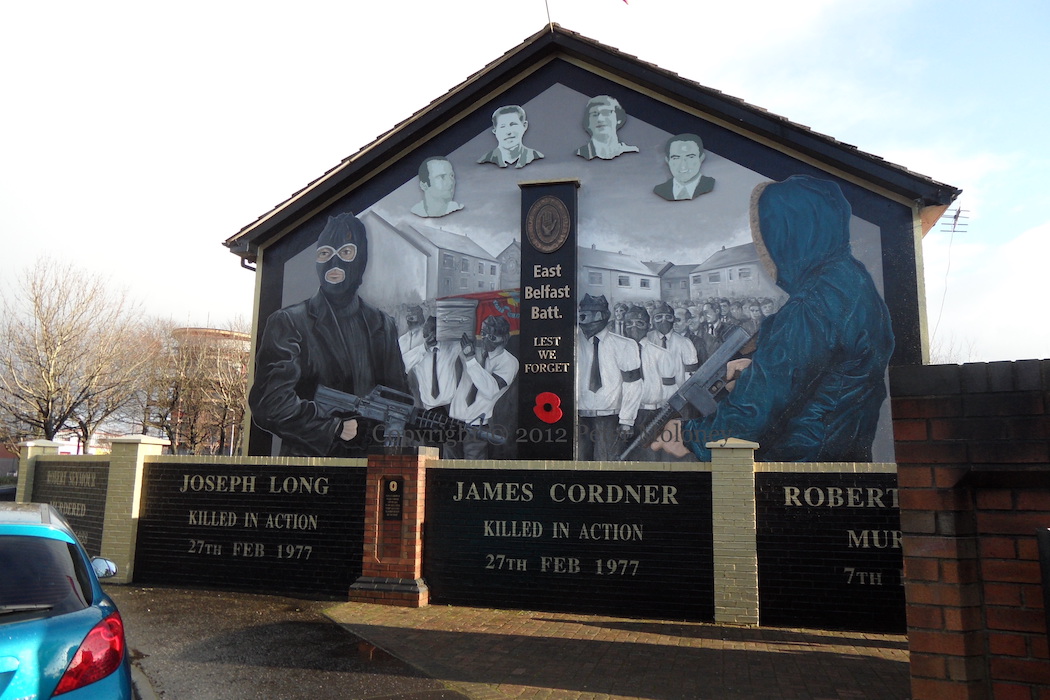
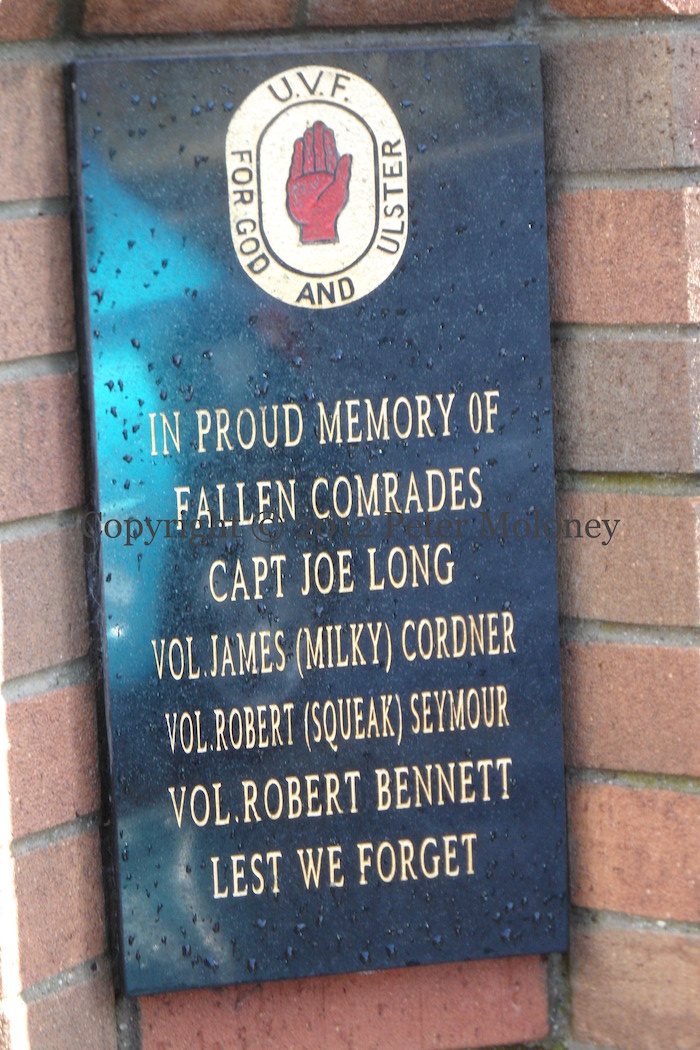
“In proud memory of fallen comrades Capt Joe Long, Vol James (Milky) Cordner, Vol Robert (Squeak) Seymour, Vol Robert Bennett – lest we forget”. Seymour was shot dead by the (P)IRA (Sutton); James Cordner and Joseph Long were killed in a premature explosion (Balaclava St), and Robert Bennett was killed by the British Army during a riot (Sutton).
The plaque was previously on a brickwork column in front of the previous mural – see M02953.
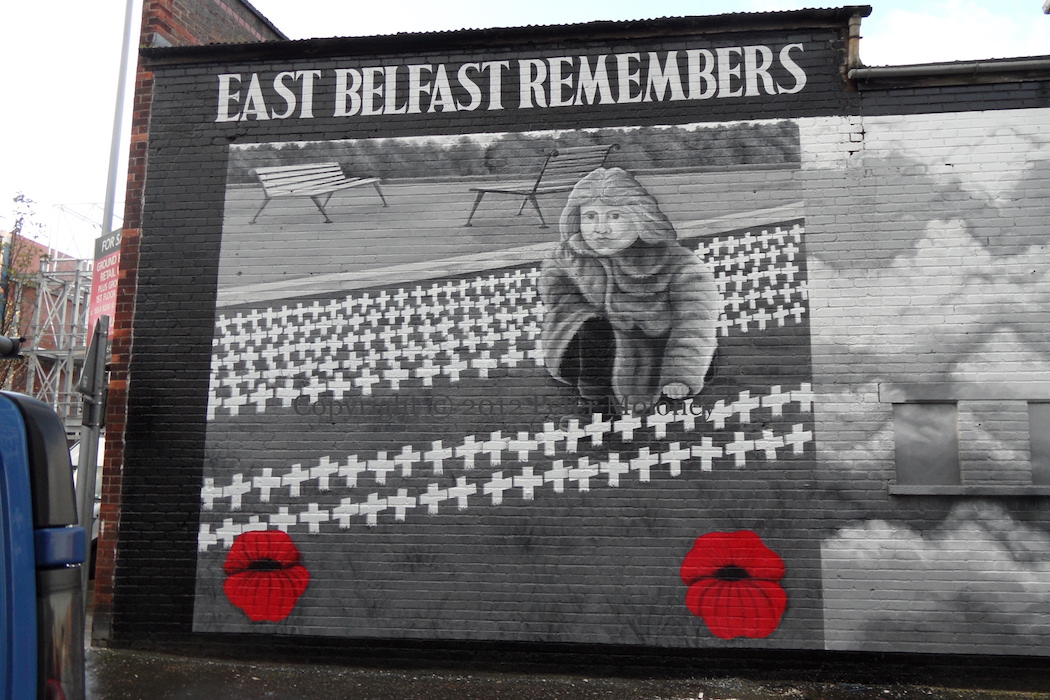
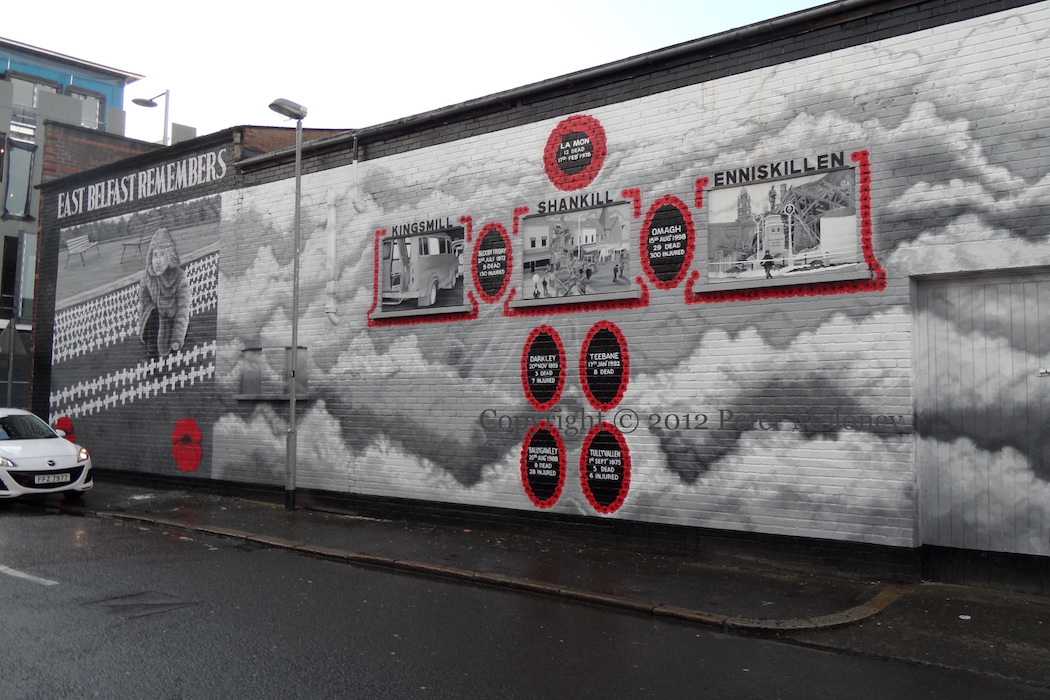
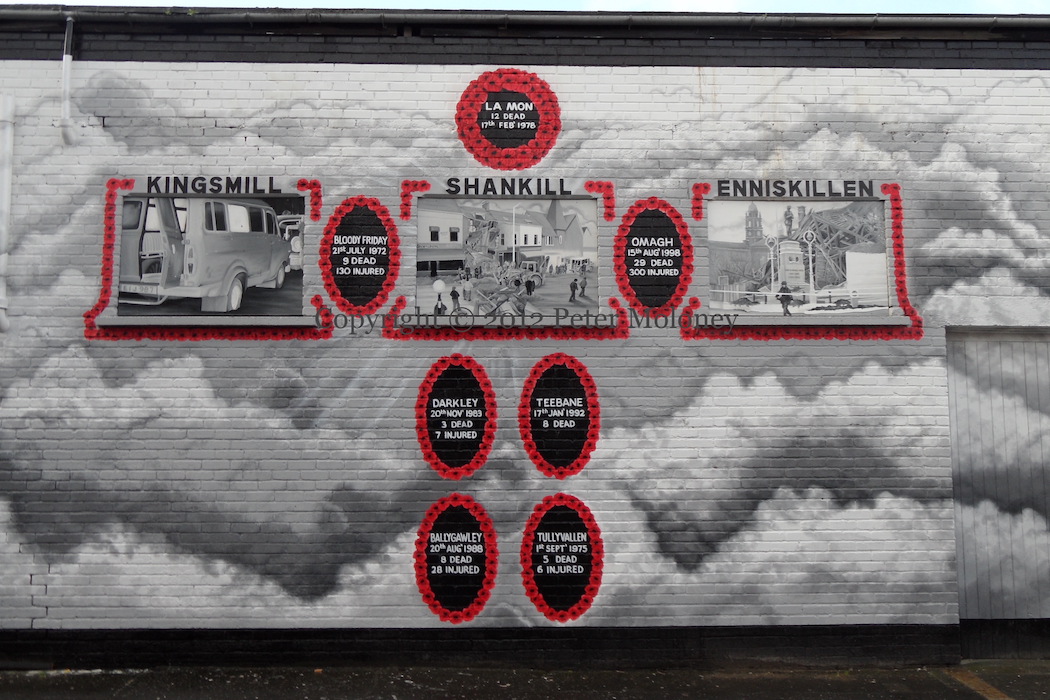
East Belfast remembers both the Great War and the victims of various attacks during the troubles: in pictures: Kingsmill – Shankill – Enniskillen; in garlands of poppies: La Mon 12 dead 17th Feb 1978, Bloody Friday 21st July 1972 9 dead 130 injured, Omagh 15th Aug 1998 29 dead 300 injured, Darkley 20th Nov 1983 3 dead 7 injured, Teebane 17th Jan 1992 8 dead, Ballygawley 20th Aug 1988 8 dead 28 injured, Tullyvallen 1st Sept 1975 5 dead 6 injured.
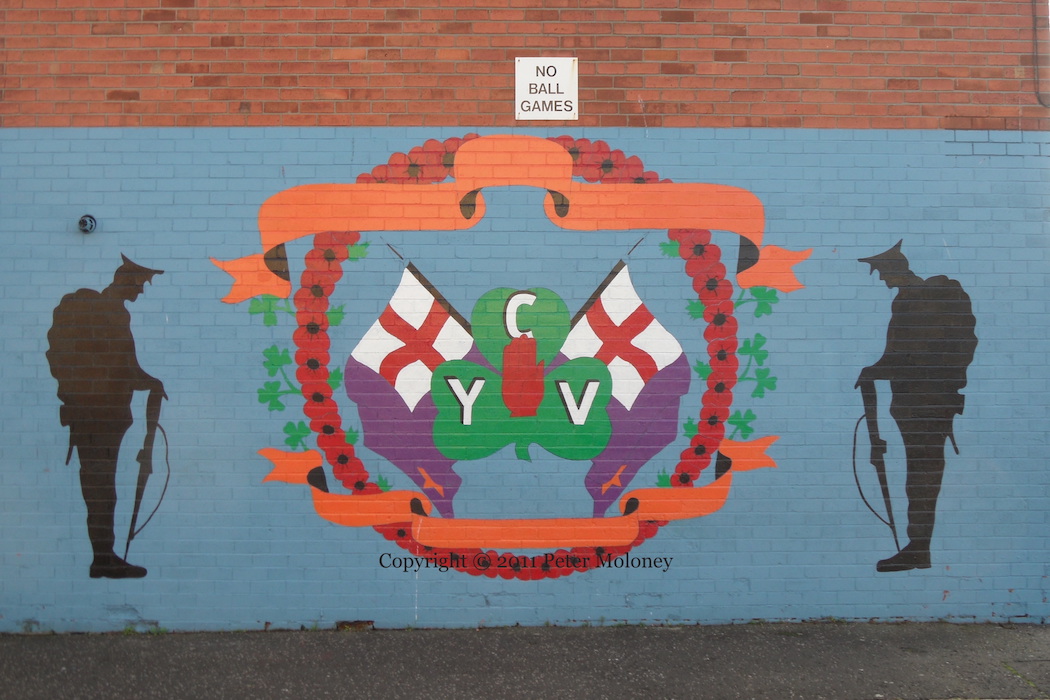
The shamrock and the poppy. The Young Citizen Volunteers formed a battalion of the Royal Irish Rifles and so part of the 36th (Ulster) Division during the first world war.





 Peter Moloney Collection