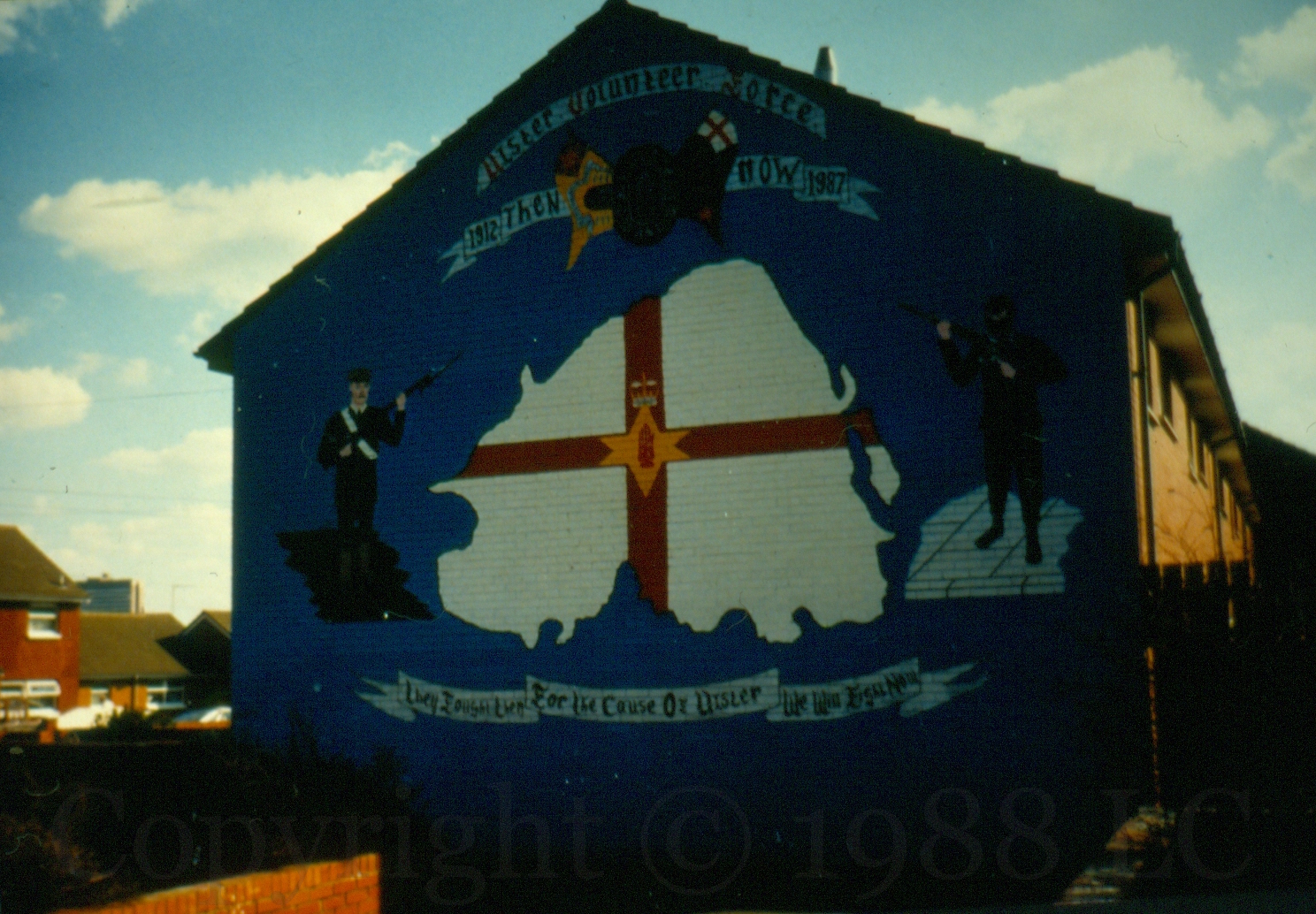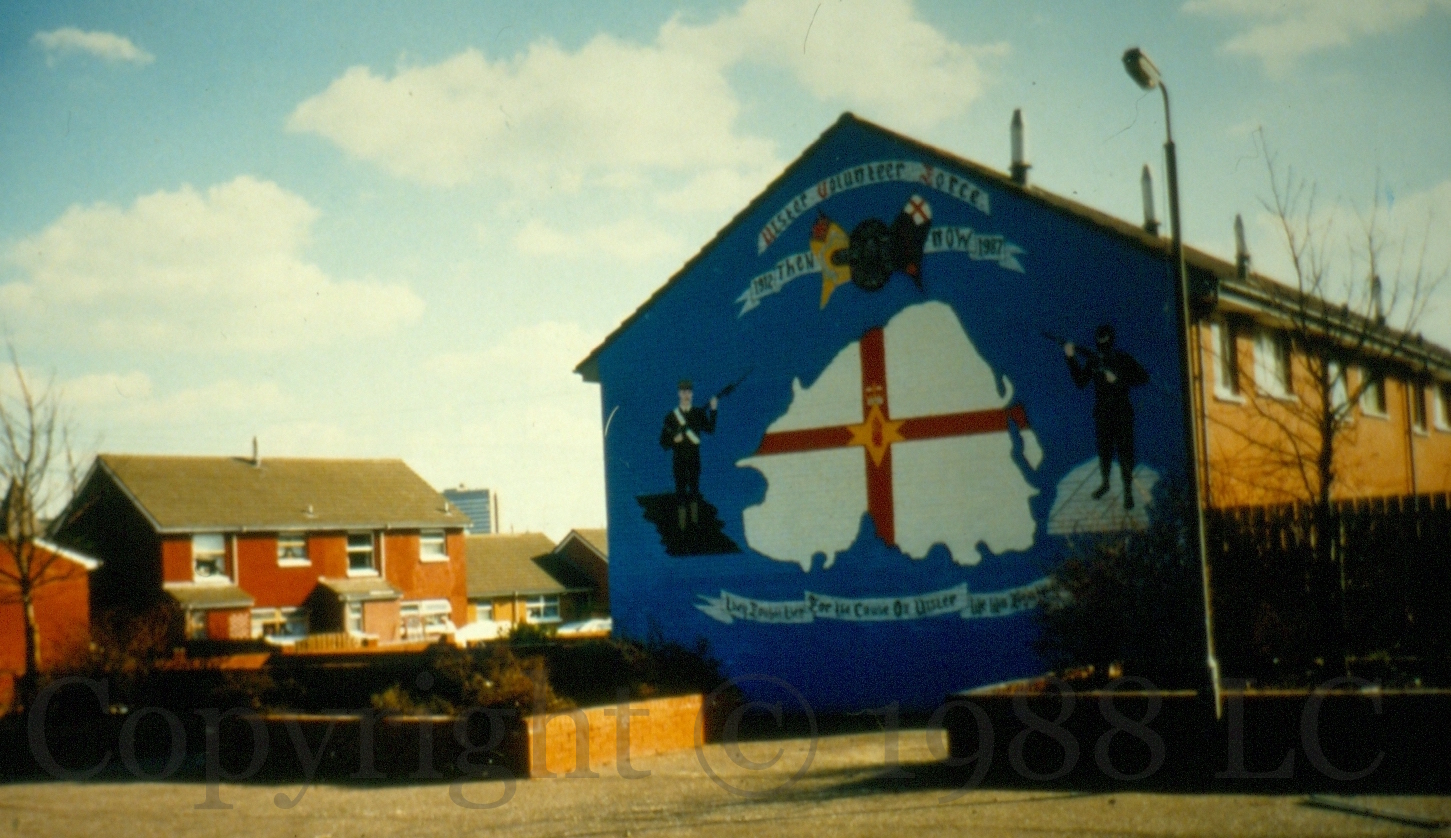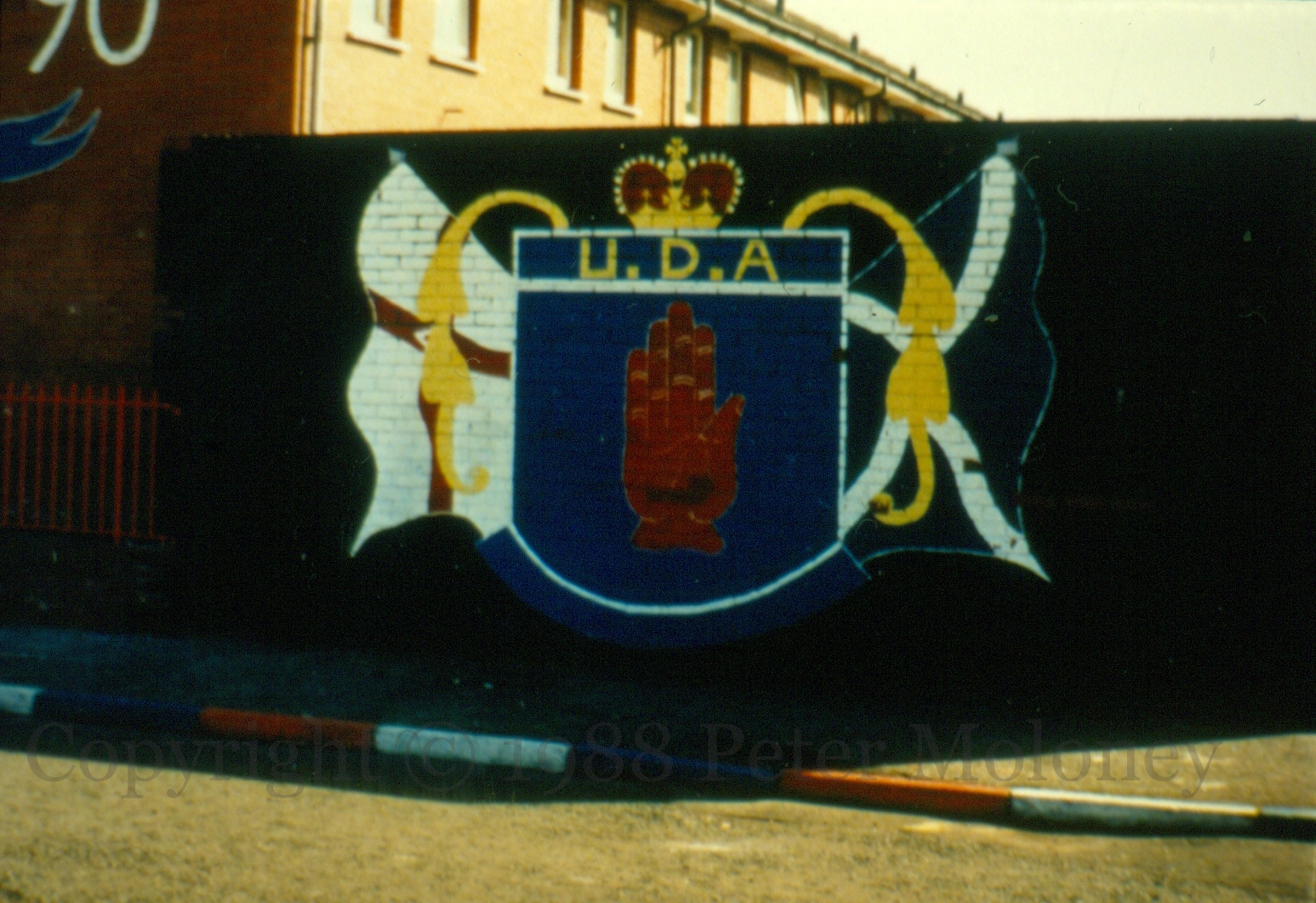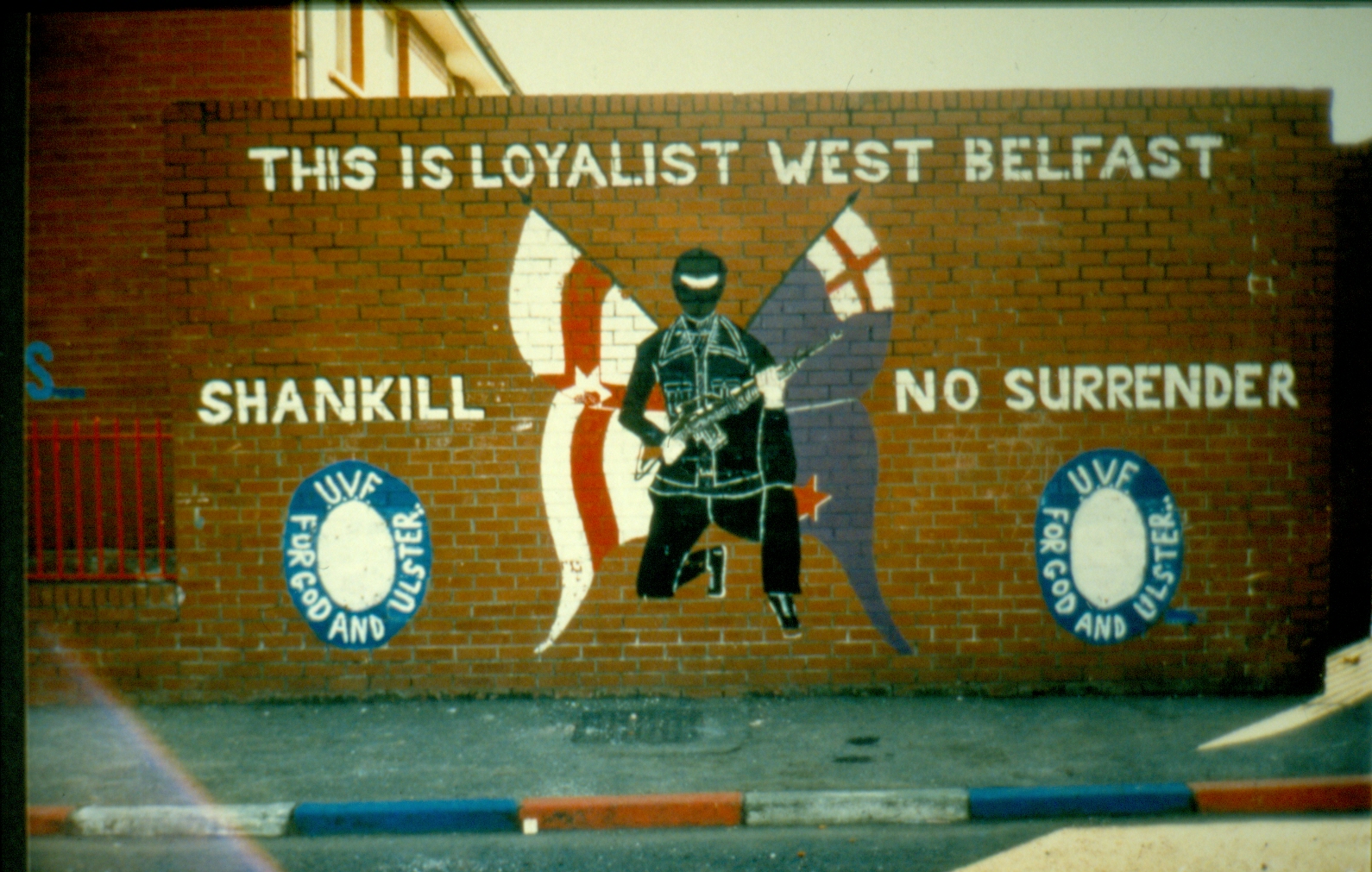
Both UVF and UDA emblems (as well as PAF and YCV) in the quadrants of an Ulster banner shield with Northern Island in the middle. Union flags on the side and barbed wire above. No 5 of 9 on the south side of Percy Place, Belfast.
Mural No 4 of 9 in Percy Place, Belfast pairs an Ulster banner with a St Andrew’s Saltire, with a red hand on a six-pointed star beneath a crown. “United we stand.”
UDA/UFF/UDF/LPA mural in Percy Place, Belfast. (No 3 of 9) The slogan is mistakenly written as “Sans pure” – it should be “sans peur” (without fear). “Quis separabit”
Percy Place, No 2 of 9. Loyalist paramilitary volunteer (perhaps based on Gusty Spence) with an Ulster banner in one hand and an automatic rifle in the other, standing on an unattached Northern Ireland.
The left-most mural (No. 1 of 9) in Percy Place, Belfast. The central motif of a red hand on a Saltire is unusual. 1690 is the date of King William III’s victory at the Battle of the Boyne.
The West Belfast Ulster Special Service Force (USSF) was a local Shankill unit within the West Belfast regiment of the Ulster Volunteers. It lost 90% of its men at the battle of Albert on July 1st, 1916. For more of its history see BygoneDays.
On the left of the lightning bolt are the soldiers of the 36th Ulster division (U.V.F.) R.I.R (Royal Irish Rifles) on the western front in 1916; on the right are “UVF prisoners of war, Long Kesh”.
A similar board was painted in the UVF compounds of Long Kesh. Of it, Billy Hutchinson (in his 2011 piece “Transcendental Art“) said, “My favourite mural was one inspired by the British anti-war poet, Siegfried Sassoon. Suicide In The Trenches depicts a UVF volunteer split down the middle by a bolt of lightning. Half of him depicts a 36th Ulster Division soldier under heavy fire in a rainsoaked WW1 trench. The other half shows a ’70s volunteer incarcerated behind barbed wire and over-shadowed by watch towers.” (The piece – W2021.1.8 in the Ulster Museum collection – includes the last verse from Sassoon’s Suicide In The Trenches.)
Hutchinson also describes the importance of the Orange Cross welfare organisation in selling prisoner art produced inside the prison. Stevie McCrea of the RHC was killed in the Orange Cross in 1989 – see Stevie McCrea.
These two murals are side-by-side in Craven Street. On the right, a farmer’s wife defends the farm (the stone wall) in order to preserve it as part of the UK (the Union Flag) despite the threat of Home Rule; on the left, “in proud and loving memory” of three UVF volunteers assassinated by the IRA: Shankill Butcher Lenny Murphy, John Bingham, and William “Frenchie” Marchant. “Lest we forget.”
UFF/UDA/LPA/UDF emblems in the four fields of an Ulster banner on a shield, flanked by Union flag and Saltire, with gunmen on manoeuvres in the countryside.
Crumlin Road, Belfast. To the left, and out of view to the left, are a pair of UVF murals.
The Ulster Banner, Union flag, St Andrew’s Saltire and the UVF’s own flag stand around the UVF red hand emblem (For God and Ulster, 1912), next to an LPOW hand in barbed wire.
The wide shot shows the accompanying YCV shamrock and an in-progress painting of the emblem of the 36th (Ulster) Division. For the completed version, see 1993.
Crumlin Road, Belfast, at Queensland and Tasmania streets.